New Sales Rep Ramp Compensation Structures
Data-driven ramp schedules and guarantee structures solve quota misses that start on day one.

Picture a rep who starts the job in February and is handed a full annual quota anyway, as if the eleven months left on the calendar were a full year of selling time. That rep cannot produce twelve months of revenue in ten, and no amount of coaching or hustle can change that math. Quota attainment across B2B SaaS account executives has fallen sharply since 2022, driven by quotas that have outrun pipeline capacity, territories stretched thinner than they used to be, and deal cycles that have lengthened while targets stayed flat. When a plan assigns a full number to a partial-year hire, the plan is broken before the rep sends a first email, and the miss becomes visible in Q3 results, by which point there's no quarter left to fix it. The pattern is structural and predictable: ramp periods go unplanned, full-year quotas land on partial-year hires, and pay is built around production the rep had no way to generate yet.
How long ramp takes, by role and selling motion
Ramp length isn't something a sales leader decides by preference. It follows from sales cycle length, deal complexity, and where the rep is starting from, and it differs by role in ways that matter for plan design. Enterprise account executives work complex deals with several stakeholders, so they often need six months or more before they can carry a full number. Sales cycle length sets a hard floor on what any schedule can ask of a rep: a deal that takes four months to work cannot close in month two, so a ramp schedule that assigns half-quota in month two on a team running a ninety-day sales cycle is grading the rep on deals that didn't have time to exist yet. The reliable way to set ramp length is to pull the last eight to twelve hires in a given segment, chart their monthly bookings by month since start date, and find the month where the cohort's median output reaches a full-quota run rate. That month is the ramp length for that segment, full stop on guesswork. The analysis has to run separately for each segment, because an enterprise seller and an SMB seller are not climbing the same curve, and a single company-wide ramp number will misfit one of them every time.
Building a Ramp Quota Schedule
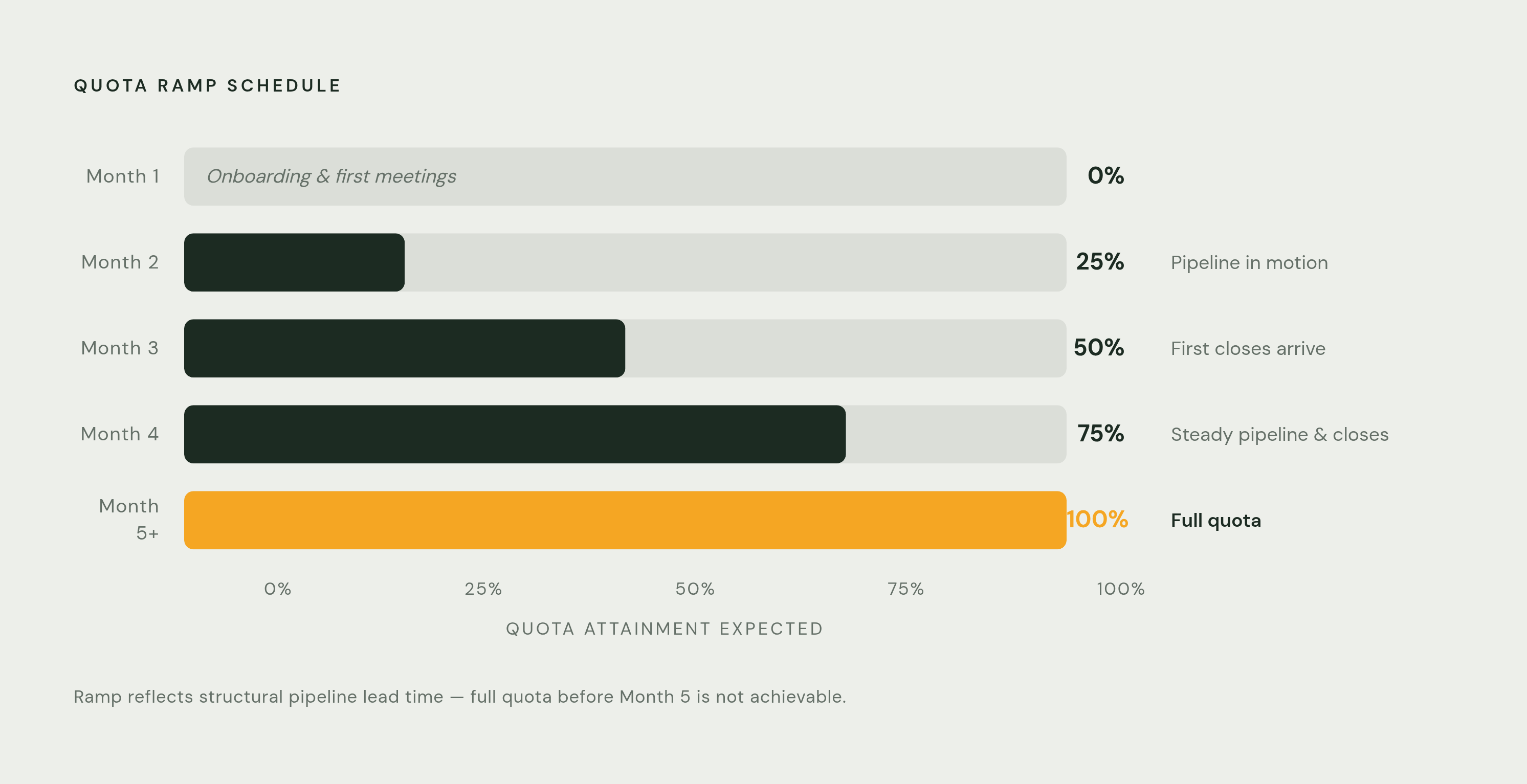
Once you know ramp length from real cohort data, you can turn that timeline into a quota schedule the plan can run on, and you build it from expected pipeline creation and segment win rate, not a curve chosen because it looks tidy on a slide. A four-month ramp might run like this: month 1 at 0%, covering onboarding, territory research, and first meetings booked; month 2 at 25%, reflecting pipeline creation at target rate with early-stage opportunities in motion; month 3 at 50%, as the first closes from month 2's pipeline come in; month 4 at 75%, with full pipeline generation running alongside steady closing; and month 5 onward at 100%. Each month's percentage should equal the pipeline you could realistically have built in prior months, multiplied by the segment's win rate, then adjusted for the average time between creating a deal and closing it. Before any of this gets built, it helps to check the full-ramp number against a market reference: The Bridge Group's study of 158 companies puts median SaaS AE on-target earnings at $200,000 against a $920,000 quota, a 4.6x ratio, which gives a quick sanity check before the ramp schedule gets built down from the full number. The schedule belongs in the comp plan document the rep signs on day one. Reps who can see the exact month their number steps up stop relitigating it every single month.
Guarantee versus recoverable draw: which structure fits which situation
Once the quota schedule is set, the question turns to how variable pay works during the months when quota is reduced, and this is a genuine risk-allocation decision made deliberately, as part of the plan design itself. A non-recoverable guarantee pays the rep the target variable amount regardless of what they produce, and the company never gets that money back. A recoverable draw advances the same cash but claws it back out of future commissions once the rep starts closing. The guarantee costs the company more up front, but it removes the debt overhang that pushes a new rep toward discounting hard just to close something fast. A rep who knows they owe money back is going to be tempted to close anything quickly, sacrificing deal quality for speed. A draw protects the compensation budget, but it leaves the rep chasing a balance, and if that rep leaves the company before paying it off, it creates a messy recovery dispute. For most roles, the practical default is to guarantee the variable component for the duration of ramp, then move the rep onto standard plan mechanics on the published exit date. Whichever structure gets chosen, the written agreement needs to spell out payment terms and what happens to an unrecovered draw balance if employment ends early, and it needs to account for the fact that minimum wage floors apply to commission-based roles in most states, so earnings during ramp or a slow month have to clear that floor regardless of what the plan formula produces.
Why milestone-based exits create the wrong incentives
Ramp should end on the calendar date published in the plan, not whenever the rep happens to hit some output milestone, because milestone-based exits punish exactly the behavior the plan is supposed to reward. If a rep closes a large deal in month two, they get pushed onto the full number early, and that penalizes speed. A rep who stalls stays on a reduced number longer, and that rewards stalling. Worse, the capacity plan stops being forecastable at all once exit dates become a function of deal timing instead of a fixed calendar, because nobody can predict in advance which reps will trigger an early exit and which won't. One exception holds: a rep who changes roles mid-year, say moving from an SMB segment to enterprise, is working a genuinely different motion and needs a fresh ramp built around that new segment's cycle length and deal complexity. Outside of that case, the exit date is fixed, and it doesn't move for anyone.
Accelerators and clawbacks during and after ramp
Accelerators and clawbacks serve opposite functions in a comp plan, rewarding overperformance on one side and protecting against bad revenue on the other, and both need deliberate design during the ramp window specifically. Most SaaS companies run accelerators: they typically pay standard commission rates up to quota, then increase rates at each tier above it. During ramp, those accelerator tiers have to apply against the ramped quota for that month, not the full annual number, or a rep who genuinely overperforms in month two still reads as badly behind plan against a yearly target they were never positioned to hit yet. Clawbacks deserve closer scrutiny during ramp than at any other point in the year, because a new rep under draw pressure to close quickly is more likely to land deals that later churn. The guarantee structure described above reduces that risk by removing the pressure to close for cash flow reasons, but the clawback policy still needs to be written out clearly, covering what triggers it and over what lookback window, regardless of which pay structure is in place.
How ramping reps change the capacity plan
Every rep in ramp opens a gap between the headcount a company has on paper and the productive quota that headcount can actually deliver, and that gap belongs in the revenue plan from day one. Building the capacity plan correctly means working month by month: for each month, sum the ramped quota actually assigned across the whole team, not the full-quota headcount number, and compare that total against the revenue target. The amount left uncovered has to be addressed some other way, whether through earlier hiring, over-assigning tenured reps, or revising the target itself. Skipping this step is one of the most common ways a hiring-driven revenue plan fails: headcount arrives on schedule, the plan still misses, and the postmortem blames execution when the real problem was capacity math that never accounted for ramp. The ramp discount hits the commission budget too: you owe guaranteed variable pay for ramping reps as a fixed cost in months one through four no matter what they produce, so Finance needs that cost built into the budget ahead of time, not discovered at payroll close. Clean data underneath is what makes any of this work: field hygiene, correct close dates, and accurate deal amounts in the CRM feed directly into every ramp and commission calculation, so dirty data in Salesforce produces wrong ramp numbers before the compensation engine even runs its first calculation.
Why spreadsheets break down precisely when ramp plans get complex
Ramp compensation is a multi-variable, time-sensitive calculation almost by definition: rates change by month, draw balances accumulate and get recovered, clawback lookback periods span pay cycles, and territory changes hit mid-year, all interacting in ways a shared Excel file struggles to track correctly. Formula drift is the most common way this fails in practice. Any user with edit access can overwrite a formula cell without triggering a warning, so a single typo in a nested IF statement can silently miscalculate payouts across an entire column of reps, and it often goes uncaught until a rep notices their check looks wrong, sometimes pay periods after the error was introduced. When Finance relies on manual exports to run these numbers, reps start to notice discrepancies on their own, and that triggers shadow accounting, where account executives build their own spreadsheets just to check Finance's math. If a twenty-person AE team loses even a few hours per rep per month to that kind of duplicate bookkeeping, it loses a real block of prime selling time every month. The last days of the month should push reps to close deals, but instead they turn into a dispute between Sales and Finance over whose numbers are right.
What commission software needs to handle for ramp plans specifically
Commission software earns its place in managing ramp plans through a specific set of capabilities, not through generic automation: configurable step-up quota schedules, draw balance tracking, deal-level attribution, and locked pay periods that hold up under the complexity ramp introduces. Step-up schedules need to live in the plan rules as a configurable setting, not as a manual adjustment someone re-enters every month. A rep's quota for month two should be the output of a rule in the system, not a number someone typed into a cell. Draw balances need to be visible to both the rep and Finance at any point during ramp, showing clearly what's owed and what's already been earned back against it, so nobody is relying on memory or a side spreadsheet to know where things stand. Deal-level attribution, the link between each individual contract and the commission payout it generated, matters for audit defense and for ASC 606 compliance, which requires the incremental costs of obtaining a contract to be capitalized and amortized (an exception under ASC 340-40-25-4 allows immediate expensing when that amortization period would run one year or less). If a platform collapses everything down to one per-rep payout number for payroll, it destroys the attribution that financial reporting needs. Locked pay periods with logged approvals create the audit trail that makes a ramp calculation defensible, both to a rep disputing a number and to an auditor reviewing commission expense months later. And none of it holds up without solid CRM integration, because ramp calculations depend on close dates and deal amounts that live in Salesforce or an equivalent system. Weak integration forces manual imports, and when you import manually, stale numbers feed into the very time-sensitive calculations ramp plans need to get right.