Admin Permission Controls That Enforce Commission Payout Immutability After Period Close
Locked periods need append-only records and separated admin roles to prevent silent changes.

Commission software with locked pay periods and audit trails must enforce immutability through append-only records, separated admin permissions, and cryptographically verifiable evidence. A close button alone cannot stop changes after close. Effective controls keep the accepted payout intact, require separate approval for corrections, and make it possible to detect attempts to change the underlying evidence.
Why a closed period is not automatically a locked period
Closing a period is an administrative act. It marks work as complete, but does not by itself establish that the completed record cannot change. In a spreadsheet, a user can overwrite a formula cell without triggering a warning. When two operations managers maintain separate copies, there is no single source of truth against which either version can be judged closed.
Software built for this purpose can have the same weakness. Someone with database write access can still change a period status flag in a mutable table, even if the application no longer shows an edit button. That gap undermines commission calculation verification, which requires an independent check that calculated payouts match the plan terms and underlying sales data. If those inputs or results can change silently afterward, the reviewer cannot establish which record was accepted and paid.
What the data model must look like for immutability to be real
Immutability begins when a commission record is committed at acceptance. From that point, an adjustment must create a separate, additive correction record. The accepted record remains intact as evidence. This model distinguishes what the system originally calculated from what an authorized correction later changed, so a historical payout remains explainable without treating the latest value as the entire history.
That history must also survive changes elsewhere. Commission calculation events must therefore go in an audit log that is separate from the order or deal record. Each event should identify the authenticated actor, precise action, affected object, timezone-aware timestamp, before-and-after field values, and rule or plan version that produced the result. System context and the approval or reason complete the explanation. “Admin” does not identify a specific user, while “modified” does not establish which field changed or from what value to what value.
The same principle applies to commission plans. An effective-dated, versioned rule model creates a new rule version when terms change and preserves the previous one. Historical statements then remain derivable under the rules that produced them, while new terms can take effect deliberately. Calculation and payment routing must also remain separate concerns, because conflating the two makes it harder to audit how an earned amount became a payment. These separations preserve the evidence needed to explain each stage without making the historical calculation depend on a mutable current record.
How storage-layer controls make tampering detectable rather than just prohibited
An append-only model needs protection below the application. Write-once-read-many, or WORM, storage and object-lock storage prevent overwrite or deletion during a configured retention period. That protection restricts what can happen to stored records, but it is not a complete audit trail. The record also needs a way to reveal whether its content or position in the sequence has changed.
Cryptographic hash chaining supplies that complementary check. Each record includes the hash of the previous record, so altering an earlier entry breaks the chain and makes the change detectable. Hashing supports content-integrity checks, while previous-record linkage supports order and gap detection. Append-only storage and SHA-256 hash chaining therefore provide complementary protections.
The defensible claim is tamper-evident. Privileged access, compromised infrastructure, or restoring a backup can get around a single protection mechanism, so an absolute promise is unrealistic. Retention protection restricts alteration, while cryptographic verification makes alteration detectable after the fact. That detection claim is testable, which gives reviewers something more substantial than an assurance that application permissions prohibit editing.
The access-control architecture that prevents any single actor from altering a closed record
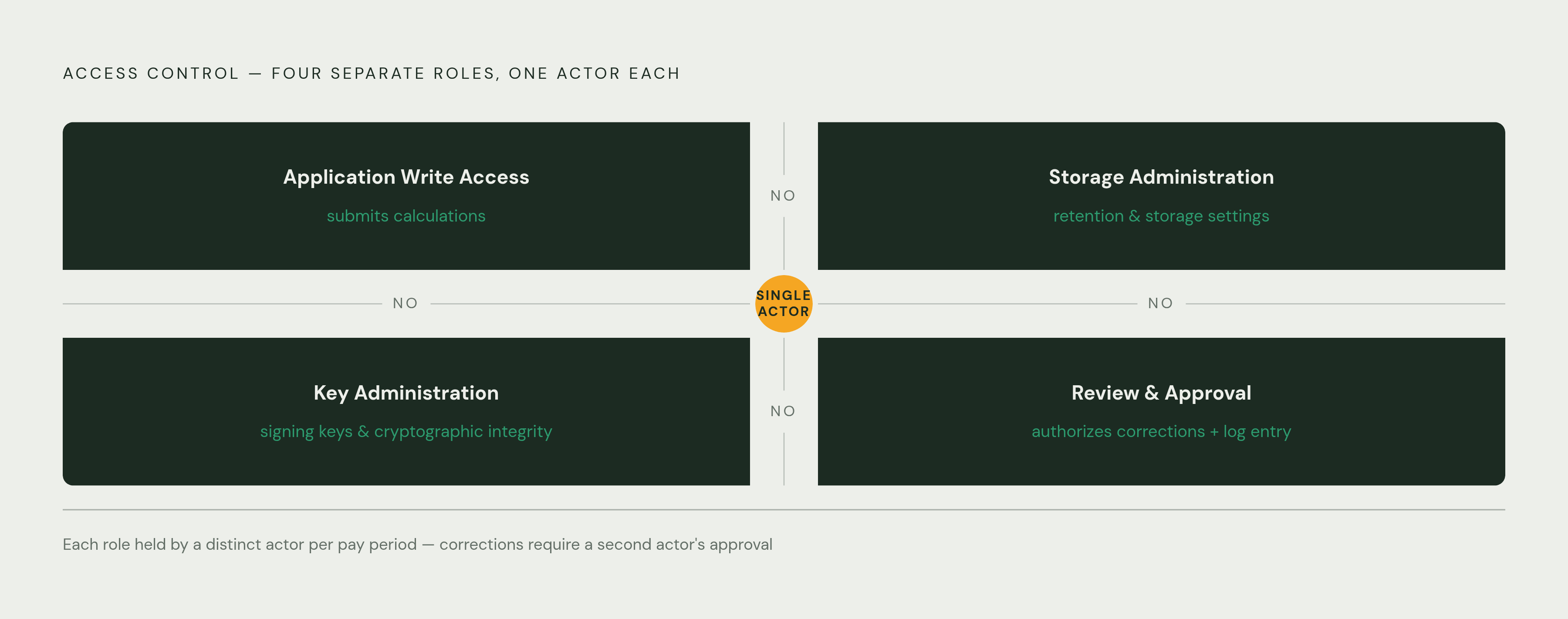
If one administrator can change commission records, configure retention, control signing keys, and approve corrections, the system leaves its evidence under one actor’s authority. The architecture must separate application write access, storage administration, key administration, and review and approval for the same pay period.
Application write access determines who can submit calculations. Storage administration controls retention policies and storage-layer settings, while key administration controls the signing keys used for cryptographic integrity. Review and approval determines who may authorize a correction to a locked record. No single administrator should hold more than one of these roles for the same period. A correction should require a second actor’s approval and create its own log entry identifying who authorized it and why.
Role assignments, approval records, and a separate log of administrative actions put privileged activity on record so it can be reviewed too. Super-admin-controlled draft creation can support this pattern when explicit approval is required before a new rule or correction takes effect. Database-enforced immutability and atomic audit trails then connect the approved action to its evidence without permitting the original record to be overwritten.
Access should start with no permission and be granted only by exception. Row-level security policies with explicit deny-all defaults on commission tables establish that starting point for both reads and writes. Together with administrative logging, these controls address unauthorized access as well as unauthorized alteration. A powerful admin account must therefore be prevented from unilaterally changing closed-period records and the evidence protecting them.
Why regulators treat commission records as financial records, not operational ones
Commission records are used for financial reporting as well as sales operations. Their retention, integrity, and access controls therefore fall within the financial-record obligations applicable to the organization and record type. The precise requirements depend on the regulatory framework. Treating every commission platform as an operational calculator overlooks the evidence Finance must retain after a payout has been processed.
SEC Rule 17a-4 requires broker-dealers to use WORM storage, with a minimum six-year retention period and third-party audit access. MiFID II requires EU investment firms to capture full order lifecycle data with microsecond timestamps and a minimum five-year retention period. These are sector-specific obligations. They establish why retention and access cannot be treated merely as product preferences where those rules apply.
ASC 606 adds a commission-specific accounting obligation. Incremental costs of obtaining a contract, including commissions, must be capitalized and amortized over the period the company expects to benefit. A practical expedient permits immediate expensing when the amortization period would be one year or less. Commission records must consequently support timing and classification as well as payout accuracy. For Finance, a locked historical record underpins accrual accuracy, capitalization and amortization, expense control, and the ability to defend the accounting during an audit.
How the absence of these controls compounds into specific operational failures
Without immutable evidence, a dispute becomes forensic reconstruction. Finance or the team responsible for revenue operations must recover which rules ran, what data entered the calculation, and who made a manual adjustment from email threads and spreadsheet versions. Proving that a single number is correct can take hours. The missing evidence is the same evidence an append-only calculation log would have captured as part of the original process, rather than leaving someone to assemble it after payroll.
The spreadsheet workflow also weakens independent verification. The person who builds the file is typically the person who runs it and the person expected to audit it. That concentration is a structural limitation. If an error remains uncorrected, it can propagate through subsequent periods until an annual true-up or audit exposes it. The reconstruction then expands from one period to every period affected by the original error.
Payment records can contain a different kind of gap. A disbursement file or commission statement is not sufficient evidence when its entries cannot be traced to corresponding calculation records. Regulators and auditors require that trace, and missing links become findings. A stored payment amount proves less than a complete record showing how the amount was derived, adjusted, approved, and routed.
Upstream data mismatches make that derivation especially important. A CRM may record total contract value while the plan pays on annual recurring revenue, or identify one account owner when the deal involved a split. An independent reviewer needs a structured, version-controlled transformation record to work out the commissionable amount from the source data. Preserving only the final result leaves the hardest part of the explanation missing.
How immutability controls also resolve a rep-trust problem, not just a compliance one
The lock protecting an auditor’s evidence also protects a rep’s reference point. A locked statement that explains the payout lets the rep check earnings against the deal data and plan rules without worrying that the official record will later change silently. Any legitimate adjustment remains visible as a correction rather than replacing the statement the rep previously reviewed.
Disputes are often about transparency as well as accuracy. Reps who can verify commissions against a locked record have fewer reasons to challenge an otherwise correct result, even when the payout matches what an opaque process would have produced. With immutability, a calculation that was wrong stays wrong. It preserves the evidence needed to explain the calculation or identify the correction, making disagreement resolvable without rebuilding the entire pay cycle.
When reps cannot check the official number, they do their own calculations in shadow spreadsheets, which takes time away from selling each month. If top performers begin questioning whether they are paid fairly, their loss of trust can also affect retention. Accurate records for Finance, transparent statements for reps, and flexibility to change plans are not competing goals. Effective-dated rules let the business change future terms while period-close locks keep the evidence that supports past earnings.
What to verify when evaluating whether a commission platform actually enforces these controls
Buyers should evaluate the enforcement behind a “closed” status. The data-model test checks whether accepted commission records can be changed in place or must use additive corrections. The audit-log test is whether calculation history survives edits to the underlying deal or order. A platform without those separations has moved the spreadsheet into a database without resolving its central integrity weakness.
Evaluation should establish whether retention-protected storage prevents overwrite or deletion, and whether hash chaining makes changes to content or sequence detectable. It should also establish whether calculation access, storage administration, key administration, and approval can be assigned separately for the same period. The correction workflow must require a second actor’s approval and produce a separate correction record with its own audit entry.
Historical derivability is the next essential criterion. Effective-dated plan versions must keep the rules used for earlier statements, while CRM lineage must show how the source data became the commissionable amount. Rep-facing statements should expose a locked view of earnings that traces to the deal data and plan rules. These capabilities distinguish a stored total from an explainable financial record. They also show whether the platform can support a dispute through evidence rather than a fresh calculation under current conditions.
Administrative friction remains a legitimate evaluation concern. Some platforms enforcing these controls require dedicated headcount or recurring vendor support, and that burden belongs in the decision. However, simplicity loses its value when a major variable cost cannot be defended to an auditor or explained accurately to the people being paid. The relevant comparison is the effort required to operate controlled records against the recurring work of reconstructing uncontrolled ones.