Period Locking Approaches Across Leading Commission Management Tools
How the strongest commission platforms prevent payroll from silently drifting after periods close.

Period locking is the operational safeguard that stops a completed pay period from silently changing after payroll runs. It sounds simple: freeze the numbers, move on. The real test is narrower and harder than that description suggests, and most vendors fail it quietly rather than obviously. How a commission platform actually implements that freeze, what triggers it, what can still slip past it, decides whether Finance can defend those numbers six months later in an audit or a rep dispute, or whether they're stuck explaining a number nobody can trace.
Locking is not the same as closing, and treating the two as interchangeable is where most of the damage starts. A closed period just means everyone agreed the work was done. A locked period means the underlying data, the calculations, and the approvals are frozen in a state that cannot change without leaving a trace. An unlocked "closed" period can still drift. Three weeks later, a hierarchy edit, a plan-rule change, or a deal attribute correction gets picked up by a recalculation engine and quietly re-runs against a period everyone assumed was final.
That's the silent-drift risk, and it's the reason period locking exists as a discipline rather than a checkbox. If a hierarchy edit or a plan-rule change recalculates a locked period without triggering a restatement workflow, the rep's pay statement and the accounting ledger start to diverge, and nobody notices until an audit, a dispute, or a year-end reconciliation forces the question. Reconstructing what actually happened at that point requires effective dating, version history, a record of who approved what, and proof that any restatement went through a governed process rather than a quiet edit. Those four things, effective dating, versioning, approvals, and restatement evidence, are what separate one platform's locking architecture from another's.
What spreadsheets cannot enforce about period locking for Finance teams
Spreadsheets have three structural gaps that make real period locking impossible, no matter how careful the team running them is.
The first gap is version snapshotting. The file that produced March's payroll numbers has almost certainly been opened, edited, and resaved dozens of times since. Files get modified, formulas get changed, and structural edits accumulate over time. The exact version that generated those original numbers usually can't be pulled back, because nothing forced a snapshot at the moment payroll ran.
The second gap is the audit log, or rather the lack of one. A manual adjustment, made to fix a miscalculated tier or a missed deal, leaves no record of who made it, when, or why, unless someone happened to leave a comment in the cell. Auditors don't accept "someone probably fixed that in April" as documentation.
The third gap is time-dependent variables. Quotas, commission rates, and OTE targets change quarterly at most sales organizations, and spreadsheets handle that by spawning new tabs and file versions named after whatever logic made sense to the person who built the original model. That knowledge lives outside the system rather than within it, which creates continuity risk when personnel change.
These gaps compound rather than sit side by side. Spreadsheet error rates run high enough that independent research has found nearly 90% of spreadsheets contain at least one error, and commission-specific studies have found errors touching a substantial share of total payouts in a given year. Without a locking boundary, there's no clean line where an error gets caught and stopped before it feeds into the next period's baseline calculations.
The cost of manual reconciliation appears everywhere Finance and RevOps touch commission data. Teams routinely burn tens of hours a month reconciling manual spreadsheet models, individual disputes eat the better part of a workday when the underlying data lives in a spreadsheet instead of a governed system, and month-end close slips days at a time waiting on commission numbers Finance can actually trust. More deeply, there's no defensible record to point to when someone asks why they're right. It's that there's no defensible record to point to when someone asks why they're right. A locked, immutable period gives Finance something to stand on in an audit. A spreadsheet gives them a file that's changed forty times since March.
The compliance requirements that make period locking non-negotiable for public and regulated organizations
For public companies, and for anyone getting ready to become one, period locking is a requirement baked into how commission costs have to be accounted for under standard accounting rules. It's baked into how commission costs have to be accounted for under standard accounting rules.
ASC 606, and its companion standard ASC 340-40, require that incremental costs of obtaining a contract, which for most sales organizations means the commission paid to close it, get capitalized and amortized over the expected period of benefit rather than expensed the moment the check clears. That single rule carries heavy technical weight. It demands tracking commissions at the individual contract level, with defined start and end dates. It demands a systematic amortization schedule for every capitalized commission. It demands documentation an auditor can follow, linking each payout back to the specific deal and the specific plan rule that generated it. And it demands a line between commission types, since front-line rep commissions are typically capitalized under this treatment while supervisor or manager bonuses usually get expensed directly.
IFRS 15 applies essentially the same capitalization logic internationally. Any organization with sales teams spanning that jurisdiction and another major regulatory territory. entities ends up managing both standards at once, often inside the same commission platform.
This is exactly where period locking stops being a nice-to-have. If a deal's attribution changes after the period locks, and the amortization schedule tied to that deal doesn't update through a controlled, documented process, the capitalized asset on the balance sheet no longer matches the commission records supporting it. That's a real audit finding.
The commission software market has started treating this as a competitive front rather than a background feature. In September 2026, Qobra announced new capabilities aimed squarely at ASC 606 and ASC 340-40 compliance: deal-level attribution, historical rule versioning, and immutable audit trails built into its accrual accounting. Compliance architecture is becoming something buyers evaluate directly, not something they assume exists.
Enterprise-tier platforms implement period locking with configurable approvals, version control, and SOX-grade audit trails
Enterprise-grade commission platforms handle plans with accelerators, tiered rates, triggers, split credit, and clawback logic, often without custom code for every plan variation. Locking, at this tier, is rarely a single switch. It's a layered set of controls, and the strength of those layers is exactly where enterprise platforms earn (or don't earn) their price tag.
The strongest implementations tie every commission calculation back to its source data, so a number on a rep's statement traces backward to the deal record, the rule version that governed it, and the approval chain that signed off on it. Plan changes get version-controlled, so a modification to a plan in October doesn't retroactively rewrite what July's plan actually said. Approval workflows tend to be configurable across multiple roles, letting an organization require sign-off from a comp administrator, a sales manager, and a finance controller before a period locks, instead of trusting one person's judgment on a Friday afternoon.
Security certifications matter here too, and not as a checkbox exercise. SOC 1 and SOC 2 compliance matter because commission data requires strong controls around access and change management. For an organization operating under SOX, the combination of version control, configurable multi-role approval, and source-level traceability is usually what decides vendor selection, more than any single interface feature.
Capability at this tier comes with a real trade-off, though, and it's one vendors rarely lead with. Auditability and error-reduction features that catch overpayments before they happen are common strengths in enterprise-focused compensation platforms, but querying years of locked periods for historical pipeline analysis can slow down noticeably in large organizations with long retention windows. That's not a flaw so much as a tax on scale, and it deserves a direct question during evaluation rather than a discovery eighteen months in.
Platforms built for large, multi-plan organizations with global hierarchies and sellers spanning dozens of countries tend to push locking beyond payout records alone. Automated calculations, governed approval workflows, and auditable processes are the baseline expectation, and some platforms stretch integration into territory and quota planning, so a period lock cascades across planning domains instead of staying contained to the commission ledger alone.
Mid-market platforms approach period locking with speed and transparency alongside governance
Mid-market platforms generally optimize for a different variable: how fast an organization can get live, and how much visibility reps get into their own numbers before a period ever locks.
Implementation speed matters enormously at this tier. Getting a mid-market sales organization onto a new comp platform in weeks rather than a more extended rollout changes the math for a RevOps team that needs results this fiscal year, not next one. No-code plan builders paired with real-time rep-facing dashboards let sellers see their projected earnings before the period closes, and that has a direct, practical payoff: fewer disputes land after the lock, because reps catch discrepancies while there's still time to fix them. Audit trails and approval workflows exist in these platforms too, generally with less granular configurability than the deepest enterprise systems offer, but enough for most mid-market compliance obligations.
Native alignment with a specific CRM ecosystem changes the locking conversation in a different way. When commission calculations pull directly from a single CRM's data model, traceability improves, because there's one source of truth instead of several systems that need reconciling against each other. The mechanics of how a retroactive deal change propagates, or doesn't, into a locked period are tied to that CRM's own data behavior, and that's worth understanding before assuming the commission layer alone controls the outcome.
Platforms built around live CRM integrations raise a related question worth asking directly in any vendor conversation: when pipeline data flows continuously rather than through periodic imports, what exactly defines the snapshot that gets locked at period close? A live-data model is powerful for real-time visibility, but it needs an explicit, documented rule about the precise moment the data freezes, because "live" and "locked" pull in opposite directions by definition.
Qobra's September 2026 compliance update as a case study in locking architecture
The update was framed specifically around ASC 606 and ASC 340-40, and the three capabilities added, deal-level attribution, historical rule versioning, and immutable audit trails, map directly onto the compliance gaps those standards create.
Deal-level attribution means every capitalized commission ties back to a specific contract, with defined start and end dates, and the locking mechanism preserves that link even if someone later edits the underlying deal record. Historical rule versioning means the plan rules governing a locked period stay accessible in their original form: if the commission plan changes in the third quarter, that change doesn't reach backward and alter what the second quarter's lock actually recorded. That's the exact silent-drift scenario Finance teams need ruled out. And the immutable audit trail means that once a period locks, the record can only change through a separate, governed restatement process, never through a direct edit that leaves nothing behind.
What the announcement shows, past its specific feature list, is that "does this platform lock periods?" is the wrong question to put to a vendor. The right question breaks locking into its component parts and asks which ones are actually built, and which ones are just assumed.
What a structured period locking evaluation should test across any commission platform
Nearly every dedicated commission platform on the market locks periods in some form today. That's table stakes, not a differentiator, and any vendor pitching it as a standout feature is selling the floor as if it were the ceiling. What the lock actually protects, and what can still slip past it, is the narrower and harder question, and it needs specific scenarios thrown at it, not marketing language accepted at face value.
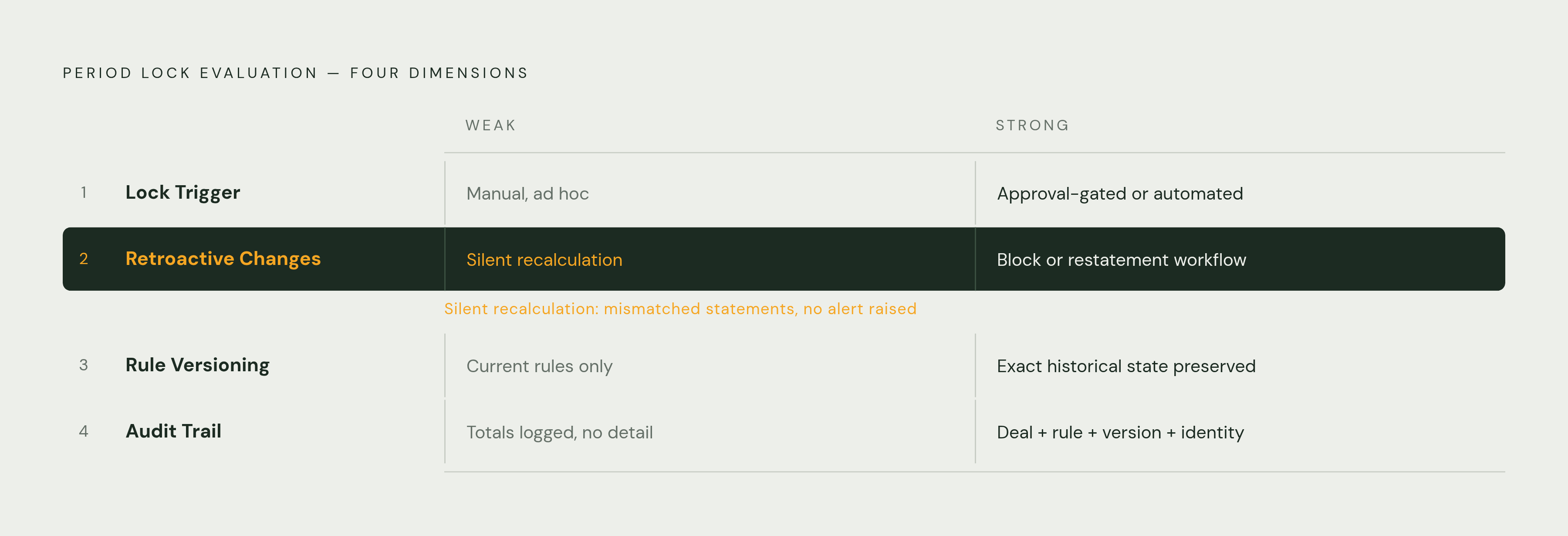
The lock trigger mechanism comes first. Locking can be manual, where an administrator clicks a button; approval-gated, requiring documented sign-off from multiple roles before it takes effect; or automated, triggered by a date or a defined event. Manual locking sets up fastest but relies entirely on someone remembering to do it. Approval-gated locking builds the strongest audit record, because the sign-off chain becomes part of the evidence itself. Automated locking removes human error from the timing but shifts the risk onto whoever designed the triggering rule, so that rule deserves scrutiny of its own.
Retroactive change handling comes second, and this is where silent drift either gets caught or slides through. When a deal attribute, a territory assignment, or a quota changes after a period has locked, does the platform block the change outright, route it through a formal restatement workflow with its own approval and documentation, or quietly recalculate the locked period in the background? That third outcome, silent recalculation, is the specific failure mode every evaluation has to rule out, because it produces rep statements and accounting records that no longer match, with no alert firing on either side.
Rule versioning comes third. Ask directly whether the plan rules governing a locked period stay preserved in their exact historical state, and whether an auditor or a Finance team member can pull up what the rules said at the time, independent of anything changed since. If the answer requires reconstructing history from memory or from a chain of old emails, the platform doesn't actually have this capability, whatever the sales deck says.
Audit trail completeness comes fourth. Every calculation on a rep's statement should trace to a specific deal, a specific rule, and a specific version of that rule. Every manual adjustment, no matter how small, should carry an identity, a timestamp, and a stated reason. And that full record needs to export cleanly for an external audit, without someone on the RevOps team hand-assembling it from four different systems the night before.
For public companies and organizations operating under SOX, or preparing for a public listing, these four dimensions aren't academic exercises. An audit that closes in a week instead of a quarter, and a rep dispute that resolves with a screenshot instead of turning into a drawn-out reconciliation project nobody wanted to own, both come down to these four tests.