Commission Software Implementation Cost and Timeline Expectations
Implementation labor costs far exceed software subscriptions, so budget accordingly.
Most buyers price a commission software deal by looking at the subscription line and treating everything else as a footnote. That's backwards: most buyers price a commission software deal by looking at the subscription line and treating everything else as a footnote. The subscription is often the smallest number on the invoice, and the gap between what a team expects to spend and what it actually spends comes almost entirely from implementation work nobody budgeted for.
Commission software isn't a large-scale business management system, and it shouldn't be treated with that level of dread, tools like Quota Queue, a spreadsheet-free commission calculation platform that takes companies from raw deal data to payroll-ready statements, exist precisely at that smaller, more manageable end of the market. But the same basic dynamic appears here: the labor to deploy, configure, migrate data, and train a sales team routinely costs more than the software license itself. According to industry research, only 27% of companies have fully automated their end-to-end commission process. The rest are running some version of spreadsheets, manual reconciliation, or a patchwork of tools duct-taped together. The distance between "where the data lives today" and "where the software needs it to live" is almost always bigger than the sales demo suggested.
Two mistakes occur repeatedly. One is underestimating total cost, because buyers see the subscription price and mentally file services, connectors, and internal hours under "probably fine." The other, less discussed, is overestimating timeline, assuming every deployment carries enterprise-grade complexity when a 20-person sales team's actual situation is a lot simpler than the horror stories suggest. Both mistakes are avoidable once you know which cost and timeline drivers you actually control. That's the point of what follows.
What commission software implementation includes
Buyers tend to think of implementation as "configuring the software." That's one piece of a three-piece problem.
The first piece is commission structure: the actual math. Tiers, accelerators, clawbacks, SPIFs, splits between reps on the same deal. The second piece is commission policy: the document, often only half-written, that governs who's eligible for what, when payouts trigger, and how disputes get resolved. The third piece is the payout process itself, the operational rhythm of calculating, validating, approving, and delivering pay each cycle. Software touches all three. Vendors sell the first one hardest because it's the most demoable, but the other two are where projects stall.
Every deployment, regardless of platform, moves through the same rough sequence. Discovery and plan documentation come first, followed by mapping data sources and connecting the CRM or spreadsheet exports that feed the system. Then plan configuration: building out the actual tiers, accelerators, SPIFs, and clawback rules inside the tool. Testing comes next, and it needs to include extreme scenarios, not just the typical case. What happens to a rep who hits 400% of quota in one month? Does the accelerator logic hold, or does it silently break? After testing, most serious implementations run a parallel period, comparing the new system's output against the old spreadsheet for a cycle or two before cutting over. Training for reps and managers follows, then the first live pay run, then a stabilization window where the inevitable edge cases get sorted out.
The phase most commonly skipped is discovery. Teams walk into onboarding assuming they have a commission plan, and what they actually have is a PDF that's two versions out of date and a set of exceptions that live only in the compensation manager's head. Shortcutting discovery is one of the more reliable ways to blow a budget, because ambiguity that appears during configuration turns into a change request, and change requests cost more than conversations do.
Company size, plan complexity, baseline cost, and timeline
Size and plan complexity set the floor. Everything else, integrations, data quality, vendor queue, sits on top of that baseline as a modifier, not a replacement for it.
Small teams, roughly 10 to 30 reps running one or two plan types, are looking at two to eight weeks from kickoff to first live pay run. First-year spend on platforms with transparent, published pricing tends to be around €18,000 to €30,000; platforms with more configuration depth run $25,000 to $45,000 or more. For teams this size, the bottleneck is almost never the software. It's getting the plan documentation into a state where someone can actually configure against it.
SMB and growing teams in the 50-to-500-rep range see similar timelines when the plan is straightforward, two to eight weeks, with total initial investment (software plus basic implementation services) landing between $30,000 and $150,000. The range is wide because "50 reps" and "500 reps" behave very differently once you add a second plan type or a regional variant.
Mid-market deployments, meaning multiple plan types, multiple territories, and real CRM integration work, typically run three to six months from signed contract to full deployment, though simpler versions can close in four to eight weeks. The internal resource burden here is the part teams consistently underestimate: budget 100 to 200 hours of internal effort to get through implementation, and expect ongoing administration to run 5 to 10 hours a month after go-live. That's not vendor time. That's your RevOps or finance team's calendar.
Enterprise deployments, multiple plan variants, legacy data sitting in systems nobody wants to touch, and integrations across several platforms, run 6 to 9 months for the complex cases. Payback windows stretch accordingly, typically 18 to 24 months. Most companies reading a piece like this one are not enterprise deployments. Their realistic timeline is measured in weeks, not quarters, and understanding that changes how they negotiate with a vendor who might otherwise quote enterprise-grade timelines out of habit.
Platform-by-platform implementation timelines for named tools
Timelines vary by a factor of roughly ten across the market, and the spread itself tells you something.
Deployment ranges reported across vendors and industry data run from as fast as two to four weeks on the low end, up through two to six weeks, roughly two months on average per data reported by one review platform, eight to twelve weeks for more complex configurations, up to three to nine months for enterprise-tier deployments. A ten-times gap between the fastest and slowest implementation isn't a software quality story. It's a plan complexity, data readiness, and integration depth story. A platform that deploys in three weeks for one company could take three months for another, depending entirely on how many plan variants, how many data sources, and how clean the CRM data is going in.
One structural factor worth understanding before comparing vendors is pricing model. Some platforms price by the number of active commission plans rather than by seat count. Seat-based pricing inflates cost as headcount grows, which distorts any timeline-to-value comparison a growing company tries to run. A team that doubles its sales headcount under seat-based pricing pays roughly double; the same team under plan-based pricing may pay nothing extra if the plan structure itself hasn't changed. Ask about this directly during vendor evaluation, since it's not something that shows up on the pricing page.
These ranges are starting points for negotiation, not commitments a vendor owes you. Treat them as the opening bid in a conversation about your actual complexity, not a guarantee.
The hidden cost line items vendors rarely surface in the initial proposal
The subscription price is the number on the homepage. The number that actually determines total cost lives in the services schedule, and vendors are not in a hurry to lead with it.
Implementation services fees on enterprise-tier platforms commonly run into the tens of thousands or more, and services in general tend to add 50% to 150% on top of first-year subscription cost. That's not a rounding error, that's often the larger of the two numbers. Integration and connector fees stack on top: some platforms, such as Spiff, charge a recurring monthly fee per non-Salesforce connector, a cost that compounds fast once a company's commission-relevant data lives across three or four different systems instead of one. Support tiers are another quiet upcharge; premium support, the level that actually gets implementation-grade responsiveness instead of a 48-hour ticket queue, can run 30% of net license cost on some platforms.
Internal labor doesn't appear on any vendor invoice, but it's real money. Call it 100 to 200 hours for a mid-market deployment, and at a fully-loaded internal rate, that's a five-figure cost the finance team should be counting even though nobody sends a bill for it. Compressed timelines cost extra too: rushing a deployment carries a premium, commonly cited in the 20% to 50% range in implementation cost benchmarks, because accelerating a project means pulling vendor resources off their normal queue.
Data migration is its own cost center, scaling with how dirty and how old the CRM data is. Manually moving data between a CRM and a spreadsheet is exactly the kind of error-prone process commission software exists to eliminate, so if the migration plan involves a lot of manual reconciliation before go-live, that's a sign the underlying data problem hasn't actually been solved yet, just moved. And most budgets stop counting at go-live, when the honest answer is that go-live is the start of a stabilization window where edge cases the testing phase missed start to appear.
Ask any vendor for a complete services schedule alongside the subscription quote before comparing proposals. A cheap subscription attached to an expensive services engagement isn't a cheap deal.
Which timeline and cost drivers are in your control
Some of this is genuinely in your hands. Some of it isn't, and pretending otherwise wastes negotiating energy that would be better spent elsewhere.
Plan documentation is the single highest-leverage thing a team can do before signing anything. Arriving at kickoff with a written, complete commission policy, not a verbal walkthrough, not a PDF from two plan revisions ago, changes the shape of the entire project. CRM data quality matters almost as much: clean, current data with closed deals correctly mapped to the reps who own them shortens both the integration and testing phases considerably, while messy data stretches both out. Internal resourcing is the third lever. Projects stall most often when the internal owner, whoever from RevOps, finance, or sales ops is supposed to be driving the deployment, has it as a secondary responsibility squeezed between other duties rather than a real allocation of hours.
Scope discipline helps too. Deferring the non-essential plan variant, the edge-case rule that affects three reps, the custom report nobody's asked for yet, into a phase two keeps the initial go-live on schedule. And vendor selection itself is a timeline lever: choosing a platform whose complexity tier actually matches your plan complexity, rather than the platform with the most features on the comparison page, is a decision that pays off in weeks saved.
What's not in your control: the number of distinct plan variants a company runs, since each one adds its own configuration and testing cycle regardless of how well-prepared the team is. The number of system integrations required works the same way, and each one commonly adds $3,000 to $15,000 in comparable deployment contexts, stretching the timeline along with the cost. Vendor implementation queues matter too. Popular platforms have backlogs, and contracting in Q4 often means a January start whether or not your team is ready sooner. Enterprise security and compliance reviews, SOC 2 documentation, data handling agreements, IT security sign-off, add weeks regardless of how fast the platform itself can technically deploy.
Compression is real when the controllable factors line up. Organizations moving onto cloud-based commission platforms have shortened deployment cycles down to 4 to 6 weeks when data readiness and internal ownership were both strong going in. That's not a guarantee. It's evidence that the controllable half of this equation actually moves the number.
What the spreadsheet baseline costs, the comparison that reframes ROI
Here's the comparison most vendor pitches skip, and it's the one that actually matters: what does doing nothing cost?
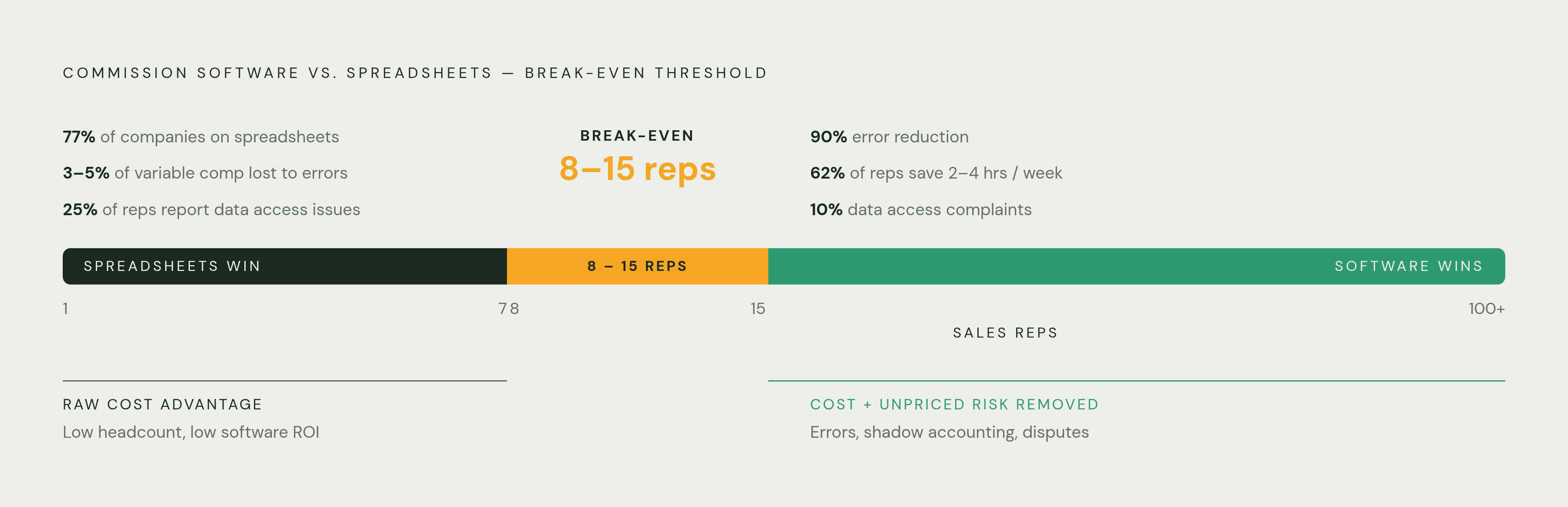
Per Aeqium's Compensation Planning Trends Report, 77% of companies still run their pay cycles on spreadsheets. So this isn't a hypothetical baseline, it's the default state of the industry. Spreadsheets don't send an invoice, so the cost is easy to miss. It appears as admin labor recalculating commissions by hand every cycle. It shows up as error correction, and commission errors are estimated to cost organizations 3% to 5% of variable compensation budgets, which for a team running a few million dollars in variable pay is not a small number. It appears in disputes: Commission disputes are a well-documented drain on operations time that rarely gets logged anywhere as a cost.
Then there's shadow accounting, reps keeping their own private spreadsheet to double-check what the company owes them because they don't trust the official number. Industry interview data cited by Sales Cookie puts this at 62% of reps, spending 2 to 4 hours per week on it. That's uncompensated selling time converted into spreadsheet reconciliation, quietly, every single week. Audit prep is the last hidden cost: with no audit log, every compliance request turns into a manual reconstruction project.
The break-even point, based on honest total-cost-of-ownership comparisons, tends to be between 8 and 15 reps. Below that, spreadsheets genuinely win on raw cost. Above it, software wins on cost and also removes a category of risk the team was absorbing without ever pricing it. Companies that move to dedicated commission software report error reductions of up to 90%, and data access complaints drop sharply too, cited at 10% of software users versus 25% of spreadsheet users. That gap is the argument, more than any single dollar figure is.
Realistic payback windows and what accelerates them
Payback for a typical deployment runs 9 to 18 months. Complex enterprise deployments stretch that to 18 to 24 months. Those are the baseline numbers to plan against, not the ceiling and not the floor.
A few things pull the payback window in. Processing cycle times, shorten to under 48 hours with proper automation, and administrative effort drops by more than 40%. Error rates fall below 1% with automation done correctly, which directly cuts overpayment exposure and dispute volume at the same time, since a lot of disputes start with a rep catching a mistake the company didn't catch first.
Rep productivity affects the return on the investment significantly. Recovering the hours reps spend on shadow accounting hands selling time back, and at an annual sales turnover rate near 35%, nearly triple the average seen across other industries, even one retained rep changes the ROI math meaningfully. Commission disputes are a well-documented trigger for reps walking, which makes payout transparency a retention lever with a dollar value attached, not just a fairness argument.
Building the internal business case is a straightforward exercise, even if nobody wants to do it. Take current admin hours per cycle, multiply by a fully-loaded rate. Add 3% to 5% of the variable comp budget as error exposure. Assign a real number to one avoided rep replacement. Compare the total against first-year platform cost, services included, not just the subscription line. The case is strongest for teams above the 8-to-15-rep break-even point running at least moderate plan complexity. Below that line, a well-structured, lightweight platform priced by plan rather than by seat can still make sense, even if the labor savings alone don't fully close the case, because the risk it removes has value too.
What a realistic implementation plan looks like in practice
Before signing anything, get the paperwork right. Write down every current commission plan variant, from memory is not good enough, someone needs to actually document it. Audit CRM data quality and figure out which fields map to which commission triggers, and how clean those fields actually are. Name an internal owner with real allocated hours, not someone squeezing this in around a full-time job. Get the vendor's implementation fee structure in writing, subscription and services listed separately, not bundled into one reassuring number. And ask for a client reference at your actual size and complexity, not the vendor's flagship enterprise logo.
Once the contract is signed, the work starts with plan documentation, finished before configuration begins, not worked out in parallel with it. For a small team, that whole stretch from kickoff through a stable first live pay run runs two to four weeks. For mid-market, expect it to run longer, closer to the three-to-six-month range described earlier, with more testing cycles built in for each additional plan variant.
The teams that hit the fast end of every range share the same profile: documentation that's actually finished before kickoff, CRM data that doesn't need much cleanup, and one clearly accountable person driving the project instead of a committee. That's not a secret. It's just the part of the process that's fully within a team's control, sitting right next to a handful of factors, vendor queues, integration counts, compliance review, that aren't.