Commission Operations Handoff Between Sales Ops and Finance
Ensure Sales Ops and Finance share a defined handoff protocol for commissions.
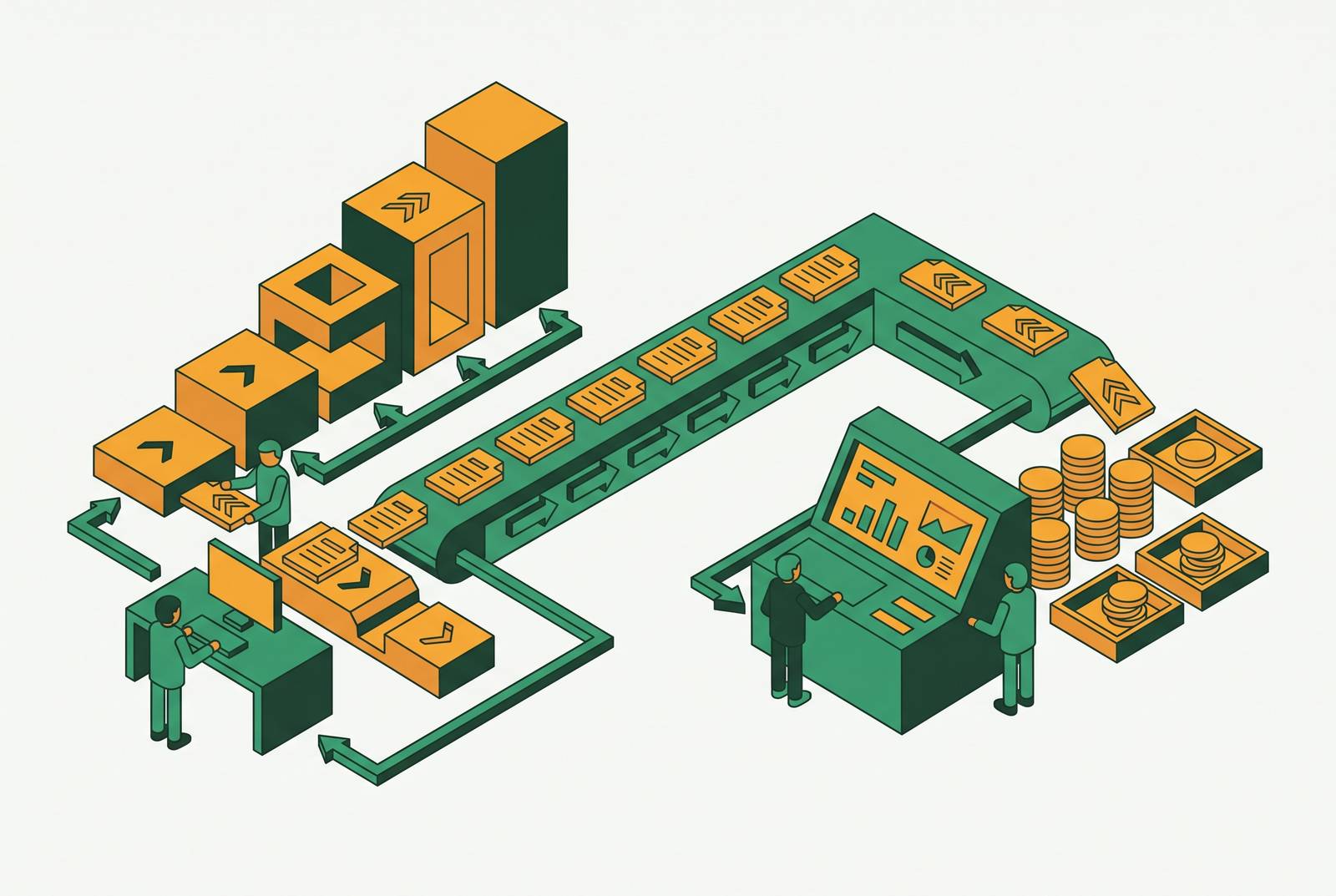
Commission software for mid-market RevOps and Finance teams should enforce a defined handoff and calculate payouts. An accurate, on-time commission cycle depends on four components, namely a data contract, clear ownership, approval checkpoints with deadlines, and a locked audit trail. The Sales Ops–Finance handoff fails when those connections remain undefined, even when both teams do their own work correctly.
Why the Sales Ops–Finance commission handoff breaks down structurally, not personally
The end-of-cycle scramble often starts with an accrual that does not match the commission calculation. Sales Ops has one payout total, while Finance has reconstructed another from an export. Both teams have legitimate authority over the numbers at different stages, but no formal protocol connects those stages. The disagreement exposes an undesigned seam.
That seam runs through several disconnected records. Deal data lives in the CRM, rates and rules sit in spreadsheets built by someone who may have left, and Finance rebuilds accruals at quarter-end. Without a defined chain of custody, a stale export, formula overwrite, or inconsistent rule can break the connection between those records. Neither team can then locate the break or establish responsibility confidently. This is a governance and process problem before it is a technology problem, although technology can amplify it.
What each team actually owns, and where their responsibilities genuinely overlap
Sales Ops owns compensation plan design and modeling, including quota-to-OTE ratios, accelerator tiers, SPIFs, territory assignment, and plan documentation. It also owns rep-facing communication so reps understand their plans and can calculate their payouts. Finance owns accrual entries and liability recognition, recording commission expense in the period earned regardless of when it is paid. It also owns payroll submission and disbursement, so the final, locked payout must go into payroll without anyone entering it again by hand. Finance is accountable to auditors for the accuracy and completeness of compensation expense.
Whether payout happens at booking, invoicing, or cash collection affects what motivates reps and what Finance needs for recognition. For multi-role deals, Sales Ops designs the credit split, while Finance validates that total credit does not exceed the full deal value and that the accrual matches. For clawbacks, Sales Ops sets the trigger, while Finance enforces recovery and books the reversal. A mid-period plan change also needs both a plan amendment and an accrual true-up, so both teams must do their part to complete it.
How spreadsheet-based handoffs turn the shared zone into a recurring failure point
Separate spreadsheet copies make this overlap difficult to govern. Finance may accrue against a rate table that Sales Ops has already updated, so each team’s results agree with its own records but clash with the other team’s results. A formula overwrite can also propagate silently across the rep population until someone disputes a payment, sometimes pay periods later. Without an audit trail, neither team can reconstruct the rule version, source data, or manual adjustment behind the disputed amount.
Finance therefore faces an expensive choice when it receives a summary assembled from several spreadsheets. It can accept the underlying work on faith or spend days rebuilding the analysis. The cost is asymmetric because overpayments may be absorbed without being measured, while underpayments prompt reps to maintain private trackers and question subsequent payslips. Spreadsheet-based handoffs lack the approval checkpoints needed to settle these conflicts before payment. Platforms such as Quota Queue lock pay periods and log approvals and rule changes, making the handoff traceable rather than leaving it hidden in version conflicts and formula drift.
What a designed handoff requires — the four components no one explicitly builds
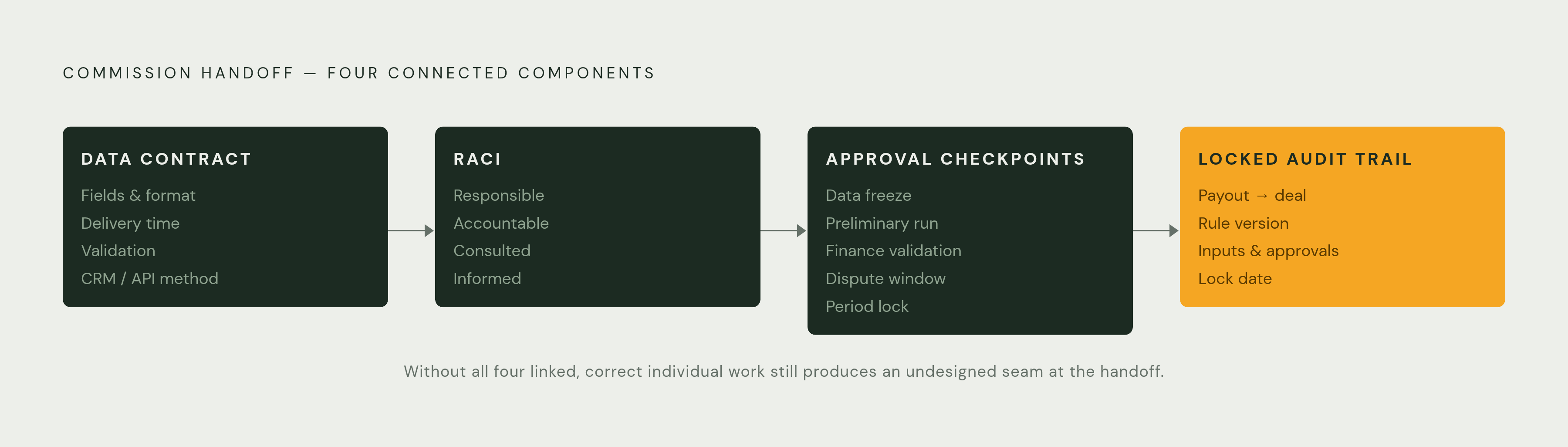
A reliable handoff requires four connected components. The first is a data contract that defines which fields Finance receives, their format, their delivery time, and the validation required before acceptance. It also specifies whether CRM data enters through a direct API pull or a file export. Without that agreement, each month’s export reflects a new take on what Finance needs.
The second component is a RACI covering the full commission lifecycle. It identifies who is Responsible for deal data quality, Accountable for the final payout, Consulted before a mid-cycle rule change, and Informed when a clawback is triggered. A RACI that ends at plan design leaves accrual and payroll ownership unresolved. Both teams also need to sign off on shared decisions, beyond just discussing them. A structured workflow, such as the one Quota Queue provides, enforces and documents collaboration on payout timing, credit allocation, clawbacks, and mid-period changes.
The third component is a sequence of approval checkpoints with explicit SLAs. Those checkpoints define when data freezes, when each team reviews the calculation, and when the period locks. The fourth is a locked audit trail connecting every payout to its deal, rule version, calculation inputs, approvals, and lock date. Together, these components define what crosses the handoff, who answers for it, when it must move, and how the result can be reconstructed.
Building the data contract — what deal data Finance actually needs and when
The close-date-versus-payment-date dispute is a useful starting point because correct dates can still produce incompatible calculations. The contract must distinguish close date, recognition date, and cash collection date, then define their roles in commission eligibility, accrual, and payment. Otherwise, Sales Ops and Finance can assign the same deal to different periods. The deal amount must be just as clear because total contract value, annual recurring revenue, and net new ARR each give a different base for the commission. A field labeled “amount” does not resolve that choice.
The contract must state whether splits are recorded in the CRM or applied in the commission calculation layer, and who validates that credit is complete and non-duplicative. The contract must also specify conditional inclusion, exclusion, or deferral to the next cycle for deals in “verbal commit” or “pending signature” status. These inclusion rules must be set before the preliminary run. Agreeing on them prevents both teams from applying different boundaries to the same data.
The contract must then define how quickly the calculation reflects CRM reality. It should specify the integration method and refresh cadence for updates in Salesforce or HubSpot, because uploaded files retain the staleness risk of spreadsheet exports. Before the preliminary run, Sales Ops should check the deal fields and Finance should check that deal amounts reconcile to the revenue recognition ledger. Both teams should sign off on that validation. Acceptance then rests on named checks rather than an assumption that the other team reviewed the data.
Defining the approval checkpoints that keep the cycle on schedule
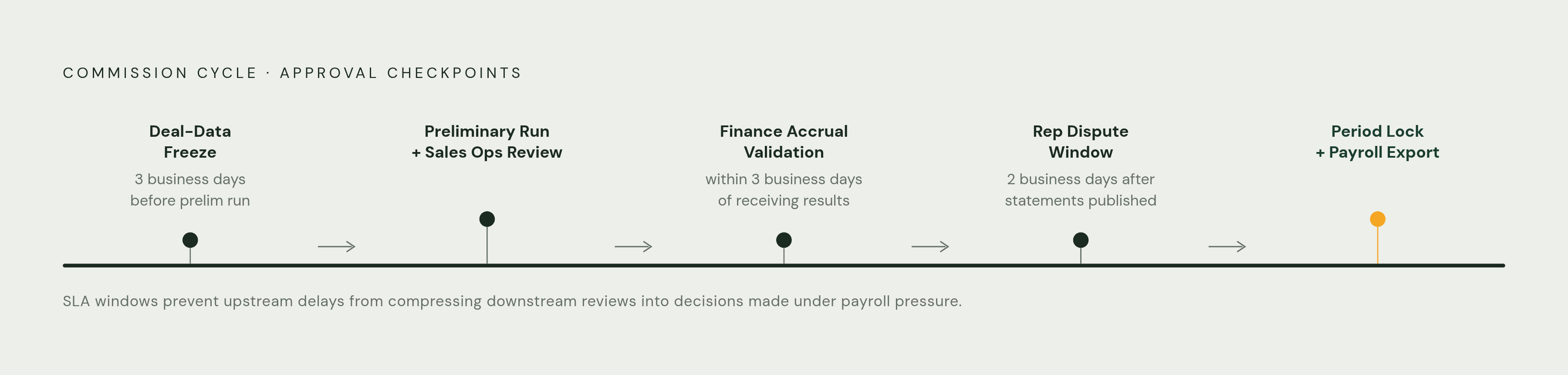
The cycle should begin with a deal-data freeze announced to the sales team in advance. Reps need to know the cutoff so they can flag errors before new deals stop entering the current-period calculation. The next checkpoint is the preliminary commission run and Sales Ops review. Sales Ops checks the output against plan rules, catches formula or data anomalies, and documents exceptions before passing the results to Finance.
Finance accrual validation is the formal handoff checkpoint. Finance reconciles the preliminary payout total against the revenue recognition ledger and flags deal-amount discrepancies. Reps then get provisional statements, with time to dispute them before the period locks. Once Sales Ops and Finance have both approved, the final checkpoint locks the period and sends the export to payroll. Any further change to an approved result requires a formal amendment.
Each checkpoint needs a set time window, such as a data freeze three business days before the preliminary run, Finance validation within three business days of receiving it, and two business days for reps to raise disputes after statements are published. Without those SLAs, delays compress the remaining reviews and turn approval into a decision under payroll pressure. Mid-cycle plan changes need a separate amendment process so they do not bypass the sequence. Sales Ops documents a territory reassignment or accelerator adjustment, Finance signs off on the accrual impact, and the amendment receives an effective date.
The audit trail as operational infrastructure, not a compliance afterthought
Checkpoints have limited value if neither team can establish what was approved. A usable audit trail links every commission line to the source deal, the deal’s field values at calculation time, the calculation date, and the applicable rule version. Rule history must retain effective dates so a mid-year amendment creates a new version and preserves the old one. That preserves the ability to reconstruct a Q1 payout using Q1 rules months later. The approver log then establishes who reviewed each checkpoint and when.
The same record must capture every post-calculation adjustment, manual override, and clawback with a reason and an approver. This turns dispute resolution into an explanation of the deal, rule, and calculation. A complete record can support an answer in minutes, while an absent one can consume hours without producing a definitive result. The distinction matters even when the original payment was correct, because an unexplained result still damages rep trust.
That record also helps Finance meet its audit duties and gives HR the compensation records it needs. Pay transparency laws in force as of 2026 require records of compensation decisions, though what they require varies greatly by jurisdiction. Access controls, audit logs, and encryption protect the same commission data that teams need to explain payouts. Compliance is therefore not a separate reason to assemble records after the cycle. It depends on infrastructure that should already make the handoff verifiable.
What to look for in commission software for mid-market RevOps and Finance teams
Evaluation starts with how the platform represents plans, where its data comes from, and what record survives a pay period. Declarative rules with effective dates support historical reconstruction, while overwriting a model destroys that continuity. Native CRM connections and direct data warehouse integrations reduce dependence on manual files. A locked, immutable record should preserve the deal, rule version, calculation, approver, and payroll export.
Does the CRM connection reflect events directly or depend on a scheduled export, and what is its refresh latency? Can a historical period be reconstructed with the rules then in effect? Does the approval workflow make Sales Ops review, Finance validation, and period lock required steps, or does it have just one approval button? Can reps see the details for each deal on their statements before the lock so they can raise disputes before payroll?
Quota Queue is one option to evaluate against those requirements. It imports deal data through a CRM connection or file upload, assists plan building through automated extraction from existing documents, and supports tiered rates, accelerators, SPIFs, and clawbacks. It also supports approval, period locking, and payroll export, while AI assistance leaves human review and approval in place. Its pricing is based on the number of active compensation plans, with seats and rep headcount left out of that count. Encryption in transit and at rest and a no-training-on-customer-data policy address the sensitivity of compensation data.
The choice between CRM connection and file upload still matters, as do refresh timing and approval sequencing. For a team leaving spreadsheets, the relevant comparison is whether the platform removes manual transfers and preserves reviewable history. A new calculation interface alone does not establish either.
Putting the handoff design into practice — where to start when the current process is a spreadsheet
An inherited spreadsheet process does not require a simultaneous overhaul of plans, tools, and governance. Start with the data contract and freeze date by agreeing on the required fields, the deal state that triggers inclusion, and when the data closes. Next, write down the RACI across the full cycle and share it with both teams. Then place the approval checkpoints and their SLAs on a shared calendar. These changes establish obligations without waiting for a software replacement.
Once those obligations are clear, a platform can enforce them structurally. Finance can close its accrual without rebuilding Sales Ops’ calculation, and a rep dispute can be answered from the deal-level statement. Both teams approve a mid-cycle plan change with a clear effective date, so it comes as no surprise at quarter-end. The first action is to write down what Sales Ops owes Finance, what Finance owes Sales Ops, and when each obligation is due.