Commission Plan Audit Trail Requirements for SOX Compliance
Companies face criminal exposure if commission calculations lack SOX-compliant audit trails.
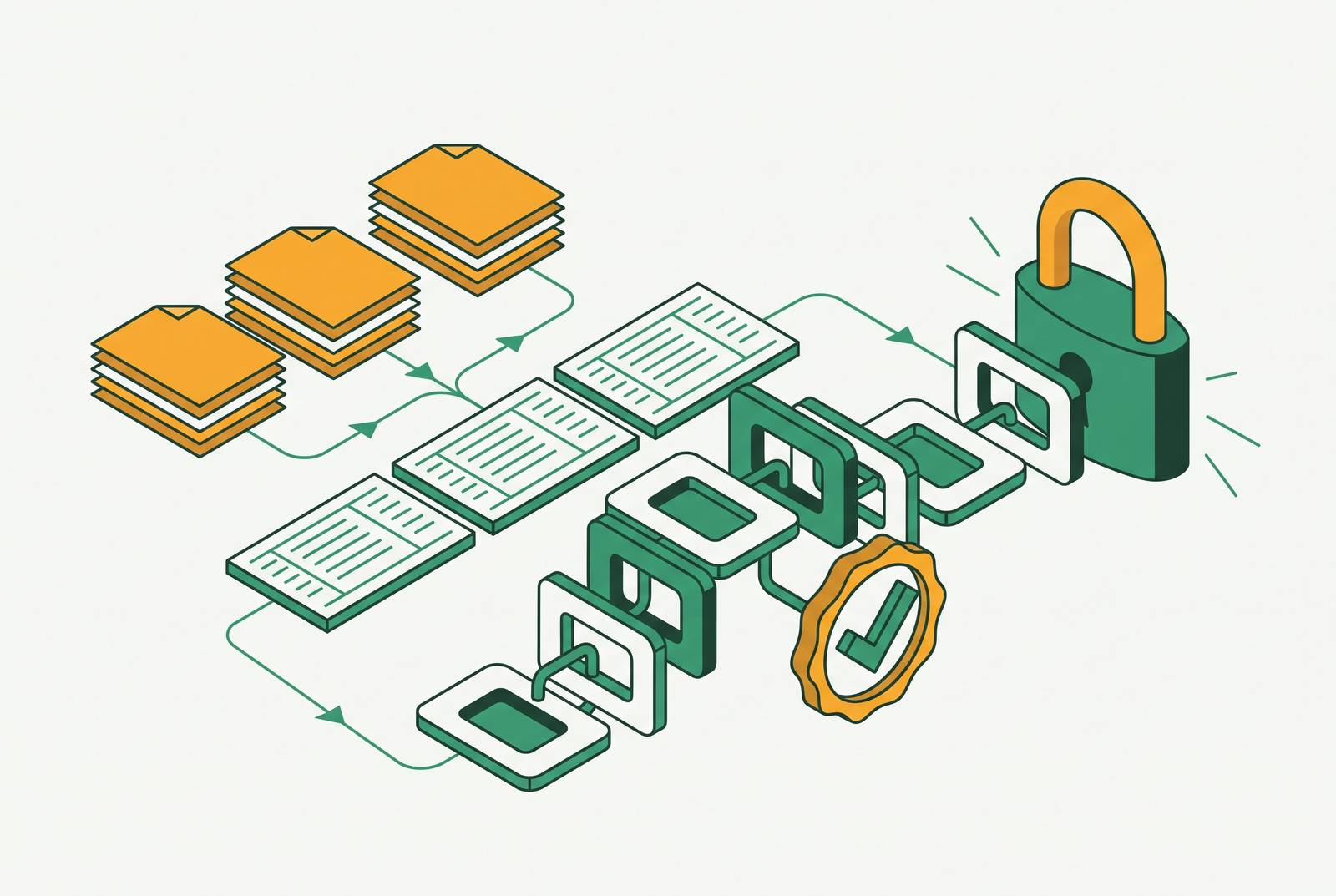
Sales commission plans are not a back-office detail sitting outside the reach of Sarbanes-Oxley. They are a material financial liability, flowing directly into payroll, revenue accruals, and deferred-cost schedules, and that flow is what pulls them inside the SOX perimeter.
Why sales commissions fall inside the SOX perimeter
Commission payouts flow directly into payroll, revenue accruals, and deferred-cost schedules, placing them inside the SOX perimeter.
SOX exists to make a specific promise enforceable: that the financial information a public company reports is honest, reliable, and secure, and that both management and outside auditors are willing to put their names on that claim. A commission calculation that cannot be traced, reconstructed, or defended under audit breaks that promise just as surely as a misstated inventory figure would.
The regulatory environment around this promise has gotten less forgiving, not more. On March 19, 2026, the SEC announced a dedicated SOX enforcement group aimed at audit firm misconduct, a move that signals sharper scrutiny of internal control failures and less tolerance for gaps in the audit cycles ahead. That shift raises the cost of treating commission calculation as a spreadsheet exercise outside the view of internal controls.
The exposure reaches past the company and into the people who sign the certifications. Executives who willfully certify false financial reports face criminal penalties that can run as high as 20 years, and the obstruction and record-related offenses under Section 802 carry their own penalties of up to 20 years, with securities fraud exposure reaching 25 years. A commission liability that is wrong, and that nobody can trace back to its source, becomes a personal legal problem for the CEO and CFO who sign off on it.
What Section 404 demands from an audit trail
Section 404 is not satisfied by the simple existence of records. It requires audit trails with specific, testable properties, ones that auditors check against documented evidence rather than take on faith. The standard is concrete: for any given control, the organization has to show what was performed, who performed it, when it happened, what information was reviewed, whether any exceptions turned up, and how those exceptions got resolved.
That standard breaks down into six properties that auditors test for directly in a commission audit log. Records have to be immutable, so that nothing can be altered after the fact without leaving a trace; a system where a record can be silently overwritten fails this test. Every action has to carry a timestamped, authenticated user identity, tied to an individual rather than to a role, a team, or a shared login. Changes have to capture both the before value and the after value, not just the final state, so a modified number can be reconstructed in both directions. Closed pay periods have to be locked, so that any retroactive change requires a logged override and a fresh approval rather than a quiet edit. The approval chain, running through manager, RevOps, and Finance, has to be recorded with identity and timestamp attached to each step, not inferred after the fact from an email thread. And the whole system needs documented change management: defined processes for adding and removing users, content, and devices, and for installing and updating software, with a record of who made each change, what was changed, and when.
Segregation of duties runs through all six properties as a standing rule rather than a separate item. No single person can be allowed to manage the commission process from plan design through calculation through approval and payout. The control chain has to be split across roles, and that split has to be enforced by the system itself, not left to policy on paper. SOX ITGC auditors test this directly, walking through five identity-control domains, access provisioning, access deprovisioning, periodic access review, privileged access, and segregation of duties, every audit cycle, sampling specific transactions and asking for the full evidence trail behind each one. Audits lean into this kind of substantive testing rather than checklist completion, probing the actual evidence behind each attestation, the reconciliation rate between a system's catalog and what is really happening in the target system, and whether the review cycle changed anything.
Why spreadsheets structurally cannot satisfy these requirements
Spreadsheets fail this standard because the properties SOX requires are absent from the tool itself, no matter how carefully it gets used.
Take immutability first. Any cell in a spreadsheet can be overwritten with no trace left behind, because there is no built-in mechanism that prevents or logs a change after it happens. Individual attribution fares no better. Version history, where a tool offers it, tracks file saves rather than individual field edits, and in any shared-file environment that attribution collapses entirely, since multiple people touch the same file under the same save history. Before-and-after capture does not exist either: once a formula gets changed or a figure gets overwritten, nothing in the file records what used to be there. Locked pay periods are a matter of habit, not enforcement. Treating a period as "closed" in a spreadsheet is a convention the team agrees to follow, not a control the system enforces, and anyone with file access can reopen and edit a supposedly closed period without the system stopping them. The approval chain suffers the same fate: approvals that live in email or in comment threads are not timestamped system records, and an auditor asking to walk through the evidence rarely finds them surfaced cleanly.
Emailing the spreadsheet around only makes the gap worse. Current guidance flags spreadsheet-and-email workflows specifically as a security and audit risk, and calls instead for a central, version-controlled system that can actually produce the record a SOX audit demands.
The scale of the exposure matters here too. For a public company, even a small miscalculation spread across a large sales force is a material financial issue, one that can affect the accuracy of accrual estimates and the company's ICFR attestation.
How commission errors and missing audit trails propagate
A missing or unreliable commission audit trail does not stay contained to the team that runs commissions. It spreads into rep trust, into the quality of Finance's accrual estimates, and into the personal legal exposure of the executives who sign the certifications.
Inside RevOps and Finance, an unstable commission calculation turns every accrual into an estimate built on top of another estimate. That stacking creates tension during close, draws more audit scrutiny than a clean process would, and chips away at confidence in margin projections across the business. Some finance teams respond by overaccruing to cover the uncertainty, which protects against understatement but ties up cash that did not need to sit idle.
The deferred-commission requirement under ASC 606 is the least obvious link in this chain, and also one of the most consequential. Companies have to defer incremental sales commissions and amortize them over the revenue-recognition period. Commission data has to be traceable not only for the payout itself but for the deferred-expense schedule that follows it. A gap in the commission audit trail is, by extension, a gap in the deferred-cost balance that auditors examine directly. One practice some finance teams have used to close that gap involves building SQL-driven dashboards that pull commission triggers out of the CRM, lay them against the revenue-recognition schedule, and calculate monthly deferred balances, which lets the team model deferred payout profiles for quarters still ahead.
For the executives at the top of the certification chain, the stakes are personal rather than institutional. Section 302 certification puts a name on the line: CEOs and CFOs who certify financial statements containing materially misstated commission liabilities are exposed to the full range of SOX penalties, not a reduced version of them. Reps feel the consequences too, in the form of eroded trust whenever a payout looks arbitrary or unexplainable, though that erosion sits downstream of the Finance and executive exposure rather than at the center of it.
None of this is happening in a static regulatory climate. A Protiviti report found that most companies report their compliance requirements have grown over the past two years, and more than half saw their internal compliance costs rise as a result. The cost of staying non-compliant is climbing faster than the cost of building the controls that would fix it.
The additional compliance gap introduced by automated commission calculation tools
Organizations that bring AI into commission plan building or calculation pick up a new compliance problem layered on top of everything already required: individual user attribution.
Enterprise AI deployments produce this gap in a predictable pattern. An AI tool accesses regulated data under a service account or an API key, and no log anywhere records which individual person directed that access. SOX's audit trail standard calls for attribution to a specific person, and service-account logging, by its nature, cannot supply that.
Closing the gap means building a specific kind of record for every AI-influenced step in commission calculation. At minimum, that record needs an NTP-synced timestamp, the authenticated identity of the human involved (not just the service account), the identity and version of the AI system, the identity and version of the model it ran on, the inputs it received with their source, the specific rule or prompt it was given, a record of human review or approval tied to the reviewer's identity, and a tamper-evident proof that the record hasn't been altered since it was created.
None of this argues against using AI to help build commission plans. AI-assisted plan building is a useful and legitimate capability, provided the human review and approval that follows gets logged with the same rigor as any other control activity in the system. AI can assist with the calculation, but the person who reviews and approves the output remains the one the audit record has to name.
Architecture of a compliant commission audit trail
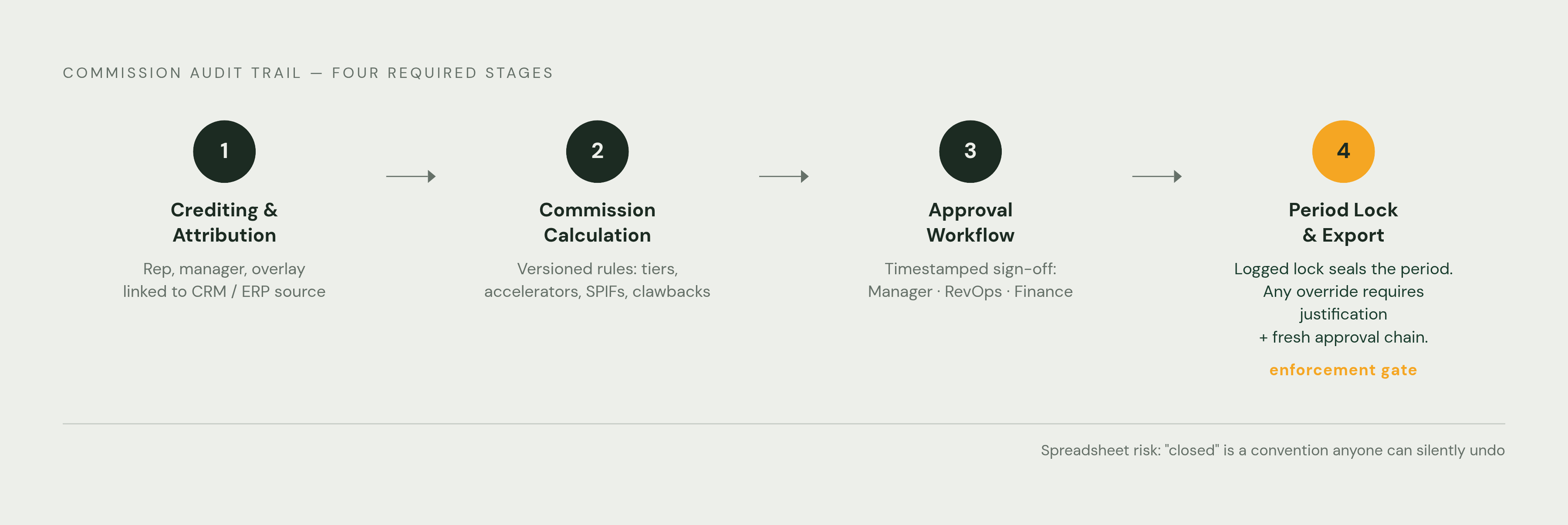
A SOX-compliant commission audit trail is built into the architecture of the system that runs commissions, present at every step from the moment a deal is imported through the moment a pay period is locked.
That architecture breaks into four stages, and each one carries its own audit trail obligation. Crediting and attribution come first: the system has to record, at the transaction level, which rep, manager, team, or overlay receives credit for a given deal, with that source data traceable back to the CRM or ERP it came from. Commission calculation comes next, and the rules applied there, tiered rates, accelerators, SPIFs, clawbacks, need to be versioned so that the exact rule set behind any given payout can be reconstructed later, not just the number it produced but the logic that produced it. The approval workflow follows: manager review, RevOps review, and Finance review each need to produce a timestamped, identity-attributed approval record inside the system itself, rather than scattered across email threads. The final stage is period lock and export, where each pay period gets sealed by a logged lock action, and any adjustment made after that lock requires a logged override with a stated justification and a fresh approval chain behind it.
Quota design belongs inside this same audit logic, not off to the side as a planning exercise. Building quotas bottoms-up from CRM data is itself an auditability requirement: weighted pipeline coverage can be defended because every input in it traces back to CRM stage probabilities, while a blanket assumption is just a number somebody asserted, with nothing behind it an auditor can walk through.
Before any platform gets chosen, ownership has to be settled. Finance, RevOps, Sales Operations, and IT need to agree in advance on who owns plan interpretation, who owns the source data, who validates the calculations, who grants approvals, and who administers the system. Ambiguous ownership is, on its own, a segregation-of-duties risk, regardless of how good the underlying software is.
A CRM can cover revenue and customer data well through field-level change history, such as Salesforce Field Audit Trail, which keeps field-level change records for up to ten years and supports API queries. It is not a substitute for a dedicated commission calculation system, because CRMs were not built to run incentive compensation programs, and the audit trail for commission logic has to live inside the system that actually performs the calculation.
The payoff for getting this right extends past the audit itself. One global SaaS finance team built its deferred-commission logic directly into the system, so that deal length, margin, contract type, and billing terms automatically triggered one of three commission deferral templates, each version-controlled and auditable on its own. Reps stopped reading deferred pay as a penalty once the logic behind it was visible and consistent, and started reading it instead as proof that the company was keeping its word. Trust and behavior moved together, once the system gave both sides something concrete to check.