CRM to Payroll Commission Data Workflow Design
Data handoffs between systems cause most commission errors, not the math itself.
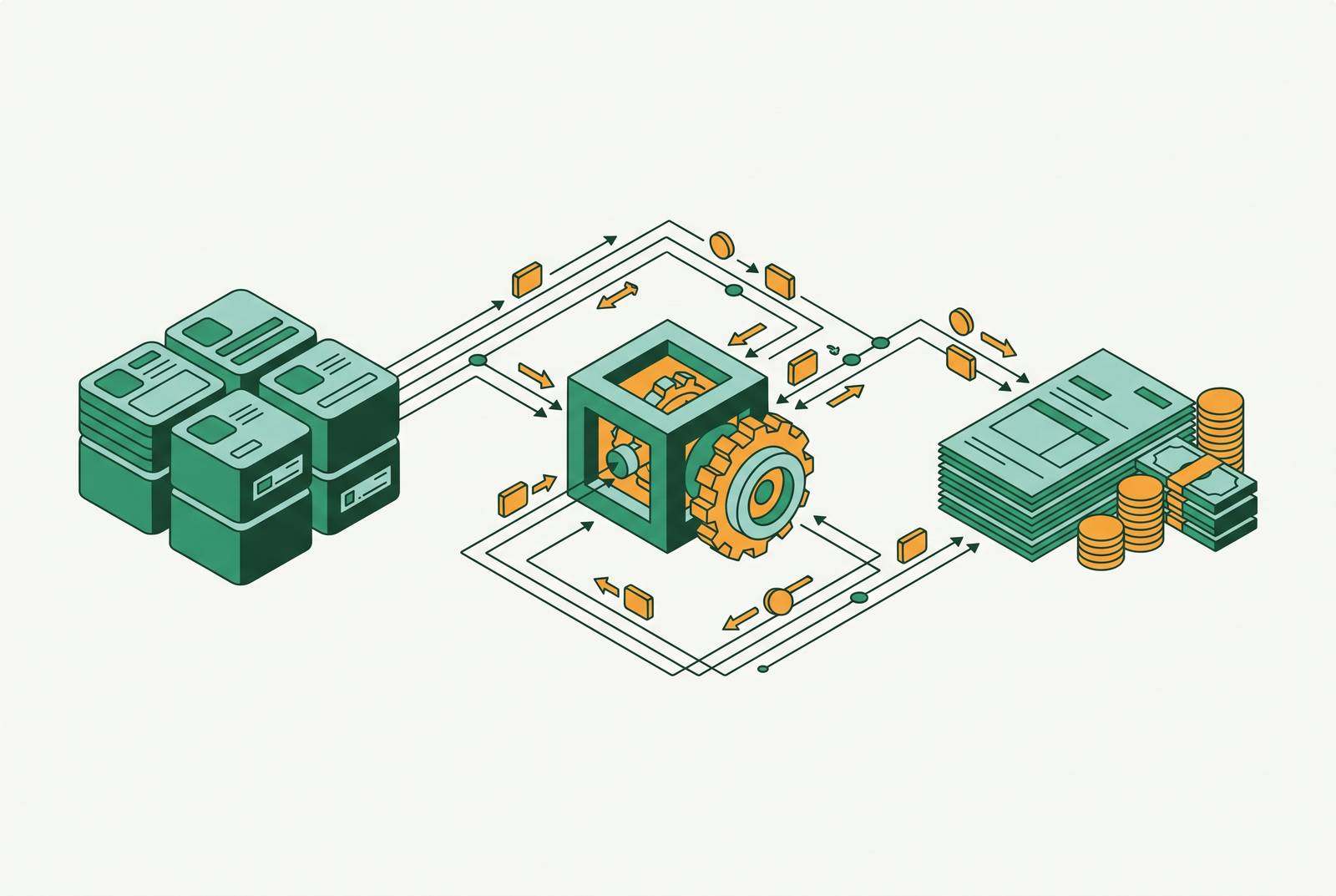
Commission calculation fails most often not at the point of math, but at the points where systems hand data to each other. CRM ingestion, plan rule application, calculation review, payroll export: four handoffs, and each one is either engineered to catch errors or left informal enough to pass them through. Most organizations treat commission as a calculation problem, so they invest in formulas and spreadsheet logic. The actual failure mode is a data-flow problem: incomplete records enter the chain, partial rules get applied against them, someone eyeballs the output, and the mistake surfaces only after the money has already gone out.
Sixty percent of organizations don't track the accuracy of their own commission payments. That statistic alone should stop anyone who thinks this is a solved problem. Most companies have no mechanism to know whether the chain worked, which means the errors that do exist are discovered by accident, usually by a rep who built their own spreadsheet to check the company's math against their own memory of the deal.
What makes CRM data "commission-grade" before it touches a calculation
Errors rarely start in the formula. They start in the input.
A CRM that's good enough for pipeline reporting tolerates gaps. A rep can leave a field blank, guess at a close date, or round a contract value, and the pipeline forecast still functions well enough for a Monday meeting. Commission calculation has no such tolerance. Close date, ARR, product line, discount percentage, contract term: these fields aren't advisory context anymore once they feed a payout. They're contract-grade. Present, complete, and validated against the signed agreement, or the number downstream is wrong.
The failure modes at ingestion tend to repeat across organizations. Required fields go missing and nobody notices until a calculation spits out a null or an impossible result. Deal amounts get entered before discount negotiations are final, and then nobody circles back to update them once the ink dries. Duplicate deal records creep in, especially when a deal changes owner or gets re-associated with a different opportunity, and now there's a double-count risk sitting quietly in the pipeline. Close dates reflect the day a rep clicked a button in the CRM, not the day the customer signed, which matters enormously the moment a clawback clock or a timing rule depends on the actual signature date.
The fix isn't a downstream cleanup process run by whoever happens to own commissions that quarter. It's making the compensation-relevant fields required and validated at the point of entry, so a rep can't advance a deal stage without the data that payroll will eventually need. Ingestion method matters here too. A direct CRM connection removes a manual export-then-import step, and every manual re-entry between a closed deal and a commission calculation is a chance for a transcription error to sneak in invisibly. The data a rep sees in the CRM should be the exact data the commission engine reads. Nothing in between, no separate file, no second copy that can drift from the first.
How plan rules need to be encoded, not approximated, for the calculation to be trustworthy
The compensation plan document says one thing. The spreadsheet formula that's supposed to implement it says something close, but not identical, and the gap between the two is where most commission errors are born.
Consider the phrase "accelerator kicks in at full quota." Sounds simple until an actual formula has to decide what happens to the deals a rep closed before crossing that threshold. Does the accelerator apply only to deals above the line, or retroactively to everything in the period once the line is crossed? Plans are often ambiguous, or worse, unambiguous in the document but approximated incorrectly in the formula that's supposed to enforce it. Tiered rates that change at quota boundaries are where this breaks most visibly, because the edge case, the deal that lands a rep just over quota, is precisely the case a manually built formula is least likely to have been tested against.
SPIFs add a time-bound eligibility window that has to be checked against the actual close date, not just the calendar month. Clawbacks triggered by a customer cancellation require ongoing monitoring of deal status well after the original payout, not a one-time calculation at close. Splits and overlays across multiple contributors on the same deal add another layer of who-gets-what that a single formula column struggles to represent cleanly. The research on this points to a specific threshold: plans with more than three components produce more payout errors. That's not a communication problem where reps are confused about their plan. It's a calculation-reliability problem, where the plan has become too structurally complex for an ad hoc formula to hold correctly.
AI-assisted plan extraction, reading an existing compensation plan document and proposing a rule configuration from it, can speed up the encoding work considerably, which is the workflow Quota Queue was built around as a spreadsheet-free commission calculation platform. But speed isn't the same as accuracy, and the encoded rules still need a human to review and approve them before they touch a live calculation. That review isn't a nice-to-have step tacked onto the process. It's the accuracy guarantee itself. Version control matters just as much: when a rule changes mid-period, the system has to know which version applies to which deals, and that mapping needs to be auditable after the fact, not reconstructed from memory during a dispute.
A compensation plan that lives only in a document isn't yet a commission plan. It becomes one only once its rules are encoded precisely enough that two people, working independently from the same deal data, would land on the same number.
Where calculation errors compound and why review must be structural, not a final check
Run the math on a 1% error rate across a sales organization, and the result is that roughly 11% of reps could receive an incorrect payment over the course of a year. That reframes what "small errors" actually means. It isn't a rounding footnote. It's a trust problem touching more than one in ten reps annually, compounding across every pay period.
The specific error types tend to be structurally hard to catch by hand. Multi-tier formulas can produce correct-looking output for most reps and still break precisely at the quota boundary, which is exactly the case least likely to get scrutinized because it looks fine on the surface. Rounding applied inconsistently across a period builds small discrepancies that don't surface until someone reconciles the full quarter. Clawback triggers get missed because no one is actively monitoring deal status after the original payout went out the door. Employee status changes, a start date, a termination, a role change mid-period, don't propagate into the calculation automatically, so the payout reflects an org chart that's already out of date.
A final review by one person isn't a structural catch. It's a bet, and a fairly reckless one, that a single reviewer will find every error across every rep, every deal, and every rule combination in whatever time they've been given before payroll runs. Structural review looks different. Calculation outputs need to trace back to the specific deal, rate, and rule that produced them, not just present a number with no lineage. Exceptions should get flagged automatically: a rep's earnings well outside their historical range, a deal with no commission calculated at all, a threshold condition that should have triggered but didn't. Manager or finance approval needs to be recorded and timestamped, attached to the pay period itself, not confirmed over email where the record disappears into someone's inbox. And once a pay period is locked, no retroactive change should be possible without a documented adjustment and a stated reason.
Cox Automotive reported a 99% commission payout accuracy rate after adopting an automated incentive compensation system, saving 172 hours of administrative time in a single month. That's the gap between structural review and manual review, quantified. The approval workflow matters for one more reason beyond operational tidiness: it's the evidence a company needs if a dispute escalates. Oracle faced a $150 million class-action lawsuit in 2017 over underpaid commissions. Disputes that aren't resolved through auditable records tend to get resolved in court instead.
What reps experience when the workflow is opaque and what it costs the organization
According to Sales Cookie's research, a large majority of reps run their own shadow-accounting spreadsheets just to verify what the company tells them they've earned. That means a parallel commission system exists at most organizations by default, running quietly alongside the official one, built entirely out of distrust.
The Aberdeen Group found that shadow accounting can eat up a substantial share of a rep's monthly time. Time not spent selling, not spent prospecting, spent instead reconstructing a calculation the company should have shown them in the first place.
Shadow accounting isn't a trust problem that gets solved with better communication. It's a transparency problem, solved only with actual visibility into the calculation. Reps build their own spreadsheets because they cannot see the math behind the number that lands in their account, so they build the math themselves from whatever data they can access. And here's the harder truth underneath that: once a company eliminates shadow accounting by handing reps a real-time, itemized statement, the underlying calculation has to be correct. Errors that were previously invisible to reps become visible the moment the statement gets detailed enough to check. A transparent statement built on a broken calculation damages trust faster than an opaque one ever could, because now the rep can point to the exact line that's wrong.
The downstream cost of getting this wrong is measurable. WorldatWork found that 22% of reps file at least one commission dispute per year. Separately, research shows a significant share of sellers report having left a job over a compensation dispute. Replacing a sales rep is estimated to cost an organization roughly $115,000 on average, once recruitment, training, and the lost sales during the transition gap are all accounted for. The fix is structural, not motivational: a commission statement that shows the deals, the rates, and the rule that produced each line, the same audit trail Finance already needs internally, surfaced to the rep in a format they can actually read. Seventy percent of employees want some form of pay transparency, and that expectation applies to variable commission pay just as directly as it applies to base salary.
The payroll export as a formal handoff, not a file download
Most failures that look like "payroll errors" aren't payroll errors at all. They're earlier mistakes, from ingestion or rule application or review, that nobody caught before the export made them permanent.
A payroll-ready export requires a few specific things. The commission amounts have to be finalized, approved, and locked, not sitting in a live spreadsheet where a last-minute formula tweak is still technically possible. The format needs to map onto the payroll system's fields without manual reformatting, because manual reformatting is just another manual re-entry step carrying its own error risk. And there needs to be a clear record of exactly what was exported, to which payroll run, and which pay period it covers, so that if a question comes up three weeks later, the answer lives in the commission system rather than in somebody's sent-mail folder.
Commission data is compensation data, and it carries the same exposure as any other compensation record. The UK Information Commissioner's Office issued a significant fine against the Police Service of Northern Ireland in 2024 following a spreadsheet disclosure error. A file sent to the wrong person isn't an inconvenience. It's a data breach. Commission figures need encryption in transit and at rest, access scoped by organization, and governance equivalent to what payroll data already gets, not stored on a shared drive or attached to an unprotected email.
The export step is also where Finance formally closes the period. Once the export happens, the pay period should lock in the commission system, and no retroactive edit should be possible without a documented adjustment and a reason attached to it. That lock is the audit record proving the period was complete and authorized when it closed. A clean payroll handoff is proof the entire upstream workflow actually worked. If the export step still requires manual fixes at the eleventh hour, it means an earlier handoff failed to catch something it was supposed to catch.
Evaluating commission software against the handoff architecture
Most commission software gets evaluated on calculation features: does it handle accelerators, clawbacks, SPIFs, multi-currency splits. Those questions matter, but they miss the more important one. A platform that handles arbitrarily complex calculations and then exports the result to a shared spreadsheet for Finance to review manually hasn't actually solved the problem. It's just moved the fragile handoff one step further down the chain.
The better evaluation runs through each stage of the handoff itself. At ingestion: does the platform connect directly to the CRM, or does it depend on a manual file export? Can it validate required fields at import, before a calculation ever runs, rather than after? At plan rule encoding: can rules carry version control with effective dates attached, and is there a human review and approval step built in before a rule set goes live for a pay period? At calculation review: does the platform produce deal-level statements that trace every output back to its input data and the rule that generated it, and does it flag anomalies automatically rather than relying on a reviewer to spot them by hand? At payroll export: does the export only draw from a locked, approved period, does it map cleanly onto payroll system fields, and is there an audit log of exactly what went out and when?
Pricing model shapes adoption in ways that are easy to overlook. Platforms priced by seat count effectively penalize a growing sales team for adding headcount, and that dynamic tends to push Finance toward limiting who gets access to the tool at all, which quietly defeats the entire transparency goal the tool was supposed to serve. A plan-based pricing structure keeps cost predictable as the team scales instead. Security posture isn't optional either: org-scoped tenancy, full audit trails, encryption in transit and at rest, and a clear policy against using customer commission data to train external models are baseline requirements for anything that touches payroll.
More than 60% of small and mid-sized businesses still manage commissions on spreadsheets, according to Commissionly's 2025 Benchmark Report. For most organizations evaluating a change, the real comparison isn't one platform against another. It's structured software against a spreadsheet workflow they've already outgrown. The teams that benefit are specific: reps who finally get a transparent, deal-level statement instead of a mystery number; managers who can approve a period without running their own manual reconciliation first; and Finance and RevOps teams who close each period with a locked, auditable record instead of a folder full of version-numbered spreadsheet files nobody fully trusts.