CRM Data Quality Requirements for Accurate Commission Calculations
Dirty CRM data breaks commission calculations faster than most companies notice.
Commission accuracy has nothing to do with the formula and everything to do with the record it runs against. Most CRMs fail on more than one data-quality dimension at once, and every one of those failures runs straight through to a paycheck before anyone notices. This piece walks through the specific requirements, completeness, accuracy, consistency, freshness, and field-level standards, that sales and RevOps teams need to enforce before commission logic is allowed to touch a deal record.
Why CRM data is the actual input to commission calculations, not just a supporting system
Pipeline reviews, forecasts, quota attainment dashboards: all of it draws on the CRM as the one authoritative source of truth. Commission logic draws from those same fields, which means a blank discount field or a stale close date doesn't just skew a report, it changes what lands in someone's bank account. That's a different category of problem than the usual data-hygiene conversation.
Most organizations still treat CRM cleanliness as an optimization, something to get to when there's time. For commission purposes, that framing is backwards. Clean data isn't a nice-to-have layered on top of a working comp process; it's the precondition for one. Revenue teams live inside the CRM all day long, every stage change, every note, every amount field gets touched there. But the moment a deal actually closes and someone needs to calculate what's owed, that same trusted data gets pulled out, dumped into a spreadsheet, and processed somewhere else entirely. That disconnect isn't an accident of bad habits. It's structural, built into how most companies have separated "the system where deals live" from "the system where pay gets calculated".
The rest of this piece maps what needs to be true about CRM data, field by field, threshold by threshold, before a commission engine should be allowed to run against it.
How widespread and fast CRM data degrades in practice
The decay rate alone should worry anyone running commissions off CRM data. RecordContext's research puts annual CRM data decay at 91%, and working through that benchmark means a database that was clean right after a cleanup project is only about 55% accurate by month six, and down to roughly 9% accurate by month twelve. That's a swift decay. That's most of a database turning unreliable within a year of the last time anyone fixed it.
CleanList's 2026 figures tell a similar story from a different angle: B2B data decays at around 22.5% per year on average, and in tech startups specifically, that figure climbs as high as 70%. Tech startups happen to be exactly the kind of company most likely to be running commission software on top of a young, fast-growing CRM. The overlap is not comforting.
None of this is really about sloppy reps, either. Contacts change jobs, companies get acquired or rebrand, account histories stop getting updated the moment the original owner moves to a new territory. These are structural causes of decay, built into how business relationships actually change over time, not failures of individual diligence.
Then there's the logging burden itself, which makes data decay worse rather than better. RecordContext found reps spend about 5.5 hours a week on manual CRM entry, which works out to roughly 14% of a 40-hour week, or close to 286 hours a year. Worse, 37% of staff admit to fabricating data at some point, meaning even the records that do get touched can't be assumed trustworthy just because they're recent RecordContext. A post-cleanup database is roughly 55% accurate at month six and only 9% accurate after twelve months, giving cleanup projects something like a six-month half-life. Data quality has to be treated as ongoing maintenance, not a project with a finish line.
The six dimensions of CRM data quality and the ones that break commission calculations first
ZoomInfo's 2026 guide breaks CRM data quality into six distinct dimensions, each with its own way of failing. Treating data quality as one undifferentiated problem, "the CRM is messy," is why so many cleanup efforts don't hold.
Accuracy covers the basics: wrong deal amounts, incorrect close dates, territory assignments nobody updated after a reorg. Any of these produces a direct miscalculation of payout, no complex failure chain required. Completeness means blank fields, a missing product type, an empty rep-owner field, a discount rate nobody entered, which either breaks the commission engine outright or quietly triggers a default rule that has nothing to do with the actual deal.
Consistency is where naming variants do the damage. "IBM," "International Business Machines," and "IBM Corp." can exist as three separate account records, and once that happens, territory credit gets duplicated, splits get miscalculated, and payouts double up on the same underlying deal. Commission gets paid on revenue that no longer exists when a deal's status doesn't get updated after a cancellation or downgrade, which forces a clawback that never needed to happen if the stage field had been current.
Uniqueness failures, duplicate records, cause territory conflicts and inflated pipeline counts, but the sharpest commission consequence is a single deal getting credited to two different reps. Validity rounds out the list: a phone number sitting in an email field, a malformed date, data that's simply in the wrong shape for the field it occupies, which causes routing and calculation rules to misfire without throwing any visible error.
These dimensions interact, and that interaction makes them dangerous. Inconsistent naming causes uniqueness failures downstream, because deduplication logic can't recognize "IBM Corp." and "International Business Machines" as the same account, so both records survive and keep drifting further apart over time. That's why fixing one dimension in isolation so rarely sticks. The MIT Sloan Management Review, cited in a Gedys analysis, put the revenue cost of poor data quality at roughly 15 to 25% of total revenue across affected companies Cleanlist. That figure gets more specific once commission costs alone are isolated later in this piece.
What good CRM data looks like: the field-level benchmarks commission teams should measure against
Vague statements about "messy data" don't give anyone a target. CleanList's 2026 scorecard measures ten metrics across five rating tiers, and it functions as the reference table for any commission-adjacent audit. CleanList's 2026 triage guidance states that if three or more metrics land in "Poor" or "Critical," there is an urgent hygiene problem, and teams should start with duplicates and email validity because they have the highest downstream commission impact.
Phone accuracy rate reaches "Good" at 75 to 85%. Field completion rate becomes a real problem below 90%, since that's the point where reps are working off records with meaningful gaps in them; a separate ZoomInfo benchmark puts the minimum passing threshold at 80% as a lower bound some teams use. Address completeness is rated Good between 70–85%. Lead source tracking is rated Good between 85–95%, and gaps here break attribution logic for sourcing bonuses and SDR splits.
Bounce rate stays "Good" under 2%, and anything above 5% signals a critical list quality or deliverability problem. Job title standardization at 80 to 90% keeps deals from misrouting into the wrong comp plan tier ZoomInfo. Data freshness, measured as records updated in the last 90 days, is rated Good between 65–80%, while below 50% means stale records are embedded in active commission periods. The contact-to-account match rate is rated Good between 88–95%, and mismatches break account-based territory and split-commission logic.
Email validity rate, duplicate rate, and field completion rate predict overall CRM health with surprising accuracy, according to CleanList. Both Salesforce and HubSpot expose most of these numbers natively, through field completion reports, duplicate management jobs, and last-modified-date filters, which makes this an audit that doesn't require new tooling to start running. Email validity rate is rated Excellent above 97%, Good between 93–97%, with a target for commission-adjacent data integrity of 93%+, according to Cleanlist. The duplicate rate is rated Excellent under 3%, Good between 3–5%, and anything above 5% is an active commission risk.
Which CRM fields commission calculations depend on, and the standards each one requires
Every data point a commission calculation needs should live inside the CRM. If a comp rule depends on something that doesn't exist there, the fix isn't a side spreadsheet, it's adding that field to the CRM itself.
Close date needs to reflect the actual contract execution date rather than a forecast date someone entered months earlier, since it's what determines which pay period a deal lands in. Deal stage and status need real-time updates: a deal left sitting in "Closed Won" after a cancellation is a guaranteed overpayment waiting to happen.
Product line or SKU drives tiered-rate and product-based multiplier logic, and when the same product is entered differently by different reps, the calculation error is silent. Discount rate needs to be a validated numeric field for any gross-margin-based commission structure, never a free-text note buried in the deal comments. Territory assignment has to be standardized and match the plan's territory table exactly, or split-credit logic breaks. Rep or owner has to resolve to one unambiguous user record, since a deal with a blank or "unknown" owner simply cannot be paid out correctly. Account and company fields need consistent deduplication, because this is the single field most responsible for duplicate-credit disputes between reps.
Validity rules enforced mechanically produce all of this: numeric fields that reject text entries, date fields locked to one format, picklists for product, territory, and stage instead of open text boxes. And whenever a commission rule references something living outside the CRM, a side-deal term, a manual override, a custom discount negotiated over email, it's a structural gap. It's a structural gap, and the fix is to document it as a required field and enforce it from that point forward.
How dirty CRM data turns into specific commission errors and their costs
RecordContext's figures put this in stark terms: 76% of organizations say less than half their CRM data is accurate and complete. That's the norm across organizations, not a pattern limited to a handful of poorly-run teams. That's the majority.
Each data failure maps to a specific, predictable commission error. Duplicate records mean the same deal gets credited to two reps, producing an overpayment and a dispute that takes Finance days to untangle. A stale deal status, one where a cancellation never got logged, means commission gets paid on revenue that's already been reversed, forcing a clawback that damages trust on top of the accounting mess. An inconsistent product field applies the wrong rate tier, systematically over- or under-paying an entire product line in a way nobody notices until a rep does their own math and finds the gap. A blank territory field routes the deal into a default rule that credits the wrong person or skips a split that should have triggered. And a close date reflecting the forecast rather than the signed contract shoves the deal into the wrong pay period, throwing off a rep's quarterly attainment numbers.
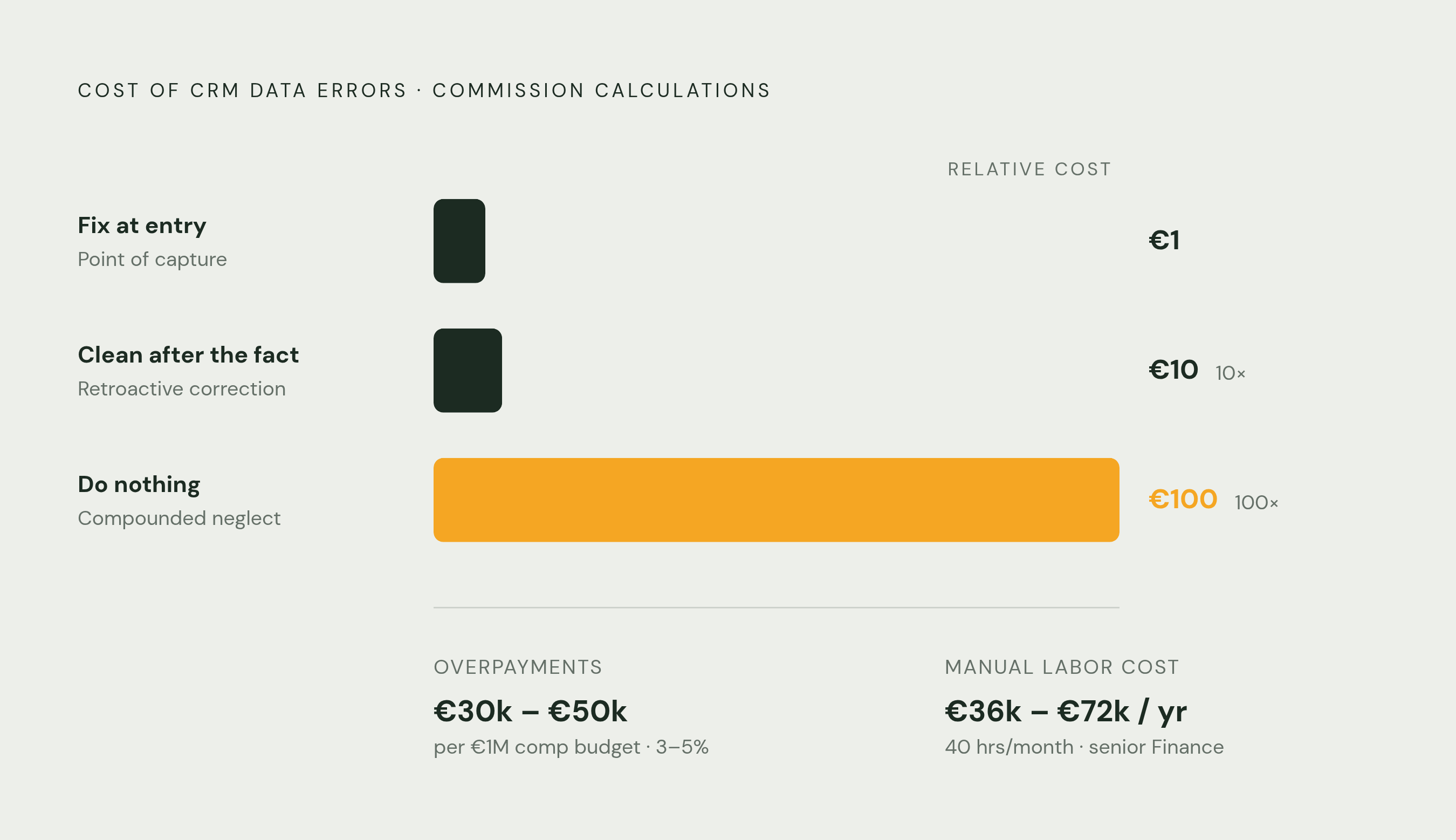
The financial cost of these errors is not trivial. Gartner's figures put overpayments from calculation errors at 3 to 5% of total sales-compensation spend, which on a €1M annual commission budget works out to €30,000 to €50,000 a year, gone, on mistakes that trace back to bad source data. The trust cost runs alongside it. Sales turnover is roughly 35% annually, nearly triple the 13% average across industries as of 2025 benchmarks, and retention tracks commission accuracy directly. Then there's the labor cost: Finance and RevOps teams exporting CRM reports, cross-referencing records, applying rules by hand, chasing down edge cases, and fielding disputes, a cycle that eats days of effort every single month.
Practical enforcement: how sales and RevOps teams keep CRM data commission-ready between pay cycles
Three mechanisms do most of the work here, and they need to run together rather than in isolation. Validation rules at the point of entry, Salesforce validation rules, HubSpot required properties, stop a deal from ever reaching "Closed Won" with a blank commission-bearing field. Controlled vocabularies replace free text on product, territory, and stage fields with picklists or a fixed taxonomy, which is what actually eliminates the "IBM" versus "International Business Machines" class of failure before it starts. Automated deduplication, run on a schedule (Salesforce's Duplicate Management jobs, HubSpot's manual duplicate review tool) needs to happen before each commission period closes, not after a dispute forces someone to go looking.
Freshness deserves its own cadence. CleanList's benchmark calls for 65% or more of records updated within a 90-day window, and commission teams should treat that 90-day mark as a hard audit trigger rather than a soft guideline. Gedys' 2025 "rule of ten" makes the economic case: roughly €1 per record to enforce clean data at the point of entry, €10 per record to clean it after the fact, and €100 per record when nothing gets done at all. Prevention is not a hard sell once the numbers are laid out that way.
The discipline that ties all of this together is the same one from earlier: when a commission exception gets handled outside the CRM, someone needs to document what field was missing and treat that gap as a required field going forward, not just patch the one incident. And enforcement doesn't belong to one team. RevOps owns the field-level rules and dedup schedules, Finance owns the pre-period audit against commission-bearing fields, and sales managers own deal-stage hygiene inside their own teams. If any of that gets split off, the whole system degrades back toward the numbers in section two.
Why connecting CRM data directly to commission processing removes the manual-export gap where most errors enter
Even a CRM that clears every benchmark above can still produce bad commission numbers, because the export step itself is where a fresh set of errors gets introduced. Stale snapshots, broken formulas, copy-paste mistakes are not caught by the CRM's own validation rules, because by the time each happens, the data has already left the CRM. CRM Data Quality Requirements for Accurate Commission Calculations.
That gap is not a minor inefficiency. Commissionly's 2026 figures show 47% of organizations still run incentive compensation on spreadsheets, and that's not simply a tooling preference, it's an architectural hole sitting between clean CRM data and an accurate payout.
Direct integration removes the export step, the stale-snapshot risk, the manual rule application, and the reconciliation cycle, and automated systems, per Prowi's figures as cited by Commissionly, bring error rates under 0.5% and cut processing time by 80 to 90%. Evaluating a commission platform against this standard means looking for direct CRM integration rather than file upload as the primary path, field mapping that actually respects the controlled vocabularies already enforced upstream, automatic status-change triggers that catch clawbacks as they happen, and deal-level audit trails that tie every payout back to the specific record and rule that produced it. Anything less reopens the same gap this entire discipline exists to close. The labor cost of the gap is that a senior Finance or RevOps person spending 40 hours per month on commission calculations costs $3,000–$6,000 per month in labor, or $36,000–$72,000 per year, on work that is downstream of the CRM data quality effort, not separate from it.