Month-End Commission Close Process for Finance Teams
Structuring commission close as a dedicated workflow cuts month-end delays in half.

Month-end close means reconciling transactions, posting adjustments, and getting the books ready for reporting. Commission calculation is the part of that process most likely to blow the deadline, and most Finance teams still handle it like an afterthought bolted onto the rest of the close rather than a workflow with its own steps and sign-offs. That distinction, structured process versus improvised scramble, is the difference between closing in four days and closing in eight.
The scale of the delay is well documented. Ledge's 2025 benchmarks show only 18% of finance teams close in one to three business days, half take longer than five, and more than a quarter take over a week. APQC benchmarks put the median close at 6.4 days, with top-quartile teams finishing in 4.8. That gap between median and top quartile isn't explained by bigger teams or more people in seats. It comes down to how the work is sequenced.
Commissions sit at a crossroads that no other line item on the close checklist has to deal with: Finance, Sales, and RevOps all touch it, and it generates more disputes than any other accrual on the books. The inputs, accruals, clawback adjustments, period-end true-ups, don't arrive on Finance's schedule. They arrive on Sales's schedule, or billing's, or whenever a rep finally flags a deal that should have posted three weeks ago.
The accounting stakes go beyond payroll accuracy. Under ASC 606 and IFRS 15, commission expense carries specific recognition requirements that extend beyond simple period expensing. A miscalculated commission doesn't stay contained in comp expense. It bleeds into revenue recognition, and if it's wrong enough, it becomes a restatement problem. Treating commission close as an add-on to the main close means absorbing all of that complexity with none of the structure built to manage it. The case for building a dedicated workflow starts there.
Why commission calculations are harder to close than most other accruals
Most accruals are estimates fixed at a point in time. Commission accruals are something else entirely: they're rule-applied calculations that shift depending on deal data, plan logic, and timing rules that differ from plan to plan and rep to rep. A depreciation schedule doesn't change because someone closed a deal on the 31st at 11:58 p.m. A commission accrual does.
Plan mechanics are where the real complexity lives. Tiered rates kick in at quota thresholds, so the rate that applies to a given deal depends on cumulative attainment, and attainment isn't final until the very last deal of the month clears. Accelerators compound the problem: a deal that pushes a rep over a tier boundary can force a retroactive recalculation of every earlier deal that quarter at the new, higher rate. SPIFs and overlay bonuses run on eligibility rules that have nothing to do with the base plan. Splits and co-sell credit require two or three people to agree on how a deal gets carved up. Clawbacks reverse commissions that were already paid out in a prior period, which means negative accruals that have to tie back to payments already on the books. Draws against future commission need to be tracked and netted out before anyone gets a final number.
None of this happens in a vacuum. Commission calculation needs deal data from the CRM, payment status from billing or the ERP (especially in businesses where commission triggers on cash collection, not booking), and plan assignments from the HRIS. If any one of those three sources lags, the whole calculation stalls. Ledge's 2025 benchmarks show 56% of finance teams name dependency on other departments as a top blocker to closing faster, and commission data is close to a textbook case of that problem: three systems, three owners, one deadline.
Plan variety makes the picture messier still. SDRs, account executives, and account managers typically run on different plan structures inside the same company, so a single close cycle isn't running one formula, it's running several in parallel. Commission close, then, is a sequence, not one task. It's a sequence: data collection, rule application, exception handling, dispute resolution, approval. Without sequencing, the process sprawls into whatever week it wants to.
How spreadsheet-based commission close fails Finance teams at month-end
A large share of organizations still run incentive compensation through spreadsheets. That means close to half of Finance teams are attempting to manage the complexity described above by hand, in Excel, under a deadline. Ledge's 2025 benchmarks show 94% of teams still use Excel somewhere in month-end close, and half name it as a direct reason their close runs slow.
The failure modes are specific. Version control is the first casualty: when deal data updates late in the month, which is common, nobody can say with certainty which spreadsheet has the latest numbers baked in. Audit trail is the second: Finance can't point an auditor to the rule that produced a given payout, because the formula is the only evidence that exists, and formulas fail silently, not loudly. A formula built to handle 80% quota attainment often breaks the moment a rep crosses 101% and an accelerator kicks in, because nobody wrote the edge case into the sheet.
Clawback accounting compounds the manual burden. Someone has to find the prior-period payment, net it against the current payout, and post the right journal entry by hand, cross-referencing sheets that may not even live in the same file. Commissionly data shows commission errors affect an average of 8.8% of payouts annually, and in a spreadsheet-driven process, most of those errors appear after the check has already gone out, not before.
That creates what amounts to a close-extension problem. A disputed payout appears after the period is technically closed, and Finance is stuck choosing among three bad options: reopen the period, post an out-of-period adjustment, or defer the fix to next month. None of the three is clean, and all three create downstream audit questions.
For companies under SOX, or getting ready for it, this isn't a cosmetic gap. Spreadsheets don't have access logs, they don't lock periods, and they don't produce approval records, which are exactly the controls auditors look for around compensation expense. And the time cost is real even where it isn't isolated by function: Ledge's 2025 benchmarks show cash reconciliation alone eats 20 to 50 hours a month across three to five different systems. Commission reconciliation under spreadsheet conditions runs the same pattern, stitching together sources that were never built to talk to each other.
The structured commission close: a repeatable sequence with defined gates
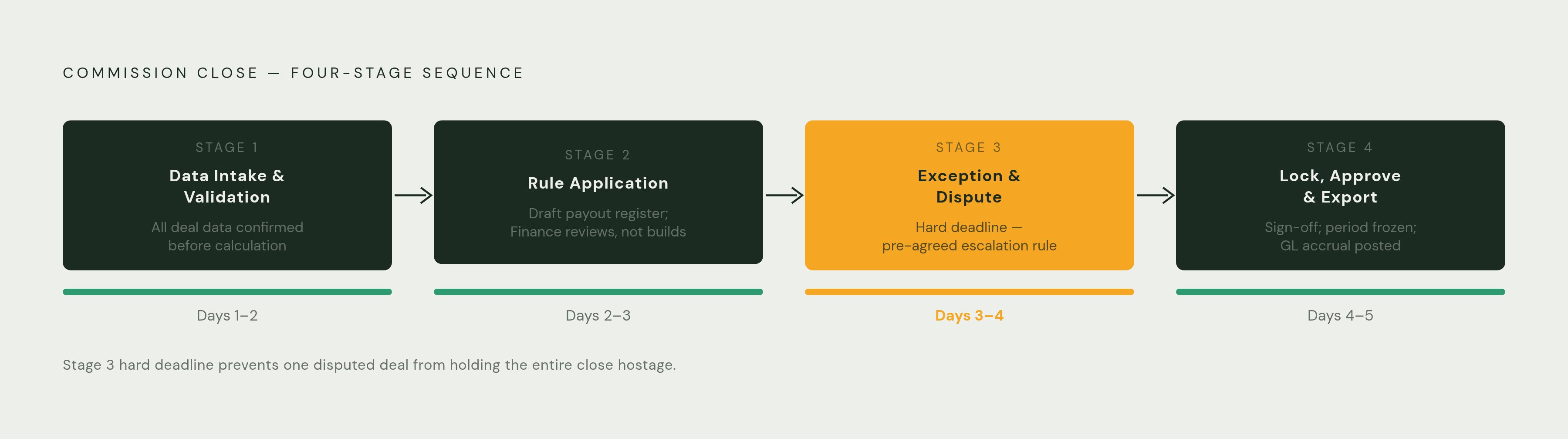
Commission close moves faster, and comes out more accurate, when it's run as a mini-process with its own intake, calculation, review, and approval stages, rather than handed to one person as a single task due on the 3rd. Four stages make up that sequence, and each one has a gate that has to be cleared before the next begins.
Stage one is data intake and validation: pull closed-deal data from the CRM, confirm deal status, verify payment receipt where commission ties to collection, and flag anything missing or ambiguous before calculation starts. This gate exists to stop recalculation later, which is far more expensive than catching a bad record up front.
Stage two is rule application. Each rep's plan logic, tiers, accelerators, splits, clawbacks, draws, gets applied to the validated deal data to produce a draft payout register. Ideally this step runs on automation, so Finance is reviewing outputs rather than manually producing them line by line.
Stage three is exception handling and dispute resolution. Deals that crossed a tier boundary, clawback candidates, disagreements over a split, all of it gets reviewed against a defined resolution path with a hard deadline, so a single unresolved dispute doesn't hold the entire close hostage.
Stage four is lock, approve, and export. The pay period gets frozen, the calculation routes for manager and Finance sign-off with a documented approval, and the payroll journal entries and commission accrual export to the GL.
Each stage needs an owner. CRM data quality belongs to RevOps or Sales Ops. Plan logic belongs to Finance or RevOps. Exceptions get resolved jointly by managers and Finance. Final approval is Finance's call, full stop. And the work that makes this run smoothly mostly happens before the period even ends: plan rules documented and verified ahead of a new quarter, not reconstructed from memory during close week. Once a period locks, it stays locked. Any later adjustment, a reversed deal, a clawback discovered in week three, posts in the next period with a documented reason attached, not as a quiet edit to a record that's already been signed off on. Every payout should trace back to one specific deal, one specific rate, and one specific rule. That traceability is the minimum an auditor will accept for substantiating a commission accrual, and it's not optional.
Finance's requirements for a commission platform to support a structured close
A commission platform doesn't operate in isolation, it sits in the middle of a small ecosystem. CRM and ERP feed it deal and payment data, HRIS feeds it plan assignments, and payroll and the GL consume whatever comes out the other end. Weaken any one connection and the platform's output is only as trustworthy as its weakest link.
Data should pull natively from wherever it already lives, Salesforce or HubSpot, not get manually exported into a CSV somewhere. Manual export is exactly where stale or mismatched data sneaks into the process. Beyond that, Finance evaluating a platform should ask a short list of pointed questions before signing anything. Can it handle tiered rates and retroactively recalculate earlier deals when a rep crosses a tier mid-month? Does it net clawbacks against prior-period payouts and generate the correct journal entry on its own? Can it track draws and outstanding balances across multiple periods without a side spreadsheet? And can it produce a deal-by-deal, rate-by-rate audit trace that shows the actual figures behind the number?
Approval workflow matters just as much as calculation accuracy. Look for configurable approval chains (manager sign-off before Finance sign-off), timestamped approvals, and period-lock functionality that blocks retroactive edits after close. On the output side, the platform should generate a journal entry ready for the general ledger, mapped to the right cost center and period. Finance shouldn't be manually rebuilding the accrual from a raw payout list every month, since that defeats the point of automating the calculation.
Rep self-service statements deserve a mention here too, and not as a nice-to-have. Giving reps deal-level visibility into their own numbers cuts dispute volume before it ever reaches Finance's inbox. WorldatWork data shows 22% of reps file at least one commission dispute a year, and every dispute that gets resolved by a rep checking their own statement is one less ticket landing on Finance's desk during close week.
Some platforms now offer AI-assisted plan extraction, reading existing plan documents and proposing the underlying calculation rules. That speeds up setup, but a human still has to review every extracted rule before it goes live, because a misconfigured rule doesn't throw an error, it just runs quietly wrong until someone notices at payout. On pricing, platforms priced per compensation plan rather than per seat let Finance scale commission close without paying a penalty every time headcount ticks up, which matters most for organizations where team size shifts from one close period to the next.
Security is not a footnote. Finance should require encryption in transit and at rest, tenancy that keeps one customer's data fully separate from another's, audit logs on every access, and a clear, explicit policy that customer commission data doesn't get used to train models. Commission data is compensation data. It deserves the same governance standard as payroll.
The rep trust problem Finance inherits when commission close is slow or opaque
Reps don't wait around for Finance to hand them a trustworthy number. Sales Cookie's research shows 62% of reps keep a private spreadsheet just to check their own commission against what the company reports, which is about as direct a signal of distrust as a process can generate.
That shadow accounting has a real cost. Shadow accounting costs an estimated two to four hours per rep per week, which, scaled across a hundred-person sales team, adds up to roughly 12,000 selling hours lost in a year. Those aren't just wasted hours either; they're the hours that generate the dispute tickets that land on Finance's desk right in the middle of close.
WorldatWork data shows 22% of reps file at least one dispute a year, and 9% of voluntary resignations in sales roles trace back to compensation transparency problems specifically. Companies report losing reps over inaccurate commissions at a rate of 83%, and replacing a rep runs somewhere between $115,000 and $150,000 once ramp time and lost pipeline are counted. That's a number Finance should be able to cite on its own, not one it leaves to sales leadership to raise.
Transparency moves the needle in the other direction. Commissionly's 2025 benchmark data found teams with real-time commission visibility post 15% higher quota attainment, and Fullcast data associated automated commission statements, plus the removal of manual calculation errors, with a 38% average increase in sales performance within the first year.
For Finance, the payoff isn't just goodwill toward the sales org. A faster, accurate, visible commission close means fewer disputes during and after the period closes, less manager time spent fielding "why is my number wrong" questions, and one less recurring source of comp-expense restatement risk. Every dispute that never happens is an hour Finance doesn't spend reopening a calculation or posting a correction the following month.
Building a commission close calendar that fits inside the broader month-end timeline
Ledge's 2025 data puts the realistic target for a full month-end close at three to five business days for teams considered top performers. Commission close has to fit inside that window. It cannot be the reason the broader close runs long.
Preparation starts before day one. Plan rules should already be documented and loaded into whatever commission platform is in use well before the period ends, not pieced together from memory during close week. A CRM data cutoff, end of business on the last working day of the month, gives the deal data a chance to settle before calculation starts. And there should be a standing policy for deals that close after that cutoff: do they roll into next period, or does someone manually pull them in? Decide that in advance.
Days one and two belong to data intake and validation: pull from the CRM, verify deal status, flag exceptions. No calculation should start against data that hasn't cleared this stage. Days two through three are for rule application, generating the draft payout register, with Finance reviewing the output rather than building it from scratch, which is where automation earns its keep most directly.
Days three and four are for exception resolution, run against a hard deadline. Anything that can't get resolved in time follows a pre-agreed escalation rule, hold the payout or post an estimate, rather than freezing the whole close waiting on one disputed deal. Days four and five cover manager approval, Finance approval, the period lock, and the payroll export alongside the GL accrual posting.
Running it this way lets commission close finish by day four or five, in time to feed the broader close without adding a single day to the overall timeline. That's the actual goal here: commission close stops being the bottleneck it currently is at most companies. After each cycle, it's worth logging exactly where the process stalled, late CRM data, an unresolved dispute, a plan rule nobody documented, and fixing one bottleneck per quarter. That's the mechanism by which a six-day close becomes a four-day close over time, not through a single fix but through steady attrition of the friction points.
CFOs increasingly treat month-end as the proving ground for finance automation, and PYMNTS reporting from March 2026 shows that view is only gaining ground. Commission close is near the top of the list of places to act on it: it's complex, it generates more disputes than almost anything else on the close checklist, and at most companies, it's still running on the least automated infrastructure in the building.