How Sales Ops Leaders Structure the Spreadsheet Exit for Commission Tracking
Five-step playbook turns messy commission math into auditable, rep-friendly payout logic.

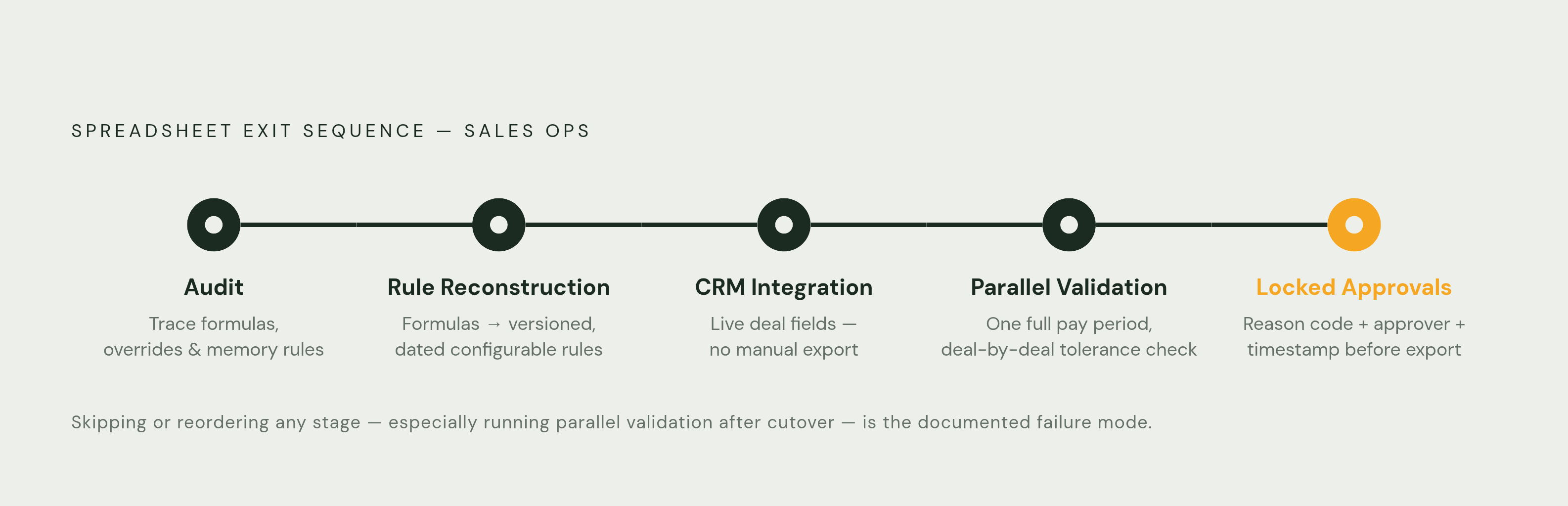
Commission management software is the spreadsheet replacement for sales commission calculation, but a reliable exit requires more than moving formulas out of a spreadsheet application. Sales Ops leaders must sequence the transition through an audit, rule reconstruction, CRM integration, parallel validation, and controlled approvals. Following those steps protects the pay cycle and gives reps a way to trace what they earned.
Why commission spreadsheets break at scale — and why the break is structural, not incidental
When a rep sends a late-night chat message about a short paycheck, Sales Ops has to work back through nested formulas, copied tabs, and manual overrides. The immediate task is finding the wrong number. Isolating the underlying error is harder because the spreadsheet may calculate exactly what its formulas instruct, even when those instructions no longer match the plan. The error goes unnoticed until someone asks about the payout.
Kennect’s Sales Ops guide identifies multi-product incentives, mid-year changes, and territory realignments as conditions that leave spreadsheets packed with hundreds of nested IF statements. These are consequences of business growth. Formula drift and competing versions make the resulting logic difficult to audit, while dependence on the person who built it turns a vacation or departure into an operational risk.
The guide describes deleting other reps’ data by hand from the master file to make statements for each rep, a task that takes hours and puts sensitive compensation information at risk. Compliance adds a more durable constraint. ASC 606 and IFRS 15 require capitalized commission costs to be amortized and auditable over the benefit period, which a spreadsheet without version control or an audit trail cannot support.
What the fragility actually costs — in rep trust, finance hours, and retention
The cost to the business starts before an error reaches payroll. SimpleRev’s commission tracking guide identifies reps’ shadow trackers as a leading indicator of process failure because they signal distrust in the official number. It also says that deal-level dashboards tend to cut disputes sharply. Confusion can cause as much friction as a wrong calculation, leaving Sales Ops to defend numbers that reps cannot explain on their own.
Finance absorbs the reconciliation burden behind those numbers. Kennect’s guide describes mismatches between CRM “Closed-Won” dates and billing invoice dates that stretch reconciliation from days to weeks, diverting time from closing the books. Sales Ops has less time for other work as it checks the numbers again and again, while reps’ distrust of the process leads them to spend time checking their compensation. Retention is exposed when that distrust persists. Replacing a quota-carrying seller can use up the savings the spreadsheet was supposed to protect, so a rushed, unreliable transition can be especially costly.
Auditing current-state fragility before touching anything else
To protect the transition, Sales Ops should begin by mapping what the spreadsheet actually computes before evaluating software or migrating data. The compensation document alone is not enough. Trace formula dependencies, locate hardcoded overrides, and identify copied formulas that still contain one-time exceptions. Rocket.new’s commission tracker guide describes this underlying “process gap” as distinct from a math error.
The audit should also trace every manual input back to its source, including CRM, ERP, billing, and HRIS systems. Check whether field names and identifiers match across those systems, rather than assuming that the same labels mean the same data. Then identify who built the sheet and who can interpret it. Any rule that exists only in someone’s memory belongs in the map, because otherwise the migration remains dependent on that person.
The output should be a plain-language account of rates, tiers, accelerator thresholds, split crediting, SPIF overlays, and clawback triggers. Someone unfamiliar with the spreadsheet should be able to reconstruct its logic from that account. Active disputes need the same treatment. Document pending adjustments and the reasoning behind them so that unresolved exceptions do not enter the new platform as accepted rules. This map becomes the working reference for migration.
Translating plan logic from spreadsheet formulas into configurable rules
With that map established, Sales Ops should reconstruct each formula as an explicit rule. Compare the written plan with the spreadsheet’s actual behavior and resolve every divergence before configuring it. Neither should silently overrule the other. The formula shows what has been calculated, while the discrepancy reveals a decision that must be settled.
An accelerator illustrates the required precision. Its configuration must specify that it applies at full quota attainment, resets quarterly, and applies to product line A only. By making those conditions separate and visible, configuration exposes assumptions that nested syntax had concealed.
SimpleRev’s guide identifies four groups of information that need explicit mapping, namely deal data, rep data, plan rules, and adjustments. For each rep role, map the role to the correct plan assignment, territory, quota, and ramp status. Then link the rule to the deal’s close date, amount, product line, and contract terms. Adjustment records require reason codes and approval attribution for clawbacks, overrides, corrections, and changes after the initial calculation.
Each rule set should also have an effective date and version history so retroactive calculations and amortization schedules remain traceable. AI-assisted plan extraction can reduce transcription by drafting configurations from existing documents. A person must still check every extracted rule. The extraction provides structure.
Connecting the platform to CRM data so commission calculations run on source truth
Once the rules are explicit, Sales Ops should connect them to authoritative data without recreating the export-and-cleanup routine. Integration depth is the highest-leverage decision in this stage. Rocket.new’s guide identifies deal amount, product type, close date, deal owner, and co-sellers as fields that must flow into commission calculations without manual intervention. When inputs are missing, the team has to reconcile the numbers again.
The distinction is between an automatic data path and a relocated manual handoff. Exporting, cleaning, and importing deal data creates a window in which calculations use stale information. Live CRM integration closes that window, but the team still needs to map how the billing data differs. The relationship between “Closed-Won” dates and invoice dates must be resolved at the field level.
The platform should fit existing CRM workflows. Sales Ops should establish whether the connection is bidirectional and event-driven or periodic and batch, and whether quota changes and territory assignments flow through it. A mid-cycle territory realignment tests how well that connection works. Time-based ownership rules must distinguish who owned the account at booking from who owned it at payout, or each realignment will recreate the need for manual overrides.
Running parallel calculations to validate the new system before cutting over
Before a production cutover, Sales Ops should run the spreadsheet and platform together for at least one pay period. This is a bounded quality gate. Its purpose is to establish documented evidence that the platform reproduces correct results and correctly changes results where the old spreadsheet was wrong. It is not an indefinite commitment to maintaining both systems.
Compare outputs deal by deal. Offsetting errors can produce an identical total while applying the wrong rules to individual deals. SimpleRev’s guide identifies calculation traceability as a prerequisite for meaningful validation, because an output number alone cannot explain a discrepancy. Both calculations need a record of how they were reached. That evidence allows the team to distinguish missed spreadsheet logic from an incorrectly configured platform rule.
Define the tolerance threshold before making the comparison, document rounding differences, and investigate discrepancies above the threshold before cutover. During the same period, Finance and RevOps should validate GL exports and accrual reporting against payroll and accounting requirements. Rep communication belongs in this phase too. Explain that parallel validation is underway and that reps will see the new calculations before the platform becomes the system of record, so the change is not introduced as an unexplained replacement paycheck.
Locking pay periods and building the approval workflow that replaces ad hoc fixes
A calculation engine alone does not prevent undocumented intervention. Sales Ops should configure adjustments to require a reason code, an approver, and a timestamp, turning what was once a cell edit into an attributable entry. The calculation and the decision to change it then remain distinguishable.
The approval chain should match who is responsible for what in the organization. Each rep’s statement goes to a manager for review, then to Finance or RevOps for approval before the final lock. Payroll export follows only after final approval is recorded. SimpleRev’s guide identifies timestamps and sign-off records on final payouts as part of the commission record, supporting data accuracy, rule consistency, and transparency.
Once a period is locked, any change should need a documented override. Clawbacks and retroactive adjustments must follow configured rules and the same approval chain as the original payment. When a deal is revised or reversed, the workflow should calculate the recovery amount and route it for approval. This preserves the distinction between a closed period and a later correction.
The resulting audit trail records calculations, adjustments, approvals, and payouts in a form Finance can review and use for ASC 606 documentation. It also supports more predictable expense reporting. When locked plan rules are used with pipeline data to calculate accruals, Finance can forecast commission expense before monthly reconciliation.
Giving reps real-time visibility into their own earnings as the transition’s trust dividend
Instead of receiving an unexplained number after the period ends, reps can see earnings update as deals close, together with quota progress, tier position, and deal-level calculations. The official record becomes something a rep can inspect rather than a number that requires a separate spreadsheet to test.
SimpleRev’s guide says reps need real-time per-deal visibility to see how their pay is worked out. A summary dashboard is not sufficient if it cannot show which rate applied to which deal and why. With that explanation available, a discrepancy becomes a specific question about source data or a rule. Sales Ops can address that question without reopening a general argument about whether the commission process deserves trust.
Visibility also restores the timing of the plan’s incentive. A rep who can see that they are three deals from the next tier threshold has information they cannot use four weeks after the period closes. The timing changes the value of the information. Deal-level statements also give managers a first response to routine questions, reducing the need to turn every request for clarification into a multi-hour formula investigation.
How should Sales Ops evaluate software to replace Excel for commission tracking?
For a team making this transition, platform evaluation should begin with the failure modes documented in the audit. Integration depth is the primary screen, followed by plan fit and governance. A richer feature set does not compensate for manual data handoffs. The platform must connect to the systems of record and support the rule and ownership changes the team actually needs.
SimpleRev’s guide distinguishes simple flat-rate structures from multi-tier, multi-component plans with accelerators and SPIFs. That distinction should calibrate the purchase. Teams with simple plans can succeed with lighter tooling and rapid implementation, while complex plans require fuller configuration capability and deeper CRM integration. Team size should inform the evaluation without substituting for an assessment of plan complexity.
Finance requirements need equal weight before purchase. Evaluate native ASC 606 capitalization and amortization, clean GL exports, and locked, timestamped audit records. Compensation data must have the same security as payroll data. Baseline expectations include encryption in transit and at rest, org-scoped data tenancy, audit trails, and a strict no-training-on-customer-data policy.
Commercial fit also depends on how the team grows. Per-seat pricing increases with hiring, while pricing by active compensation plans scales with plan complexity. Implementation timing must be assessed against the first viable pay cycle. A multi-month implementation can leave a substantial gap between the decision to exit and the ability to pay through the new system.
Finally, check for signs of an unstable vendor, such as repeated layoffs or product churn after an acquisition, as well as weak audit controls and demands to re-enter CRM data already in the system. These risks belong in the operational evaluation. The purchase should be judged against the transition it must support, from reconstructing the audited rules to producing the first approved, traceable payout.