Sales Commission Tracking Software Evaluation Criteria
Test calculation accuracy and auditability before signing any contract.

I've watched sales operations teams sign commission software contracts they come to regret within eighteen months, usually around the same point: a rep disputes a payout, nobody can reconstruct the calculation, and the admin who could explain it quit four months earlier. This pattern holds often enough that it's worth writing down, because buyers evaluate the wrong things first, in the wrong order, and pay for it later in disputes, audit failures, and rep attrition. This piece lays out the criteria that actually predict whether a platform holds up, and the order to test them in.
The market itself explains why this keeps getting harder to sort through. Major enterprise vendors are steadily sunsetting legacy on-premises product lines, which forces even companies that assumed they'd sidestepped this decision into a migration cycle whether they planned for one or not. Dozens of vendors are chasing the same buyers, and nearly all of them claim the same accuracy and the same integration depth on a slide. Most evaluations end up comparing demo scripts instead of comparing what the software does once real data and real edge cases hit it.
What "commission tracking software" actually needs to do before any evaluation begins
Buyers routinely mash three separate layers of functionality into one mental category, and that's where evaluations go sideways before they even start. The calculation engine does the math: tiers, accelerators, splits, clawbacks, SPIFs, ramped plans for new hires. Sitting above that is commission policy management, the rules layer governing eligibility, timing, deal coverage, and what happens when a rep disputes a number. Then there's payout workflow, the operational plumbing of data import, review, approval, and export to payroll.
A basic tracker tells a rep what they earned. A real incentive compensation platform explains why they earned it, and that gap is the line between a tool worth demoing and one worth buying.
What actually forces most purchases isn't headcount growth on its own, it's complexity running into conflict. Plenty of sales orgs run five or more commission rules per plan, and disputes at least a couple times a quarter aren't unusual. Spreadsheets don't fail because a team gets big; they fail because the volume of exceptions outpaces the number of people available to chase them down by hand.
A buyer who only tests whether a platform "can calculate" misses the actual failure point. Splits, overrides, mid-year accelerator changes: that's where disputes get born, and it's exactly what a polished vendor demo is built to avoid showing you. Everything below is ordered to surface those gaps before the contract gets signed, not after.
Calculation accuracy and rules depth — the first thing to test, not the last
Spreadsheet-driven comp processes carry a meaningfully higher error rate than automated platforms, and that gap is the real cost of staying on spreadsheets past the point where a plan has more than a couple of rules baked into it.
Accuracy, in practice, comes down to specific things a platform either handles or doesn't. Native support for tiered rates, accelerators, and splits, configured without custom code or a support ticket. SPIF structures, quarterly bonuses, and ramped plans an admin can set up directly, no engineering queue involved. Future-effective dating, so a plan change scheduled for next quarter doesn't force a rebuild of the whole model. Multi-rep splits on channel and overlay deals, handled by the system itself instead of patched together with manual overrides after the fact.
The hidden cost shows up in admin time, and it's substantial: comp admins spend an average of 89 hours each month on manual payout reviews and dispute resolution. That's not a rounding error, and it's a proxy for how much of the job gets spent correcting calculation failures instead of just running payroll on schedule.
Here's a test that cuts through vendor claims fast: ask for a live demo of a tiered accelerator with a mid-quarter plan change applied retroactively. Count the steps, and notice who on the team is actually allowed to do it. An answer involving a support ticket already tells you what you need to know. Done right, this kind of automation gets payouts landing in days instead of weeks, but that speed is downstream of accuracy; it isn't a separate feature you shop for on its own.
Auditability and locked pay periods — what finance and legal actually need
A striking share of companies have over- or underpaid sales commissions in the past year without catching it in time. When that happens, the question that matters isn't how it happened, it's whether anyone can prove what was calculated, when, and under which version of the plan.
A genuinely auditable platform locks pay periods so nobody edits them retroactively once a payout gets approved. It logs who reviewed and who approved, and when, and it keeps plan version history, so the rules in effect at the time of a specific payout can be pulled up months later. It also produces deal-level statement detail a rep can inspect directly, with finance able to trace it back to the source record.
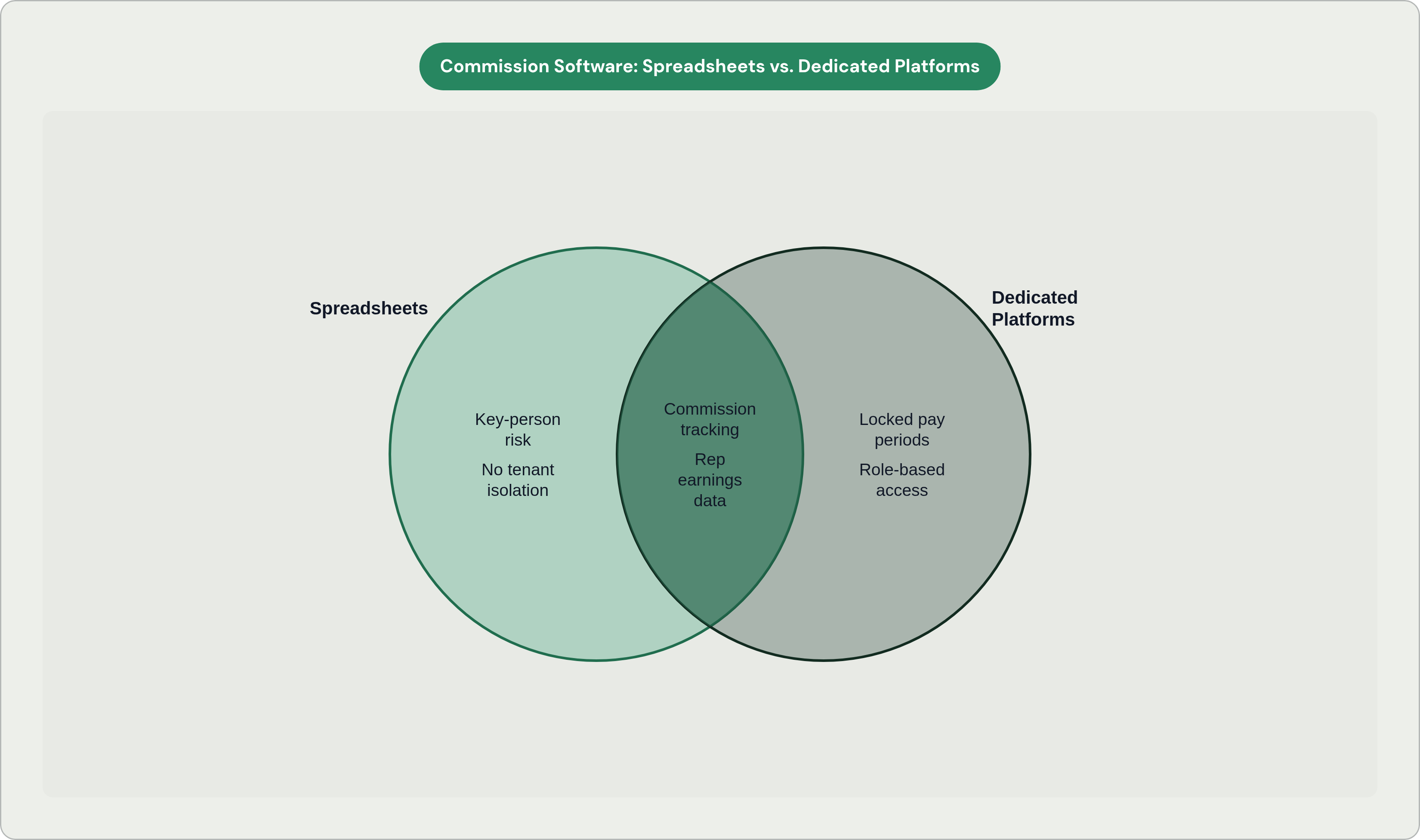
Companies subject to ASC 606 revenue recognition rules or SOX internal controls audits need commission expense documentation built ahead of time, not assembled from memory the week before the audit. That reconstruction problem has a name in the field: key-person risk. The one analyst who owns the master spreadsheet leaves the company, and the model often leaves with them. This is a structural failure baked into the tool, not bad luck.
The test is simple: ask whether pay periods lock after approval, and ask whether the audit log actually exports. A vague answer to either question is the answer.
CRM and data integration — where calculation errors usually originate
Most commission errors don't start in the calculation engine; they start upstream, in the handoff between systems. Pulling deal data out of a CRM into a separate spreadsheet reintroduces the exact copy-paste failure mode the software was supposed to kill in the first place.
Integration quality comes down to a few concrete things. Native connectors to the CRMs the team already uses, not a workaround stitched together from CSV exports. Field-level mapping flexibility, so deal stage, close date, split attribution, and product line all map correctly into the commission rules instead of flattening into a generic import. Two-way or near-real-time sync, so a deal that closes or updates in the CRM shows up in the calculation without someone re-running a report by hand. File upload as a fallback, for teams not yet on a connected CRM, so the platform meets the data where it lives rather than demanding a migration first.
Finance teams that automate commission calculation instead of manually reconciling it close the books noticeably faster. That benefit depends entirely on integration quality, though; automation without clean data feeding it just automates the errors faster.
The test: have the vendor walk through the integration with your actual CRM, not a generic stand-in. Ask how attribution works on split deals, and ask what happens when a deal gets updated after its pay period already closed. Watch for one specific red flag: any platform that requires ripping out and replacing existing CRM workflows to function correctly is adding migration cost that can erase the efficiency gain it's selling you.
Rep-facing transparency and what it does to quota attainment
Teams using dedicated commission software have been shown to exceed their targets at substantially higher rates than those relying on spreadsheet-based tracking. That's not just a satisfaction metric, it points to something specific: visibility changes behavior on the sales floor, because a rep who can see the math starts optimizing toward it.
The trust gap between spreadsheet-run comp and dedicated software is stark, and most of that gap traces back to one thing: whether a rep can check their own numbers without asking someone else to verify them first.
Transparency, concretely, means a rep-facing view of current earnings, quota progress, and deal-level breakdown, available whenever the rep wants to look, not delivered once a month as a static PDF. It means statement detail granular enough that a rep can spot a discrepancy on their own, without filing a ticket and waiting days for an answer. It also means the logic behind a number is traceable by the person who earned it, not buried in an admin-only view somewhere.
There's a retention cost to getting this wrong. A large share of sales professionals say they'd leave for a comparable role with better pay transparency, which makes opacity a turnover risk with a real price tag attached. Pay transparency laws in California, New York, Illinois, and elsewhere now require documented, accessible commission plan terms, so a platform producing auditable, rep-viewable statements does double duty: cutting disputes and cutting compliance exposure at the same time.
The test: pull up the rep dashboard live. Can a rep answer "how much will I earn if I close this deal today" without walking down the hall to ask a manager?
Security standards that apply specifically to commission data
Commission data isn't ordinary business data. It reveals individual earnings, quota attainment, deal attribution, and the pay structure of the whole sales org, so a breach here carries legal, competitive, and employee-relations fallout well past a typical data incident.
The minimum bar worth insisting on: encryption in transit and at rest, not just at rest. Org-scoped tenancy, so one customer's data is structurally walled off from another tenant's queries or admin accounts. Role-based access controls, so reps see their own numbers, managers see their team's, and finance sees the full ledger, with no single view exposing everyone's pay to anyone holding a login. A clear, written policy on whether customer data trains AI models matters too, because compensation data should never end up as training material for somebody else's product.
Worth saying plainly: a shared spreadsheet with commission data on it fails every one of these by default. No tenant isolation, no audit log of who opened it, no defined encryption policy at all. This is an absence of secure infrastructure, not a lesser version of it.
The test: ask vendors directly for their data residency policy, their tenant isolation architecture, and their AI training data policy. Any vendor that can't answer all three clearly, in writing, is treating commission data like it's no different from a marketing spreadsheet.
Pricing model and how it affects long-term fit
Seat-based pricing punishes hiring by design. Every rep added to the team raises the bill, so a growing sales org ends up with a built-in disincentive to bring new hires fully into the commission system on day one, exactly when they need the visibility most.
Plan-based pricing, charging by the number of active compensation plans rather than by headcount, decouples cost from team size and keeps the expense predictable as the team scales. This is the crux of long-term fit: a platform priced reasonably at 20 reps and priced out of reach at 60 is a problem pushed down the road, not a solution. Model the cost at current headcount and at two future growth stages before signing anything.
Watch for the costs that never make it onto the pricing page: implementation and onboarding fees, per-integration charges for each CRM connector, fees for exporting audit logs or pulling historical data, and charges for plan changes, in cases where a vendor treats what should be a self-serve admin task as billable professional services.
Run the numbers across a range of team sizes, and the risk-adjusted cost of staying on spreadsheets grows quickly once errors, disputes, and admin hours are counted fairly. Beyond that range, the risk-adjusted cost of staying on spreadsheets (errors, disputes, admin hours) consistently runs higher than the subscription.
Applying the criteria as a structured shortlist process
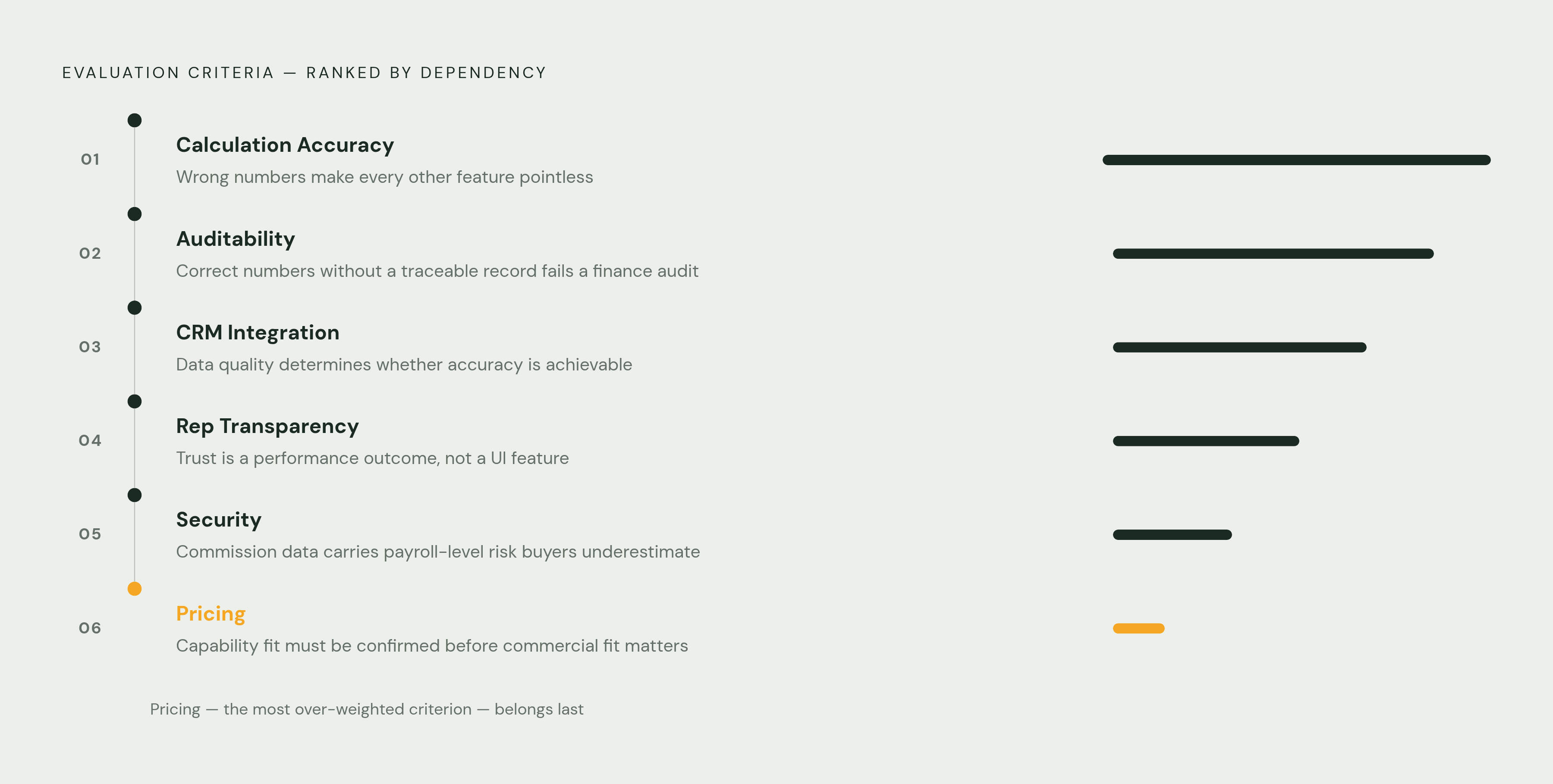
Accuracy comes first because wrong numbers make every other feature pointless. Auditability comes second because a correct number with no traceable record still fails finance in an audit. Integration comes third because data quality determines whether accuracy and auditability are even achievable in the first place. Transparency comes fourth because rep trust is a performance outcome, not a nice-to-have interface feature. Security comes fifth because commission data carries payroll-level risk most buyers underestimate. Pricing comes last: commercial fit only matters once capability fit is already confirmed.
A workable shortlist process follows from that order. Start by naming the three or four commission rules generating the most disputes or admin time inside your own org, and use those, not the vendor's rehearsed scenarios, as the live demo test cases. Confirm CRM integration depth before anything makes the shortlist; a platform that can't integrate cleanly with the CRM you already run is disqualified no matter how good its other features look on paper. Request a written security questionnaire response, since a verbal assurance doesn't cut it for compensation data. Model pricing at current headcount, at double, and at triple, and cut any platform whose cost curve turns punishing before your next hiring milestone. Bring both finance and sales leadership into the final call, because the platform has to satisfy the people running payroll and the reps who need to trust their own statements.
The point of all this is finding the platform that handles your team's actual commission complexity accurately, traceably, and at a cost that still makes sense two hiring cycles from now.