What Counts as a Good Commission Rate for Sales Reps
Focus on OTE and quota first, not the commission rate itself.

On-target earnings, OTE, is base salary plus commission at 100% quota attainment, and it's the number that actually competes for talent. A candidate lines it up against a competing offer. Nobody weighs two jobs by commission percentage alone, and anyone who tells you otherwise hasn't run a comp committee.
A higher rate does not guarantee higher pay, and treating the two as interchangeable is the single most common error in how reps and companies both talk about compensation. A rep earning 12% against a small quota in a low-ACV business can land a worse OTE than a rep earning 6% in a high-volume, high-contract-value one. Whatever gap shows up between SaaS comp and retail-floor comp has almost nothing to do with which industry pays a "better rate." It comes down to deal size, sales cycle length, and what the business can afford to pay out on a closed deal.
The base-to-variable split is a structural bet on what kind of rep the role is built to hold. A 50/50 split signals real performance risk baked into the job; a 60/40 or 70/30 split toward base signals a company that wants stability and treats commission as an accelerant rather than a paycheck foundation. Commission-only still works for experienced independent sellers in high-transaction fields like real estate. For most B2B sales roles, though, commission-only is a retention liability: the income volatility drives off exactly the reps worth keeping.
Build the plan in this order, and don't skip steps: competitive OTE for the market and role first, quota second, rate last. Most plans run in reverse. Someone picks a rate that sounds generous on paper, backs into a quota to justify it, and never checks whether the resulting OTE clears the market bar at all. That reversal is the root cause of most of what follows in this piece.
What industry benchmarks actually show — and where they break down
Benchmarks get quoted like they settle the argument. A published rate leaves out the two things that actually determine whether it's any good: deal economics and payout timing.
SaaS and software rates typically fall between 5% and 15%, with accelerators pushing the effective rate higher once a rep clears quota. As deal size grows, OTE expectations grow with it, which is part of why enterprise SaaS reps and SMB SaaS reps sit on very different plans despite selling comparable products.
Real estate carries some of the highest nominal rates around, commonly 5% to 6% of sale price, and the number is misleading on its own. Agents split commission with brokers, deals take months to close, and effective monthly earnings look nothing like the headline percentage. Retail and wholesale sit at the other extreme, compressed by thin margins and price competition from e-commerce. A rate that looks stingy in SaaS can be generous in retail, because the economics underneath the sale aren't the same sale at all.
Benchmarks also average across seniority, territory quality, and company stage, flattening distinctions that matter enormously on the ground. An early-stage startup chasing its first ten enterprise logos and a public company living off an established renewal base are not offering comparable jobs, even when their published commission rates match to the decimal. A benchmark answers what the market charges. What a specific job is worth is a different question, and conflating the two is how a candidate ends up comparing the wrong number.
How quota design and deal size determine whether a rate is livable
A quota set to satisfy a board projection, with no regard for rep capacity or territory quality, produces a paper rate that reads well in the offer letter and rarely pays out in the real world. The same 10% rate against a realistic $500,000 quota and an aspirational $1.2 million quota describes two entirely different expected-earnings outcomes, even with an identical number printed on the page. Anyone comparing offers by rate alone, without asking what the quota assumes about ramp time and pipeline coverage, is comparing decoration rather than substance.
Deal size and rate interact almost mechanically. High-ACV enterprise sales can carry a lower percentage because the dollar commission on one deal is still substantial money, while high-volume, low-ACV transactional sales need a higher percentage, or supplemental incentives like SPIFs, just to make variable pay feel worth chasing.
Accelerators, tiered rates that climb above 100% attainment, are standard in SaaS and enterprise sales for good reason: top performers get paid disproportionately there, and that gap is a meaningful retention lever for the reps a company can least afford to lose. Caps limit finance's payout exposure, but they reliably demotivate the reps a company can least afford to lose. Once a top performer hits a cap, every deal after that point is unpaid labor from where they're sitting, and they know it. Caps are, on balance, a bad trade: the savings on a handful of over-quota payouts rarely offset the cost of losing the reps who generated them.
The actual test has two parts. Can a rep at 80% attainment earn enough to stay in the role without panicking about rent, and can a rep at 120% attainment see a real, visible jump in the check compared to the rep who landed at exactly 100%? A plan that fails the first test bleeds mid-performers. A plan that fails the second bleeds the top ones, and loses them faster, which is the more expensive failure by a wide margin.
The plan structure a rate lives inside changes what it actually incentivizes
Six commission models cover most of what actually gets deployed, and each optimizes for something different, often at the expense of everything else. Flat percentage plans are simple and predictable, suited to early-stage companies where nuance isn't worth the administrative cost. Revenue-based plans align reps directly with top-line growth, but without margin guardrails they reward deals that are closed and financially bad for the business in the same breath. Gross-margin plans push reps toward profitable deals, though only if reps actually see pricing and cost data, which often they don't. Territory-volume plans work in geographically defined markets and breed resentment fast when territories are unequal. Residual plans reward retention and expansion over time, common in subscription businesses and insurance. Hybrid plans blend the above for flexibility, at the cost of a complexity that has to be actively managed or it collapses into confusion.
Revenue-based plans deserve the most suspicion of the six, and deserve it specifically. A high commission rate on raw revenue at a SaaS company that loses money on first-year contracts accelerates churn, because reps get paid to close the deal, not to keep the customer around. The rate has to match what the structure actually rewards; the plan should pay out on retained, profitable customers rather than just signed ones. New business rates and account management rates should differ too, since prospecting a stranger and expanding an existing account are not the same job, and a comp plan that pretends otherwise is quietly punishing one of the two motions.
Research has found that sales organizations simplifying seller roles are substantially more likely to land among top performers. Plan complexity is friction, and it shows up the moment a rep tries to figure out what selling behavior actually gets rewarded, and can't.
What makes a rep trust — or stop trusting — their commission number
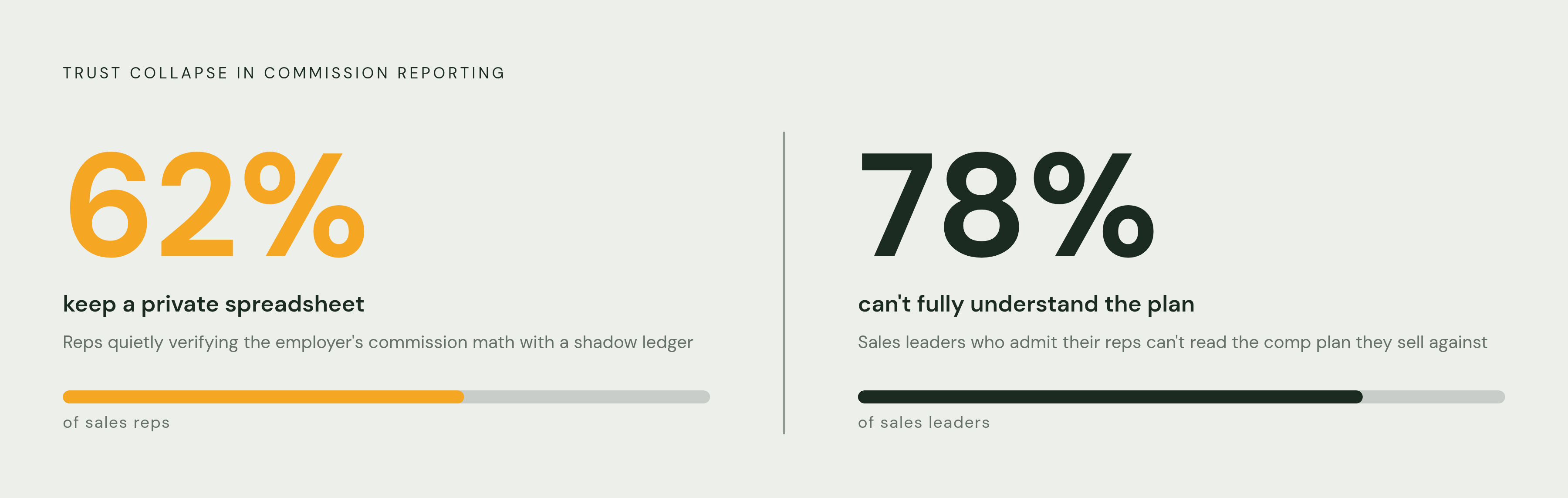
When reps stop trusting their commission statement, they build a second one. Research from June 2026 found 62% of reps keep private spreadsheets just to check their employer's math against their own: a majority of the sales force quietly concluding that the official number needs a shadow ledger running underneath it. That's an entire sales org running compensation on two sets of books, one official and one private, and only one of them trusted.
The causes are predictable and few: adjustments that appear with no explanation, plans so tangled reps can't reconstruct their own payout by hand, no real-time view into attainment or projected earnings. Separately, 78% of sales leaders admit their own reps can't fully understand the comp plan they're selling against. Read those two figures side by side and the failure sits with plan design and communication, not with reps' math skills; blaming the rep for not trusting a number nobody explained to them gets the diagnosis backward.
The fallout is a revenue problem, not just a morale one. Reps who can't verify their own numbers either check out of the plan entirely or start gaming it: timing closes around period boundaries, cherry-picking accounts likely to pay out cleanly, holding deals back rather than selling the way the business actually needs. Commission disputes are a documented driver of voluntary turnover, and replacing a rep costs far more than the disputed commission was ever worth. Transparency, in practice, means a rep pulls up current attainment, a projected payout, and deal-level detail whenever they want, without emailing Finance and waiting three days for an answer.
How commission errors silently erode what a rate is worth
Commission errors are widely reported as a recurring, structural problem rather than an occasional exception. That's a structural feature of how most commission math still gets done, and it means the "good rate" printed in an offer letter is, for half the market, aspirational rather than actual.
Errors cluster at the seams: the CRM export, the spreadsheet calculation layer, the payroll entry point. Each handoff is a place where data moves by hand, and hand-moved data is where format mismatches, copy-paste slips, and version conflicts pile up. Individual errors often go unchallenged for reasons that have nothing to do with whether they're correct: they're small enough per line item that none triggers a formal dispute, reps lack the statement detail to spot the discrepancy in the first place, and even when a rep does push back, the correction process is opaque enough that nobody's fully confident the fix was right either.
The damage cuts both ways. Underpayments erode trust in the rate itself, since a rate that doesn't reliably pay what it promises isn't really the rate. Overpayments create clawback risk and dump reconciliation work on Finance. Retroactive corrections made with no audit trail break something harder to fix than a paycheck: even a correct, well-meant adjustment looks suspicious to a rep with no record explaining why it happened. Take the trade seriously: a generous rate that pays wrong half the time costs more trust than a modest rate that pays right every cycle, without exception.
Why spreadsheet-based commission processes can't reliably support even a simple rate
The manual process is familiar to anyone who's touched comp ops: export from the CRM, calculate in a spreadsheet, land on one number per rep, key it into payroll. It works, more or less, while the plan is simple and the team is small. It does not survive contact with growth.
It stops working the moment complexity gets layered on. Every new plan component, a tier, an accelerator, a SPIF, a clawback, multiplies the formulas and cross-references a spreadsheet has to hold together without breaking. That compounds error risk right when reps are waiting to see if the check landed correctly, which is exactly the wrong moment for a broken VLOOKUP to matter.
The deeper problem is governance, not arithmetic. Spreadsheets have no approval workflow, no locked pay periods, no audit trail, and a cell can change with no record of who touched it or why, so every dispute starts from "trust us" instead of "here's the log." That ceiling doesn't move for a better template, no matter how clean someone keeps the formatting.
Spreadsheets remain the default anyway; roughly 47% of organizations still run incentive comp through them. The real cost never shows up on an invoice, since the tool itself is free. It shows up in the admin hours spent rebuilding formulas, the disputes that eat a manager's afternoon, the audit-prep scramble that happens every quarter like clockwork. Separately, 91% of organizations report changing their comp plans in the past year, yet only 21% call their current plan "very effective." That gap between how much redesign happens and how little of it actually works points at an execution and tooling failure sitting underneath the design problem.
What commission software actually does — and what to evaluate when choosing it
Commission software reads deal data straight from a CRM or an uploaded file, holds the comp plan as a set of structured rules instead of a tangle of formulas, calculates payouts automatically, and keeps a record of exactly how each number got produced.
Four things matter in evaluating a platform, and they are not equally weighted. Rep-facing visibility, real-time dashboards and deal-level statement detail, matters most: it's the one feature that actually kills shadow accounting, because it gives reps a reason to trust the official number instead of quietly building their own. CRM integration has to meet the sales team where its data already lives, rather than forcing a parallel data-entry job nobody keeps current for long. Rule configurability needs to handle tiers, accelerators, SPIFs, clawbacks, and role-specific variations without a custom code request every time the plan changes. Audit trail and approval workflow, locked periods, logged changes, means any number can be defended months later when someone finally asks about it.
Security deserves equal weight, since commission data is compensation data. It warrants the encryption and access controls payroll systems get, a higher bar than the loose file-sharing habits common in spreadsheet operations. Pricing model is worth scrutinizing closely too: seat-based pricing penalizes a company for the exact thing it should want to do, hire more reps, while plan-based pricing scales with the complexity of the comp structure instead of headcount, a meaningfully different incentive for a growing sales org.
AI-assisted plan building earns its keep extracting rules out of legacy plan documents that were never written to be machine-readable, but human sign-off on every rule still matters. Comp accuracy isn't a place to let automation run without a second set of eyes. The one evaluation question worth asking above all others: can a rep explain their own payout at the deal level, unassisted? If the platform can't answer that clearly, the transparency problem hasn't been solved, no matter how clean the underlying math turns out to be.
A practical framework for evaluating whether a specific rate is genuinely good
Four questions decide whether a commission rate holds up on the ground, checked against how it reads on an offer letter. Does it produce competitive OTE at 100% attainment, measured against real market and role benchmarks rather than the rate sitting in isolation? Is the quota behind it actually achievable, based on attainment history and realistic ramp time, rather than a figure chosen to satisfy a board deck? Does it reward the behavior the business actually needs, whether that's retention, margin, new logos, or account expansion? Can the rep verify all of it themselves, in real time, without waiting on someone else to run a report?
Reps evaluating an offer should ask for OTE at 100% attainment, median attainment across the current team, and actual deal-level statement examples, alongside the headline rate rather than in place of it. They should also ask whether commissions cap, what the accelerator curve looks like above quota, and how disputes get resolved: whether there's a real audit trail behind the numbers, or just an assurance that everything's fine. The rate itself should be the last thing asked about, not the first.
Sales leaders should build backward from competitive OTE, and should treat any rate that merely sounded reasonable in a planning meeting with suspicion until it's been checked against that number. Rates deserve review at least annually, more often when market conditions or team structure shift. The calculation and payout process is part of plan design, not separate from it: a rate only does its job if it pays out correctly and visibly, every cycle, without exception.
A good commission rate, in the end, is one a rep can understand, verify, and trust, one that pays competitively enough that the rep never has cause to wonder if they're getting shorted. Everything else, the benchmark, the accelerator curve, the plan structure, is in service of that single test.