Sales Incentive Programs That Drive Incremental Revenue
Linking rewards to revenue gain eliminates budget fights and makes programs self-sustaining.
Most sales incentive programs don't die in the field. They die at budget review. A finance team looks at what the program cost, asks what it returned, gets an ambiguous answer, and cuts it the following year. The programs that survive share one trait: they are not funded as expenses in the first place. They are built so that every reward is paid out of revenue or margin the program itself created. That means the question "what is this costing us" never has to be answered, because the honest answer is close to zero.
A fixed-budget incentive program has to compete for its own existence every cycle. Someone has to argue that the money spent on trip certificates or accelerator payouts was worth more than the same money spent on headcount, marketing, or product. When the results are murky, which they often are, the program loses that argument. A self-funded program sidesteps the fight entirely: rewards are drawn from incremental margin, the margin generated above what the sales team would have delivered anyway, so the payout is never competing against other line items for approval. Xceleration's incentive design guide puts it this way: the conversation needs to shift from what a program costs to what it generates. That reframing only works if the structure behind it holds up in practice, and the scale of the money involved makes the stakes worth taking seriously. Companies spend heavily on these programs every year, most of it still structured as plain expense rather than as an investment expected to produce a return.
Before getting to that structure, one distinction has to be settled, because conflating it is probably the single most common design error in sales compensation. Commission and incentives are not the same instrument, and they do not do the same behavioral work. Commission is baseline pay. It is the percentage built into every rep's offer letter, already priced into what they expect, and it covers what a paycheck is supposed to cover. Because it is guaranteed and expected, it stops operating as a motivator in any meaningful behavioral sense. It no longer feels conditional, so it no longer changes behavior at the margin.
Incentives work differently because they are conditional. They activate only above a defined performance threshold, and because the reward is not guaranteed, it retains the motivational pull that commission loses once it becomes routine income. The research backs this up with more than intuition. Xceleration's guide cites Kishore et al. in the Journal of Marketing Research, which found that commission structures induced greater neglect of non-incentivized behaviors compared to bonus-based plans. So when you pay people purely on commission, their focus narrows instead of broadening: attention goes to whatever is directly commissioned, and everything else that matters to the business gets ignored. The practical implication follows directly: raising commission rates is not a substitute for building a structured incentive program, because the two instruments serve different behavioral functions and one cannot do the other's job.
The Self-Funding Loop: Baseline, Incremental Target, Reward Pool
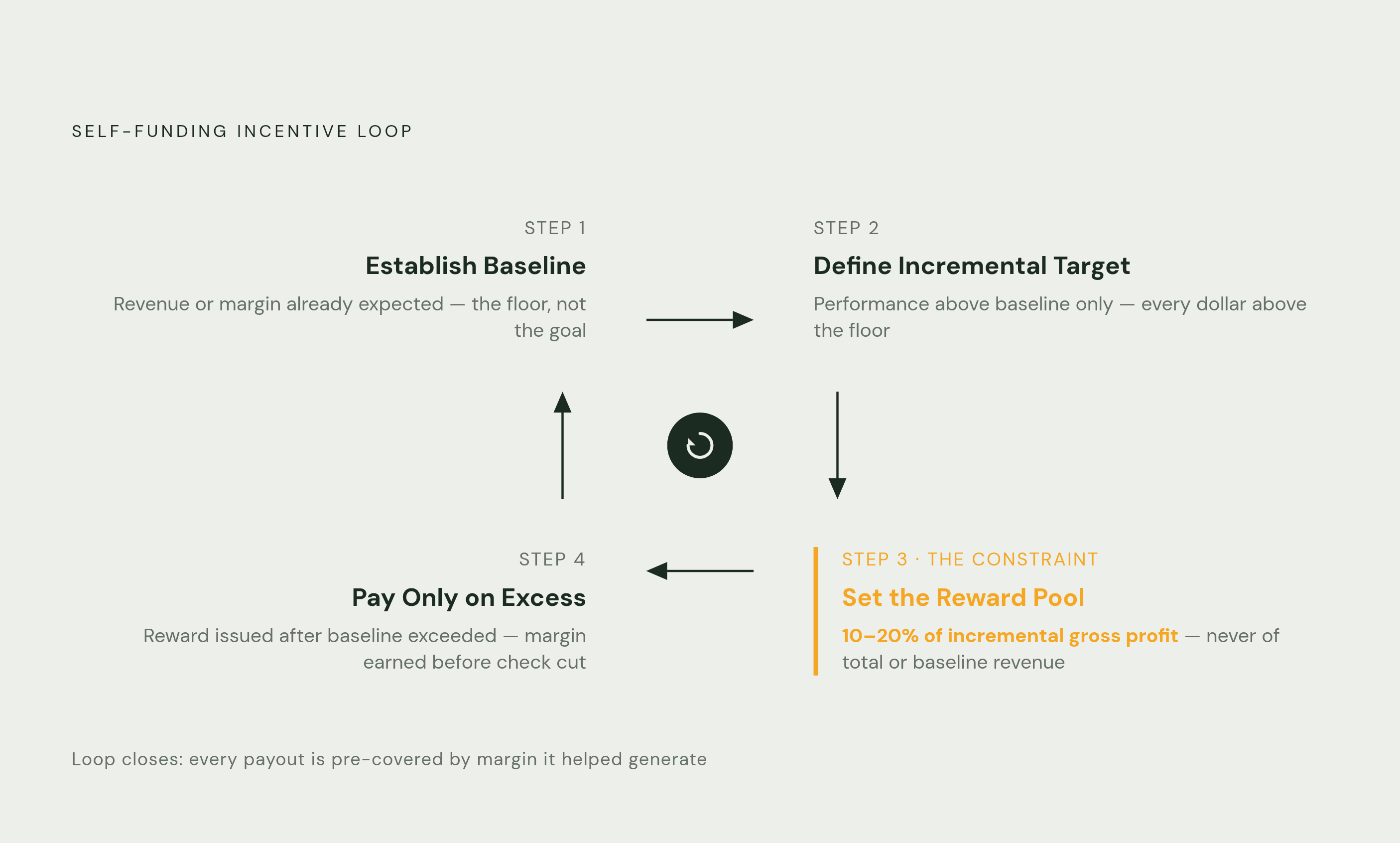
Once the distinction between commission and incentive is clear, the next question is mechanical: how does a program actually fund itself without taking on financial risk? The model runs on four steps, and the loop only holds if none of them gets skipped.
The first step is establishing a baseline, the revenue or margin a participant is already expected to deliver based on prior performance or quota. This baseline is a floor, not a target, and treating it as anything else breaks the logic of everything that follows. The second step defines the incremental target: the additional performance, above that floor, that the program is specifically designed to unlock. Without a clearly defined incremental target, there is no way to know which dollars of revenue the program actually caused and which would have shown up regardless.
The third step is where the self-funding mechanism actually lives: the reward pool is set as a share of incremental margin, not of total revenue and not of baseline margin. Xceleration's guide puts the standard range at 10 to 20 percent of the incremental gross profit a program generates, so rewards come only from the new margin the program creates, never from the margin the business would have earned anyway. The fourth step follows: participants get paid only when they exceed their baseline, so every payout is already funded by the time it goes out the door, because the margin covering it has already been earned before the check is cut.
Xceleration's guide walks through a worked example to show how this plays out in practice: a baseline revenue figure, a defined incremental lift target, an assumed gross margin, and a reward pool drawn only from the margin tied to that incremental lift. The result in that example is a net margin retained by the business alongside a positive return on the program investment itself. Total program cost, including both rewards and administration, comes in smaller than the incremental profit the program produces. That is the entire self-funding thesis in one sentence, and everything else in incentive design is just detail work that keeps this inequality true.
Running a program this way introduces one obvious risk: what happens if the incremental margin does not materialize before a payout is owed? Three structural choices manage that risk directly. If you set thresholds above baseline, rewards simply do not activate until a participant has already exceeded their performance floor, and the Incentive Research Foundation, as cited in Xceleration's guide, recommends linking reward budgets directly to increased revenue or profit rather than relying on artificial payout caps. If you use tiered payout structures, you spread the reward across several performance levels instead of one all-or-nothing threshold, so reward cost tracks margin as it actually happens, not in one lump sum at the end. And the performance period itself needs careful calibration: short contests are easier to fund because the incremental margin is visible quickly, while longer programs demand more conservative reward sizing and tighter, more frequent tracking to avoid overcommitting before the lift is confirmed.
The financial structure only works if it is pointed at the right people, and this is where most incentive design goes wrong even when the funding mechanics are sound. Most of a program's incremental revenue comes from the middle of the sales team's performance distribution, rather than from the top performers most programs are built to reward.
Top performers have already internalized the habits that drive high-effort selling. Their behavior does not move much in response to a new incentive structure, because they are already operating near their ceiling regardless of what the program offers. The middle of the distribution is different: these reps are competent, capable of more, and respond to clear targets, visible progress, and rewards they can actually reach. That middle cohort is where performance is genuinely movable, so most of a program's design attention should go there.
The strongest evidence for this comes from outside the incentive vendor world. A three-year controlled field study across hundreds of territories at a large pharmaceutical firm, published in the Journal of Marketing Research, found that activity-based incentives produced measurable sales lift when compared to a no-incentive baseline. This was a peer-reviewed field experiment conducted independently of any company that sells incentive software. The more striking finding from that same research: paying activity-based incentives to supervisors, rather than to individual reps, produced higher profits while drawing on a much smaller share of the total bonus pool. Incentivized managers drove more call activity from their teams through coaching and closer monitoring, and that moved the middle of the distribution more efficiently than paying each rep directly ever could. Managers hold leverage over the middle cohort that a program aimed only at individual reps cannot reach on its own, so if you incentivize that lever, manager behavior, you move the whole team, not just its edges.
A real-world program backs up the same pattern from a different angle. A Fortune 500 manufacturer ran a 9-month channel incentive program, and it delivered strong revenue growth and real market share gains. A large share of the reward participants in that program were first-time earners. The lift came from people who had never won before, not the same top performers collecting another trophy. That is what a program reaching the middle of the distribution should look like.
None of this means top performers should be ignored. They should still be recognized through accelerators, President's Club trips, and status rewards, but those serve as retention tools, not as the engine of incremental lift. Building the core incentive structure around the top 20 percent of a sales team leaves most of the available lift sitting on the table, uncaptured, because the people most capable of changing their behavior in response to the program were never the intended audience in the first place.
Goal-setting and reward sizing: the design decisions that determine whether the program moves behavior
Knowing that the middle cohort drives incremental revenue only matters if the program's mechanics are built to reach them. Four design decisions, attainability, behavior focus, reward type, and payout frequency, decide whether a program activates that middle group or quietly turns into a contest only the top performers finish.
Attainability comes first because it governs participation itself. When targets feel out of reach to the middle of the team, those reps disengage long before the program ends, and a tiered structure with multiple thresholds keeps more of them in the game for longer. Online Rewards' 2026 channel incentive guide documents exactly this pattern: tiered incentive structures reward participants at multiple performance levels rather than only at the top, which sustains motivation among mid-performers and cuts down on dropout during the middle of a campaign.
Narrowing the number of behaviors a program tracks matters just as much as setting the right threshold. One10 Marketing's guide cites Incentive Research Foundation research: programs built around two to three key behaviors produce meaningfully higher performance gains than programs that track five or more metrics at once. A B2B SaaS company illustrated this directly: rather than incentivizing total revenue, the company rewarded reps specifically for proposing multi-year agreements and premium support packages, the exact behaviors that drove larger contract values, and deal sizes rose within two quarters.
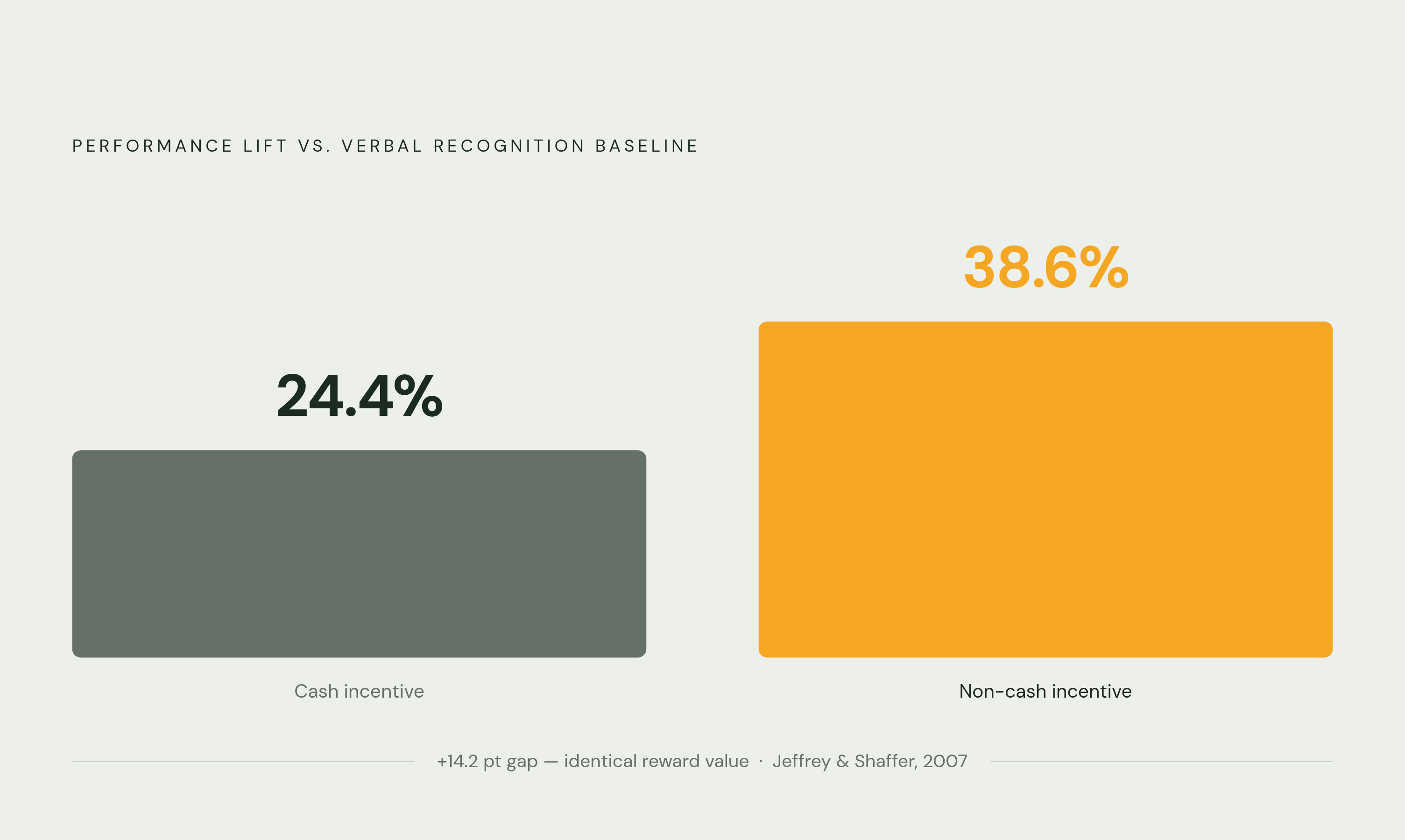
Reward type shapes the size of the performance lift more than reward size does, which cuts against how most finance teams instinctively approach compensation. Xceleration's guide cites Jeffrey and Shaffer (2007): non-cash incentive programs produced a 38.6 percent performance lift over a verbal recognition baseline, well above the lift seen from cash programs of equivalent value, and that gap held even when the dollar value of the reward was identical. Cash blends into a rep's existing compensation almost the moment it hits a bank account, so it loses the conditional quality that made it motivating. A trip, a certificate, or an experiential prize keeps its identity as a reward long after it is earned: people talk about it before they win it and remember it after. Giftatrip's 2026 incentive ideas guide notes that for longer incentive cycles, travel and experiential rewards sustain engagement in ways deferred cash payouts rarely match, because the anticipation of the experience becomes part of the motivation itself.
Different roles call for different reward structures and different payout timing. Monetary tools like tiered commission accelerators, short SPIFs run over two to four weeks, and quarterly bonuses work alongside experiential rewards like President's Club trips and team offsites, and recognition tools like public leaderboards or peer-nominated awards, and the combination tends to outperform any single reward type used alone. The lag between behavior and payout is itself a design decision with real consequences. A reward a rep can see and reach in real time produces more lift than a larger reward that shows up on a statement six weeks after the behavior that earned it. Margin alignment closes the loop: paying out on revenue alone, without regard to margin, risks rewarding a heavily discounted deal at the same rate as a high-value one, and tiering payouts to track profit margin is what keeps a long-running program sustainable rather than accidentally subsidizing bad deals.
Visibility and real-time tracking as a behavioral multiplier, not a reporting feature
Every design choice covered so far assumes reps can actually see the program working, and if they can't, none of those choices change behavior. Visibility changes behavior more than the size of the reward does. Wink Suite's 2026 incentive trends report states this directly: a smaller reward a rep can watch accumulate in real time produces more lift than a larger bonus they will only see on a statement weeks later.
The mechanism behind this is behavioral reinforcement. Real-time tracking closes the loop between an action and its reward while the action is still fresh, rather than confirming it long after the moment has passed and the connection between the two has faded from memory. Online Rewards' 2026 guide backs this up with its own finding: when participants can instantly see how close they are to the next reward tier, motivation rises, transparency builds trust, and that trust is what sustains engagement across the length of a program.
The inverse is just as true, and it is where a surprising number of otherwise well-designed programs quietly fail. Friction kills engagement before a program can produce any lift. Online Rewards finds that if participants cannot check their own progress easily, engagement drops, and any program that depends on manual tracking or a clunky, hard-to-navigate portal will not scale past its first few enthusiastic participants. Rule simplicity belongs in this same category. If a program carries too many qualifying conditions, the middle cohort genuinely struggles to navigate it, and that confusion drives the disengagement the design was supposed to prevent. One10 Marketing finds that programs built around a structured, ongoing communication plan achieve 34 percent higher participation than programs that rely on a single announcement at launch and little else. Keeping the program visible throughout its run, not just at the start, is what keeps the middle of the team aware that the target is still within reach.
Sources
- Sales Incentive Ideas List: Top 15 for 2026
- How to Design Sales Incentive Programs
- A Step-by-Step Guide to Designing a Sales Incentive Program
- 7 Best Practices for Channel & Partner Incentive Programs in 2026 - Online Rewards
- Sales Incentive Trends 2026
- Sales Incentives: Data-Backed Guide to Plans That Work in 2026
- Incentive Program for Sales Teams: 2026 Guide