Tiered Commission Structure Design and Tradeoffs
Marginal rates smooth behavior; retroactive rates create dangerous timing games.

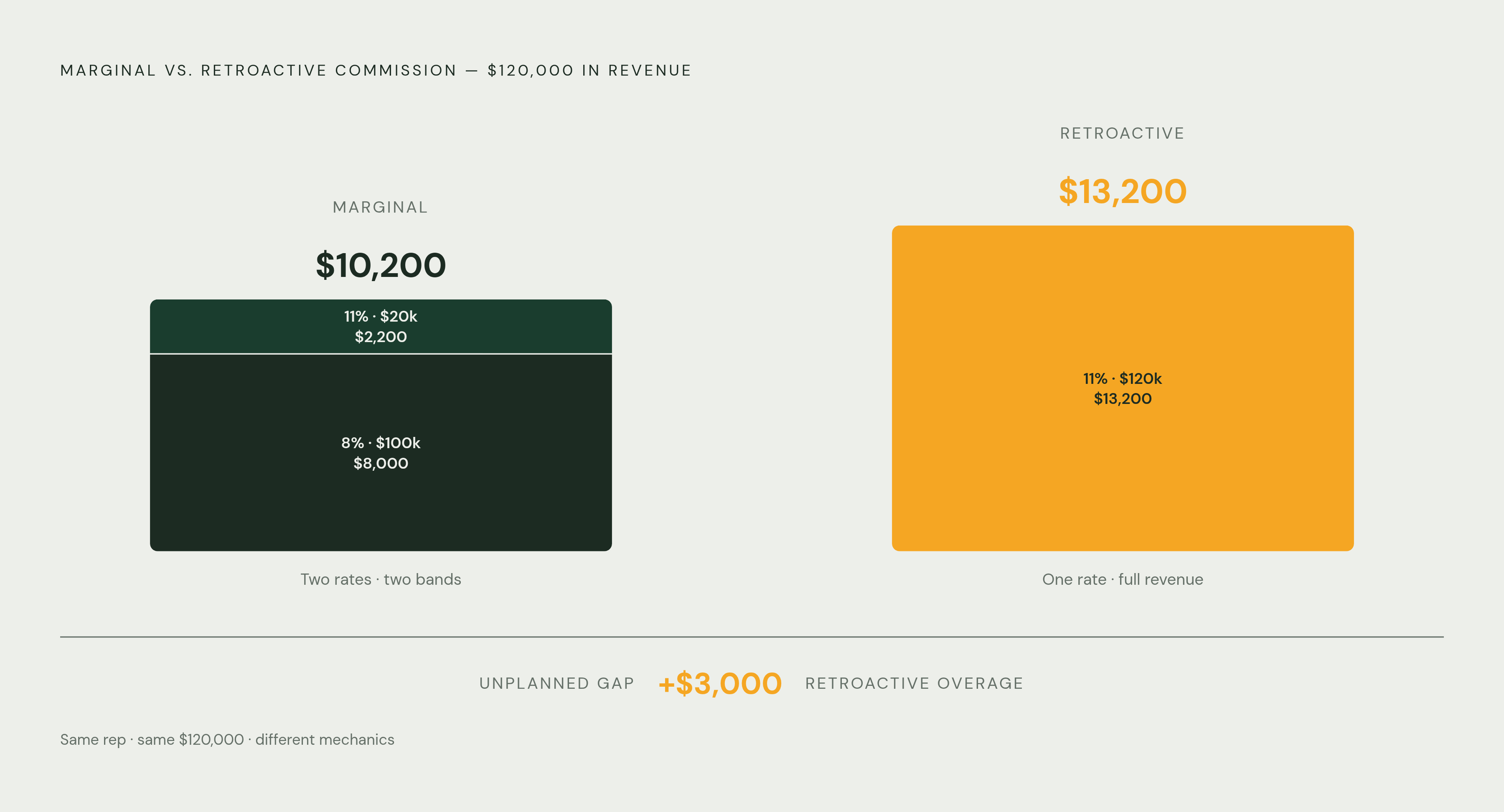
The first structural decision in tiered plan design, and the one with the longest downstream consequences, is whether the plan uses marginal or retroactive mechanics. Under a marginal structure, each rate applies only to revenue within that specific band. A rep earning 8% on the first $100,000 and 11% above that threshold earns the 11% rate only on dollars that exceed the line. Under a retroactive structure, crossing a tier boundary reprices everything. That same rep, clearing the upper threshold, suddenly earns 11% on every dollar sold in the period.
Retroactive structures are more expensive and harder to forecast. A single deal closed at the end of a quarter can trigger a large, unplanned payout on revenue already accrued and already embedded in the expense model. Finance teams that have managed retroactive plan cycles know this intimately; accrual reliability is a recurring problem, not an edge case. But the budget exposure is only part of it. Retroactive mechanics create cliff dynamics at tier boundaries, and cliff dynamics produce timing games. Reps approaching a threshold have real financial incentive to delay a close, compress a discount to nudge a transaction across the line, or accelerate paperwork on deals that aren't ready. None of those behaviors serve the customer or the company.
Marginal structures require more careful explanation upfront. A rate table is not sufficient. Reps need worked examples, deal by deal and dollar by dollar, showing exactly what their take-home changes at each band. Once they understand the mechanics, behavior smooths out across the full period. There's no single moment where everything reprices at once, so there's no single moment worth gaming. The choice between these two approaches ultimately determines whether reps think in terms of bands they can optimize steadily, or thresholds they will target episodically. That's a behavioral distinction, not a mathematical one, and it plays out in every pipeline review you run.
How to Set Tier Boundaries That Drive Behavior Without Breaking the Budget
Tier boundaries set aspirationally, without reference to historical attainment data, feel arbitrary to reps. Worse, they read as manipulative. A company that places its upper tier at 200% of quota when the historical attainment ceiling for its top decile is 140% has designed a tier that no one will ever reach. Reps who have been around long enough recognize this immediately, and it poisons trust in the plan before the period starts.
A workable framework starts with the data. Design the first tier to be reachable by roughly the top four-fifths of the team. Reserve higher tiers for demonstrably exceptional performers, and model the effective commission rate at each attainment level before the plan is published. A common four-tier shape covers a sub-quota band (0 to 80% attainment), an at-quota band (80 to 100%), an overachievement band (100 to 150%), and an exceptional band above 150%. The exact percentages should be calibrated to the team's actual historical distribution, not to round numbers that look clean on a slide.
Rate jumps between tiers must feel materially meaningful to a rep doing mental math on their next deal. A one-to-two percentage-point bump rarely changes behavior in high-velocity or high-ticket environments. A jump large enough to materially shift take-home pay, when multiplied across the deals a top rep is likely to close in that band, does change behavior. Larger rate jumps are more motivating and more expensive, in that order. Running financial sensitivity scenarios at the 50th, 75th, and 90th percentile of team attainment before the plan goes live is how you catch the version that looks motivating in a spreadsheet but creates a budget problem in Q4.
How Many Tiers Is Too Many
Two to four tiers is the practical ceiling for most sales organizations. Beyond four, cognitive load increases to the point where reps stop tracking their position in the structure, and the motivational signal weakens accordingly. A rep who can't quickly calculate what one more closed deal does to their paycheck can't be meaningfully motivated by the tier they're approaching. The structure becomes background noise.
More tiers also multiply calculation complexity. Each additional band is another place for a formula error to compound, another lookup to execute, and another reconciliation to perform when CRM data changes. The case for fewer tiers is cognitive and operational: reps can hold the structure in their heads, trust the math, and act on it in real time.
There are situations where a wider structure is defensible, specifically teams with very wide attainment distributions and a genuine strategic need to differentiate payout at multiple points on the curve. Even then, the communication burden grows with every tier added. A rep who trusts the plan and understands it spends less time on shadow accounting and more time on pipeline. Plan simplicity is, among other things, a retention asset.
Deal-Level Tiers vs. Period-Level Attainment Tiers: Different Problems, Different Tools
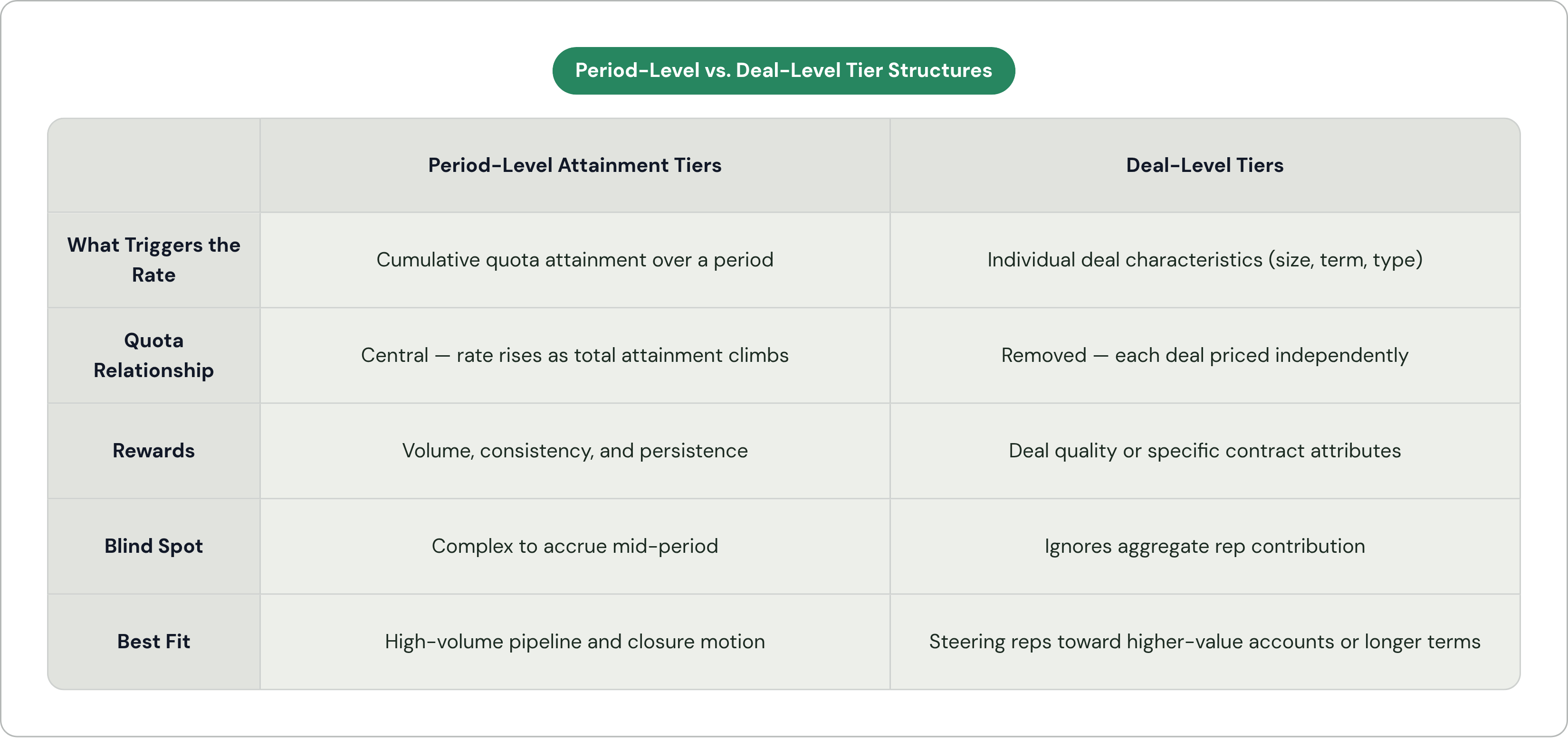
These two structural approaches are frequently conflated, and conflating them produces plans that serve neither purpose cleanly.
Period-level attainment tiers function on cumulative performance within a measurement window. The commission rate rises as total attainment climbs over the course of a quarter or year. They reward volume and persistence, and they're the standard mechanism when sustained output is the strategic objective.
Deal-level tiers determine the commission rate based on characteristics of an individual transaction, independent of quota. A lower rate applies to deals under a certain contract value or term length; a higher rate applies to deals that meet or exceed a defined threshold. The quota relationship is removed from the equation entirely, which simplifies per-transaction administration and makes the incentive legible at the moment of the sale.
The tradeoff is that deal-level tiers don't reward total volume. A rep who closes many mid-sized deals earns the same rate on every one of them regardless of aggregate contribution. This is appropriate when the company's priority is directing reps toward higher-value accounts or longer contract commitments. A SaaS organization migrating its customer base from annual to multi-year agreements may pay a base rate on annual contracts and a higher rate on multi-year agreements, a deal-level structure tied to contract type rather than cumulative attainment. Period-level structures fit better when consistent pipeline generation and volume closure is the revenue motion. The choice between them should follow the behavior the company actually wants to produce, not whichever structure is easier to explain at a kickoff meeting.
The Perverse Incentives That Poorly Calibrated Tiers Reliably Produce
Poorly calibrated tiered plans produce predictable failure modes. Each traces back to a specific design decision, which means each is correctable. This matters because the instinct, when a plan misfires, is usually to question the rep rather than the structure.
Sandbagging, the practice of holding deals to accumulate them at the start of a new period when the rep can earn the highest rate from the first dollar, is a direct consequence of retroactive mechanics combined with sharp period resets. End-of-period deal compression, where reps offer unauthorized discounts to close before a period ends, damages margin without delivering meaningful quota overage; it's driven by cliff dynamics at tier boundaries. Coast-and-stop behavior, where reps who reach the top tier early disengage for the remainder of the period, reflects a plan design in which the structure has no open-ended upside. Each of these patterns is a rational response to the incentive structure the company built. That framing is uncomfortable. It's also correct.
Team dynamic damage is less discussed but equally consequential. When individual tier structures are steep enough that deal ownership carries substantial dollar value, reps protect their pipeline rather than collaborate, even when collaboration would produce a better outcome for the customer and a larger deal for the company. That's not a cultural failure. It's a structural one, and it requires a structural correction.
Balancing Individual Tiers With Team-Level Incentives
Individual tiered structures, even well-calibrated ones, create a gravitational pull toward isolation. Each rep is optimizing for personal attainment. This is by design, but it carries real cost in environments where pipeline handoffs, team selling, or shared account coverage are part of the revenue motion.
A team commission overlay addresses this without dismantling individual incentive. The mechanism is a bonus paid to all qualifying reps when the team collectively hits a defined revenue target. It sits alongside individual tiers rather than replacing them, adding a shared stake in collective outcomes and giving reps a financial reason to care about how the team is tracking, not just their own number.
The overlay's design must be held to the same rigor as individual tier thresholds. A team target unreachable in most years isn't an incentive; it's a disappointed expectation administered annually. The target should be set against historical team attainment, sized to be meaningful in dollar terms, and visible to reps alongside their individual progress. When a rep can see both their personal tier position and the team's collective attainment in the same view, the connection between individual behavior and shared outcome stays legible throughout the period. When those numbers live in different places, or aren't shared at all, the overlay exists on paper but doesn't function as an incentive.
Why Calculation Errors Are Structurally More Likely in Tiered Plans Than in Flat Ones
A flat commission plan requires one multiplication: rate times closed revenue. A tiered plan requires band identification for each transaction, multi-rate application across those bands, and period accumulation that updates as new deals close and existing records change. Each step introduces a new opportunity for error, and those errors compound.
In spreadsheet-based processes, a wrong threshold in one cell propagates across an entire pay period's output. CRM data is not static: deal ownership transfers, renewal types get reclassified, start dates get corrected. Any change to the underlying data after commissions are calculated creates a discrepancy that's difficult to trace and time-consuming to resolve. Retroactive plans are especially fragile because a single data correction can reprice an entire period's worth of transactions, producing payroll variance that neither Finance nor the affected rep anticipated.
The trust problem this creates is not abstract. When reps can't verify their own numbers through the plan's native logic, they build shadow spreadsheets. They spend time reconciling instead of selling. The complexity that makes tiered plans motivating is the same complexity that makes them error-prone, which is a structural argument for automating calculation rather than simplifying the plan itself.
What the Calculation and Approval Workflow Needs to Handle for Tiered Plans to Work Reliably
Accurate tier identification requires that every deal map correctly to the right compensation plan and the right quota threshold. That mapping must be explicit and auditable. When it's assumed rather than documented, discrepancies become untraceable and disputes become expensive.
Period-level accumulation logic must handle mid-period changes without manual intervention. Rep transfers, deal reclassifications, clawbacks, and retroactive corrections all need to flow through the system and produce recalculated outputs that are visible and documented. Locked pay periods with logged approvals prevent retroactive edits from silently altering finalized payouts. When a dispute arises, the audit trail is what makes it resolvable in minutes rather than days.
Finance needs accrual visibility before the period closes, not a spreadsheet export afterward. Commission expense must be reflected accurately in revenue reporting, and the path from deal close to payout to payroll must be documented and reproducible for ASC 606 and SOX-compliant environments. When that path is reconstructed after the fact rather than recorded in real time, it introduces compliance risk and reconciliation cost simultaneously. A plan that a spreadsheet can technically represent is not a plan a spreadsheet can reliably administer at scale.
What to Look for in a Commission Platform When Evaluating Support for Tiered Structures
The core capability question is whether the platform can natively model both marginal and retroactive tiering, and both deal-level and period-level structures, without manual workarounds. Platforms that require workarounds to model standard tiered mechanics reintroduce the same fragility they're supposed to eliminate. Test this with a real plan before signing a contract, not on the basis of a demo built around simple examples.
Data integration matters in a specific way: the platform must pull deal data directly from the CRM. Any process requiring a manual export step reintroduces the data-freshness problem, because exported data is stale the moment it leaves the source system. Audit trail and period locking must be built in, not bolted on. Pay periods should be lockable with logged approvals, and any dispute should be traceable to a specific deal, a specific rule, and the specific version of the plan in effect at the time.
Rep-facing visibility reduces shadow accounting before it starts. When a representative can see their current tier position, cumulative attainment progress, and deal-level statement detail in real time, the informational gap that drives shadow accounting closes. Finance workflow integration should surface accruals directly rather than requiring manual journal entries.
Pricing structure is worth examining carefully. Seat-based pricing increases software cost directly with headcount growth, creating friction as the team scales. Quota Queue prices by the number of active compensation plans rather than by headcount. Quota Queue covers CRM or file-based deal import, plan extraction and review, rule configuration for tiered rates, accelerators, SPIFs, and clawbacks, and locked, approved, payroll-ready export. The question worth asking of any platform is whether it meets teams where their data already lives and handles the full complexity of tiered plans without requiring RevOps to become implementation specialists. A platform that demands significant internal expertise to configure and maintain has shifted the administrative burden rather than eliminated it.