Commission Approval Workflow Design for Finance Teams
Structured approval workflows prevent commission errors before payroll runs, not after.

Commission approval breakdowns in Finance happen because of design failures, not people failures or tool failures. The path from raw calculation to locked payout typically has no defined stages, no clear owners, and no escalation rules, so each pay cycle gets improvised from scratch.
Why Finance teams need a defined commission approval workflow
The underlying mechanism is straightforward enough to diagnose. Comp plans, quota data, CRM deal records, and payout calculations all live in separate places, and without a workflow that connects them in sequence, Finance ends up reconciling after the fact instead of approving while the numbers are still in motion. By the time anyone notices a discrepancy, the pay cycle has already closed, and the question becomes damage control.
Spreadsheet-based commission processes make this worse in a specific way. Formula drift creeps into shared workbooks over successive pay periods, and the absence of any audit trail means the Finance team cannot defend a calculation when a rep disputes it, because there is no log of what rules ran, what data fed the calculation, or who made a manual adjustment three cycles ago. When a rep asks why their payout differs from what they expected, "the spreadsheet says so" is not a defense that holds up, especially under the pay transparency requirements now taking hold across more states and more compensation structures.
The consequence Finance cares about most occurs after payroll has already run: overpayments and underpayments surface too late to catch cleanly, forcing correction cycles that consume RevOps time and erode rep trust at the same time. A rep who gets shorted one quarter and overpaid the next (then asked to return the difference) stops trusting the plan itself, regardless of whether the plan was ever the problem. A structured approval workflow, built with defined stages, role-based ownership, and explicit escalation rules, is the prerequisite to accurate, auditable commission payouts. Automation and tooling belong after that design work is done.
The three Finance roles that must have defined ownership before the workflow starts
A layer of roles and responsibilities underlies every approval workflow. If you don't define owners at each step, requests stall, because every approver assumes someone else is already acting on it.
Commission approval needs three roles, and each one carries a distinct set of responsibilities. The commission calculator, often a RevOps owner, is responsible for importing deal data, applying plan rules, and producing the initial calculation for review. In workflow terms, this person is the requester. The Finance reviewer checks that calculation against the plan documents, the quota attainment records, and any manual adjustments before the payout is allowed to advance, acting as the first-level approver. The Finance controller or CFO holds final lock authority for payouts above a defined threshold, or for any case that falls outside the standard rules, serving as the escalation approver when judgment calls are needed.
Permissions need as much deliberate design as the roles themselves. Each person should be able to view, comment on, or approve only the records relevant to their own step, not the full dataset, because commission data carries the same sensitivity as payroll data. When software is built around role-based access controls and audit logging, the way Quota Queue structures its approval layer, that discipline holds at scale, so nobody has to manually restrict access every time a new reviewer joins. Approval workflow design requires that each person know when to act and what their authority actually covers at that moment; ambiguity at this layer is the most common reason workflows stall before anyone even gets to automation.
The Finance-RevOps-Sales triangle is the structural map that produces all of this. RevOps wants clean data flowing out of the CRM, Finance wants locked historical statements and a defensible audit trail, and Sales wants payouts that arrive on time and can be explained in plain terms when a rep asks a question. Role definitions are how those three interests get coordinated instead of left to collide at the worst possible moment, which is usually the week payroll runs.
The five sequential stages of a commission approval workflow
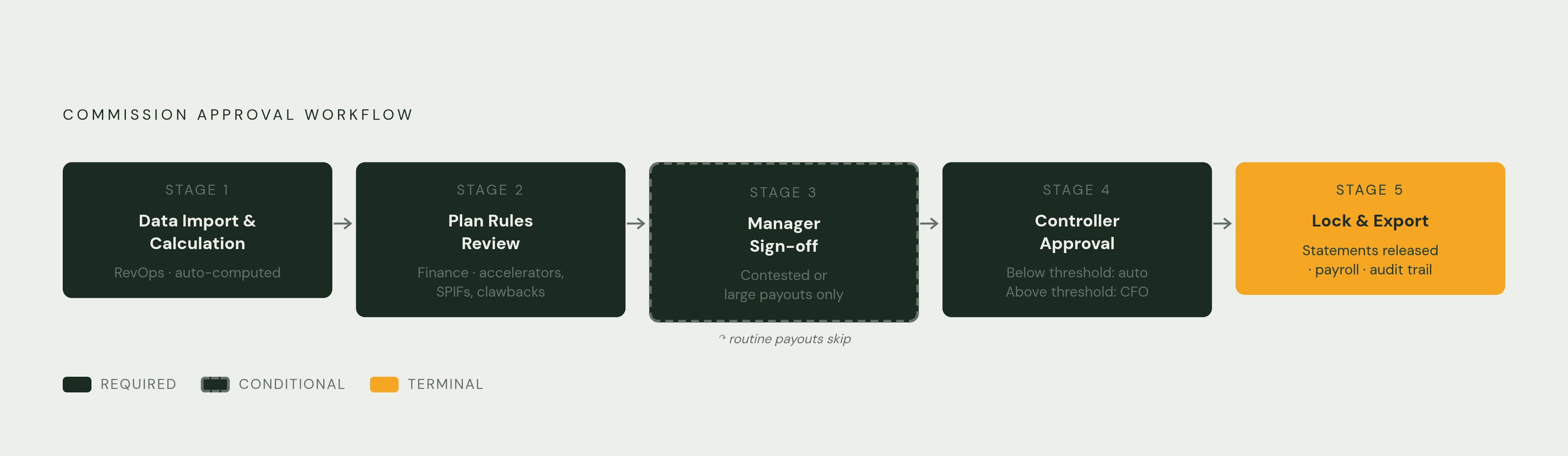
A commission approval workflow follows a sequential pattern for a reason: each stage has to complete before the next one opens, because downstream approvers depend on upstream decisions being settled and final. Sequential approval is the right structural choice when accountability is tied to order, and commission payouts bring high governance and high risk, so they qualify on both counts.
Stage 1 is data import and calculation. Deal data is pulled from the CRM, or uploaded via file if no integration exists, then compensation plan rules are applied and a draft payout calculation is generated. This stage belongs to RevOps or the commission calculator, and it should involve no manual formula editing at this point: the calculation comes from the system and gets logged as it's produced, not reconstructed by hand afterward.
Stage 2 is plan rules review. The Finance reviewer confirms that the correct plan version was applied, that accelerators, SPIFs, clawbacks, and tiered rates fired as the plan specifies, and that edge cases such as splits, retroactive adjustments, or new hires mid-period are documented. You should keep comments and supporting attachments in this stage's record, because a side email chain is hard to locate six months later.
Stage 3 is manager or sales leadership sign-off, and it's conditional: it applies only to contested deals or unusually large payouts. The sales manager or VP has to confirm quota attainment figures and deal attribution before Finance locks the record. Straightforward pay cycles can skip this step entirely, but contested deals or unusually large payouts require it before moving forward.
Stage 4 is Finance controller approval combined with threshold routing. Payouts below a defined threshold advance automatically once Stage 2 is complete. Payouts above the threshold route to the controller or CFO for a second review. This routing keeps senior Finance staff out of routine, low-risk payouts, but they still control the large ones.
Stage 5 is lock, statement generation, and payroll export. Once the final approver signs off, the pay period locks, so no further edits to that record are possible, and rep-facing payout statements are generated and released. The locked record and the export file both get preserved as part of the audit trail, so the number a rep sees on their statement matches what Finance can produce if that number is ever questioned later.
Each of these five stages needs a defined SLA attached to it: how many business days does a given approver have before the request escalates? If you don't build SLAs into the design from the start, requests sit untouched and the whole pay cycle slips, usually at the worst possible moment relative to the payroll calendar.
How threshold-based routing and conditional logic prevent approval bottlenecks
Approval levels should track risk and payout size, not just organizational hierarchy. If every commission payout routes through a CFO review, it creates a bottleneck that slows payroll without making the routine calculations any more accurate; it just adds a delay to the easy cases along with the hard ones.
Conditional routing changes the approval path based on predefined conditions. In commission workflows, the conditions that matter are payout size, whether an exception or manual adjustment was applied, whether the deal involves a split or multi-role credit, and whether the rep is in their first or last quarter of a plan year, since both edges of a plan year tend to generate more disputes than the middle.
A practical routing matrix illustrates the principle. A standard payout with no exceptions, sitting below the defined threshold, needs only Stage 2 Finance review before auto-advancing to lock once that sign-off is in place. A split-credit deal, or one with contested attribution, needs parallel review by Finance and sales leadership before it's allowed to advance at all, since a dispute over whose deal it was is a different kind of risk than a dispute over the math.
The strongest failure mode in this design is over-engineering the routing rules themselves. Conditional routing breaks down when the rules are poorly documented and nobody can explain why a particular payout went to a particular approver, which defeats the purpose of having an audit trail. The fix is to document every routing condition in plain language alongside the workflow configuration, and to validate that logic against a test batch before the first live pay cycle runs on it.
Escalation rules Finance teams must define explicitly
An approval workflow without defined escalation rules is only half built. The path for on-time, routine approvals covers one half of the design; the path for late, contested, or exception cases is what gets tested once real operating conditions set in.
Escalations should trigger on time delays, SLA breaches, or defined risk thresholds, not on someone remembering to send a manual follow-up email, since manual follow-ups are precisely what a working escalation design is meant to replace.
Three scenarios need to be defined in advance. An SLA breach occurs when an approver hasn't acted within the defined window; the system should automatically reassign the request to that approver's backup or notify their manager, without removing the original approver from the record, so the log reflects both the delay and how it was resolved. A dispute raised by a rep happens after statements are released but before the pay period locks in payroll; the workflow needs a formal dispute path specifying who receives the dispute, what documentation is required, what the resolution SLA is, and how the corrected calculation gets re-approved and logged before any adjustment reaches payroll. An exception or override request arises when a manager asks for a manual payout adjustment outside the plan's rules, such as a performance exception or a renegotiated split; this needs to route to the Finance controller and, where it's material enough, to legal or HR, with the reason for the exception logged as a named comment rather than left as just a changed number with no explanation attached.
Rejected calculations should return to the previous stage with comments attached, not restart the entire workflow from Stage 1. If a rework loop forces full resubmission, it slows the cycle down without adding any real governance benefit. The audit trail for escalation events matters just as much as the audit trail for approvals: timestamps, the named trigger for the escalation, the named resolver, and the resolution action all need to be captured in the same place.
What the audit trail must capture at each stage
A commission approval audit trail is only useful if it's immutable and complete. A log that can be edited after the fact, or one that captures only the final decision without the intermediate steps, cannot support a dispute defense or hold up under a compliance review, which matters more as pay transparency rules expand across jurisdictions.
The audit trail needs to capture the input data used in the calculation: the deal records, quota figures, the plan version applied, and the resulting output number. It needs the identity and timestamp of every approver action, whether that's an approval, a rejection, a comment, or an escalation trigger. It needs a record of any adjustments made between stages: what changed, who changed it, and the stated reason for the change. It needs the version of the compensation plan that was active at the time of the calculation, since plan changes mid-period have to be versioned rather than overwritten, or the historical record stops matching what was actually paid. And it needs the lock event itself: who locked the pay period, at what timestamp, and what the locked figures were at that moment.
Approval workflow software creates structured, trackable flows where every step is clearly defined, which is what gives Finance teams accountability and transparency they can point to when questioned. But Finance teams still have to verify, on their own, that the audit records are exportable, retained for a defined period, and access-controlled so that only authorized roles can view commission-level data. Permission controls on the audit trail itself carry their own weight here: who can see a given rep's statement, who can export the full audit log, and who can initiate an amendment all need to be defined as part of the workflow design, not left sitting at whatever the default system settings happen to be.
Designing the workflow first, then choosing the tooling to support it
The most common implementation mistake is selecting approval workflow software before the workflow itself has been designed. A tool can't make up for undefined stages, missing role assignments, or absent escalation rules; it will only automate the existing confusion faster and at greater scale.
General-purpose approval workflow tools, the kind built for invoice approvals, purchase orders, or procurement, tend to handle sequential and conditional routing well, but they aren't built around commission-specific data structures. They don't natively understand tiered rates, accelerators, clawbacks, quota attainment, or pay period locking, because those concepts simply don't exist in a procurement context.
Finance teams should check four things before they commit to a commission-specific platform. Does the platform maintain a complete, timestamped, immutable audit trail for every calculation and every plan change? Can it handle retroactive recalculations with version history preserved, so a mid-period plan change doesn't silently overwrite prior calculations? Is there a native CRM integration, or does reconciliation require a manual data export step, which tends to be the highest-risk handoff in the entire process? And does it include a rep-facing earnings portal, so payout statements are available to reps directly without Finance having to field individual queries one at a time?
Pricing structure matters for how Finance models this cost over time. Seat-based pricing penalizes a team for growing headcount, charging more simply because more people need to log in and check their own numbers. Quota Queue ties cost to the number of active compensation plans instead, so the price doesn't move just because the team adds reps who each need to see their own statement.
The sequencing principle holds regardless of which platform a Finance team eventually chooses. Map the five stages and assign role ownership first. Document the routing conditions and escalation rules second. Validate the logic against a test pay cycle third. Only then configure the tool to match the workflow that's already been designed, rather than letting the tool's defaults define the workflow by default.