Free and Low-Cost Commission Tracking Tools and Their Limits
Free tools shift commission costs from your invoice to errors, reconciliation, and lost rep trust.

Free commission tracking tools do not eliminate cost. They relocate it, shifting the bill from a monthly invoice to a slower accumulation of calculation errors, reconciliation hours, and rep distrust that appears on a budget line only after it has already become expensive. Three categories of free or low-cost tool exist for this job: general-purpose productivity software repurposed for commissions (spreadsheets, Airtable, Notion, Trello), platform-trapped affiliate tools built for e-commerce (GoAffPro, UpPromote, BixGrow), and purpose-built sales compensation platforms, which, notably, tend to offer no meaningful free tier. Each of the first two categories hits a different wall: spreadsheets break on accuracy and auditability, productivity apps break on complexity and automation, and affiliate tools break the moment a business context outgrows the narrow platform they were built for. Knowing which wall a given tool will hit, and roughly when, determines where the real cost appears and how large it becomes.
What spreadsheets actually do when commission calculations get complex
Spreadsheets remain the default tool for B2B commission tracking, and for good reason: a basic template covers employee names, sales data entry, commission rate columns, automatic calculations based on sales amount times rate, running totals by employee, period-over-period comparisons, and payment status tracking. That structure handles a small team with a flat rate and no exceptions just fine. The trouble starts exactly where the business gets more interesting: more reps, more plan tiers, more exceptions are the precise conditions under which a spreadsheet stops being reliable.
The weakness is that spreadsheets have no structural protection against the errors commission math invites. There is no audit trail either, so resolving a disagreement about who changed what, and when, depends entirely on memory and goodwill.
Worse, most of the errors that matter never announce themselves. The economics of getting it wrong are also lopsided: overpayments are close to unrecoverable, since asking a top performer to return money is both legally awkward and commercially self-defeating, so they tend to get absorbed quietly. Underpayments cost you more than the dollar amount involved, because a shorted rep stops trusting the statement and starts keeping a private tally.
Shadow Accounting: How Spreadsheet Errors Erode Rep Trust
A commission error does not stay contained to the pay period it occurred in. It changes how a rep behaves afterward, and that behavioral shift tends to cost more than the error itself. Once a rep stops trusting what finance sends them, the response is almost always the same: they build their own tracker outside the official system, logging deals, payout estimates, accelerators, exceptions, and expected earnings by hand. This habit has a name: shadow accounting.
The direct cost is time. The indirect cost runs deeper: once that pattern sets in, the relationship between sales and finance stops functioning as a partnership and starts functioning as an audit, with each side assuming the other is either wrong or withholding. Top performers have the most commission dollars at stake, which makes them the most likely to notice a discrepancy, the most likely to have other job offers, and therefore the most likely to leave when the math stops adding up. Losing the rep who caught it is not.
If platforms lock pay periods, log every approval step, and make the full commission calculation traceable, they close the information gap that forces reps into shadow accounting. Quota Queue, for instance, treats commission calculations as auditable by design instead of something you reconstruct after a complaint, so the finance-to-sales relationship looks more like collaboration than adversarial fact-checking.
Productivity Apps' Ceiling for Commission Tracking
Tools like Trello, Notion, and Airtable solve a real problem that flat spreadsheets do not: they give a team shared visibility into work in progress, with structure that a single grid cannot offer. Commission tracking, though, needs calculation logic, automation, and a live connection to sales data, and none of these three were built to provide that.
Trello's free plan includes unlimited cards, unlimited Power-Ups per board, unlimited storage with a per-file cap, a monthly limit on Workspace command runs, and caps on boards and collaborators per Workspace. It works well as a visual queue: columns for Inquiry, Quoted, Deposit Paid, In Progress, Awaiting Approval, and Shipped map cleanly onto pipeline stages. Client access compounds the problem: free-plan Workspaces are already capped on total people, and the single-board guest access that would let a client see just their own deal sits behind a paid Standard plan or higher.
Notion's free plan caps uploads at 5MB per file, keeps only 7 days of page history, and lets you add just 10 external guests. The 5MB upload limit is also a real constraint for any team that wants to attach deal documentation directly to a record.
Airtable goes further structurally: its free tier caps records per base, limits attachment storage, keeps two weeks of revision history, and allows up to 5 collaborators with Editor or Creator access, plus a capped number of commenters and unlimited read-only viewers. Every export reintroduces the same staleness problem the original spreadsheet had.
Limits of Platform-Specific Affiliate Tools (GoAffPro, UpPromote, BixGrow)
Affiliate commission tools solve a different problem than internal sales compensation, and you need to grasp that before you try to rank the tools against each other. Their free tiers are often generous for what they are built to do: tracking commissions owed to external partners based on referral links and coupon codes.
GoAffPro's free "Hobby" plan includes unlimited affiliates, unlimited revenue tracking, a branded affiliate portal, basic analytics, PayPal Payouts support, native integrations with Shopify and WooCommerce, and email support. For a simple Shopify affiliate program, that is a functional, complete setup. It is not designed to handle internal sales rep compensation with tiered rates, accelerators, clawbacks, or deal data pulled from a CRM, and GoAffPro's own paid tiers make the boundary explicit: multi-level commission structures sit behind the $49/month Premium plan, and fraud management tools along with custom compensation plans require the $99/month Business plan.
UpPromote caps its free usage at 200 affiliates, and it lacks the fraud detection and more advanced tracking found in its paid tiers. That is a cost that scales with revenue rather than staying flat, which matters for budgeting in a way a fixed monthly fee does not. Like GoAffPro, UpPromote is built entirely to track affiliate partners, not internal sales reps.
BixGrow's free Starter plan includes email automation and a marketplace listing that helps attract affiliates, but it caps out at 30 affiliates and 50 orders per month, limits that matter even for a small program.
The shared limitation across all three tools is structural rather than a matter of generosity or feature count: they are not built to connect to a CRM, apply tiered accelerators, handle clawbacks, produce payroll-ready exports, or support manager approval workflows. Those are the exact things internal sales compensation requires, and no amount of free-tier generosity changes what the tool was designed to do.
The CRM integration gap that every free tool shares
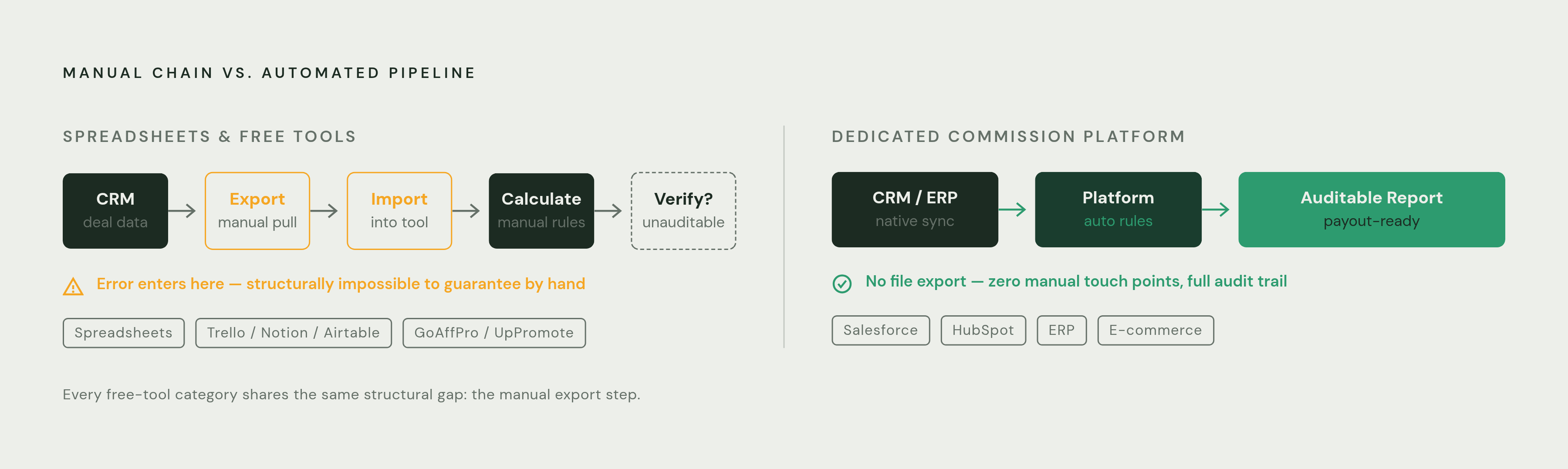
Spreadsheets, productivity apps, and affiliate tools diverge in almost every other respect, but they share one gap that explains why all three eventually become expensive in ways that are hard to see coming: none of them connect natively to a CRM. Every one of them requires a manual export step between where deal data actually lives and where the commission math happens, and that export step is where errors get in and auditability falls apart.
What dedicated commission software does differently, at its core, is connect to the systems where deal data already lives, whether that is a CRM like Salesforce or HubSpot, an ERP system, or an e-commerce platform, and pull closed deal data automatically, apply pre-set commission rules, and produce an auditable payout report without anyone exporting a file. Without that connection, every calculation cycle depends on someone exporting from the CRM, importing into the tracking tool, and confirming that nothing in the CRM changed between the export and the calculation. That confirmation is structurally impossible to guarantee by hand.
Retroactive edits to CRM records are the specific pattern that catches most finance teams off guard: a deal gets amended after the export was already taken, a territory gets reassigned mid-quarter, a refund processes after payroll cut-off. None of these produce an error message in a disconnected tool. They produce a wrong number that looks exactly as valid as a right one. A finance team working from multiple spreadsheets or disconnected tools has no way to verify its own output. The team either accepts the numbers on faith or burns days rebuilding the analysis from scratch to check it.
The Transition to Dedicated Commission Software in Practice
Moving off spreadsheets and disconnected tools does not mean you tear down existing workflows overnight. It is a structured process with a reasonably predictable shape, and knowing that shape removes the main reason teams stay on free tools longer than the cost actually justifies.
A purpose-built commission platform does four things a free tool structurally cannot do. It handles plan definition, encoding rules, rates, tiers, accelerators, and eligibility criteria in a structured system instead of a nested IF formula that one typo can break. It handles crediting and attribution, with logic that is logged and reviewable rather than argued about after the fact, answering the question of which rep, manager, team, or overlay gets credit for a given deal, which is the source of most commission disputes. It applies commission calculation automatically against CRM, ERP, or billing data with no manual export step in between. And it routes results through an approval workflow, so calculations pass through manager, RevOps, and finance review before pay periods lock and results export to payroll.
The discovery value of that structure is visible in the case of an AgencyBloc insurance agency client, where one customer identified 14 Medicare Advantage policies that had gone unpaid in January alone. That single finding covered the software's entire annual cost. It is a result that is structurally impossible to produce with a spreadsheet, because a spreadsheet has no automatic mechanism for cross-referencing policy data against payment records to catch what was missed. Integration depth is the variable buyers need to look at closely during a transition: whether a platform connects to the CRM natively, through a documented API, through file transfer, or through middleware changes how reliable the data pipeline actually is. Before committing, test the complete cycle, including error handling, data refreshes, corrections, and reconciliation, treating a demo's happy path as insufficient evidence.
Criteria for Evaluating Commission Software
Knowing why free tools fail only helps if it turns into specific criteria for what to require from a paid alternative. The failure points covered above translate directly into a checklist.
CRM integration depth comes first: does the platform connect natively to the CRM where deal data already lives, or does it still require a file export? Native or well-documented API integration is the baseline for eliminating the manual-export failure mode that every free tool shares.
Plan complexity support comes next: can the platform handle tiered rates, accelerators, SPIFs, clawbacks, and territory splits without custom code or workarounds bolted on after the fact? Commission plans are rarely as simple as a flat percentage, and software that forces a team to simplify its plan just to fit the tool hands the complexity cost right back to finance.
Auditability and approval workflows matter just as much: can pay periods be locked? Is there a logged trail showing who reviewed and approved each calculation? These are the features that make commission data defensible in a dispute and usable in an audit, something a spreadsheet cannot provide no matter how carefully it is built.
Rep visibility is the direct fix for shadow accounting: can individual reps see their own earnings, quota progress, and deal-level statement detail in real time? Without that visibility, reps will keep their own private trackers regardless of what system the company has bought.
Security treatment of commission data deserves the same scrutiny as payroll data, because that is functionally what it is: encryption in transit and at rest, access control scoped to the organization, and a clear policy on whether customer data gets used for anything beyond the calculation itself.
Pricing model is the criterion that most directly separates tools built for growing teams from tools that punish growth. With per-seat pricing, every new hire raises the bill, whether or not that hire changes the complexity of the compensation plans in use. A platform priced by the number of active compensation plans, rather than by headcount, keeps costs predictable as a sales team scales, which is the structural answer to the question of how to avoid paying more for commission software every time a new rep joins.
Quota Queue is one platform built around these specific criteria: it imports deal data through a CRM connection and plan documents through file upload, builds and reviews compensation plans with AI-assisted extraction, configures tiered rates, accelerators, SPIFs, and clawbacks, and locks, approves, and exports results for payroll. It is priced by the number of active compensation plans rather than by seats, encrypts data in transit and at rest, keeps tenancy scoped to the organization, logs audit trails, and does not use customer data to train its models. None of that makes the free-tier options covered earlier the wrong choice for the teams they fit. It just marks where those tools stop being enough, and where the criteria above become the standard you should measure any paid alternative against.