Payroll Export Requirements for Commission Software Output
Export design determines whether commission payouts survive audit and payroll scrutiny.
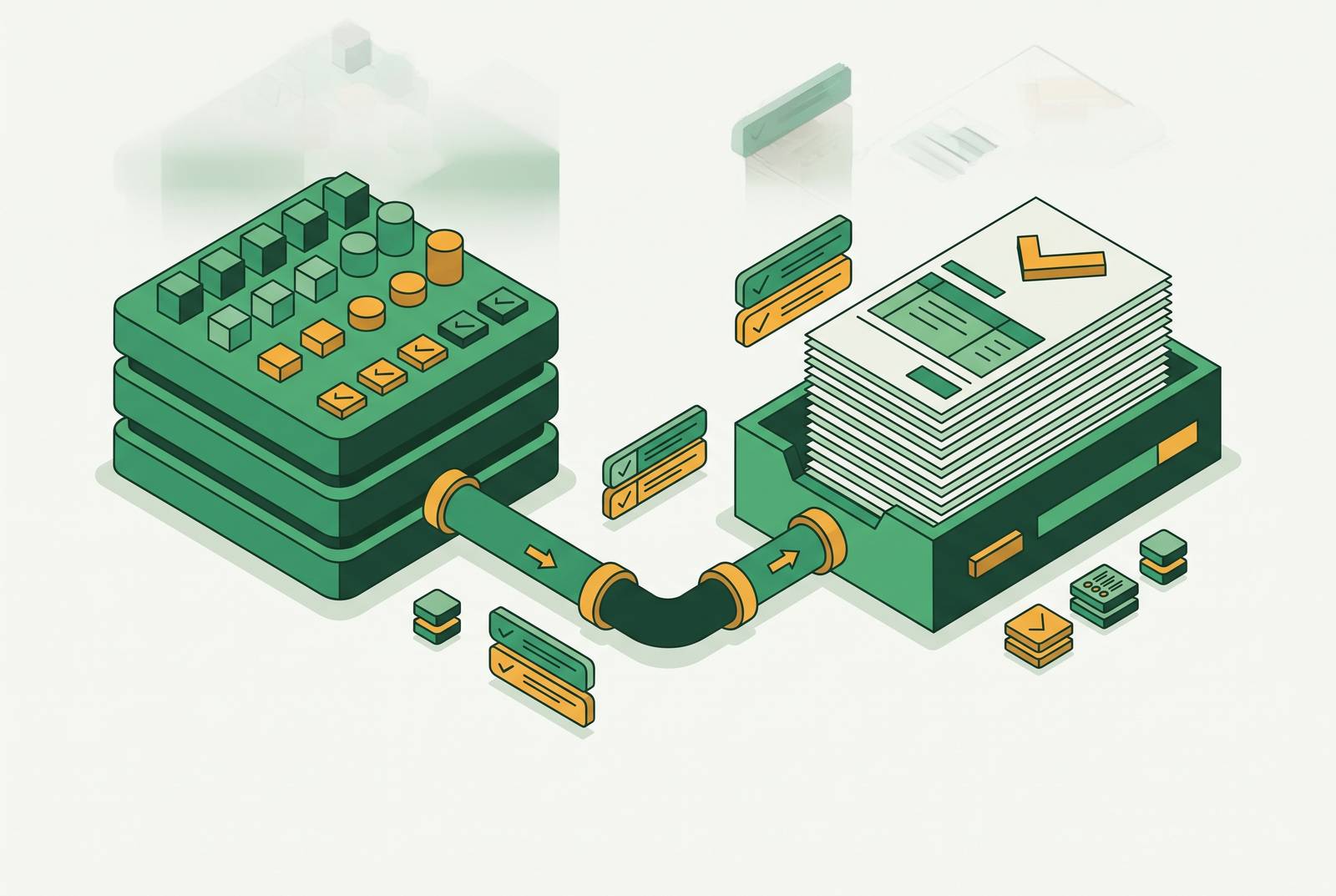
The payroll export is the moment a commission calculation either proves itself or fails in front of the people who have to act on it. A payout figure that cannot be traced back to a deal, a rep, or an approval record is a liability sitting in a payroll system waiting to be questioned.
Most finance and RevOps teams treat the export as the last five minutes of the commission cycle, a formality after the real work of calculating rates and tiers is done. In practice, the export is the constraint that determines how the entire process has to be built upstream. The file has to satisfy a payroll platform's field requirements, a finance team's audit standards, and compliance obligations that don't bend to accommodate a sloppy handoff. That handoff crosses organizational and system boundaries at the same time: commission software on one side, payroll software with its own formats, timing windows, and ingestion rules on the other, and finance and compliance sitting in between with their own non-negotiable requirements.
When something goes wrong at this stage, the damage is not a quick fix. The export is where every shortcut taken earlier in the cycle becomes visible and expensive.
Commission plan structure and export file requirements
The fields a payroll export has to carry are set long before anyone builds the export. They come from the shape of the commission plan itself. A flat-rate plan, where every rep earns a fixed percentage with no tiers or conditions, produces a simple output: one payout line per rep per period. That is the easiest case a commission system will ever handle, and it tells you almost nothing about whether the system can handle anything harder.
Tiered and accelerator plans raise the requirement immediately. The export now needs rate-tier identification and threshold-crossing detail, so payroll and finance can look at a number and confirm it matches the plan's own logic rather than taking it on faith. Gross-margin plans add another layer: the export needs deal-level cost data, not just revenue, because the commission itself depends on margin, not top-line sales. Residual and renewal commissions, common across SaaS, telecom, and insurance, push further still. These structures require multi-period tracking that a single monthly payroll file was never built to hold. The export has to carry period identifiers and links back to prior periods so a renewal commission paid in month six can still be traced to the contract signed in month one.
SPIFs and one-time bonuses need their own flag in the export, distinct from regular commission, so payroll can apply the right tax treatment and route the amount to the right general ledger code. Splits and overlays complicate things further by requiring the export to carry not just an amount but an attribution, specifying which share belongs to which rep, which manager, and which overlay role. None of this is a software configuration detail. It is a direct consequence of how the plan was designed, and a plan written without the export in mind will eventually run into a file that cannot carry what the plan requires.
What payroll systems need to receive commission data correctly
A commission export is a structured input to another system, and that system has its own expectations about format, field mapping, and timing that have nothing to do with how the commission platform prefers to organize data. A mismatch between what the commission system sends and what payroll expects produces one of two outcomes: outright rejection of the file, or worse, silent miscalculation that nobody notices until a rep complains about their check.
Payroll platforms typically need a defined set of fields to process commission data correctly. The employee identifier has to match the payroll system's own ID for that person, not the contact ID the CRM happens to use. An earnings type code has to distinguish commission from salary, bonus, SPIF, and clawback, since each of these gets taxed and coded to the general ledger differently. A pay period identifier has to reference the locked period the payout belongs to, not simply the date the file happened to be exported. The gross payout amount needs to arrive in the currency and decimal precision payroll expects, and a cost center or department code has to travel with it for GL allocation and finance reporting. Some payroll platforms also require an explicit approval flag, an indicator that the payout has been locked and signed off, before they'll ingest variable pay.
Format matters as much as content. CSV and flat-file exports remain the most widely accepted way to get commission data into payroll, but platforms with direct API integrations can accept structured payloads, which cuts down on the manual field-mapping errors a flat file invites. Timing is just as rigid: payroll cutoff windows are fixed dates, not suggestions, and commission data that arrives after that cutoff either misses the pay cycle entirely or forces an off-cycle run, both of which create downstream headaches for reps and for finance.
Why deal-level attribution must survive the aggregation step
Payroll only needs a single number per rep per period. Finance, audit, and compliance need far more than that, and a commission process that discards deal-level detail on its way to that single number cannot reconstruct it later no matter how much time gets thrown at the problem.
With deal-level attribution, you can trace every commission line back to a specific deal, contract, or renewal event recorded in the CRM. And it means the period in which the deal was credited stays locked, so no one can quietly shift a deal from one period to another without leaving a logged record of the change.
This matters beyond internal tidiness. Under ASC 606 (specifically ASC 340-40), incremental costs of securing a contract, including sales commissions, have to be capitalized and amortized rather than expensed all at once. Stripping that detail out during aggregation leaves finance with no way to comply with the standard.
When deal-level detail goes missing, finance teams have to rebuild it by hand from CRM exports and spreadsheets every single close cycle, and that reconciliation task gets heavier as the team grows and the plan gets more complex. The sharpest consequence appears in an audit. A flat per-rep total with no provenance behind it cannot survive a SOX audit or an internal controls review. Every payout number needs a traceable path running from the original deal to the final payment, and that path has to be intact before the export ever leaves the building.
The audit trail and period-lock requirements finance teams need before approving a payout
Finance cannot authorize a commission payout for payroll on the strength of a number alone. The export has to come with, or embed, evidence that the number was approved, the period was locked, and every change along the way was recorded, because without that evidence the figure is not defensible to anyone who later asks where it came from.
A finance-ready audit trail needs several specific elements. A calculation timestamp records when the commission figures were computed and from which data snapshot they were drawn. An adjustment log captures any correction made after the initial calculation, along with who made it, when, and why. The approval chain needs to show manager, RevOps, and finance sign-offs with their own timestamps, each identifying who actually reviewed the number, rather than a single generic "approved" flag.
Period locks exist to prevent retroactive changes to a pay period once it has closed. For companies approaching public markets or facing external audits, the ability to produce a complete, timestamped record of every calculation and approval for a given period has become close to a baseline expectation rather than an advanced feature.
How spreadsheet-based commission processes collapse at the export stage
Spreadsheet-based commission processes tend to fail at exactly the export stage, because the act of aggregating numbers for payroll is the same act that destroys the deal-level detail and audit evidence described above. The failure is built into how spreadsheets work.
Formula drift is the clearest example. Industry research on spreadsheet-based commission processes puts the error rate at nearly 80% of companies making commission mistakes this way, and the mechanism is simple: any user with edit access can overwrite a formula cell in a shared commission spreadsheet without triggering any warning. Manual transfer compounds the risk. When someone copies numbers out of a spreadsheet and into payroll software, that is the exact moment a second, independent error opportunity opens up, on top of whatever errors the spreadsheet itself already contains.
Spreadsheets also have no native mechanism for locking a period once it's approved. A correction made the day after payroll runs leaves no trace and cannot be distinguished from the original number. There's no way to tell, months later, whether a figure was right the first time or quietly patched afterward. Approval, in most spreadsheet workflows, is an email thread or a verbal nod, neither of which constitutes a timestamped, traceable record that would hold up under review. And when the spreadsheet finally aggregates into per-rep totals, the deal-level rows that produced those totals usually live on a separate tab or get deleted outright, leaving the number that reaches payroll with no way back to the deals that generated it.
CRM data quality and its effect on the payroll export
A commission export is only as accurate as the CRM data that feeds it. Garbage deal records, missing close dates, wrong owner assignments, and opportunities stuck in the wrong stage all produce commission calculations that are wrong before any compensation rule even gets applied.
A handful of CRM fields determine export accuracy more than any other part of the system. Deal owner and split assignments, if entered incorrectly, send commission credit to the wrong rep, and the export carries that mistake straight into payroll with no way to catch it downstream. Renewal and upsell flags matter just as much for residual and expansion commission structures, since a missing or inconsistent flag causes either a missed payout or a duplicate one.
A serious commission software implementation defines integration rules before go-live rather than treating them as a post-launch fix: field mappings, record ownership, how often data refreshes, how errors get handled, and what the reconciliation procedure looks like. Validation needs to run before every export cycle, not just once at setup. That means running sample calculations against deals with known outcomes, running parallel calculations against the prior period's actuals, testing edge cases like splits, ramps, and terminations, and getting finance sign-off on the reconciliation before the file moves anywhere near payroll.
The security and access controls the export layer requires
A commission export file is compensation data. It holds individual earnings, deal-level revenue detail, and organizational structure information, and it needs to be protected in transit, at rest, and through access control the same way any sensitive financial record would be, not treated as a routine report that anyone on the team can pull.
That protection has to show up at several specific points. Files moving from the commission system to payroll need encryption both in transit and at rest; an unencrypted CSV emailed between two systems is a data exposure risk in plain terms, not a hypothetical one. Access to the export function itself should be limited to authorized finance and RevOps roles, and a sales rep's ability to view their own commission statement is a separate, narrowly scoped permission that has nothing to do with access to the full export file. If your organization operates across multiple entities or regions, export access needs to be scoped to the entity a given user is actually authorized for, so a regional manager in one market cannot pull commission data belonging to a different region. The export action itself needs its own audit trail, logging who exported which period's data, when, and to what destination, separate from the audit trail covering the calculations inside the file.
SOC 2 Type II compliance has become close to a baseline expectation for commission software that handles export-ready compensation data, because this is the point where data crosses from the commission system into payroll. Organizations operating across jurisdictions with data localization requirements also need to account for data residency rules when designing where that export path runs and where the file is allowed to sit.
What commission software must provide for export capabilities
You need to scrutinize a commission platform's export capability as closely as its calculation engine. Format flexibility, attribution depth, governance controls, and integration with the payroll systems already in use matter far more than how the dashboard looks.
Start with field-level format flexibility: can the export be configured to match a payroll system's exact requirements, down to employee ID format, earnings type codes, and decimal precision, or does the platform only produce a fixed template that payroll then has to work around? Check whether deal-level attribution survives into the export record, so every payout can be traced back to the deal that produced it, or whether the platform only outputs a per-rep total with nothing behind it. Ask whether period locks are actually enforced by the system, preventing retroactive changes to a closed period, rather than left as a policy someone has to remember to follow. Ask what the audit trail looks like at export time: whether calculation timestamps, rule versions, and approval chains travel with the file or have to be reconstructed separately. And ask what security controls govern the export function itself, from encryption to role-based access to logging of the export action.
A platform that cannot answer these questions clearly is not ready for the handoff that the entire commission cycle exists to produce, because these requirements are what let a payout survive contact with payroll, finance, and an auditor.