RevOps Ownership of Commission Operations
RevOps should own commission operations because it spans all three layers of the calculation.
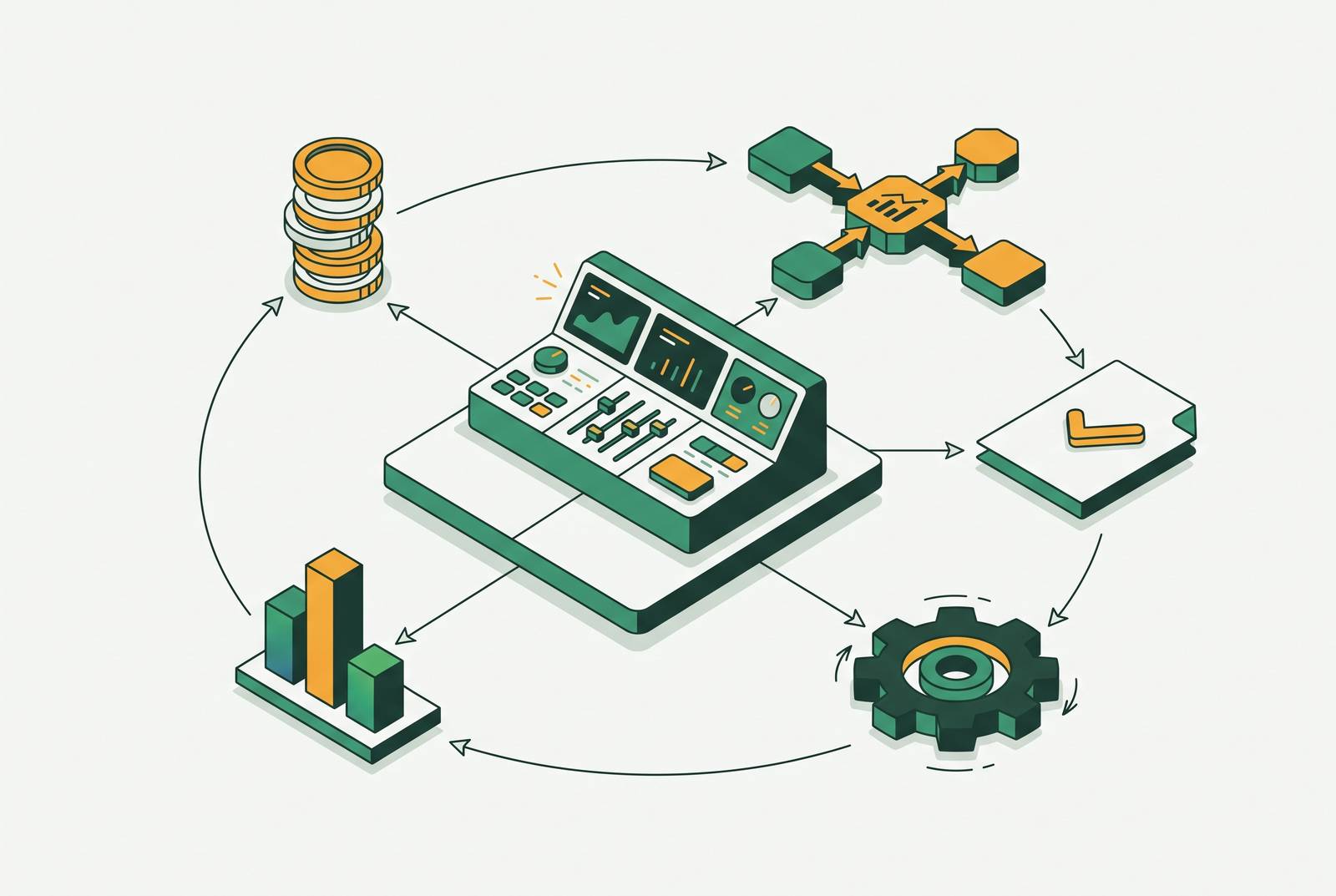
Commission operations sits in the wrong place at most companies, and the misplacement is structural. It is the one workflow that touches all three domains RevOps exists to connect: CRM data, Finance's approval cycles, and the behavior of reps on the sales floor. Sales Ops owns quota-setting and keeps the CRM clean, but Sales Ops reports into the VP of Sales, the CRO, or a centralized RevOps leader depending on the org chart, and its authority runs out at the edge of the sales team. Finance owns the approval of payouts, yet it has no way to check whether the CRM data behind a payout is clean or whether the deal was credited to the right rep. RevOps is built differently: it spans the full revenue lifecycle and is meant to run independently of any one department, which puts it in the unusual position of holding working relationships with all three sides of a commission calculation at once.
Wherever commission ops lands determines where the failures appear: park it in Sales Ops, and Finance approval turns into a handoff that nobody manages end to end. Park it in Finance, and CRM data quality becomes somebody else's concern, which in practice means nobody's. RevOps is the only function positioned to own the connective tissue between those layers rather than just one end of it. RevOps already unifies process, data infrastructure, and technology across sales, marketing, and customer success. Commission operations just asks for those same three capabilities applied to a single, high-stakes workflow: the one that determines what a rep gets paid.
What RevOps owns across the revenue lifecycle
RevOps is typically described through four pillars: Plan, Perform, Pay, and Performance. Those four map onto the commission lifecycle almost exactly. RevOps already controls the upstream inputs that decide whether a commission number comes out right. Pay is not an adjacent concern bolted onto RevOps from the outside. Pay is one of the four pillars by name, so commission operations is a named, central part of the RevOps mandate rather than a side project.
Look at what RevOps managers already do day to day: lead territory and quota planning, run forecasting workflows, and administer commission plans. That settles the debate over whether RevOps should own commission ops, since RevOps already owns the inputs that feed it. Quota models are the denominator in every commission calculation. Whoever builds and maintains the quota model is, in effect, already halfway to owning the commission calculation that depends on it.
The trouble starts when that logic isn't followed through. RevOps frequently ends up owning the upstream inputs, the CRM, the quotas, the territories, while a separate team owns the downstream output, the actual payout. That split is where handoff failures start, and handoff failures are what drive commission disputes. A quota model that RevOps built and trusts is only useful if it feeds directly into the calculation that pays the rep. When the two are split apart, every dispute becomes a forensic exercise in figuring out which team's data was stale.
How the plan-to-pay process breaks down without end-to-end ownership
Picture the typical setup at a mid-size sales organization. Payout calculations happen in yet another tool, or another spreadsheet, maintained by whoever had the bandwidth that quarter. None of these four systems talk to each other in real time, and none of them are reconciled against one another on any regular cadence.
That is the condition under which plan-to-pay breaks down at every handoff, not occasionally but as a matter of course. An accelerator is supposed to trigger once a rep crosses a specific quota threshold, but the plan document and the calculation tool disagree on what that threshold is, so the payout comes in wrong and nobody can say why until someone manually walks the math back through four separate files.
The same pattern appears in territory design. Commission calculations built on siloed inputs fail for the identical reason: each team protects its own data, and the cross-functional view that would catch the error before it reaches a paycheck never exists.
The commission dispute rate is a signal worth watching the way a health metric gets watched. A rising dispute rate says one of three things: the comp plan has gotten too complicated for anyone to calculate by hand or verify at a glance, the CRM data feeding the calculation is dirty, or the payout process is too slow to catch errors before they compound. Each of those three conditions also predicts rep attrition. Commission disputes are an early warning sign for turnover long before the turnover numbers themselves move.
What a CRM-anchored, single-source-of-truth commission workflow looks like
The real fix is anchoring every commission input, quotas, deal data, crediting rules, payout math, to the CRM, so that all of it draws from a single source of truth rather than four systems that each claim to be authoritative.
Quota setting is the clearest place to start. Instead of taking a board-level growth number and dividing it across headcount, a bottoms-up model builds each rep's quota from what the CRM shows is actually achievable, territory by territory, then aggregates those numbers up to the company target. The resulting quota is one that both Finance and the sales floor can trust, because every piece of it traces back to a number in the system rather than a top-down assumption. That traceability matters enormously when a rep disputes a number, because the quota is a figure built from data that's still sitting in the CRM, not a guess anyone has to defend from memory.
The same logic extends to the moment a deal closes. Crediting and attribution rules belong inside the system itself, encoded as logic the CRM enforces, rather than written down in a comp plan document that a calculation tool never actually reads. Ambiguous crediting rules are the single biggest driver of commission disputes, and encoding them removes the ambiguity at the source rather than resolving it after the fact.
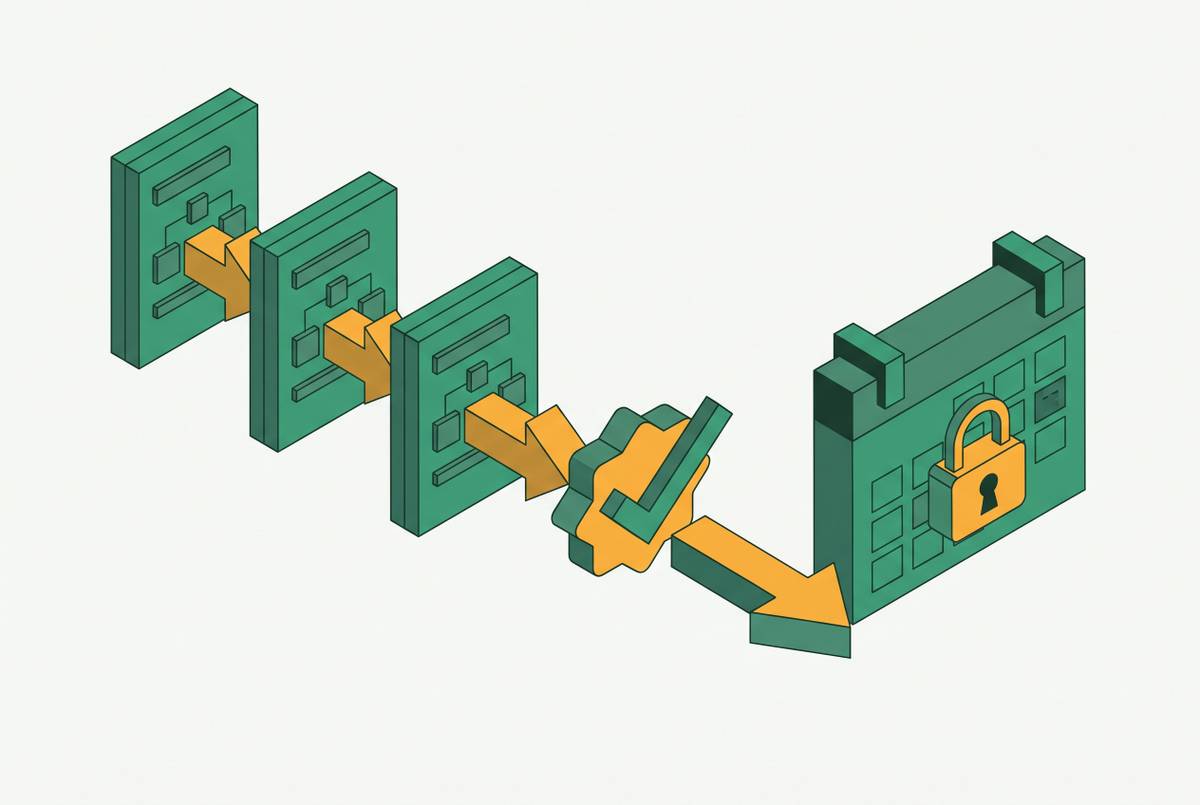
A functioning commission workflow runs through six stages: plan definition, covering rules, rates, tiers, accelerators, quotas, and SPIFFs; crediting and attribution; the calculation itself; an approval workflow that routes results through RevOps and Finance review; rep-facing statements; and reporting and variance analysis, covering accruals, reconciliation, forecasting, and an assessment of how well the comp plan is actually working. RevOps is positioned to build and run this whole sequence because it already owns the CRM data layer, the quota model, and the standing relationship with Finance that approval routing depends on. Plan definition is a joint effort between RevOps and Finance. Calculation validation belongs to RevOps alone. Finance approves the output. That division is clean and traceable, and it sets up how the Finance partnership needs to work in practice.
How RevOps structures the Finance partnership for commission approvals
RevOps taking ownership of commission operations does not strip Finance of approval authority. It changes what Finance is approving. Instead of a spreadsheet that has to be re-verified from scratch every pay cycle, Finance's review is fed by data that has already been structured and checked.
Consider the failure mode under Finance-owned commission ops as it typically runs today. Finance receives a payout file it did not build, generated from data it has no way to interrogate directly, and is left with two options: approve it on trust, or spend days re-deriving the calculation by hand to confirm it's right. Either path is a problem. The second is exactly the kind of bottleneck that delays payroll and leaves reps waiting on money they've already earned.
The RevOps-owned alternative runs the calculation against CRM data under locked rules, produces a structured output with a full audit trail attached, and routes that output to Finance for approval with every input visible and checkable. Finance approves faster in this model because it trusts the inputs, not because the review is any less rigorous. RevOps operates independently of both sales and marketing because business priorities set by a single department distort cross-functional optimization, and that independence is why Finance is more willing to hand over calculation ownership. Neutrality is the thing Finance is actually buying when it delegates.
A clear division of responsibility keeps the arrangement from drifting: RevOps owns plan interpretation, source data validation, and running the calculation itself. Finance owns final approval and the release of payroll. Locked pay periods and a logged approval trail make the whole arrangement auditable after the fact, so Finance can show exactly who approved which calculation, against which data, on which date. That same audit trail does double duty on compliance. A RevOps-owned, auditable commission workflow produces the documentation those laws require as a natural output of running the process correctly.
Treating commission data with the same security and governance rigor as payroll data
Commission data carries three overlapping kinds of weight at once: it is personal earnings data, it is financial reporting logic, and it is variable pay documentation. Each of those three carries its own compliance exposure, and RevOps taking ownership of commission operations means taking on all three. Personal earnings data brings GDPR considerations into scope. Financial reporting logic is relevant to financial-controls regulation for any public company. Variable pay documentation now falls under state-level pay transparency law.
Variable pay documentation deserves particular attention, because it has moved from an HR courtesy to an actual compliance obligation. None of these laws currently require a company to document its commission plan's calculation methodology up front, but the direction of travel is toward more disclosure, not less, and a RevOps-owned system that already produces a clean audit trail is far better positioned to meet whatever comes next than a system built on spreadsheets with no version history.
Access control follows the same logic that governs payroll systems generally. In a commission platform, role-based access is not a nice feature, it's a governance baseline: reps see only their own statements, managers see their own team, RevOps admins configure the underlying rules, and Finance approvers review and sign off, with each role restricted to its own defined scope. SOC 2 attestation matters for the same reason it matters in payroll and HR procurement: enterprise deals can stall out entirely if a vendor can't produce recent attestation, and RevOps teams evaluating commission platforms should treat that attestation as a gate a vendor has to clear, not a feature to weigh against others.
What rep-facing transparency requires from the RevOps-owned commission system
A commission system that RevOps trusts internally but that reps can't actually see into has not solved the underlying problem it was built to solve. Rep-facing transparency is the real test of whether RevOps ownership is working, because the rep is the person the whole system is ultimately calculating a number for.
Shadow accounting, reps keeping their own private spreadsheet to track what they believe they're owed, is the clearest sign that the official system has lost the room, a sign of opacity where reps don't trust a number they can't trace and so build their own version they can. Accuracy and explainability are not the same thing. A calculation can be completely correct and still fail, because a rep who cannot trace their payout back to the specific deals and rules that produced it will not believe the number regardless of whether it's right. Distrust behaves like inaccuracy in terms of its effect on engagement and, eventually, on attrition.
What transparency actually requires is concrete: a self-service portal where a rep can see current earnings, progress against quota, deal-level detail behind every statement line, and the specific rules that produced each calculation, available at any point in the cycle rather than delivered as a PDF once a month. Real-time visibility changes behavior on the floor. A rep who can see exactly where they stand against an accelerator threshold in the final week of the quarter will make different closing decisions than one who finds out only after the payout lands. Treating the commission dispute rate as a RevOps health metric makes RevOps accountable for whether reps trust the system, not only for whether the calculation is technically correct, and that accountability is what drives the design decisions that make transparency real rather than aspirational.
Evaluating commission software as a RevOps infrastructure decision
Commission software bought as a convenience tool for sales will not hold up against what RevOps actually needs from it. The evaluation has to treat it as revenue infrastructure, judged by the same standard applied to a CRM selection or a data warehouse decision, because that is functionally what it is.
A defensible platform, from a RevOps standpoint, needs a plan builder that can handle accelerators, decelerators, caps, SPIFFs, clawbacks, and tiered rates applied with precision across the board. Role-based access control, encryption standards consistent with payroll systems, and current SOC 2 attestation belong on the requirements list from the start. A system that can't produce a full audit trail on every calculation and every change isn't a system RevOps can defend when Finance, a rep, or a regulator asks how a number was reached.
Judged against those criteria, the choice of commission platform stops looking like a sales-team convenience purchase and starts looking like what it actually is: a piece of core revenue infrastructure, evaluated with the same rigor applied to any other system that RevOps is going to be accountable for five years from now.