Commission Calculation on Net Profit vs Revenue
How you define the base changes what reps chase and what finance owes.
Most comp plan conversations spend their time on rates and quotas. What gets less airtime is the question underneath both: what exactly are you paying commission on? That omission shapes rep behavior, margin outcomes, and how much administrative pain finance absorbs six months later.
Quota attainment slipped from 66% of reps hitting quota in 2022 to 51% in 2024. I don't read that as a rounding error in a survey nobody opens. It means the mechanics of a comp plan, not just the rate printed on the offer letter, now carry real weight in whether a rep hits her number at all. Whether a company pays commission on revenue or on profit decides what a rep chases, how finance reconciles what's owed, and how much damage one aggressive discount does before anyone notices.
How revenue-based commissions work and why they became the default
The mechanics are about as plain as compensation gets. Take a fixed percentage, apply it to the total value of a sale, done, regardless of what the deal cost to deliver. Commission equals rate times deal value. No cost inputs, no margin math, nothing else to look up.
That simplicity explains why revenue commissions took over the market. They're easy to explain in an offer letter, easy for finance to audit, and easy for a rep to work out in her head before she's even left the customer's parking lot. Most revenue-based plans pass a basic test without trying: can she figure out what she's owed without opening a spreadsheet or calling payroll?
The model also tracks with what a rep actually controls. She negotiates price and gets the signature. She doesn't set cost of goods sold, staff the delivery team, or manage what happens to margin after the ink dries. Paying her on the number she influences, rather than one she never touches, has an obvious logic to it. In SaaS specifically, the going rate for an account executive's commission sits around 11.5% of bookings at quota, with most plans landing between 11% and 14%.
What the model never resolves is profitability. A $100,000 deal sold at a high margin pays the same commission as a $100,000 deal sold at a low margin, because the formula never looks at margin in the first place. That's a rounding error when every product in the line shares roughly the same cost structure. The moment it doesn't, it becomes an expensive blind spot, and a lot of finance teams find out the hard way.
What "commissionable revenue" actually means — and why the definition produces disputes
"Deal value" sounds like a single number. It isn't. Ask five finance leaders what counts as the commissionable base on a multi-year contract and you'll likely get five different answers: total contract value, annual recurring revenue, or just the first year's booking.
Net-new versus expansion revenue raises the same fork. Does a rep earn the same rate for growing an existing account as she does for landing a brand-new logo? Some companies say yes, revenue is revenue. Others say no, a new logo is harder to win and should pay more. Then there's everything riding alongside the deal itself: services fees, discounts, refunds, implementation charges. Inside the commissionable base or outside it? The plan document either answers that before the deal closes, or somebody finds out the hard way at payout time.
This is where most commission disputes actually start. The arithmetic, once the inputs are pinned down, is trivial, multiply a rate by a number. The argument is always about what the number is. "Revenue-based" isn't one model. It's a family of them, and an undocumented version of any member of that family carries just as much risk as a fully built-out profit plan. Simplicity on paper means nothing if nobody wrote down what the base actually is.
How gross margin and net profit commissions are calculated
Gross margin commission starts with a subtraction most people learned in an accounting class and never think about again: revenue minus cost of goods sold, divided by revenue, gives gross profit margin as a percentage.
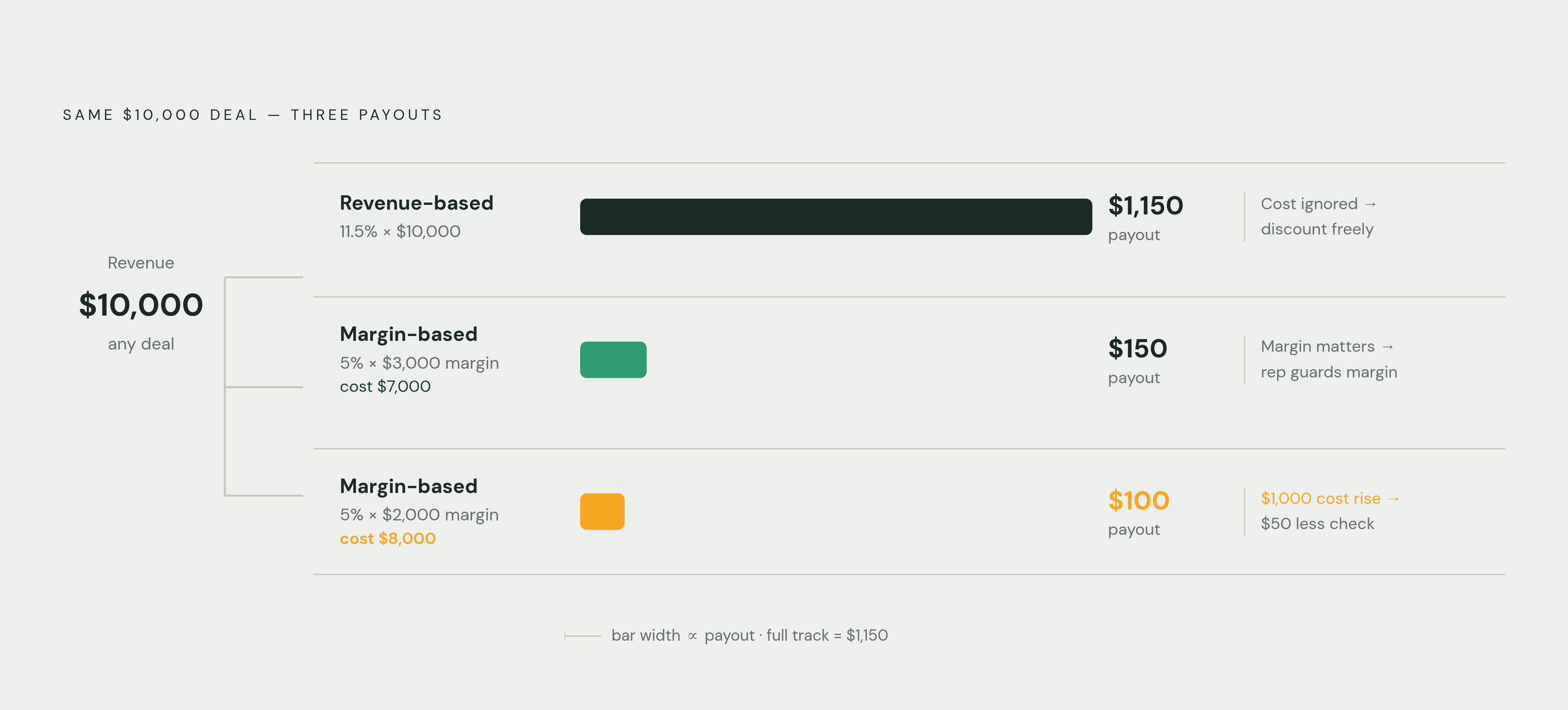
Run the numbers on a real example. A $10,000 job with $7,000 in direct costs leaves $3,000 in gross profit, a 30% margin. At a 5% commission rate on that margin, the rep earns $150. Take a second $10,000 job, same top line, but direct costs climb to $8,000. Gross profit drops to $2,000, and at the same 5% rate, the payout falls to $100. Same revenue, same rate, different check, because the cost structure moved and the commission followed it down.
The rate holds steady while the check size swings, because the variability lives in the cost stack, not the formula. Net profit commissions push the subtraction further still, pulling out operating expenses, overhead allocations, and in some plans even the cost of the commission itself before the rate ever gets applied. The deeper that stack goes, the further the number drifts from anything the rep actually touched.
One side effect worth naming: discounts get absorbed automatically under a margin plan. A rep who knocks 20% off list price takes a direct hit to her own commissionable profit, not just to the company's spreadsheet. Under a revenue-based plan, that same discount costs her nothing.
What each model actually incentivizes — and where each creates the wrong behavior
Revenue-based plans reward speed and volume. Close it, move to the next one. There's no penalty for shaving the price to get a signature, because the formula never asks what the deal was worth to the business after costs came out. If discounting closes the deal faster, a rational rep discounts. That's not a character flaw. It's the plan working exactly as designed.
Margin-based plans flip that math. A rep who discounts now cuts into her own paycheck, not just the company's gross margin line, so the two parties' interests finally point the same direction. Go-to-market organizations have leaned harder into efficiency metrics over the past couple of years, and margin commissions fit that shift toward durable growth over pure top-line expansion.
Profit-based plans carry a control problem that comes up constantly in practitioner conversations: the profitability of a project can hinge on implementation quality, delivery team performance, or cost overruns that happen months after the rep's signature is dry, none of which she had any hand in. That's the single most common objection sales teams raise when profit commissions get proposed. There's a timing problem too. A services-heavy project might not close out financially for the better part of a year. Pay commission at booking on an estimated margin and the company is paying on a guess. Pay it at project close instead, and the rep waits a long time for money she already earned.
Each model fails in its own direction. Revenue-only plans push reps toward over-discounting, toward chasing thin-margin logos, toward treating deal quality as somebody else's problem. Profit-only plans push reps toward cherry-picking easy, high-margin work while avoiding the complex enterprise deals that carry real delivery risk, and toward fighting finance over cost allocations that look invented from where the rep sits. I've sat in those meetings. Nobody wins the argument, and the plan just gets patched instead of fixed. The real question isn't which model is correct in the abstract; it's which failure costs a given business more at its current stage.
The industries and deal structures where each model fits best
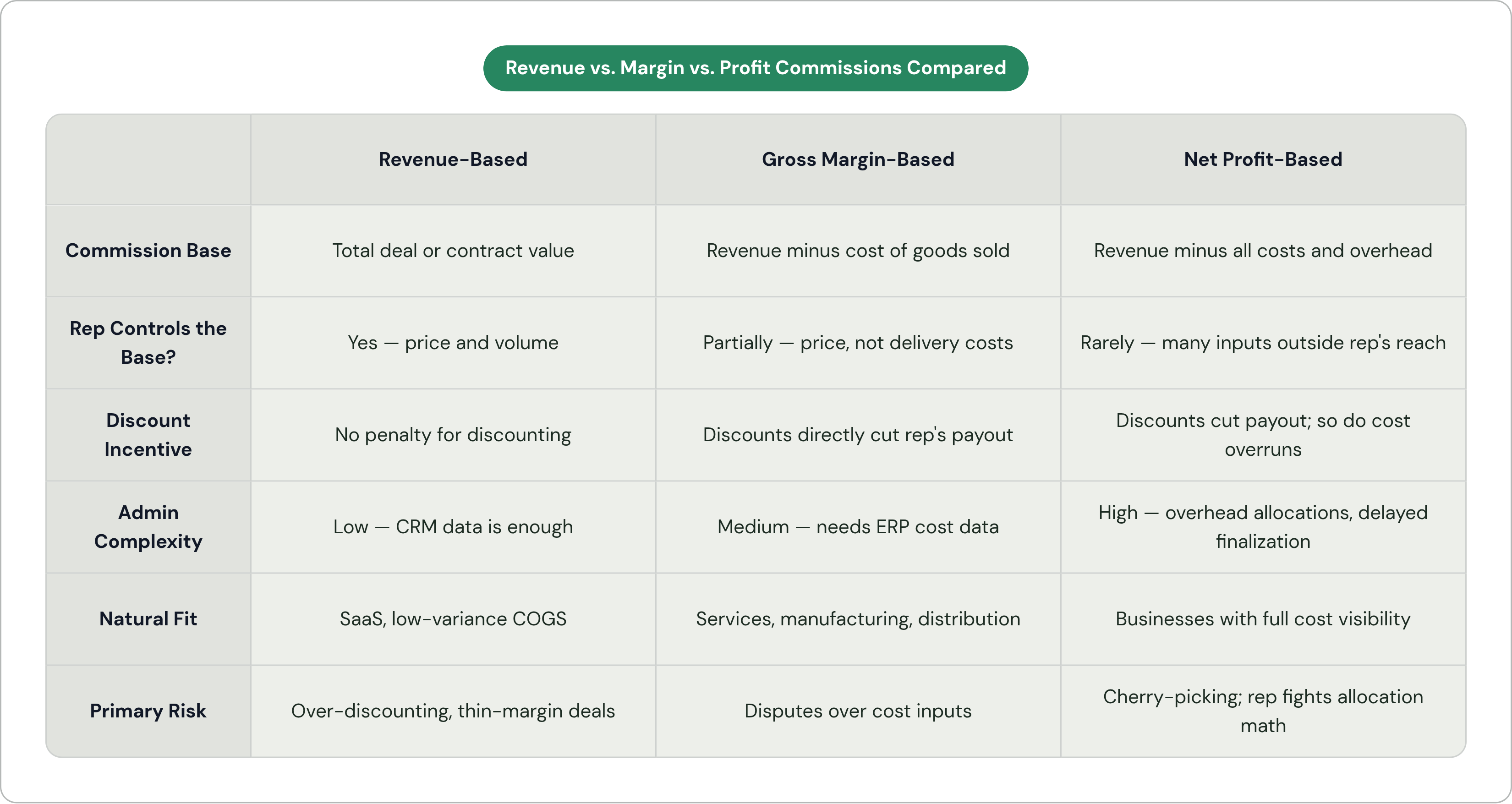
Revenue-based plans make the most sense where margins hold steady across the product line, where reps have little pricing authority to abuse, or where cost data simply isn't visible to sales at the moment the deal closes. SaaS is the textbook case. Software COGS run low and don't swing much deal to deal, so the model stays clean without extra plumbing bolted on.
Margin-based plans earn their keep where reps hold real discounting power, where cost of goods sold moves meaningfully from project to project, as it does in services, custom manufacturing, or physical goods, or where a company has already watched a discount culture eat its margins and needs a structural fix instead of a stern email from the VP of Sales. Construction, professional services, manufacturing, and distribution are natural homes for gross margin commissions, because the cost of delivering one job rarely resembles the cost of delivering the next.
Push the cost allocation further, toward true net profit, and the model gets more contested, especially in businesses with shared overhead where reps start arguing the allocations were invented to hit a number. That argument isn't always wrong. Companies selling a wide product mix, high-margin software bundled with low-margin hardware for instance, sometimes split the difference with product-level margin tiers, treating each line's economics on its own terms instead of forcing one formula across an uneven portfolio.
How hybrid structures combine revenue simplicity with margin accountability
Most B2B SaaS organizations don't pick one model and stop there. The common pattern, per Optymyze's research on the space, is revenue-based commission as the core calculation, with accelerators above quota and tiered rates underneath it.
Margin accountability gets layered on top without tearing out the base. A margin floor pays a reduced rate, or nothing, on deals that fall below a set gross margin threshold. A discount gate requires manager sign-off past a certain discount level, keeping the approval decision separate from the commission math itself. Margin-linked accelerators go a step further, paying a richer rate above quota to reps who close at or above a margin target, while reps who close below it earn a smaller bump for the same volume.
Clawbacks do related work from a different angle. If a customer churns within six to twelve months of signing, the company recovers the commission, prorated against however much of the contract term remains. That builds a downstream profitability check into a plan that otherwise settles everything at signing, and these provisions have gotten more common as churn pressure has grown across the industry.
What reps actually like about revenue commissions survives in a hybrid plan: they can work out their own check without a finance degree. What changes is the worst behavioral risk a pure revenue model invites. The further a cost input sits from what the rep actually controls, the more it belongs as a guardrail or modifier, not the main event.
The administrative cost of net profit commissions that rarely shows up in the design conversation
Revenue commission inputs usually sit right there at deal close: contract value, close date, which rep gets credit. One export from the CRM can drive the whole calculation.
Gross margin commissions need cost data CRMs generally don't hold, things like COGS, project costs, and delivery costs, which tend to live in an ERP system, a project management tool, or the accounting ledger instead. Net profit commissions need more still: overhead allocations, indirect costs, and sometimes adjustments that don't get finalized until weeks or months after the deal itself closed.
Spreadsheet errors aren't the rare exception; they're closer to the rule. Both problems compound when the inputs are scattered across systems instead of pulled from one source everyone trusts. Picture a deal closing in the CRM with one cost estimate, then getting reconciled weeks later in the accounting system against actuals that came in different. That gap turns into a version-control argument that's hard to settle without an audit trail showing which number was used and when.
For finance and RevOps, running a profit-based plan means committing to a defined cost-finalization date, a written policy for what happens when actuals miss the estimate, and a pay period that locks and actually stays locked. None of that is optional once plan design calls for profit math, and it gets worse as headcount grows.
What accurate calculation requires regardless of which model a company chooses
Both models live or die on one thing: a commissionable base spelled out in writing before the pay period opens, not negotiated after the fact when somebody's check looks wrong.
Xactly's published framework splits a commission plan into three pieces worth naming separately: the commission structure (the math, the tiers, the accelerators, and the logic tying them together), the commission policy (eligibility, clawbacks, deal coverage, timing), and the payout process (the actual workflow for calculating, checking, and delivering the money). Treating those as three separate documents, rather than one vague plan memo everyone half-remembers, is what keeps a company out of trouble later.
Revenue models need the base codified in plain language: total contract value or annual recurring revenue, net-new or expansion, how discounts factor in, how multi-year deals get treated. Margin models need the cost inputs named, their source systems identified, a finalization date set, and a written policy for adjustments landing after the deal closed, not an informal understanding that six people remember six different ways.
Hand a new hire a hypothetical deal. She should be able to work out her own commission fast, with confidence. If she can't, the plan needs simplifying, or at minimum better documentation, before it goes live. Pay transparency laws now on the books in California, New York, and Illinois require employers to publish commission plan details up front, and a plan that isn't documented to that standard carries real compliance exposure, not just an administrative headache.
Where manual processes break down when commission inputs get complex
At a small enough scale, a diligent ops person can run commission out of a spreadsheet by hand. Tedious, error-prone, survivable. Tools like Quota Queue, a commission calculation platform that converts raw deal data into payroll-ready statements without spreadsheets, exist precisely because survivable stops being acceptable once the plan gets complex or the headcount grows. As headcount grows, though, the error rate doesn't grow at the same pace as the team; it compounds, and one bad pay cycle can trigger disputes across the whole sales floor at once, all landing on the same desk in the same week.
The spreadsheet's real cost never shows up on the "spreadsheet is free" side of the ledger. There's the labor of the person maintaining it, the cost of the errors it produces, and the cost of the disputes those errors set off. Comp administrators lose close to 90 hours a month, on average, to manual work like reviewing payouts and chasing disputes, time that doesn't go toward anything the business actually needed.
The data-decay problem hits profit-based commissions hardest of all. Cost figures pulled from different systems at different points in time bring formatting mismatches, timing gaps, and version conflicts that are nearly impossible to trace once they're buried in a spreadsheet with no audit trail. Internal auditors have flagged spreadsheets as a shaky foundation for decisions touching payroll and financial reporting, which is exactly the risk profile of a commission calculation built on cost allocations that feed straight into reported margins. A large share of sales professionals say they'd leave for a similar role elsewhere if the pay were more reliable, and a botched commission run is one of the fastest ways to convince a rep hers isn't.
What to look for in commission software when the plan involves margin calculations or hybrid logic
Revenue-only plans are simple enough that almost any commission tool on the market handles them without strain. Margin-based and hybrid plans ask a lot more of both the calculation engine and whatever's feeding it data.
A few things matter most. The tool needs to support tiered rates, margin floors, and accelerators that reference actual cost data, not just the deal value sitting in the CRM. It needs to connect to both the CRM and the ERP, pulling deal data and cost data from wherever each one actually lives, instead of asking someone to retype numbers by hand. Locked pay periods and a real audit trail matter a great deal here too, especially on profit-based plans where cost inputs don't finalize until after the deal has already closed. Reps should be able to open their own statement and see exactly which revenue figure, which cost figure, and which rate produced their number, not a total they have to take on faith.
I've watched teams try to bolt margin logic onto a tool built only for flat-rate revenue commissions, and it never holds. The formulas get hardcoded into a spreadsheet tab nobody else understands, and the whole thing breaks the first time a product line gets added or a cost source changes format.
The more sophisticated the plan gets, whether that's profit-based, hybrid, or something in between, the stronger the case for structured software becomes, not weaker. Complexity that lives in a spreadsheet doesn't disappear. It just waits for the next pay cycle to surface.