Accelerator and Decelerator Mechanics in Commission Plans
Accelerators flip reps' math to close deals now instead of sandbagging them later.
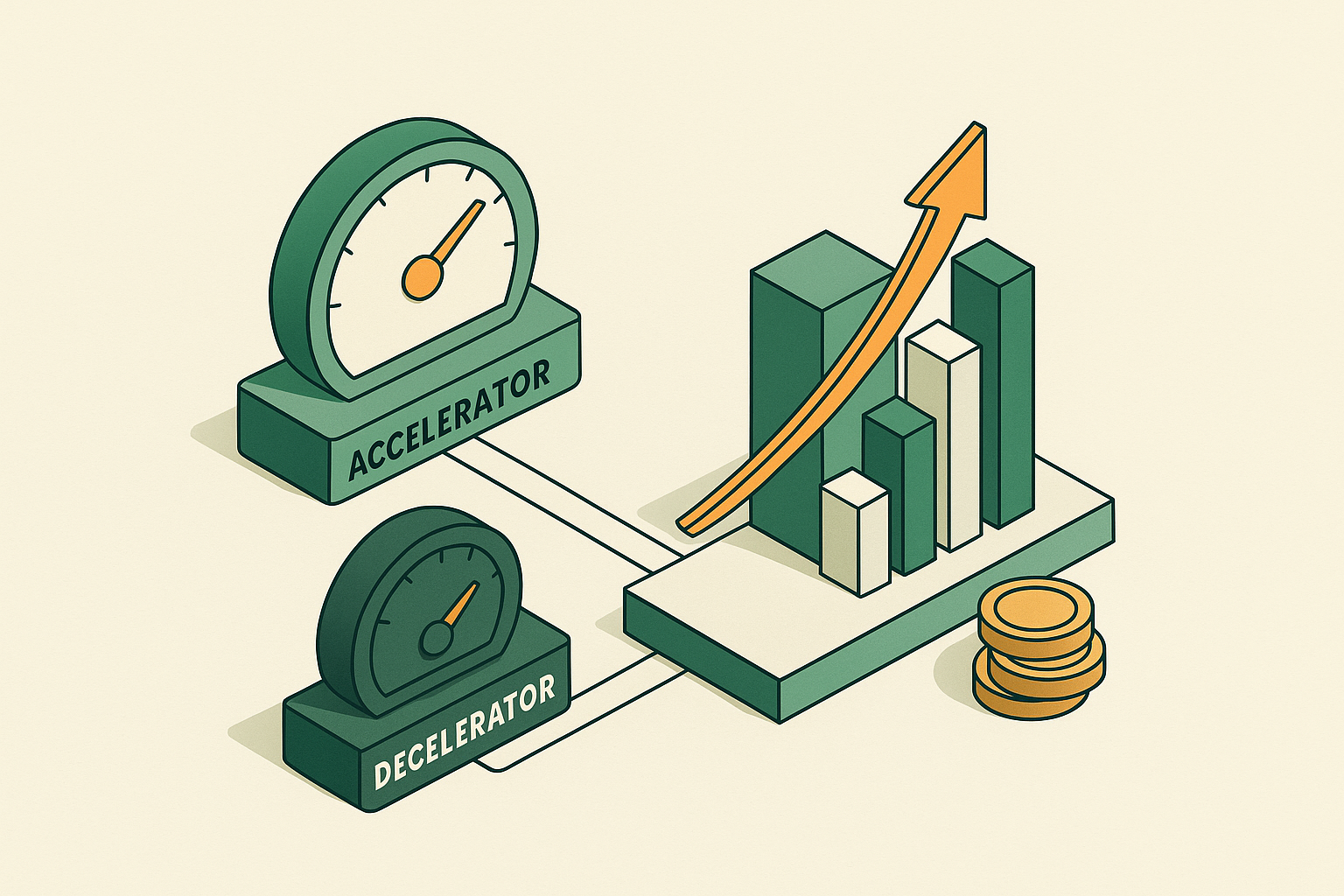
Flat commission pays the same rate on every dollar, whether that dollar closes in week one or week twelve. A rep who's already hit on-target earnings does the math fast: nothing rewards closing the next deal this period instead of next. Waiting costs nothing, and it might even help, since it gives them a head start on the following cycle's number.
Nobody puts that logic in a Slack message. No rep announces they're sandbagging. It shows up in the forecast as slippage, deals that were verbally committed sliding right for reasons everyone blames on "customer delays." Usually it's just rep math, working exactly as flat commission trained it to work.
An accelerator breaks that math. Once the rate steps up past quota, a dollar earned in month four is worth more than a dollar earned in month one, and the rational move flips to keep selling straight through the finish line. Research out of Harvard Business School, Darden, and Yale found overachievement compensation plans produced 13% higher revenue and 2% higher profit than flat-rate structures. Harvard Business Review has cited a steeper number for plans stacking multiple accelerators: 17% higher sales. Reps chase whatever the plan makes valuable, and an accelerator makes overperformance the most valuable thing on the board, which is a different kind of pressure than simply handing more money to people who were going to win anyway.
How a tiered accelerator structure works in practice
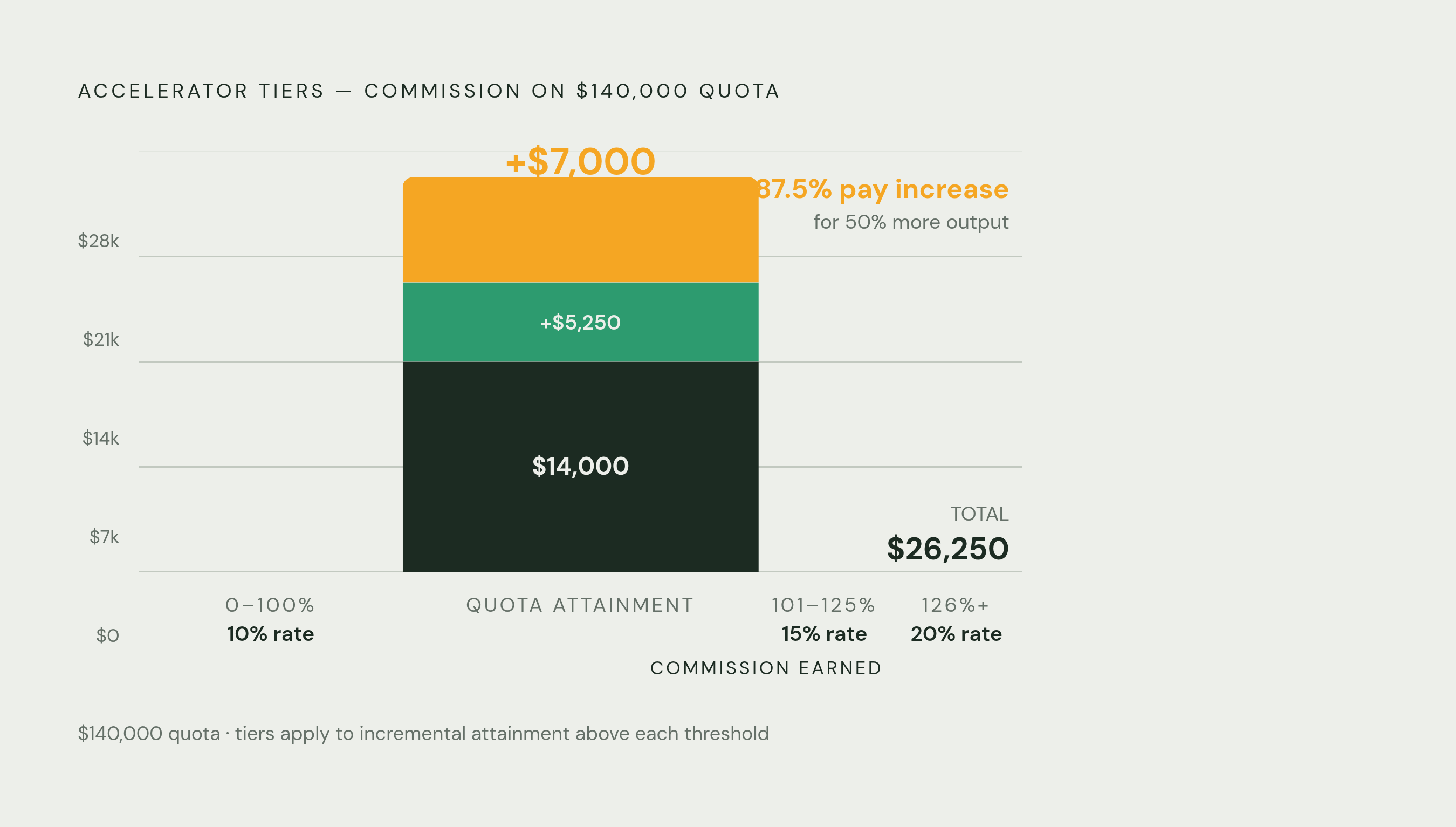
The standard shape runs a base rate through 100% of quota, then escalating rates for each band above it. Prowi's research lays out a clean version: a rep with a $140,000 quota and a 10% base rate earns $14,000 on that first slice. From 101% to 125%, the rate jumps to 15%, adding $5,250 on the next $35,000. Above 126%, it climbs to 20%, adding another $7,000 on the same-sized band after that. Close 150% of quota and the rep walks away with $26,250. An 87.5% pay increase for a 50% increase in output.
That gap between pay growth and output growth is the whole mechanism.
Two to four tiers is the sweet spot. Fewer than two, and there's no real escalation, just a step function that builds no momentum. More than four, and reps lose track of which band they're sitting in; a plan nobody can calculate in their head stops motivating anyone. The first threshold matters as much as the tier count does. For closing roles, it belongs at exactly 100% of quota. Push it higher, and the team learns quietly that quota isn't the real bar, which undercuts the one number everyone's supposed to be rowing toward.
Capped or uncapped comes down to what a company is optimizing for. Uncapped pulls harder on top performers, since there's no ceiling on what one more closed deal is worth. Capped buys cost predictability, but it carries a hidden tax: a rep who hits the ceiling has the same reason to stop selling, or push deals into next period, as a rep on flat commission with no accelerator at all. Triggers need to map to real strategy, too, not just raw revenue. A company chasing top-line growth wants quota-based triggers; a company pushing multi-year contracts or new product adoption needs triggers built around those specific behaviors instead.
How decelerators work and where they actually belong
A decelerator drops the rate when a rep falls below a minimum threshold, usually 50% of quota. Someone who normally earns 10% might earn half that on deals closed in a period where they land under the line. That's the underperformance case, the one most people picture first.
There's a second use that gets almost no attention, and it may matter more. Call it protection against the windfall deal. Prowi documents an enterprise structure paying 8% through 100% of quota, 12% from 101% to 120%, 16% from 121% to 150%, then dropping back to 12% above 151%. That drop isn't a penalty. It's a guard against the bluebird, the single outsized contract that lands a rep at 300% of quota through timing or luck rather than sustained selling. The company still pays overperformance generously; it just refuses to let one anomalous deal blow up the comp budget for everyone else on the team.
Decelerators show up outside the attainment conversation too. Worried about margin erosion? Apply one to heavily discounted deals, independent of whether the rep hit quota. That's a lever aimed at deal quality rather than deal volume, and reps will ask why their commission dropped on something that technically closed. Have the answer ready before they do.
Worth separating clearly from a cliff. A cliff pays nothing below the line, so a rep who's already lost the quarter has zero reason to close anything else, and the rational move is to hold everything for next period. A decelerator keeps some incentive alive even at low attainment, which is the difference between a rep grinding through a bad month and one who checks out on week two. It's also why decelerators cluster in enterprise plans built around high base salaries. When variable pay isn't the main lever, the decelerator becomes the tool that enforces a performance floor without stripping the rep of anything they actually need to live on.
How accelerators and decelerators function as a paired funding mechanism
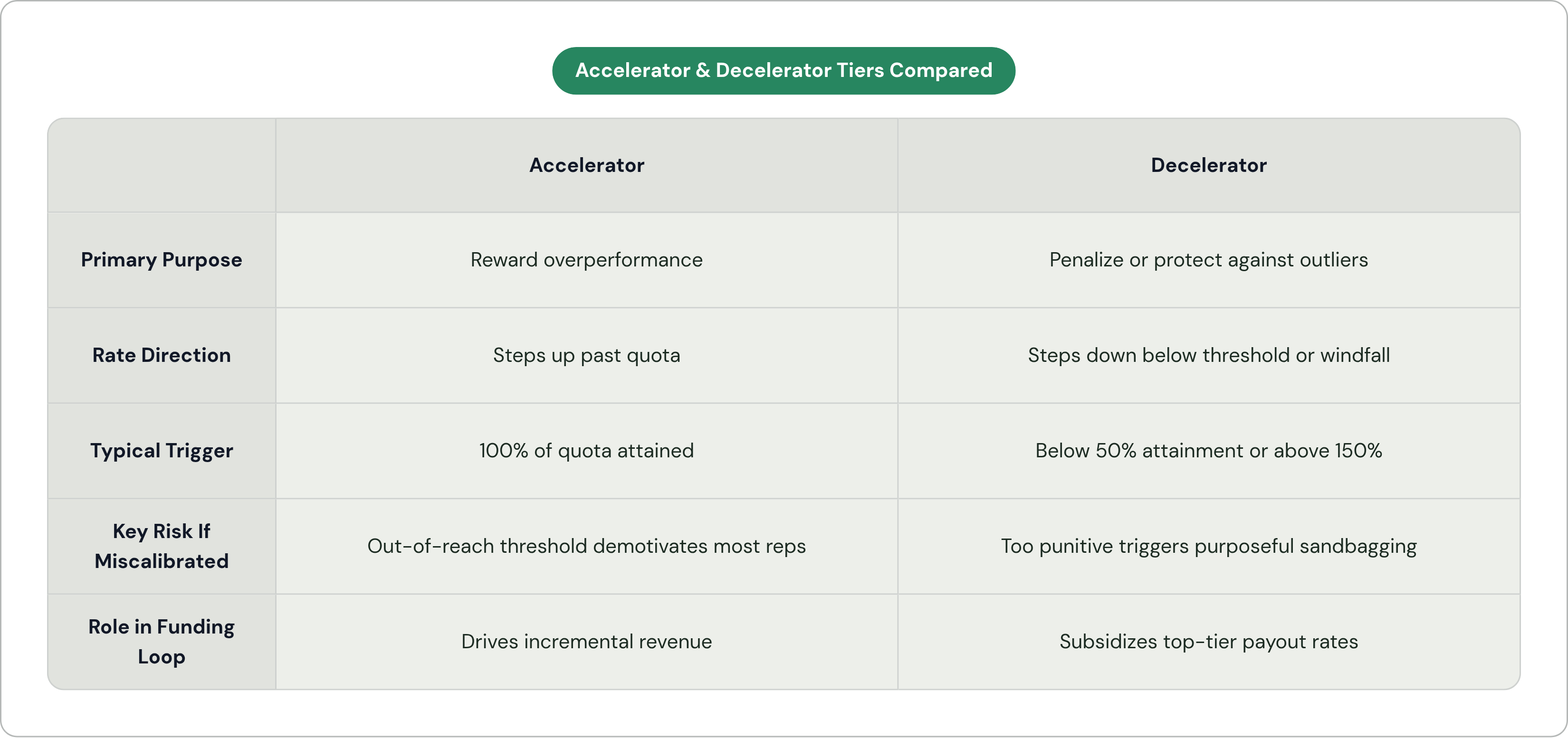
These aren't two independent design choices sitting side by side. Together they form a funding loop: money saved paying underperformers a lower rate helps fund the aggressive rate paid to the top closers.
Prowi's combined model shows the shape: 5% from 0 to 50% of quota, 10% from 51% to 100%, 15% from 101% to 125%, 20% above 126%. That 5% band is the decelerator, and every dollar it saves subsidizes the 20% rate sitting at the top. Run this across a ten-person team at $140,000 quota apiece. At 100% attainment with no accelerator, the team costs $140,000 flat. Add a 1.5x accelerator and the number climbs to roughly $166,600. Push a 2x accelerator and it lands meaningfully higher, somewhere between single digits and 28% above baseline, with decelerator savings offsetting part of the jump.
A decelerator without an accelerator sitting next to it is pure punishment, and this gets skipped constantly. It's a stick with no carrot, and sales teams clock the asymmetry within a quarter, sometimes within a single bad commission check. Calibrate the two together, and a company rewards its best reps while keeping comp spend under control. Push the decelerator too far down, though, cut too deep at the bottom, and reps start sandbagging on purpose, holding deals for a period where the math tilts back in their favor. That shrinks the deal flow the whole funding mechanism depends on. The structure doesn't collapse loudly. It just stops working, quietly, and nobody notices until the quarterly numbers come in soft for reasons finance can't quite trace.
Why quota calibration determines whether any of this works
None of the tier math above matters if the quota underneath it is wrong. An accelerator only motivates if reps can plausibly reach it. A threshold nobody crosses is an expensive line item sitting on the comp plan doing nothing, not a working incentive doing its job.
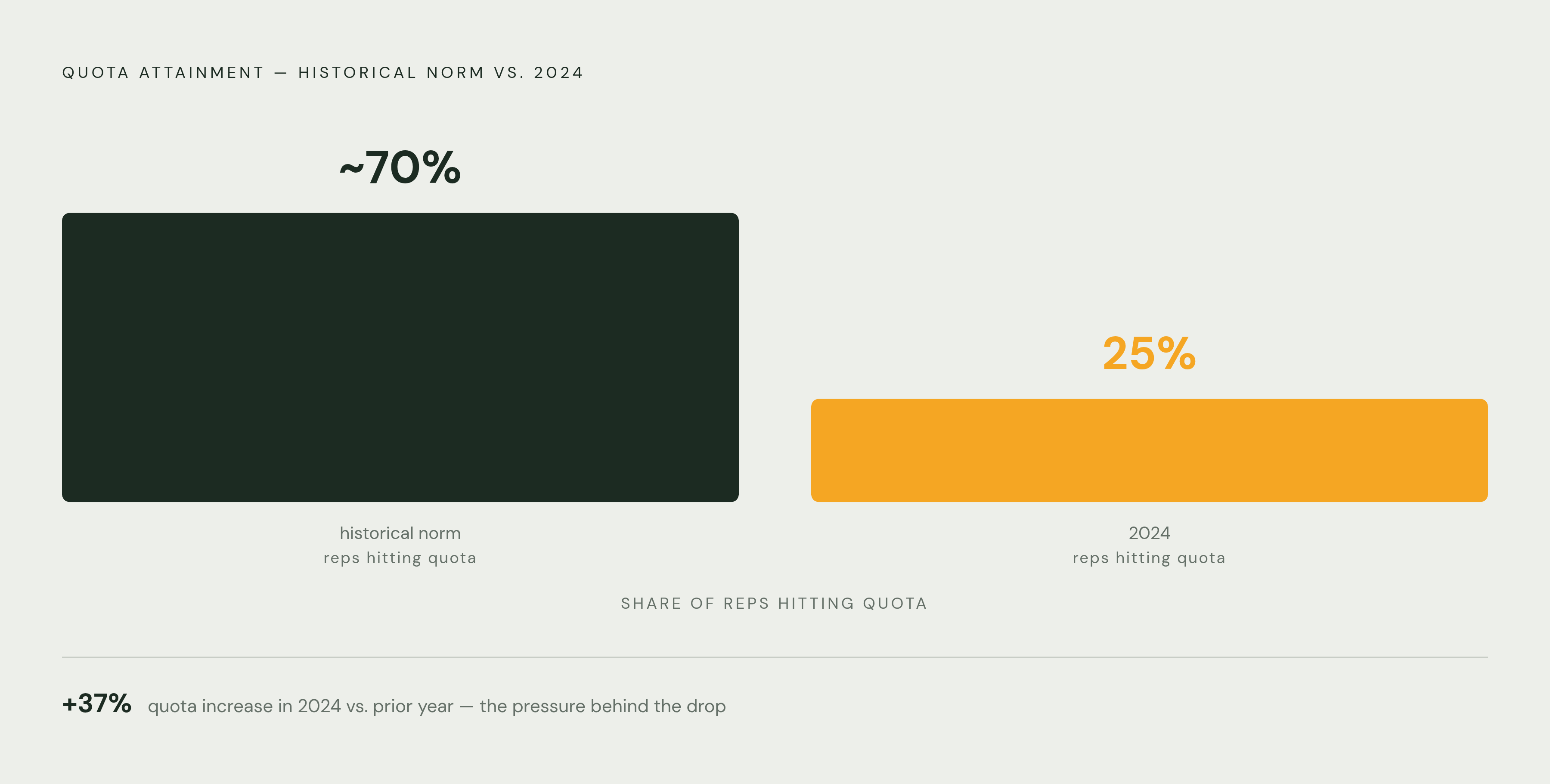
The attainment numbers right now are ugly. Only 25% of B2B salespeople hit quota in 2024, a steep fall from the roughly 70% benchmark treated as standard for years, and the RepVue Cloud Sales Index put average quota attainment at just 43% in Q4 of that year. Quotas themselves rose 37% in 2024 compared to the year before. Raise the bar that much without touching the accelerator threshold above it, and the accelerator drifts out of reach for most of the team. It becomes a reward reserved for the shrinking few who were already going to overperform anyway, defeating the entire point of installing one.
There's a workable range, worth pinning down precisely. The first accelerator tier should be reachable by something like a fifth to a third of the team: close enough to feel aspirational, rare enough to still mean something. Across the broader team, somewhere around 60% to 70% of reps should be hitting quota. Drop meaningfully below that, and the incentive structure has stopped incentivizing anything. Go too far the other direction, quotas set too soft, and the company pays out accelerators without buying any extra performance for the money. Part of why this keeps happening industry-wide: 87% of sales leaders, by one measure, set targets without a fixed methodology. Quota-setting, in practice, leans closer to guesswork than to discipline more often than anyone wants to admit, and that guesswork flows straight into miscalibrated tier lines. Model the tiers against actual historical attainment before drawing them. The threshold is only as sound as the quota underneath it. No exceptions.
The design mistakes that make accelerator and decelerator plans backfire
Raising quotas without touching the accelerator threshold beneath them used to be an occasional oversight. The 37% quota jump in 2024 turned it into something closer to an industry habit.
Capping commission to control cost is the second recurring error, and the instinct behind it makes sense; nobody wants an open-ended line item sitting in the budget with no ceiling. But a cap tells a rep to stop selling the moment they hit it, which recreates the exact sandbagging problem a flat plan produces, just relocated to the top of the range instead of parked at quota. Better options exist: tighter quota assignment up front, windfall clauses that catch deals well outside normal size, and a properly calibrated decelerator doing the cost-control work at the bottom instead of a hard ceiling doing it at the top.
Then there's the interaction risk, subtler and missed more often. Pair a generous accelerator with a punitive decelerator without modeling what reps actually do in response, and the result is the exact sandbagging dynamic the funding mechanism was supposed to prevent. If the downside of a weak period is steep enough, a rep holds the deal, trades a bad current-period rate for a good next-period one, and distorts both quarters at once. Too many tiers causes a quieter version of the same failure: complexity kills the signal, and a rep who can't run the math in their head stops responding to the incentive at all.
The last mistake sits outside the math, in process: changing the plan mid-year. Trust erodes fast when this happens, and reps remember it long after the specific numbers are forgotten. In parts of Europe it can create real legal exposure too, not just a morale problem. Before any plan launches, run it against last year's actual performance distribution, model what the payouts would have looked like, then stress it one step further: ask what happens to cost if 20% more reps clear the accelerator threshold than the model assumed.
How commission software handles accelerator and decelerator calculations — and where spreadsheets fail
Accelerator and decelerator math is conditional rate logic. The correct rate for any single dollar depends on which attainment band it falls into, whether that band resets each period, and whether it's stacking with a SPIFF or some other trigger running at the same time. Spreadsheets handle the simple version fine. They fall apart at the edges: a quota change mid-period, a deal straddling a tier boundary, a clawback forcing a recalculation of last period's attainment, two accelerators stacked across separate triggers at once.
47% of organizations still run incentive comp through spreadsheets, per Business Research Insights, despite all of that. One 2025 industry report found only 27% of companies have fully automated their end-to-end commission process, which means most of the industry is still absorbing calculation errors, reconciliation delays, and rep disputes by hand, every quarter, usually the week before payroll closes.
A common failure mode: a fifth tier gets added to a plan, the nested IF statement holding the spreadsheet together breaks under the added complexity, and someone rebuilds it from scratch before commission runs. Purpose-built software avoids that failure mode entirely. Tiered rates apply band by band automatically. Attainment updates as deals close, so a rep sees which band they're sitting in without waiting for month-end reconciliation. Pay periods lock with a full audit trail, which matters a great deal when a rep disputes the rate applied to a deal that closed on the last day of the quarter. Clawbacks recalculate against prior-period attainment without anyone touching a formula.
Quota Queue handles this by treating tiered rates, accelerators, decelerators, SPIFFs, and clawbacks as explicit rules rather than cell formulas, with every calculation logged and auditable after the fact. Commission statements show reps precisely which rate applied to which deal and why. That visibility does more work than people expect: when a rep can see which band they're in and exactly what the next deal is worth, the accelerator does the job it was built to do. Take the visibility away, and even a plan calibrated perfectly on paper won't move anyone.