Commission Dispute Resolution Processes for Sales Teams
Structured intake and SLAs stop commission disputes before they escalate.

Commission disputes look like isolated flare-ups when you're standing inside one. A rep angry about a number, a manager scrambling to explain a formula nobody wrote down clearly — yet they follow a predictable path from confusion to conflict, and that path can be interrupted at several points once a sales team decides to build a process instead of hoping next quarter goes smoother. I've sat in enough of these conversations to know the pattern by heart, and the mistake I keep running into is treating commission errors as an occasional nuisance instead of the baseline condition of running a comp program. Salesforce's State of Sales 2024 put a number on it: more than 60% of reps hit a commission error in the previous year, which is not an edge case, and honestly amounts to a fairly ordinary Tuesday.
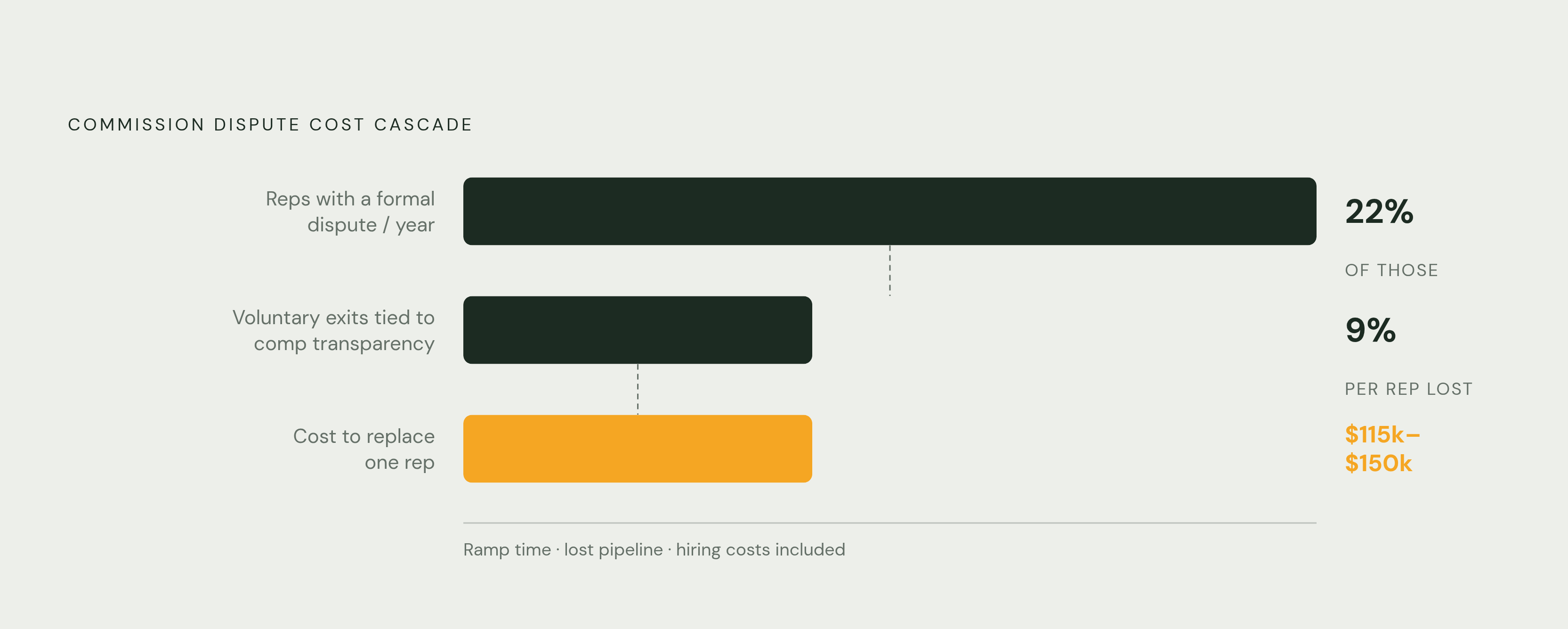
WorldatWork's numbers sharpen the cost picture. Twenty-two percent of reps file at least one formal dispute a year, and 9% of voluntary resignations trace back to compensation transparency problems somewhere upstream. Replace a rep and you're looking at $115,000 to $150,000 once ramp time, lost pipeline, and hiring costs stack up, so a dispute that festers long enough to push someone out the door stops being an HR footnote and starts being a line item on someone's budget review. Dispute rates track pretty closely with how mature the comp program actually is: well-run programs see 4 to 8 disputes per 100 statements, while spreadsheet-driven ones see 15 to 25. Comp admins report spending around 89 hours a month on payout reviews and dispute resolution, which is more than two work weeks a month, every month, going toward something a tighter process would shrink considerably.
Where most commission disputes actually originate
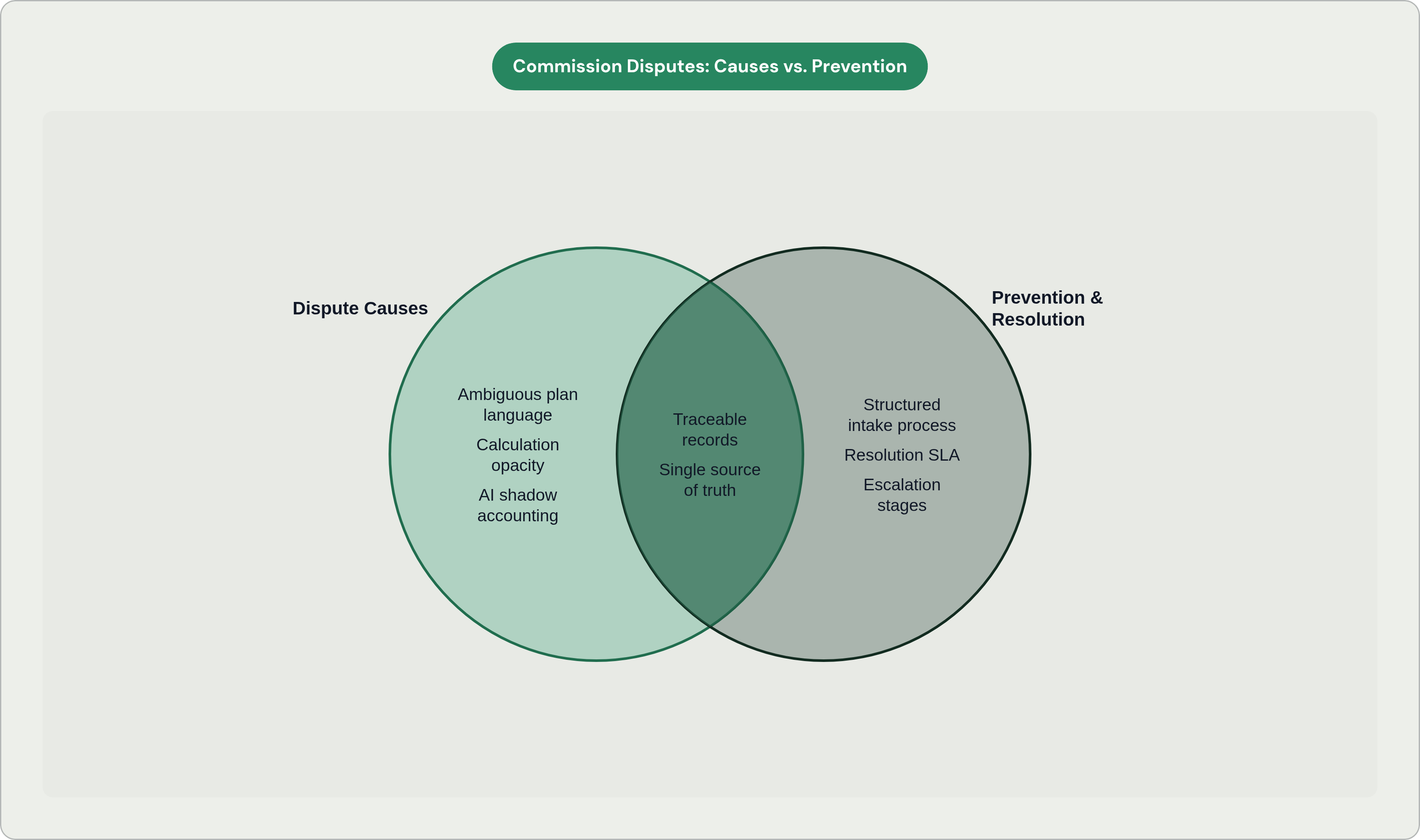
Three structural causes account for most of what lands on a comp admin's desk. Ambiguous plan language sits at the top of the list: no clear definition of when a commission is actually earned, at booking, at invoice, at payment, at renewal, or at some implementation milestone nobody bothered to write down. Calculation opacity is close behind: the rep can't see how their number was reached, the manager often can't explain it either, and Finance and sales ops are frequently pulling from different records for deal ownership, credit, or plan eligibility. Then there's splits and tiers: disagreements over how credit divides when multiple reps touch a deal, and how those splits interact with tiered rates or accelerators built for single-rep deals and never revisited since.
Seasonality makes all three worse at once. Q1 is consistently the highest-dispute quarter, because new plans take effect, territories realign, and reps notice payout differences against the prior year right when they're trying to build momentum for a fresh cycle, which is bad timing for confusion, and confusion is exactly what shows up.
There's a newer wrinkle most comp teams haven't fully reckoned with, and it's a strange one: AI shadow accounting. Reps run their own commission math through general-purpose AI tools now, and those tools produce confident-sounding answers built on incomplete or flat-out wrong assumptions about the plan. The output looks authoritative, but it often isn't, and these numbers surface in dispute conversations without disclosure, so comp teams end up debugging a hallucinated figure instead of addressing what the rep actually needed answered. None of this happens against a backdrop of trustworthy math to begin with, either; 66% of companies admit to over- or underpaying commissions in the past year. Rep skepticism, in other words, is rational.
What a structured intake process stops before it becomes a dispute
Most disputes are questions at first. Whether a question stays a question or turns into a formal grievance comes down almost entirely to whether an intake process exists.
A structured intake captures the specific statement, pay period, and deal in question, the rep's expected amount and how they arrived at it, the plan provision they believe applies, and supporting evidence: a contract, a CRM record, an email thread, a close date. Without a standardized form, disputes arrive informally, over Slack, in a hallway conversation, buried three replies deep in an email chain, with evidence scattered across five channels before anyone starts investigating. That informality is expensive, and it slows resolution while making outcomes less consistent from one rep to the next, which becomes its own fairness complaint eventually.
Pre-detection pairs well with intake. Best practice flags roughly 8 to 10 statements per cycle for review before publication, and about half of those get corrected before the rep ever sees the number, a quiet fix and the cheapest resolution there is, mostly because nobody has to feel wronged first.
The intake form does something subtler, too. Ask a rep to write their claim down in specific terms, with numbers attached, and the act of writing it forces precision. More often than you'd think, that precision reveals the misunderstanding on its own, before anyone on the comp team has cracked open the ledger.
Building a resolution SLA that sets expectations for both sides
Skip the published SLA and every dispute turns into a waiting game. Reps read silence as stonewalling even when the holdup is purely logistical, and that perception problem is often worse than whatever calculation error started it.
A working SLA needs four things: an acknowledgment window, how fast the rep hears their dispute landed, same business day, no exceptions; an initial review window, when the rep gets a first substantive response, usually 5 to 7 business days out; an escalation trigger, what happens when the first-level reviewer can't close it, and who picks it up next; and resolution documentation, where every outcome needs to cite the specific plan provision governing it, not just a dollar figure with nothing behind it.
Timing on the actual payout matters more than most teams give it credit for. Resolve a dispute in the rep's favor, and the adjustment needs to land on the very next statement. Delays here read as adversarial even when they're just a processing lag, and reps have no way to tell the difference from where they're sitting.
McKinsey research suggests standardized commission structures can reduce disputes by up to 40%, and SLAs are a core piece of that standardization, part of what makes the plan function the way it's supposed to rather than a nice-to-have bolted on afterward. There's a protective angle too: a documented, consistently applied process becomes the evidence trail if a dispute ever escalates past internal channels.
How traceable records turn he-said-she-said into an evidence-based review
Most disputes survive past the first conversation for one reason: neither side can point to an authoritative record. Everyone's working from a copy, a screenshot, a half-remembered conversation from three weeks back.
Traceable commission records rest on four things working together: a locked pay period, so once a cycle closes, the calculation freezes and any retroactive edit requires a formal amendment rather than someone quietly changing a cell; an audit trail, so every change to a deal, a credit assignment, or a rate gets logged with a timestamp and a user attached; deal-level statement detail, so the rep sees exactly which deals contributed, at what rate, under which provision; and a single source of truth, so Finance and sales ops look at the same record instead of exports that have quietly drifted apart over a few quarters.
Spreadsheet environments make almost all of this impossible in practice. Professor Ray Panko's research on spreadsheet errors found that 88% of Excel spreadsheets contain formula errors of 1 percent or more, and retroactive recalculations in that kind of environment are manual, poorly version-controlled, and nearly impossible to audit after the fact. Ask "how did you get this number" in a lot of shops, and the honest answer is that nobody quite remembers.
When records are actually traceable, the investigation itself changes shape. The question shifts from who's right to what the record shows, which is faster to answer and a good deal less emotionally charged for everyone sitting in the room. Traceable data also surfaces the recurring cases; if the same type of dispute keeps popping up, categorizing by root cause tells you whether the problem lives in the data, the rules, the timing, or how the plan got communicated in the first place. Most disputes resolve here, though some don't.
The escalation stages between a logged dispute and a legal claim
An undefined escalation path is a risk in its own right. Without one, reps skip the internal process entirely and go straight to HR, to legal, or to outside employment counsel, because they have no confidence anything internal will actually move.
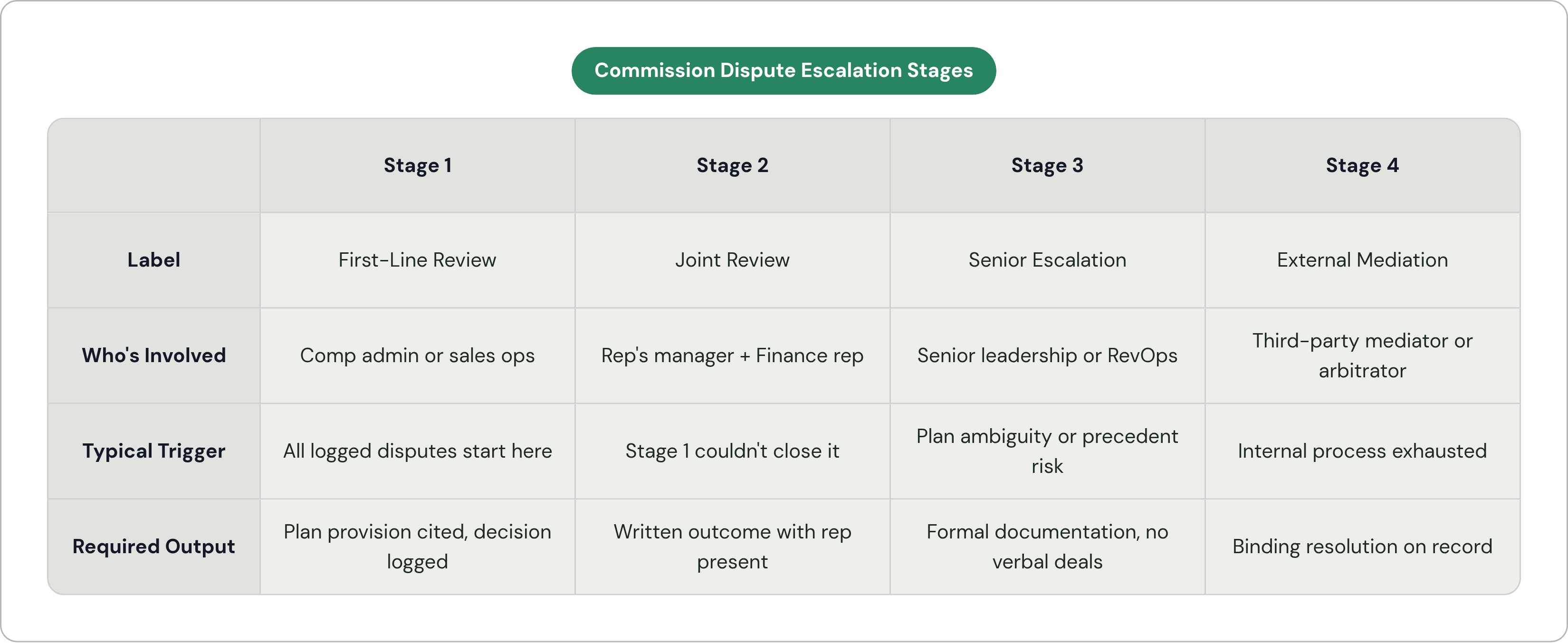
Stage 1 is first-line review: a comp admin or sales ops person checks the intake against the plan document and the deal record, and most disputes end right here. Stage 2 is a joint review between the rep's manager and a Finance representative, typically with the rep in the room, for whatever Stage 1 couldn't close. Stage 3 escalates to senior leadership or RevOps, reserved for genuine plan ambiguity, contested territory assignments, or dollar amounts large enough that the outcome sets a precedent; because it sets precedent, this stage needs formal documentation, not a verbal agreement worked out in a hallway. Stage 4 is external mediation or arbitration, held in reserve for whatever internal resolution genuinely can't close.
JAMS Mediation Services reports that 85% of disputes handled through formal mediation resolve successfully, so the external channel works when it gets used. Reaching it, though, is a failure of the internal process, not a normal stop along the way. Each stage needs an owner, a maximum duration, and a documented output: the same discipline as Stage 1's SLA, carried all the way through.
There's a compliance angle that isn't optional everywhere. California, New York, and Illinois now require documented pay calculation processes as part of pay transparency compliance, which puts a defined escalation path with written outputs inside the compliance surface itself in those states, not off to the side as a best practice. Even a well-built escalation ladder can't fix a plan that generates disputes at high volume in the first place, though, and that's where the real leverage sits.
Plan design choices that reduce dispute volume before the first payout
The plan document is the first line of defense, and it works best when three things stay separate and clearly labeled: commission structure (the math, tiers, accelerators), commission policy (eligibility, clawbacks, timing, split rules), and payout process (workflow, validation, delivery). Blur these into one dense document and reps lose the ability to find the rule that actually applies to their situation.
Here's a clarity test worth running before launch: ask a new hire to calculate their own commission on a hypothetical deal. If the answer doesn't come promptly and confidently, the plan is simply too complicated.
A handful of ambiguities need resolving in writing before launch, not after the first dispute forces the issue: the exact earning trigger (booking, invoice, payment, or milestone), the split methodology when more than one rep touches a deal, how clawbacks work and over what window, and how accelerators engage relative to quota, including whether caps exist at all. I'd argue against caps for top performers on principle; capping upside is one of the more reliable ways to demotivate exactly the people you most need selling, and I've watched it happen more than once.
Getting reps to sign or digitally acknowledge the plan document creates a shared reference point, and it quietly wipes out a whole category of "I didn't know that rule existed" disputes before they start. The 2024 State of Incentive Compensation Report found 85% of respondents believe reps with visibility into their compensation performance are more motivated. Transparency works as both a retention tool and a dispute reducer at once, though even well-designed plans still generate some disputes. What decides how often confusion turns into a formal complaint is what visibility reps have in real time.
Why real-time earnings visibility cuts dispute volume in half before it starts
Sixty-two percent of reps build shadow accounting spreadsheets to verify their own payouts, running a private audit of the company's math because they don't trust the official number, or can't see enough of it to trust it one way or the other. That habit is the direct precursor to a formal dispute, and by the time a rep opens their own spreadsheet, they've already started building a case against you.
Aberdeen Group research puts the time cost of shadow accounting at 25 to 50% of a rep's monthly time, selling time gone, spent reconciling a number the system should have shown them clearly to begin with. Shadow accounting carries its own accuracy risk now, too: reps using general AI tools to project expected commissions can walk into disputes built on hallucinated math, adding volume and complexity for comp teams who then have to debug someone else's wrong assumption before they can even get to the real question.
Give reps real-time attainment data and projected payout figures, and shadow accounting drops by roughly half in most companies I've seen, largely because it removes the "what am I actually on track for" question that drives the parallel spreadsheet in the first place. Reps who can see deal-level statement detail, which deals contributed, at what rate, under which provision, don't need to reconstruct that model on their own. The stakes are real here: after two pay errors, nearly half of employees say they'll start looking for a new role. Real-time visibility catches errors earlier and gives reps a channel to raise a question before the statement locks, rather than after trust has already eroded.
That shared record removes the information asymmetry that turns ordinary confusion into conflict, and it's a property of the system underneath, not something a spreadsheet can bolt on no matter how many tabs you add.
What a commission system needs to support a reliable dispute resolution process
Each stage of resolution above depends on something specific from the system underneath it, and none of it is optional.
Intake and pre-detection need a system that flags anomalies before statements publish, not after a rep's already noticed something's off. Traceable records need locked pay periods, timestamped audit trails, and deal-level detail as core functionality, not a reporting feature tacked on later. A single source of truth means Finance and sales ops work from the same record; any system producing separate exports for each team is, functionally, a dispute factory waiting for a trigger. Rep-facing visibility means statement detail lives inside the system the rep already uses, not a PDF emailed out after the fact that nobody can query or drill into. And an approval workflow means locked pay periods with logged approvals, so adjustments stay formal, visible, and traceable instead of silent edits made by whoever happened to have access that day.
Seventy-seven percent of companies still run their pay cycles in spreadsheets, and none of the capabilities above really exist in that environment. Quota Queue, a commission calculation platform that takes companies from raw deal data to payroll-ready statements through locked pay periods, auditable approval workflows, and deal-level rep visibility, is one purpose-built alternative to that environment. A spreadsheet can approximate a commission calculation, but it cannot lock a pay period, log an approval, or give a rep and a comp admin the same auditable view at the same time.
Commission data is compensation data, full stop, and the system holding it needs the same security posture as payroll: encryption in transit and at rest, org-scoped tenancy, a strict no-training-on-customer-data policy.
The evaluation question for any platform comes down to one thing: can a rep, a manager, and a Finance reviewer all look at the same record and reach the same answer without a phone call. If the answer is no, the platform isn't neutral ground, and it's simply a future dispute waiting for a trigger.