Commission Calculation in Excel Limitations at Scale
Excel's tiered formulas break silently as commission complexity grows.

Anyone who has run commissions this way knows the drill. Export closed-won deals from the CRM, paste into a workbook, run the formula logic underneath, split by rep, send statements. Repeat next month, usually with a slightly different export format because someone added a field in Salesforce or HubSpot since the last cycle and nobody bothered to tell finance.
The formulas doing the real work follow a handful of familiar patterns. Nested IF statements handle tiered rates, VLOOKUP or INDEX/MATCH pull quota figures off a reference sheet, and accelerator triggers get bolted on as extra conditional checks for whether a rep crossed some threshold. A flat 5% on every closed deal is simple enough, but tiers plus accelerators plus splits is a different animal entirely.
Tiered structures need cumulative logic: the first $50,000 in bookings pays at one rate, the next $50,000 at a higher rate, and so on. Building a formula that applies the marginal rate to each tier correctly, instead of slapping the top rate on the whole amount by mistake, is harder than it sounds. I've watched experienced Excel users get this wrong on the first three tries. Accelerators make it worse, because the formula now has to know where a rep sits relative to quota the moment each deal closes, not just where they land at month end. A rep who crosses 100% on the 15th should get the higher rate on everything after that, and nailing this every single month without fail is not a casual exercise.
Splits, overlays, and co-sell arrangements pile on more risk. Usually this means either multiple linked sheets referencing each other or manual overrides typed in by hand, and both fail in their own way: linked sheets break silently when someone inserts a row upstream, while manual overrides skip the formula chain entirely, so nobody downstream knows a number was hand-typed rather than calculated.
None of this is theoretical. Spend twenty minutes in Excel help forums, MrExcel among them, and you'll find a steady stream of questions from experienced users asking how to build incremental commission calculations, sliding scale formulas, tiered rate logic. These aren't beginner questions. They're standard features of ordinary comp plans, and Excel handles them awkwardly no matter how sharp the person building the sheet happens to be.
When a formula spits out a wrong number for one rep in one period, the fix under deadline pressure is almost always the same: someone types the correct figure straight into the cell, overriding the formula. It solves today's problem, but it also quietly breaks the formula chain for every future period that cell feeds into, and nobody remembers the override is sitting there until it causes a different, harder-to-diagnose mess three months later.
How a single spreadsheet error propagates across an entire pay period
Commission spreadsheets aren't a row of independent calculations sitting side by side. They're a chain, and nearly every downstream cell depends on something upstream of it. A misplaced decimal, a reversed sign, a clawback that never got applied: any one of these can move silently through every rep's payout in the same period, and the spreadsheet won't warn anyone, because it has no way to tell a correct number from a merely plausible one.
Some errors are dangerous precisely because they look right. A math error buried inside a multi-tier accelerator formula can land close enough to the expected figure that nobody thinks to question it. Data entry slips happen during the export-and-paste step, where a rep's name gets matched to the wrong deal or a currency field gets truncated. Rounding applied too early in a multi-step calculation creates drift that compounds across dozens of rows. Missed conditions surface only when someone's already looking for them, like a clawback that should have reduced a payout but didn't, or a rep whose status changed mid-quarter while the formula still points at the old tier.
The person who built the model and the people living off its output are almost never the same person. Reps see a number on a statement, but they don't see the formula behind it, and they have no way of knowing whether that formula behaved the way it should have that month, or quietly didn't.
Gartner data cited by Xactly puts a real figure on one side of this: a meaningful share of total sales compensation spend goes out the door as overpayment traceable directly to calculation error, money a properly configured engine would have caught before it left the building. Underpayment does the same damage in the other direction, just quieter. A rep who believes, even for a day, that they got shorted doesn't fully trust the system again, no matter how fast the correction lands.
The audit trail that Excel doesn't have
A real audit trail for commissions has to answer one question, over and over: who changed what, when, and why. Every formula edit, every quota adjustment, every override, every approval sign-off. Excel wasn't built to answer that question, and it shows every time someone tries to make it.
Cell history isn't kept by default, and Track Changes exists, but it's a blunt tool built for editing prose, not for governing pay decisions spread across dozens of interdependent tabs. At most finance teams running commissions this way, "version control" means a shared drive folder full of files named "CommissionsFinalv3_ACTUAL.xlsx," emailed back and forth between an analyst and a manager, with no single file anyone can point to and call authoritative.
That fragmentation only gets worse as the team grows. Multiple analysts working off different copies of the same workbook isn't some rare edge case; past a certain company size, it's close to the default state. Finance ends up with several versions of the same pay period's numbers and no clean way to say which one is right. Reps checking their own statements have no way to know whether that statement even came from the version finance actually used to cut the check.
This matters past internal tidiness. Pay transparency laws in a growing number of U.S. states now require employers to document and explain how compensation figures were derived. A spreadsheet with no locked history, no timestamped approval, and no record of who changed a formula and why can't satisfy that requirement cleanly, no matter how careful the underlying math was.
Dispute resolution runs into the same wall. When a rep challenges a payout, finance has to reconstruct exactly how that number came to be. Without a locked, logged record, that reconstruction becomes its own manual investigation, one that can burn days chasing down which version of which sheet produced which figure. Commission data is compensation data, deserving the same governance as payroll. Treating it like a shared workbook passed around by email creates exposure most teams never price in until it costs them.
Key-person risk and the operational fragility that grows around the spreadsheet
At most organizations still running commissions this way, one person actually understands the workbook: its custom logic, its workarounds, the hidden dependencies between tabs nobody ever wrote down because there was never time. Everyone else just trusts that it runs.
When that person is out sick during close, the commission run either slips or gets attempted by someone without the full picture, and errors get both more likely and harder to catch, since whoever's filling in has no idea which cells have silent overrides buried in them. When that person leaves the company for good, it's worse: rebuilding the model from scratch can take months, and the institutional memory of why a formula got structured a certain way, usually the accumulated residue of a dozen small fixes over several years, is gone for good.
This drag compounds with scale. A process that took a few hours a month for a ten-person sales team can eat days of finance time once headcount and plan variety grow, and most of that time goes to data collection and validation rather than anything resembling planning or analysis. It's time spent fighting the tool.
There's a quieter cost too, one that shows up in strategy rather than in hours logged. When rebuilding the spreadsheet after a plan change means several weeks of an analyst's time, teams quietly stop proposing plan changes, even the good ones that would clearly improve rep behavior or line up better with revenue goals. The spreadsheet's complexity becomes a ceiling on how much the company is willing to iterate on comp strategy. Odd, for a tool everyone adopted in the first place because it seemed flexible.
The labor cost, the cost of the errors, and the cost of that strategic rigidity are all real. They just don't show up on a software invoice, so they get ignored until someone finally sits down and adds them up.
What shadow accounting reveals about rep trust, and what it costs
Shadow accounting is what happens when a sales rep quietly builds their own private spreadsheet to check whether the official commission number is right. It's more common than most finance leaders assume.
A large majority of commissionable employees recalculate their own commissions manually at least some of the time, and not because they enjoy the extra bookkeeping. They do it because they don't trust what they're being handed, which is a rational response given how often errors surface once someone actually checks the math.
The cost lands twice. First, hours a week, hours a rep could spend prospecting or closing instead, get spent reconciling numbers finance already claims to have reconciled, a tax on a broken process, paid by the person least equipped to fix it. Second, and worse: shadow accounting is a signal that the incentive system has failed at its actual job. A commission plan exists to drive behavior. When a rep spends attention verifying pay instead of pursuing it, the plan has stopped functioning as an incentive and has become background noise, a low hum of anxiety running under their week.
The downstream effects show up in numbers companies can't wave away forever. A meaningful share of sales reps file at least one commission dispute in a given year, and unresolved pay transparency issues are a documented factor in voluntary resignations from sales roles specifically. Reps consistently say clear visibility into how they're paid is a major motivator, yet only around half of companies offer anything close to real-time earnings or performance tracking. That gap is structural, baked into the tool.
Replacing a sales rep is expensive under any accounting method: recruiting cost, onboarding time, ramp period, the pipeline that goes cold while the seat sits empty. Retention is a business case on its own, and commission trust feeds straight into it.
The plan complexity that modern commission structures require, and that Excel cannot cleanly support
Almost no serious comp plan today is a flat percentage. Tiered rate structures, quota-attainment accelerators, one-off SPIFs, clawbacks for deals that churn, multi-product splits between reps, ramp adjustments for new hires still building pipeline, usage-based components tied to recurring revenue: these are standard now, not exotic add-ons, and each one stacks more formula complexity onto the calculation underneath.
Tiered rates need cumulative logic tracking earnings through multiple bands rather than one lookup, and accelerators need quota attainment tracked at the moment a deal closes, not just at period end. Clawbacks need a current-period calculation linked back to records from a prior period, which in a spreadsheet usually means one more cross-sheet reference that breaks the second someone reorders rows. Multi-product splits need dependencies across sheets that, again, break silently the moment any single input shifts.
Here's a decent test for whether a comp plan is well designed: can a rep sit down and calculate their own commission on a hypothetical deal, by hand, without asking anyone for help? If they can't, the plan is too complex or too opaque to drive the behavior it was built for, regardless of what's crunching the numbers behind it. Excel makes this test harder to pass. A formula correctly implementing a tiered accelerator with a clawback clause is, in practice, unreadable to most reps, so the very transparency that makes a comp plan motivating gets undercut by the tool running it.
As more companies move toward usage-based pricing or recurring revenue, comp plans have to keep pace, and each change costs more time to rebuild correctly in a spreadsheet than it would in a system built from day one for plan iteration. Managing this kind of complexity needs a system where plan rules get configured explicitly, applied the same way every time, and stay auditable by design rather than by accident.
What purpose-built commission software actually changes, and what to look for when evaluating it
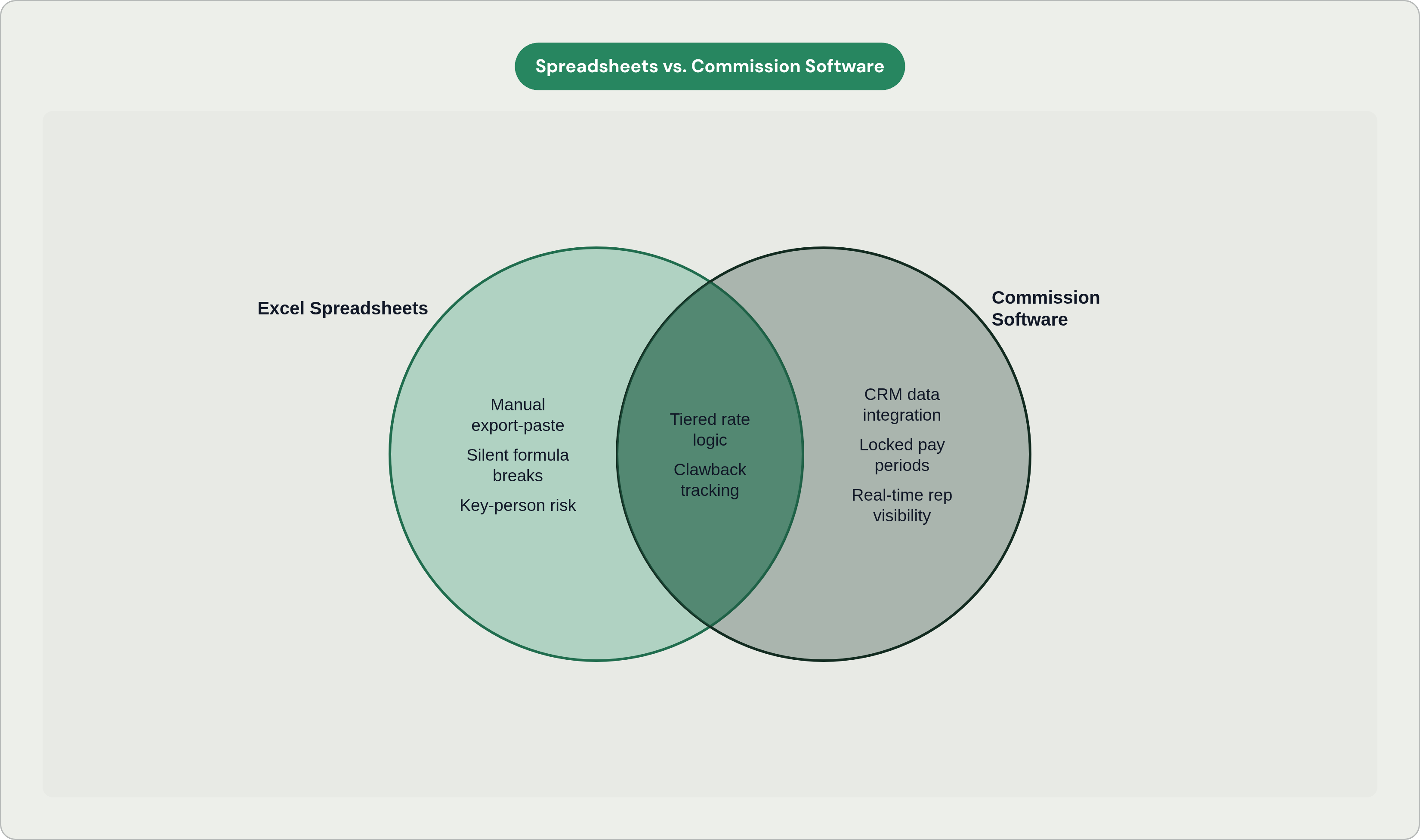
The structural shift commission software makes is simple to state: plan configuration and calculation execution get separated. Rules get defined once, applied consistently across every rep they touch, and logged automatically. That cuts reliance on a formula chain that depends on human precision holding steady every step, every month, forever.
That separation changes the daily work in concrete ways. Deal data flows in directly from the CRM or from files, cutting out the export-and-paste step where a good share of errors start in the first place. Tiered rates, accelerators, SPIFs, and clawbacks become explicit configured rules instead of nested formulas, so a mid-year plan change is a configuration update, not a model rebuild. Pay periods lock after approval, leaving a historical record that's stable and genuinely auditable instead of reconstructed later from memory and email threads. Reps get real-time access to their own deal-level statement detail, closing the information gap that drives shadow accounting in the first place.
Evaluating a platform against that standard means asking a specific, unglamorous set of questions. Can it actually handle the structure of your comp plans, tiers, accelerators, splits, clawbacks, without forcing workarounds that just recreate the fragility you're trying to leave behind? Does it plug into the CRM you already use, or does it demand a separate data pipeline that becomes its own maintenance headache? Are approvals logged, are pay periods lockable, can you trace who changed what and when, months later, without guessing? Do reps get real-time visibility into their own earnings and quota progress, or just a PDF at month end? Is commission data handled with the same rigor as payroll: encrypted, access-controlled, isolated by organization? And on pricing, seat-based models punish a company for growing its sales team, while plan-based pricing scales with what's actually being managed instead of just headcount.
AI is starting to show up in this category too, mostly to help extract and build compensation plan logic out of existing plan documents. That's a fair accelerator for setup, but it should never replace human review and sign-off on the resulting rules. A misread clause in a comp plan document is exactly the kind of mistake that shouldn't be handed to an algorithm without a person checking the output.
Quota Queue is one example built around those constraints. It moves teams from raw deal data to payroll-ready commission statements through a four-step workflow: import, build, configure rules, then approve and export. It prices by plan rather than by seat, encrypts data in transit and at rest, keeps tenancy scoped by organization, and holds to a strict no-training-on-customer-data policy. AI helps with plan extraction during setup, but human review stays part of the process rather than an optional step someone can skip under deadline pressure.
The commission software category has grown into a multibillion-dollar market with strong year-over-year expansion, and that growth is a direct response to a problem that gets more expensive the longer it sits unaddressed. The right platform for any given team isn't necessarily the one with the longest feature list. It's the one whose workflow actually matches how the sales and finance teams involved really work, and whose output the reps on the other end trust enough to stop double-checking on their own.