Commission Platform Security Certifications Worth Requiring
Security certifications are the table stakes, not the full vetting.
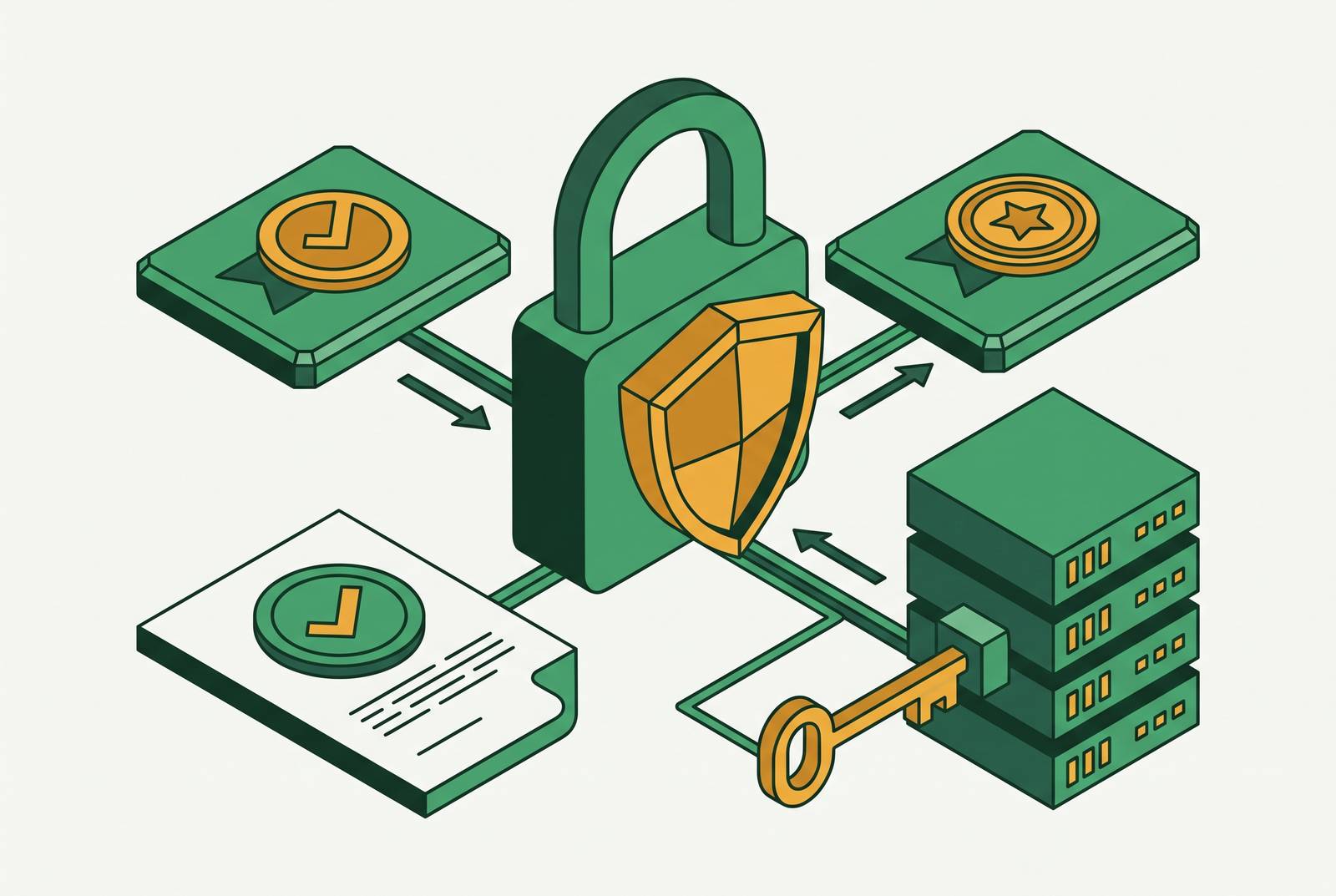
Commission platforms sit on some of the most sensitive data a company generates: individual earnings, quota attainment, deal-level payouts, and the comp logic that decides who gets paid what. If you're evaluating one of these platforms, you need a clear bar for which security certifications actually matter. SOC 2 Type II, ISO 27001, and documented data-residency compliance belong at the top of any RFP, as conditions a vendor has to clear before the rest of the conversation is worth having.
A single export from one of these systems can show quota attainment, variable pay structure, deal-level payouts, and by extension the employment terms baked into a comp plan. When that data leaks, the damage lands on individual people almost as much as on the company's balance sheet. Pay equity disputes surface. Social engineering gets a lot easier when an attacker already knows what someone earns and which deals they're chasing. Wrongful termination claims can hinge on who saw what, and when. A breach here carries a different kind of damage than a typical SaaS breach involving usernames and support tickets, and companies that miss that difference get caught flat-footed.
Regulators have made their view of comp data pretty clear by now. GDPR enforcement has produced significant fines since the regulation took effect, and that reach goes well past companies operating only in Europe. CCPA covers California-resident employees too, not just customers, which most HR and finance teams still underestimate when they scope vendor risk. A commission platform usually touches CRM deal records, payroll export files, and comp plan logic all at once, so one breach can span sales, finance, and HR in a single incident. Most RFPs still weigh security next to pricing tiers and UI polish, as if they belonged on the same scale. Security is the precondition for whatever else the platform claims to do.
What security certifications actually signal, and what they don't
A badge on a vendor's website gets misread constantly. All it really means is that an independent auditor checked whether a defined set of controls existed and worked during a set stretch of time. Nothing more.
SOC 2 and ISO 27001 answer different questions, and vendors blur this more than they should. SOC 2 is an attestation, an auditor's opinion about controls a company says it has. ISO 27001 is a certification: the vendor's information security program has been formally registered against an international standard. Both matter, but a vendor who talks about "being certified" without saying which one deserves a follow-up question.
Inside SOC 2 there's a split worth knowing: Type I versus Type II. Type I says the controls were designed correctly as of one point in time, basically a snapshot. Type II says those controls actually worked over a review period, usually six to twelve months. Type II is the bar that matters here. A vendor showing up with only a Type I report has told you their controls exist on paper; whether they held up under real operations is still an open question.
Even together, these two certifications don't settle things completely. Certifications don't tell you whether a vendor's product design protects your specific data setup, and they don't confirm every subprocessor downstream gets held to the same standard. They say nothing about whether the incident response plan works at two in the morning when something actually breaks. A certification marks the floor. It buys the vendor a seat at the table and nothing else. What you ask next decides whether they keep it.
Why SOC 2 Type II is the baseline requirement for any commission platform
SOC 2 rests on the AICPA's Trust Services Criteria: Security, Availability, Processing Integrity, Confidentiality, and Privacy. For commission platforms, the first three carry the most weight. Processing Integrity is the one buyers skip over most, oddly enough, given that it maps almost exactly onto what a commission engine has to do: processing needs to be complete, valid, accurate, timely, and authorized. That has to hold true every pay period, no exceptions.
A Type II report gives buyers a window into four things worth checking directly. Logical access controls show who can see comp plan data and at what permission level. Change management shows how plan rule edits get logged, which starts to matter once a plan has been revised six times in a fiscal year. Encryption controls cover data in transit and at rest. Monitoring and alerting shows evidence that anomalies actually get caught, not just that they're theoretically detectable on some architecture diagram somewhere.
Ask for the real report, not a marketing summary or a one-page attestation letter. Read the exceptions section closely. A clean report with zero exceptions across twelve months is a very different signal from one with noted exceptions and a page of management responses explaining them away. Watch for two patterns: a vendor who offers a Type I report while talking about it as though it carries Type II weight, and a vendor who ran SOC 2 once, years back, and never renewed. Reports expire. A two-year-old report describes a product that may not look much like what you're buying today.
What ISO 27001 adds that SOC 2 doesn't cover
ISO 27001 certifies something SOC 2 never touches: the Information Security Management System, or ISMS, that governs how a vendor builds, runs, and keeps improving its security program over time. SOC 2 tells you the controls worked during a window. ISO 27001 tells you the organization is built to keep managing risk once that window closes.
The mechanics differ in a telling way. ISO 27001 requires a formal risk assessment method, documented treatment plans for identified risks, and a recurring management review cycle. It certifies culture and governance right alongside the technical controls. Annex A covers fourteen control domains, and a few sit directly on top of how commission data gets handled: human resource security (background checks and termination procedures for anyone touching comp records), supplier relationships (the vendor has to assess and contractually bind its own subprocessors), and cryptography (an actual policy for how encryption keys get managed over time, not just "we encrypt data" repeated back to you on a sales call).
For buyers with EU employees or global operations, this certification carries legal weight beyond a checkbox. ISO 27001 certification is widely recognized as evidence of appropriate technical and organizational measures under GDPR Article 32.
One test cuts through a lot of noise here: is the certificate current, and does its scope actually cover the commission product you're buying, not some other slice of the vendor's infrastructure? Scope exclusions happen often, and vendors don't always volunteer them. SOC 2 Type II and ISO 27001 tell two different, complementary stories. SOC 2 proves the controls worked over time. ISO 27001 proves the organization is built to keep improving them. Holding both beats holding either alone.
Data residency and privacy compliance requirements that certifications alone don't resolve
Neither SOC 2 nor ISO 27001 says a word about where the data physically sits. A vendor can hold both certifications and still store EU employee pay data on U.S. servers under a transfer mechanism that doesn't hold up legally. Certifications and geography are separate questions, and buyers who mix them up leave a real gap wide open.
GDPR is specific here: personal data belonging to EU residents, including employees, can't move to a third country without an adequacy decision, Standard Contractual Clauses, or an equivalent safeguard. Commission data for EU-based sales reps falls squarely inside that rule. CCPA raises a parallel issue for companies with California sales teams. It covers personal information tied to California residents in their capacity as employees, and compensation amounts, performance metrics, and quota data all count as personal information under the statute.
Contract terms need to close this gap directly, not gesture at it. Require a signed Data Processing Agreement with subprocessors named explicitly, not described in vague general terms. Require a data residency election so production data stays within a chosen region, EU, U.S., or otherwise, and get that written into the contract rather than promised over email by a sales rep who won't be in the room a year from now. Confirm the breach notification timeline matches GDPR's 72-hour window, in writing, and confirm the vendor can fulfill deletion requests for individual employee records without some manual workaround their support team cobbles together on the fly.
Ask which cloud regions host your data right now, whether you can pick a different one, and whether that choice actually makes it into the contract. A verbal assurance carries almost no weight against a clause. Given the fine environment regulators have built around GDPR, this is a legal exposure question long before it's a procurement preference.
Security controls that should appear in the product itself, not just in audit reports
Certifications audit the vendor's environment as a whole. They don't check the specific setup protecting your comp data inside the product you're actually using, and buyers still have work to do after the audit reports land on the table.
Start with tenancy. Your organization's commission data should be logically separated from every other customer on the platform, and that separation should be built into the system design, not a setting someone could accidentally flip off during a routine update. Encryption deserves the same specificity. In transit, ask which TLS version runs; TLS 1.2 or higher is the floor, and "yes, we encrypt" isn't an answer to anything. At rest, ask about AES-256 or equivalent, and ask who holds the keys. Customer-managed keys are a meaningfully higher bar than keys the vendor manages entirely on your behalf.
Audit trails matter just as much as encryption, maybe more, for commission specifically. Every change to a plan, a rate, a quota, or a payout should carry a timestamp and a named user. That's a security control, sure, but it's also the tool that settles a dispute six months later when a rep insists their rate was different back in March.
Role-based access needs to be granular enough for how a real sales org actually runs. Finance shouldn't see individual rep statements outside their own scope; reps should see only their own numbers, never a teammate's. And one clause deserves its own line item in contract negotiations: does the vendor train AI models on customer commission data? That should be prohibited outright, not assumed off by default because nobody asked. Single sign-on and multi-factor authentication should come standard, not sit as an upcharge buried three tiers up in some enterprise plan. Run one simple test during any demo: ask to see the audit log for a sample plan change. If the vendor can't pull up a clean, complete log on the spot, the control described in the audit report probably doesn't work the way it's written down on paper.
How to structure the security evaluation into a commission platform RFP
Most commission platform RFPs treat security as a single line item, usually "do you have SOC 2?" with a yes-or-no box next to it. That's nowhere near enough weight for a category this consequential. Security needs its own section, its own scoring, split into distinct parts rather than folded into general vendor questions.
Start with certifications and audit status: SOC 2 Type II with the current report requested by name, ISO 27001 with scope and expiry confirmed, plus anything relevant to your business specifically, PCI DSS if card data ever touches the platform, HIPAA if pharma reps are in the mix. Data residency comes next: available regions, whether residency is contractually locked, a full subprocessor list. Privacy compliance follows: DPA availability, which GDPR transfer mechanism is in use, how CCPA-covered employee data gets handled, the breach notification SLA in writing. Product-level controls come after that: encryption versions, the tenancy model, how complete the audit trail actually is, RBAC granularity, SSO and MFA availability, the vendor's policy on AI training. Last, ask about incident history directly: any material security incidents in the past 24 months, and how they got disclosed. A vendor with zero recorded incidents isn't automatically safer than one who had an incident and communicated about it fast and straight.
Split the security category into rough thirds, leaning a bit toward the product itself: certifications and audit status a meaningful share, product-level controls the largest share, privacy and legal compliance a meaningful share. Adjust based on whether your organization has EU employees or sits in a regulated industry. When you check references, ask point-blank whether the vendor's incident response communication was fast and clear when something actually went wrong. Everything else on this list matters less than that one answer.
Platforms that treat commission data with the same rigor payroll systems have used for decades, encryption in transit and at rest, org-scoped tenancy, complete audit trails, locked pay periods, a hard no on training AI with customer data, are showing you an architecture that matches the sensitivity of what they're storing. Quota Queue, a spreadsheet-free commission calculation platform that takes companies from raw deal data to payroll-ready commission statements through configurable rules and auditable approval workflows, publishes these specifics as part of its standard product documentation rather than behind an NDA. Look for vendors willing to put these specifics in writing, publicly, rather than ones that require an NDA before they'll answer a straightforward security question.
What a vendor's security posture signals about the product's overall reliability
Security certifications cost real money and take real time to earn. A vendor holding both SOC 2 Type II and ISO 27001 made a multi-year organizational bet, not a weekend checklist exercise. That kind of commitment tends to travel with other habits: disciplined engineering, documented change management, an incident response process that's actually been rehearsed rather than written once and filed away.
Those same habits show up in whether commission calculations stay accurate as plan rules get more complicated. Accuracy failures and security failures trace back to the same root cause: thin process discipline and weak auditability. A vendor sloppy about one is rarely disciplined about the other. Research on the commission software market backs this up: 83% of companies fail to pay commissions accurately. That number sits next to the security discussion for a reason: it reflects the same underlying weakness, just surfacing somewhere else.
The inverse tells you just as much. A vendor who deflects security questions, hands over only a Type I report, or can't produce a current audit document is telling you something about how the whole organization runs, not just the security team. Treat SOC 2 Type II, ISO 27001, and documented data-residency compliance as non-negotiable from the first conversation, and the evaluation does the filtering for you from there. It surfaces vendors who've actually put in the work to build commission management properly, and it screens out the ones whose marketing has run well ahead of their product. Requiring these certifications is the fastest, most reliable way to find vendors who treat comp data the way payroll data has always deserved to be treated.