Commission Software Pricing Models Compared
Per-seat pricing penalizes visibility; per-payee and plan-based models fix that problem differently.

Per-user pricing, sometimes called per-seat, charges a flat monthly rate for every person who logs into the platform. That's not just reps. It's the sales manager who reviews statements, the RevOps analyst who audits plan logic, the Finance reviewer who signs off before payout runs. Per-payee pricing draws a tighter circle: you pay only for the people actually getting a commission check.
Run the numbers on a real org chart and the gap stops being academic fast. Take a 50-rep sales org with 10 frontline managers and 3 Finance reviewers. That's 63 people staring at a per-seat platform, but only 50 of them ever touch a payout. Per-payee pricing bills for 50. Per-seat pricing bills for 63, and every manager promotion or new Finance hire pushes that number up again.
Rates vary a lot by tier. Entry-level tools start around $15 per user per month; mid-market platforms tend to land near $39; enterprise tools mostly skip a published number and route you to a sales call. None of those headline figures cover what you'll actually pay. Base platform fees often stack on top. Connecting a second CRM can cost extra, one vendor charges $250 per month for each non-Salesforce connector. Premium support can tack on another 30% of net license cost.
Here's the deeper issue, and it's structural, not just additive: per-seat pricing turns visibility into an expense. Every new hire costs money. Every manager given a dashboard costs money. Every Finance reviewer added to an approval chain costs money. The model doesn't charge for commissions paid; it charges for people looking at the system. So it quietly discourages the exact transparency good commission management is supposed to create.
Tiered packages and what gets bundled in versus gated behind the next tier
Tiered pricing swaps the linear per-user math for fixed bundles. A set price buys a set feature list and a set user ceiling. It reads as predictable, and for a stretch of the contract, it is. The trouble shows up at the edges of the tier, not the middle.
Feature gating is one edge. Vendors routinely hold back what growing teams need most, multi-tier accelerators, split-credit logic, clawback tracking, a real audit log, and save it for the tier above entry. A team signs at the lower price because the demo covered the basics, then finds out mid-implementation that the one rule its comp plan actually needs sits one tier up. That discovery rarely lands at a convenient time, and the upgrade rarely comes at a convenient price.
Headcount thresholds are the sharper edge. Tiered contracts define bands, up to 50 users, 51 to 150, 151 and beyond, with a price step at each line. Cross it by one hire and the whole contract reprices, sometimes by a lot. A single offer letter can trigger a budget event that has nothing to do with the value the platform delivered that quarter.
Before signing a tiered quote, get specific on three things: which features sit behind the next tier, exactly where the headcount line falls, and what renewal looks like if the team has grown past that line by then. Tiered pricing suits a team whose size and plan complexity are genuinely stable. But it fits poorly for a team that expects real headcount growth inside the contract term, which, if the business is doing well, is most teams.
Enterprise custom pricing and what "contact us" really means for budget planning
A meaningful share of enterprise-tier commission platforms, including several of the best-known names in the category, don't publish pricing at all. You get a sales process instead of a rate card. That's not automatically a red flag; complex deployments genuinely need scoping. Still, it shifts risk onto the buyer, because "contact us" hides a few cost categories that deserve scrutiny before anyone signs.
Implementation fees on enterprise platforms range from roughly $5,000 to well over $150,000, and they're frequently quoted as a percentage of total contract value rather than a flat number, so they move as your negotiated subscription price moves. Timelines track the fee. Some platforms deploy in 8 to 12 weeks, while full enterprise rollouts, the kind touching multiple business units or global payroll systems, can run 3 to 9 months. Multi-year contracts layered with annual true-ups add another wrinkle: the effective per-unit cost can drift a good deal over the life of the agreement without the headline rate ever looking like it changed.
Rough annual benchmarks help set expectations. A 50-rep team on an entry-level tool typically lands somewhere in the $15,000 to $30,000 range a year. A 100 to 200-rep team on a mid-market platform tends to run somewhere in the tens of thousands of dollars. Teams above 500 reps on enterprise platforms commonly see well into the six-figure range a year, and global deployments above several hundred reps can reach $150,000 to $500,000-plus annually.
None of those figures tell the whole story. The subscription is one line in a total cost of ownership that also includes integration work, onboarding, training, and ongoing support. Buyers who model only the subscription line routinely land on a year-one number well below what actually gets invoiced. Before signing anything custom-priced, ask what implementation actually includes, what triggers a change order, how the true-up gets calculated, and what base support covers versus what premium support costs on top.
Plan-based pricing and how charging by compensation plan rather than by seat changes the cost structure
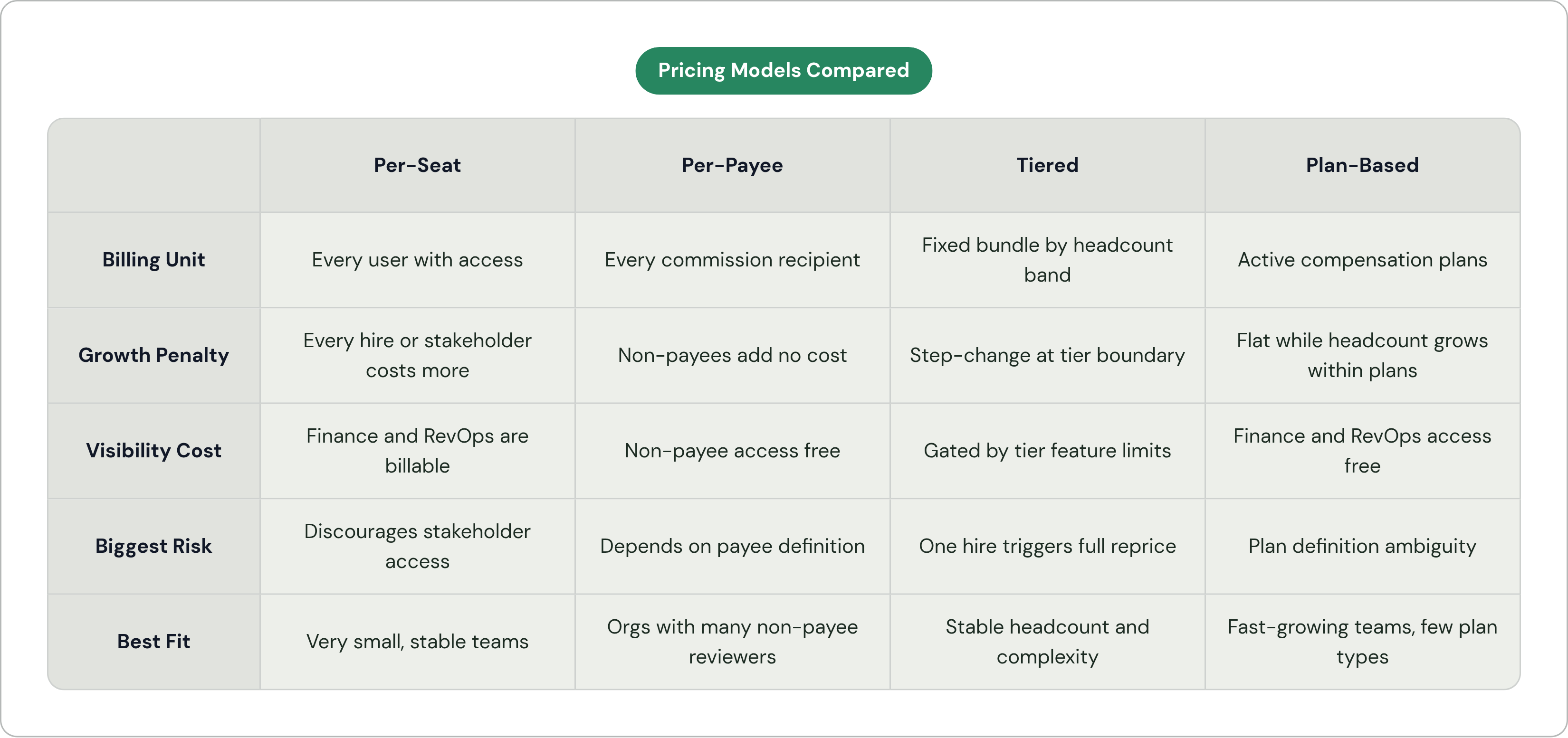
Plan-based pricing measures something else entirely: the number of active compensation plans running on the platform, not the number of people who can log in. Add a manager, a Finance reviewer, a RevOps analyst, and the bill doesn't move. Only a new, distinct compensation plan moves it.
That distinction matters most in exactly the phase where per-seat pricing hurts most: rapid headcount growth. Plan count and headcount grow at very different speeds. A company might run three active plans, say enterprise AE, SMB AE, and SDR, and stay on those same three plans whether the team behind them is 30 people or 80. The billing unit sits still even as the org chart moves.
With this model, plans are the unit of measure, so Finance and RevOps get full access to review, approve, and audit commission runs without ever counting as a billable seat. The logic is simple: commission software shouldn't penalize a company for growing, and it shouldn't penalize a company for giving the people who need visibility actual visibility.
There's a real tradeoff here, though. Plan-based pricing pays off most when a lot of people sit under a handful of plans and when non-payee access matters to the org. It offers less of an edge to a very small team where one person is admin, approver, and the only payee all at once; there, the unit of measure barely differs from a per-seat count of one. The question worth putting to any plan-based vendor is definitional: what exactly counts as a new plan, and does revising an accelerator or adding a mid-year SPIF create a new billable unit? The answer decides whether "plan-based" delivers the stability it promises or just moves the same volatility to a different line item.
The costs that no pricing model surfaces on the quote — and where they actually live
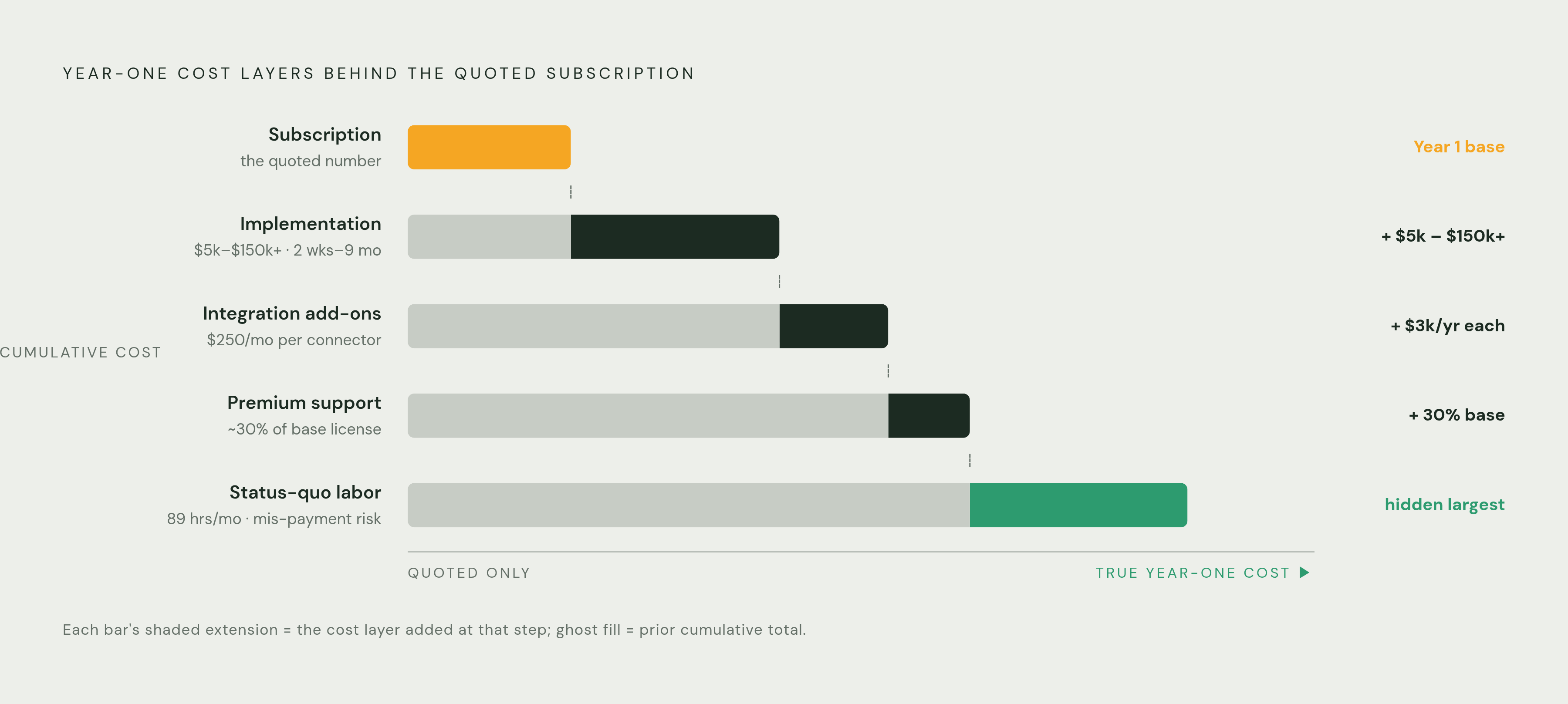
The subscription number on any quote, no matter which of the four models produced it, is rarely what a company actually spends in year one. Several cost categories only show up after the contract is signed.
Implementation and onboarding span an enormous range, from a few thousand dollars and two to four weeks at simpler platforms, to six-figure fees and three to nine months at full enterprise deployments. That range is wide enough to flip which option looks cheaper once you actually total it. Integration is its own line: connecting a non-primary CRM, an ERP system, or an HRIS tool is frequently priced as an add-on. The $250-per-month-per-connector figure mentioned earlier is one published rate among several similar structures in the market. Premium support sometimes scales as a percentage of the base license, with 30% showing up as a published figure more than once, meaning support cost climbs right alongside contract size instead of staying fixed.
Staying on spreadsheets isn't the free alternative it sometimes gets treated as, either. Comp administrators spend an average of 89 hours a month on manual payout reviews and dispute resolution, and a majority of companies report over- or underpaying commissions in the past year. Those are real costs, paid in labor and in error, even though no invoice ever arrives to make them visible.
A clean total-cost-of-ownership comparison has to hold five numbers at once: subscription cost, implementation cost, integration cost, support cost, and the labor and error cost the platform is supposed to eliminate. Timeline belongs in that math too, not as a footnote. A team spending 8 to 12 weeks implementing a new platform is still paying its old costs, spreadsheet labor, manual reconciliation, dispute cycles, the entire time. Delayed time-to-value is a real expense, even when nobody puts it on the invoice.
How pricing model choice plays out differently at different team sizes and growth stages
Small teams, roughly under 20 reps running one flat plan, are the one segment where the pricing model question barely matters. Per-user pricing at entry-level rates is cost-effective at that scale. Plan-based pricing offers little structural advantage when there's only one plan to count. A well-maintained spreadsheet remains a defensible option if the comp structure stays genuinely simple.
The growth-penalty problem gets real between roughly 20 and 100 reps, when plan types multiply and hiring is active. Per-seat cost climbs in a straight line with every hire and every stakeholder granted access. Tiered packages carry the risk of a step-change price jump at a headcount boundary that one new hire can cross. Plan-based pricing, by contrast, holds flat as headcount grows inside existing plans, which is exactly the condition this stage creates.
Mid-market teams, 100 to 200 reps, typically see plan complexity climb sharply: accelerators, SPIFs, clawbacks, split credit. That complexity raises the cost of a calculation error and raises the value of a real audit trail. Custom-quoted platforms enter the conversation here, and implementation cost and timeline stop being footnotes. They become deciding factors.
At enterprise scale, above 500 reps, custom pricing is close to universal, and total cost of ownership dwarfs whatever the per-unit rate looked like on the first call. Implementation speed and integration depth carry as much weight as price at this stage, sometimes more.
A few signals reliably say a team has outgrown its current pricing model. Stakeholder access requests getting quietly denied to dodge per-seat charges is one. A single new hire pushing the org across a tier boundary is another. There's a broader industry number worth keeping in view too: quota attainment sits well below universal industry-wide per one 2025 benchmark, a figure that points to plan design problems a rigid or opaque platform only makes harder to fix.
Questions to ask a vendor before committing to a pricing model
Start with the unit of measure. Ask exactly what gets billed, seats, payees, plans, or something else, and confirm whether every user type counts toward that number. Ask directly whether Finance, RevOps, and managers can get full review and approval access without counting as billable users. The honest answer tells you more about the pricing philosophy than the rate card does.
If you're evaluating a plan-based model, get precise on plan definition: what counts as a new plan, and does adjusting an accelerator or adding a SPIF mid-year create a new billable unit? On implementation, find out what the quoted fee actually covers, what triggers a change order, and what a realistic go-live timeline looks like for a team your size and complexity, not a generic average. On integrations, ask which CRM and payroll connections come included in the base price and which cost extra, and get the extra rate in writing. On support, ask what's included at the base tier and what the next tier actually costs.
Find out what happens to the contract if headcount grows 30% mid-term: a true-up, a tier jump, or no change at all. And take security as seriously as it deserves, because commission data is compensation data. Ask whether it's encrypted in transit and at rest, whether the environment is org-scoped, whether customer data trains any models behind the scenes. These are the same questions any careful buyer would ask a payroll vendor.
Last, ask about auditability directly: locked pay periods, logged approvals, a complete audit trail, and whether that comes standard or sits behind a premium tier. One more number worth carrying into that conversation: a majority of reps keep their own shadow-accounting spreadsheets just to check that their commissions are correct. A vendor charging extra for rep-level statement visibility is, in effect, charging you to fix a problem its own pricing model helped create.