Commission Software for Startups vs Enterprise Sales Teams
Startups and enterprises need different commission structures to match their sales maturity.
The architecture of a compensation plan reflects the maturity of the sales motion underneath it. A startup running one or two plan structures, typically base plus commission or commission-only for early hires, needs clarity above all else. An enterprise sales organization running simultaneous territory tiers, product launch incentives, accelerators, and clawback provisions across hundreds of active plans needs precision at scale. These aren't versions of the same problem. They are different engineering challenges.
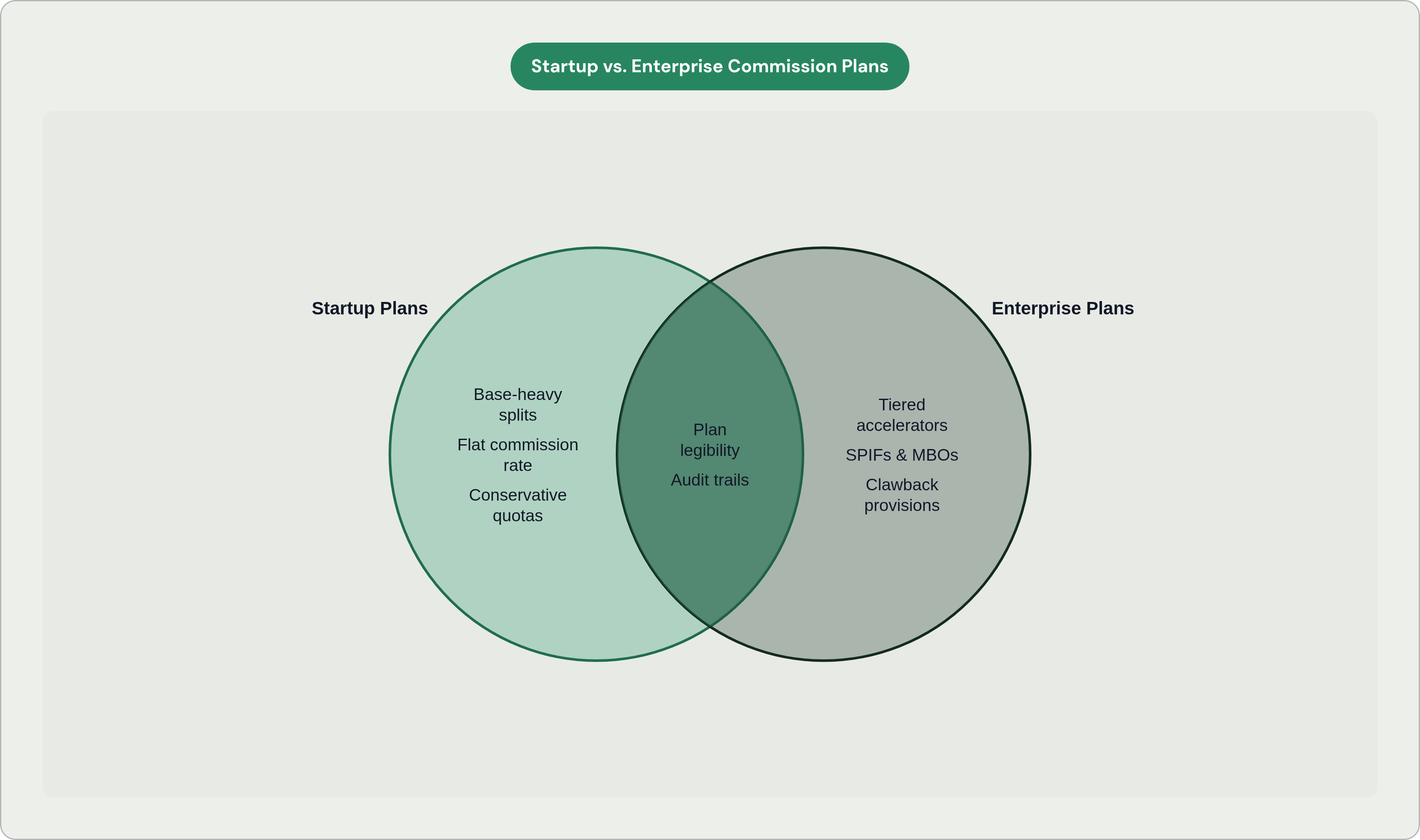
Base-to-variable splits follow predictable logic across both contexts. Entry-level and early-stage roles lean base-heavy because predictability is part of the value proposition for a hire taking a risk on an unproven company. Senior enterprise AEs working multi-month deals often carry near-even or variable-heavy splits, because the deal sizes justify asymmetric upside. Long sales cycles create a structural problem that flat, signature-day commission structures can't solve. Motivation degrades across a six-to-eight month close when the rep has no economic signal that progress is being recognized. Milestone-based payment structures address this directly, and they're a design feature most early-stage plans don't anticipate needing until a specific deal cycle forces the question.
Commission rate benchmarks follow a consistent logic. SMB deals carry higher percentage rates than enterprise deals, which trade rate for deal size. Early-stage startups push toward the higher end of the SaaS range to compete for talent against established brands with stronger inbound, better equity stories, and recognizable names. A mature company with strong brand recognition can sustain lower rates without losing candidates; an unknown Series A company can't make the same trade without a compensating variable somewhere else in the package.
Quota design is where the most damage is done at early stage. The Bridge Group's 2024 SaaS data puts the median quota-to-OTE ratio at 4.2x, a useful benchmark for teams setting initial targets. Pre-PMF startups are better served by a more conservative ratio. The reps hired before product-market fit is established are generating the signal you're need to build the sales motion, and burning them out with unachievable quotas destroys both the signal and the hire. The broader market confirms the pressure: only roughly half of AEs hit quota in 2024, a notable decline from 2022, which raises legitimate questions about whether quota-setting practices have kept pace with actual market conditions or have simply drifted toward aspirational rather than achievable targets.
Enterprise teams layer additional structural mechanisms that startups rarely need yet: tiered accelerators that step up rate after quota attainment, SPIFs for new product launches or territory pushes, MBOs tied to cross-functional metrics, and clawback provisions for churned or returned revenue. Each mechanism solves a specific behavioral design problem at scale. Accelerators retain top performers who would otherwise be indifferent once they hit 100%. Clawbacks protect margin in businesses with meaningful churn exposure.
One design principle applies at every stage, which is plan legibility. Ask a new team member to calculate their own payout on a hypothetical deal. If the answer isn't fast and confident, the plan is too complex. That test applies equally at five people and five hundred.
Where spreadsheets break down, and why it happens earlier than most teams expect
The "Excel is free" assumption hides costs that are real and compounding. Labor is the first. The time a founder, ops person, or finance analyst spends building, auditing, and defending a spreadsheet each month isn't free, it's just invisible because it doesn't appear as a line item. Multi-tier and accelerator formulas are especially prone to cascading errors; a single misapplied rate propagates across every rep the formula touches. Every error that reaches a rep becomes a conversation that consumes senior time.
The overpayment problem is documented and asymmetric. Sales Cookie's interview data with North American SMB sales managers found a 4.2% overpayment rate, a figure that compounds quietly because reps don't report windfalls. Underpayments get flagged; overpayments rarely do. Legal recovery of overpayments from current or former employees is constrained in most U.S. states, particularly where clawback clauses are absent from offer letters, making the leak effectively unrecoverable once it exits the system.
The data security failure mode is the one that rarely makes internal risk lists. Commission data contains individual compensation figures that carry the same sensitivity as payroll data, and spreadsheets offer none of the access controls, audit trails, or org-scoped tenancy that payroll systems require. The ICO's 2024 provisional fine against the Police Service of Northern Ireland following a spreadsheet disclosure error illustrates that the risk isn't only a wrong number; it can be a wrong file sent to the wrong person. That this failure occurred in a public institution doesn't diminish its instructive value for private sales organizations handling equally sensitive individual compensation data.
For startups, the break point arrives earlier than expected. A single product, two reps, and a flat commission rate is manageable manually. Add a second plan structure, a ramp period, and a clawback clause, and the spreadsheet becomes a liability. The decision to switch is almost always reactive, after an error, after a dispute, after a rep leaves angry. It should be proactive. The events that force the switch are predictable enough that waiting for one of them is just a choice to absorb the cost.
The transparency gap and what it costs in rep trust and selling time
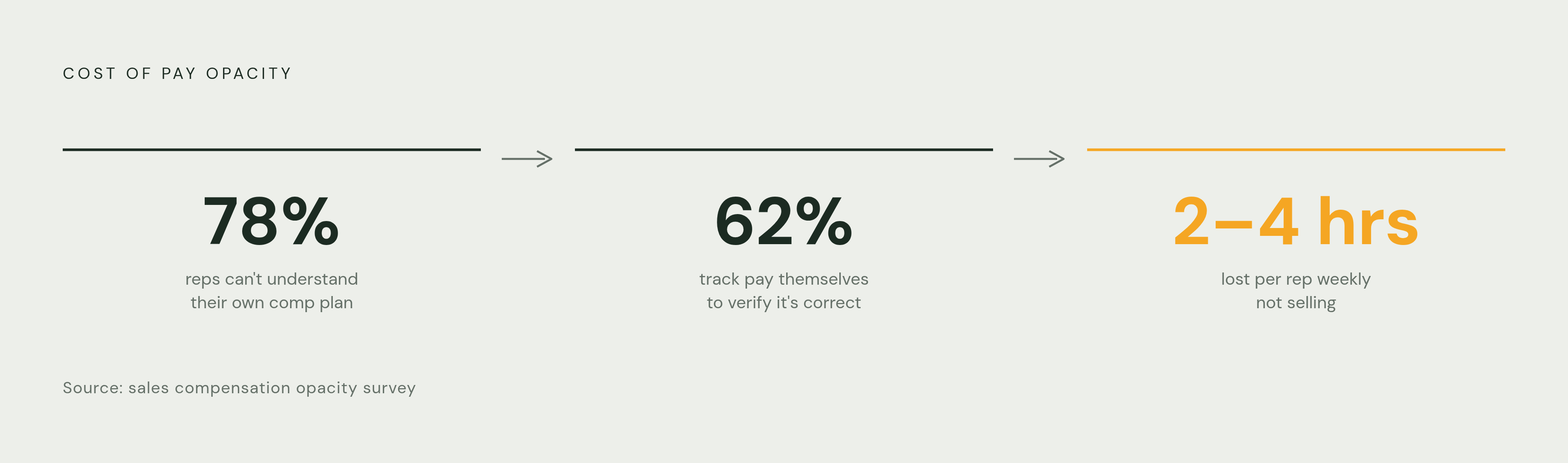
Shadow accounting is the behavior that emerges when reps can't verify their own pay. Sales Cookie's interview data puts the share of reps using shadow accounting to verify their payouts at 62%, at a time cost of roughly two to four hours per rep per week. For a team of any meaningful size, that's selling capacity permanently redirected into spreadsheet reconciliation. Separately, 78% of sales leaders report that reps can't fully understand their own compensation plans. The distrust isn't paranoia. It's rational.
Transparency isn't the same as disclosing the plan document. Knowing the rate is 8% doesn't tell a rep whether 8% was applied to the right deals at the right values. That gap is where disputes begin and trust erodes. Real transparency means a rep can trace their payout to the deal, the rate, and the rule, without asking anyone. An incentive a rep can't verify eventually stops functioning as one. Effort stops feeling connected to reward, and the disengagement or departure that follows is difficult to reverse once it sets in.
Retention and regulatory pressure are converging on the same requirement. Pay transparency laws in California, New York, Illinois, and a growing number of other states now require published compensation structures and clear documentation of pay calculations, making auditability a compliance requirement, not merely a best practice. PayScale's 2025 Compensation Best Practices Report found that companies with clear, verifiable on-target earnings report meaningfully improved rep retention compared to those without.
The quiet cost that doesn't show up in dispute logs is the rep who stops believing that effort maps to reward but doesn't say so. They don't file a dispute. They disengage, or they leave. WorldatWork data identifies a notable share of voluntary sales resignations tracing directly to compensation transparency issues. That signal is suppressed in organizations where reps have learned that raising comp questions isn't worth the friction, which means departure is often the first indication that a problem existed.
The underlying stakes are significant. Everstage's 2025 data pegs annual sales turnover at approximately 35%, roughly three times the cross-industry average of 13%. A single mis-hired and lost account executive costs around $115,000 in recruiting, training, and lost productivity. One bad comp cycle can trigger several of those losses simultaneously.
How RevOps and Finance teams experience commission workflows differently at startup vs. enterprise scale
The CRM-to-payroll gap is where most errors originate. CRM systems record intent; accounting systems record reality. Between them sit contract amendments, billing adjustments, deferred revenue, and deal edits that don't sync automatically. Every quarter that gap compounds: inflated forecasts, inaccurate headcount plans, audit exposure. When a deal closes in the CRM, commission calculation, financial reporting, and payroll should follow in an auditable, documented sequence. At manual-process companies, each step is a separate human handoff, and each handoff is where data drifts.
RevOps teams need specific infrastructure from commission systems: a direct, auditable link between CRM deal data and commission outputs, not a spreadsheet export that someone re-keyed; locked pay periods so historical calculations can't be altered retroactively; logged approvals so Finance can reconstruct any payout on demand. Gartner's research on revenue operations adoption shows that a large majority of the highest-growth companies are moving toward a RevOps model, which means commission workflow is increasingly owned by a function that demands this kind of infrastructure and has the organizational standing to enforce it.
At enterprise scale, the same requirements intensify proportionally. Hundreds of active plans across multiple territories and roles means any manual step in the workflow multiplies the error surface. Finance teams at this scale need cost governance visibility into what variable compensation is costing as a percentage of revenue, this quarter, by segment. Ad hoc spreadsheets can't produce that view reliably or quickly.
The startup-scale version of this problem isn't simpler. It's smaller, but structurally identical. A founder running commissions in a spreadsheet has no audit trail, no locked pay periods, and no separation of duties. The same risks are compressed into a team of five. Early investment in a structured workflow protects the company when a plan dispute arises, when a rep leaves, or when an investor asks about compensation cost controls during due diligence. That last scenario isn't hypothetical; it's a standard part of Series B and growth-stage diligence, and the absence of clean records is a yellow flag that experienced investors notice.
What to look for in commission software at each stage of company growth
The wrong framing in evaluating commission software is "enterprise platform versus SMB tool." The right question is whether a platform meets a team where their data and plans already live, or forces a workflow redesign to accommodate the tool. Pricing model is part of this evaluation. Per-seat pricing penalizes growing teams at exactly the moment they need the platform most. Per-plan pricing scales with actual complexity rather than headcount, which is a more honest alignment between cost and value.
Certain features are non-negotiable. CRM or file-based data import eliminates manual re-entry and the errors it introduces. Rep-level statement visibility, meaning a deal-by-deal breakdown a rep can verify without asking anyone, is the foundation of transparency. Audit trails and locked pay periods are required for dispute resolution and Finance sign-off. Encryption in transit and at rest, with org-scoped access controls, is not optional. Commission data is compensation data and should be treated with the same security posture as payroll.
Additional features matter more as plan complexity grows. Tiered rates, accelerators, SPIFs, and clawback logic represent the structural layer that flat-rate tools can't accommodate. Multi-plan management at scale is an enterprise-specific requirement; organizations running hundreds of active plans need a platform that can hold and differentiate them without manual intervention becoming the bottleneck. AI-assisted plan extraction, used to ingest existing compensation documents without rebuilding from scratch, is a meaningful time-saver, provided that human review and approval remain mandatory before any plan goes live. Automated plan activation without human sign-off is an acceptable shortcut until the day it isn't.
On the platform landscape: Quota Queue approaches the startup-to-enterprise spectrum with plan-based pricing, so a five-person startup and a fifty-person team both pay for what they actually use rather than for seats they don't need. Its four-step workflow of import, build, configure, and lock-and-export is structured enough to satisfy Finance and approachable enough for a solo RevOps hire managing five other priorities. AI assists plan creation from existing documents but requires human review before activation. Built-in audit trails, locked pay periods, and encryption treat commission data with payroll-grade security from the first plan onward.
For organizations running complex, multi-territory plans at scale, platforms like Varicent, Xactly, and SAP Commissions carry deep modeling capability suited to that environment, typically with corresponding implementation timelines and enterprise contract structures. That's an appropriate trade for organizations whose plan complexity justifies the investment. Mid-market teams whose plan complexity is growing faster than headcount will find it worth evaluating platforms that offer more configurability than basic tools without the full overhead of an enterprise deployment.
The evaluation criterion that cuts across every option comes back to the same test as plan design. Can a rep trace their own payout to the deal, the rate, and the rule without opening a support ticket? If not, shadow accounting fills the gap, and the platform has already failed the transparency standard that both startups and enterprise teams share. If calculating a hypothetical payout takes more than a few minutes, or if a dispute can't be resolved by pointing to a locked, auditable record, the current system isn't adequate. Most organizations figure this out after an incident. A few figure it out before one.