Commission Software for Mid-Market Sales Teams
Complex commission plans now outpace what spreadsheets can safely manage for growing sales teams.
Mid-market sales organizations, generally the ones running somewhere between a few dozen and a few hundred reps, sit in an uncomfortable gap. Their commission plans have grown too intricate for spreadsheets to handle safely, yet the enterprise incentive compensation platforms built for thousands of payees and a dedicated comp team hand these teams far more machinery than they need, priced accordingly. So the segment splits in two: half overpaying for capability they'll never touch, half stuck with tools that cap out right when their plans start getting interesting.
I've watched this play out at three different companies now, and the pattern repeats almost exactly. Small and mid-sized business adoption of commission software has climbed sharply over the past five years, and mid-market is now the fastest-growing cohort in the category. What follows is why that's happening, what actually breaks first when these teams try to run commissions by hand, and what a platform has to get right to earn a spot in this segment's stack.
How commission plan complexity has outpaced what manual processes can handle
Commission plans have gotten more elaborate, and not by a small margin. A plan a decade ago might have run on three to five variables. Today's plans commonly carry eight to twelve: tiered rates that shift at quota thresholds, accelerators above 100% attainment, product-specific rates and SPIFs, manager overrides, team splits, ramp adjustments for new hires, clawback provisions tied to contract length or payment terms, separate rate cards for renewals versus new business.
Any one of those, on its own, is nothing. A spreadsheet handles a tiered rate fine, and it handles an accelerator fine too. The trouble starts when all of them stack at once, applied across fifty-plus reps whose territories shift mid-quarter, whose deals touch multiple products, and whose plans each got tweaked slightly during the last hiring cycle. That's a combinatorial load no formula built by one overworked ops manager can track without something breaking quietly, somewhere in the workbook, that nobody notices until a rep asks about it.
There's an old diagnostic I still use: ask a new hire to work out their own commission on a hypothetical deal. If they hesitate, or shrug, the plan has already outgrown whatever's managing it. Caps make the problem worse in the opposite direction. Capping accelerators demotivates your best performers right when they're closing the most business. Uncapped, compounding accelerator math is exactly the kind of thing that breaks spreadsheet formulas at the edges, though, where nested IF statements and manual overrides start spitting out numbers nobody can explain anymore.
Then there's the regulatory layer, which only adds weight. Pay transparency laws bring documentation requirements spreadsheets were never built to carry. A workbook can calculate a number, but producing the audit trail a transparency law expects takes a lot of manual patching that defeats the point of using a spreadsheet in the first place.
The real error rate when mid-market teams run commissions on spreadsheets
Spreadsheets are unreliable before anyone even adds commission logic, which is part of why commission calculation platforms like Quota Queue exist as a replacement rather than a complement to them. Ray Panko's research at the University of Hawaii, which anyone who's worked in FP&A has run into at some point, found that the vast majority of Excel spreadsheets contain errors in at least one percent of their formulas. That's the baseline defect rate in ordinary financial modeling, before tiered rates and clawback clauses show up at all.
Stack commission math on top of that and it gets worse fast. Companies running manual tools report commission error rates well above what automated platforms produce, and separately, most companies admit they've paid commissions incorrectly at some point, whether from a typo, a clawback miscalculation, or two systems that were never reconciled. Getting it wrong is closer to the norm than the exception, which is a strange thing to type out and still believe, but I do.
A two or three percent miscalculation rate is not a rounding error a mid-market team can shrug off at quarter close. Real financial exposure sits on the books because of it. It shows up as an overpayment that forces an awkward clawback conversation, which damages trust no matter how gently it's handled. Or it shows up as an underpayment, which triggers disputes, sometimes attrition, and occasionally legal exposure. ASC 606 raises the stakes further: tracking amortization schedules, contract modifications, and impairments by hand doesn't produce the kind of audit trail regulators expect, and that gap widens every quarter deal volume grows.
The financial case isn't subtle, either. Independent analyses of total cost of ownership consistently find that smaller organizations, in the 50 to 100 rep range, see strong first-year returns after switching to commission software, with the bulk of the benefit coming from error reduction and the rest split between administrative efficiency and sales productivity gains. The real question for a mid-market buyer is how much the manual process is already costing them, quietly, every single month.
Shadow accounting — what it signals about commission trust in mid-market teams
A majority of sales reps, by most surveys I've seen, keep a private spreadsheet just to check their commission statement against what they think they're actually owed. Call it paranoia if you want. I'd call it a rational response to a process reps have learned not to trust on the first pass.
Shadow accounting is expensive, too, in ways that never show up on a budget line. According to the Aberdeen Group, reps can burn 25 to 50 percent of their monthly time building and maintaining these private verification sheets, time that isn't going toward selling. The problem underneath it is structural, not personal: a rep who knows their rate is eight percent still has no way to confirm that eight percent got applied to the right deals, at the right values, with the right adjustments. That gap between knowing the rule and verifying the outcome is where disputes start, no matter how well the plan document was written.
The dispute load lands on ops teams too. A meaningful share of reps file at least one commission dispute a year, and I've heard of teams spending 40-plus hours a month just resolving disputes before they automated. The underlying dynamic is straightforward: when reps can't verify their numbers through official channels, they find other ways, and the disputes that follow can be harder to resolve than a plain spreadsheet disagreement.
The attrition numbers tie it together. Compensation transparency issues drive a real share of voluntary sales resignations. Replacing a rep runs well into six figures once ramp time and lost pipeline get factored in, and most sales professionals say they'd leave for a comparable role elsewhere if the pay were clearer, even at similar total comp. Shadow accounting is usually the first sign that a commission process has already started costing a company its people.
What "commission transparency" actually requires in a software platform
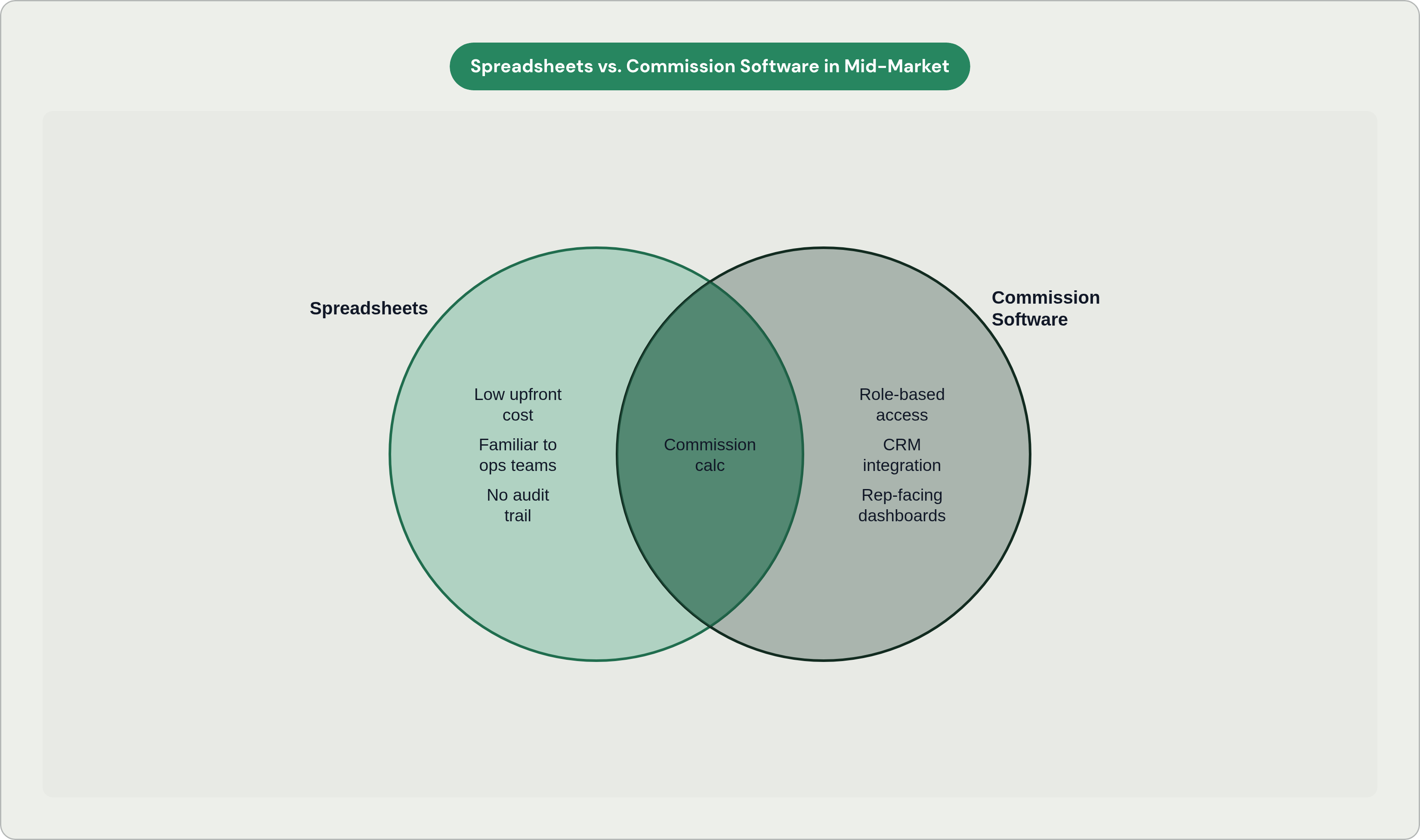
Transparency means a rep can see the actual deals behind their number: the rate applied to each one, which accelerators kicked in, what adjustments were made, and how all of it rolled up into the figure on their statement. Knowing the rule is not the same thing as seeing how the rule got applied to your paycheck.
That takes specific mechanisms, not a vague commitment to openness. A dashboard showing a rep their own earnings, quota progress, and deal-level statement detail close to real time. Calculation logic visible line by line, instead of collapsed into one total that just asks for trust. And the ability to trace any dollar on a statement back to the deal it came from, without filing a ticket or waiting on someone in ops to run a report.
Visible math kills the information gap that drives shadow accounting in the first place. Reps who can check their own numbers generally stop building parallel spreadsheets, because there's nothing left to verify that the system hasn't already shown them. This, notably, is also the feature most often left out of DIY spreadsheet builds, since it's the easiest thing to cut when the model gets built for a manager's monthly review instead of a rep's daily use.
On the finance side, the equivalent of rep-facing transparency is an audit trail: locked pay periods, logged approvals, a calculation history you can actually trace. That covers day-to-day compliance, and it becomes the evidence base if a dispute ever escalates past a normal conversation. None of this is unique to sales comp, by the way. Most employees want pay transparency in some form, and commission software that surfaces this by default is just meeting an expectation the rest of the workforce already holds.
How RevOps and Finance each experience the commission workflow — and where they collide
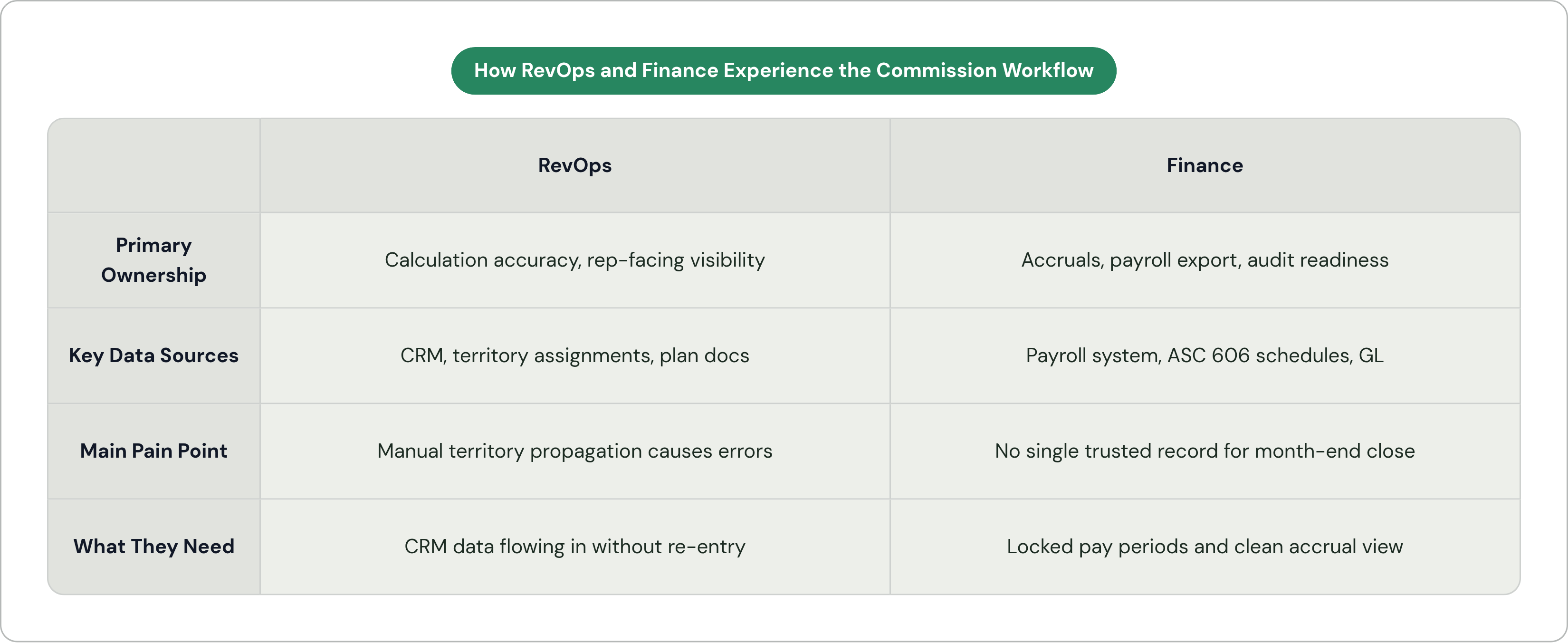
Commission sits at a junction that both RevOps and Finance claim, and both are right to claim it. That's the problem. RevOps generally owns calculation accuracy and rep-facing visibility, while Finance owns accruals, ASC 606 compliance, the payroll export, audit readiness. Both functions work off the same underlying data, usually from different systems, on different timelines, and often without knowing the other side has already touched it.
Data fragmentation is where the friction actually shows up. Data fragmentation is a persistent challenge that tracks with what I've seen firsthand: commission data tends to live in the CRM, in a plan document somewhere, in a spreadsheet, and sometimes in a separate payroll system, with no single record either side fully trusts.
Manual territory changes make it worse. Update a territory in a spreadsheet and someone has to hand-propagate that change into quotas, into commission math, into whatever dashboard leadership is looking at, and each hop is a fresh chance for an error to slip through unnoticed.
What mid-market teams actually need here is specific. Deal data flowing from the CRM into the commission tool without manual re-entry. Payout data flowing back into payroll without manual journal entries. An accrual view Finance can use at month-end without a spreadsheet reconciliation, and one locked, approved pay period record both sides can point to as ground truth.
Growth only raises the stakes. Mid-market teams heading toward a RevOps structure need commission software built to fit that model on its own, without requiring a dedicated compensation administrator just to keep running. Getting RevOps and Finance aligned on shared commission data matters more than most org charts would suggest.
The integration and data portability requirements that mid-market teams underestimate
The single most common mistake in evaluation: buyers pick a platform based on how well it builds plans, and never test how well data actually moves in and out of it. Plan-building looks great in a demo, but integration quality doesn't show its cracks until months into implementation, usually right when it's most painful to switch.
CRM integration is the data-in requirement that matters most. Commission software that still needs someone to manually export from Salesforce or HubSpot has quietly reintroduced the exact error surface it was supposed to eliminate. The acceptable patterns are fairly narrow: a native connector syncing on a schedule or triggering on deal close, a CSV upload as fallback for nonstandard CRM setups, and field mapping with validation that catches import errors before they hit a calculation, not after a rep's already staring at a wrong number.
Data going out matters just as much. Payroll export needs to be a structured file mapped to whatever the finance team's actual payroll system expects, not a summary PDF someone has to retype by hand. The vendor market has largely caught up here; API expansion has been one of the most widely adopted upgrades across commission platforms in recent years. That's the industry treating this as baseline now, not as a premium add-on.
Buyers should be wary of any platform that asks them to rebuild CRM workflows or restructure deal data to fit the tool. Good software meets a team where its data already lives. A "rip and replace" implementation is solving a problem the buyer didn't have. On timing: a well-supported migration typically takes a matter of days for data import and configuration, run in parallel with the old process for one pay cycle to confirm the numbers match before cutting over fully. Ask vendors directly about this instead of assuming it'll be painless, since the answer varies more by vendor than most buyers expect.
Commission data security requirements that mid-market buyers routinely skip in evaluation
Commission data is compensation data, plainly. It carries individual earnings, quota attainment, deal values, territory assignments: the same sensitivity class as payroll data that most organizations lock down without a second thought. Commission data usually doesn't get that same treatment, and that gap deserves more scrutiny than it gets.
The spreadsheet security gap is the clearest example. A shared Google Sheet or an emailed Excel file has no access controls, no audit trail, no encryption, and this remains standard practice for commission management at mid-market companies that would never accept the same exposure on their payroll system.
Any platform under evaluation should answer, specifically, on a short list of items. Encryption in transit and at rest. Tenancy scoped so one customer's data is never reachable by another. Role-based access so reps see only their own numbers while managers see their team's. Audit logs recording who viewed, changed, or approved any record. And a written policy on whether customer data trains AI models, which is a question worth asking bluntly, because not every vendor volunteers the answer.
For companies moving toward SOX compliance, or sitting inside acquisition due diligence, this stops being optional. SOX Section 404 requires formal internal controls over systems that affect financial reporting, and commission calculations and approvals fall squarely inside that scope. At that point, audit trail documentation is the price of admission.
Most vendors have invested in security features over the past couple of years, which means buyers should treat baseline security as a floor, not a differentiator, and should push past any vendor's claim of "enterprise-grade security" until they get the specifics behind it. A useful evaluation question, short and direct: where is the data stored, is it used for model training, and exactly how is access scoped. Vendors with immediate, specific answers are operating at the level this data actually requires.
Pricing structures and how they affect mid-market teams as they grow
Most commission software is priced per seat, per payee or active user, billed monthly. Looks clean on a pricing page, but turns into a real problem the moment a mid-market team hires aggressively, which is exactly the moment growth is supposed to feel like a win rather than a cost center. Per-seat pricing means software cost climbs in lockstep with headcount, which quietly discourages adding new reps to the platform at all, defeating the entire point of having it.
Worth knowing: some vendors price by the number of active compensation plans instead of by headcount. That structure keeps costs predictable regardless of how fast a team grows, and it lines up the vendor's incentive with plan complexity rather than raw seat count, which is a more honest match for what the software is actually doing.
Before signing anything, model total cost at current headcount, then again at 1.5x and 2x, using growth assumptions that are realistic over the next 12 to 18 months rather than the rosiest case in the deck. Ask plainly whether adding a comp plan for a new role or a new product line triggers a new fee, a new contract negotiation, or neither; vendors don't always volunteer this. Pricing structure isn't a footnote here. For a team planning to double headcount inside two years, it can matter as much as any feature on the platform.