Spreadsheet-Based Commission Tools vs Dedicated Software
Spreadsheets breed errors, disputes, and admin overhead that dedicated software eliminates entirely.
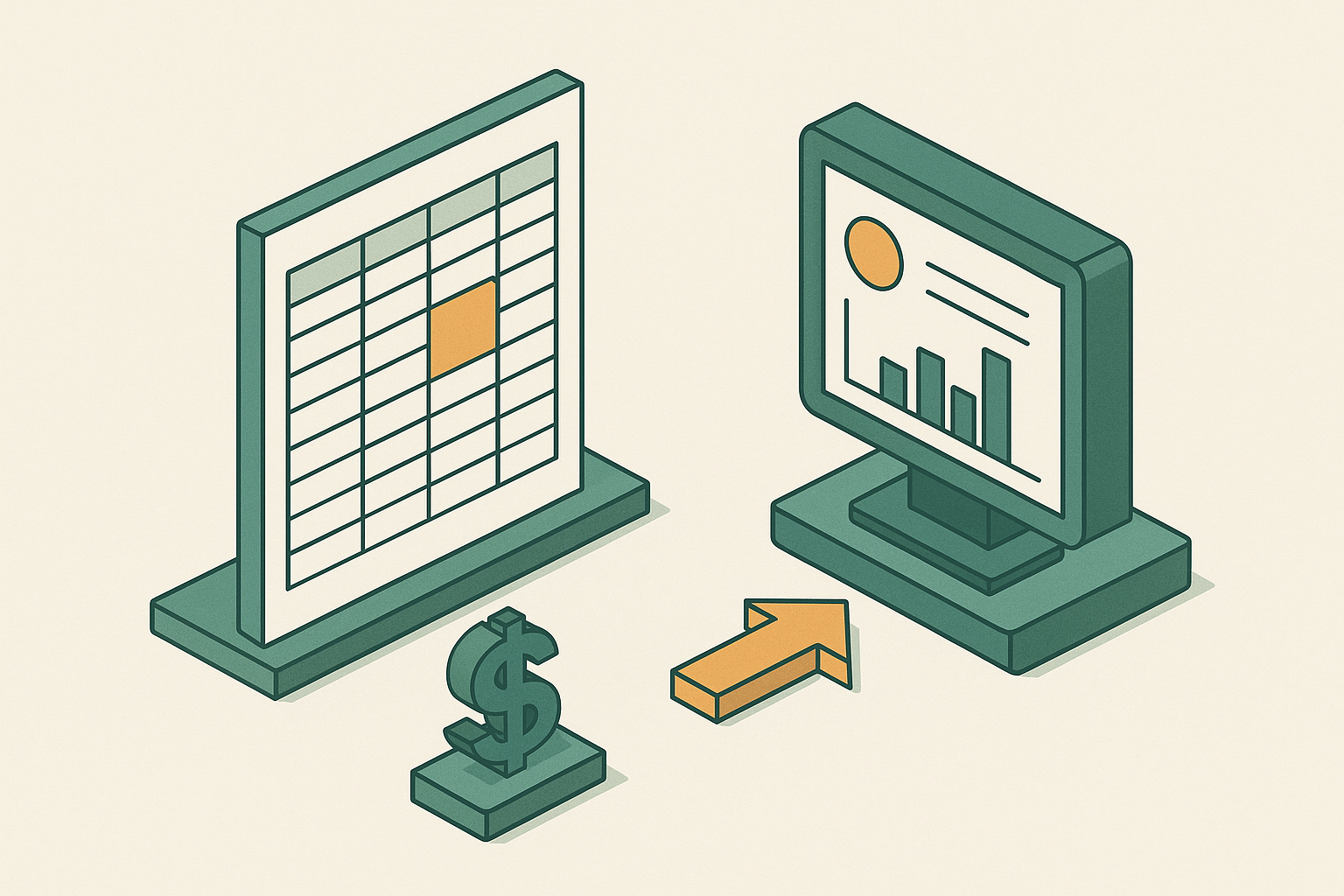
Spreadsheet-based commission tracking survives in most sales organizations for one reason: it's already there. There's no procurement cycle, no new login, and nothing to learn that finance and ops haven't already picked up over a decade of Excel and Google Sheets. Most small and mid-sized businesses still run commissions this way. The real question is what that convenience costs once a team outgrows the size and simplicity that made spreadsheets tolerable in the first place.
Ten reps on one flat rate is something a spreadsheet handles fine, since the formulas are simple, the data volume is low, and mistakes are easy to catch because there's so little to check. But a setup that works today doesn't stay working on its own. The conditions that make spreadsheets manageable erode fast once headcount climbs, plans get tiered, and deal data starts arriving from four systems instead of one.
Where spreadsheet commission calculations break down structurally
Spreadsheets are general-purpose tools. Commission calculation is a specialized, repeatable financial job, and rebuilding it by hand every cycle inside a tool that was never built for it is where things start to give.
Lookup errors are the failure I've seen most. A formula references a rate table, the table gets resorted or someone inserts a row above it, and every downstream reference now points at the wrong line. No error message pops up, and the number just comes out wrong and sits there looking fine until somebody happens to check it by hand, usually weeks later.
Tiered plans make it worse. A nested IF statement covering four or five commission tiers is exactly the kind of formula where one misplaced parenthesis quietly wrecks output for an entire cohort of reps. Mid-quarter plan changes compound it: quota parameters shift partway through the period, some formula still points at the old numbers, and nobody catches it until payout. By then it's too late to fix quietly.
Then there's the manual adjustment. Someone corrects a rep's total because a deal got miscategorized, or a discount never made it into the sheet. That correction leaves no trail, no record of who touched it, when, or why. Academic research on spreadsheet error rates has found the same thing for years running: the overwhelming majority of non-trivial spreadsheets contain at least one material error, because the medium was never built for audited, repeatable financial work. Payroll spreadsheets at least get caught somewhere downstream by payroll controls, but commission spreadsheets usually have no equivalent checkpoint at all.
The financial leakage that errors produce
Every calculation error eventually becomes a payroll transaction. Overpayments drain budget directly, underpayments trigger disputes, and disputes wear down the trust that keeps a sales team functioning day to day.
Ventana Research found that among organizations running compensation through spreadsheets, most report incorrect payments; only a small minority report a clean cycle. An error-free month is the exception here, not the baseline anyone should expect.
Underpayments carry their own weight. A rep who believes they got shorted doesn't stay quiet, and frankly they shouldn't, since commission is often the largest slice of their pay. They dispute the number, they check out mentally, or they leave. None of this is abstract. On any real commission budget, even a small error rate turns into actual dollars, either walking out the door as waste or landing in the wrong paycheck for the wrong reason.
Dedicated commission software removes the manual formula chain where these errors get born in the first place. Locked calculation logic applies the same rules to every rep, every cycle, with no copy-paste step anywhere near the critical path.
The administrative time that manual commission processes consume
A monthly commission cycle on spreadsheets means pulling data from the CRM and the billing system, reconciling the two when they don't match (they rarely match cleanly), applying manual adjustments, chasing discrepancies, then fielding questions once numbers go out. This repeats, in full, every single cycle, until someone changes the process.
Reconciliation eats most of the time. Revenue data lives in the CRM, in billing, sometimes in the ERP, occasionally in a side log someone keeps for deals that don't fit the standard pipeline. Stitching that together by hand every month has become a routine fire drill, the kind ops teams schedule around rather than fix.
Dispute handling stacks on top of that. Every time a rep questions their number, someone in ops traces back through the formula chain, finds where it broke, and explains it in terms the rep can actually follow. That conversation eats close to an hour per rep, per cycle, once a team has any real size to it.
Commission platforms cut this workload substantially. Data ingestion runs on its own, rules apply the same way every time, and reps get enough self-service visibility that routine questions never reach an ops inbox. There's an opportunity cost buried in here too: every hour finance spends reconciling commission data by hand is an hour not spent on plan design or forecasting, the work that actually grows a business. Tally your own monthly hours on commission admin, multiply by the loaded cost of whoever's doing it, and weigh that number honestly against what a platform runs.
How spreadsheet-based commissions erode rep trust over time
Most sales professionals say they want more visibility into how their commission gets calculated. Current practice doesn't deliver it, and reps notice fast. When someone can't see the mechanics behind their own number, they stop trusting the number.
What follows has a name: shadow accounting. Reps who don't trust the official figure build their own spreadsheet to check it independently. Aberdeen Group has pegged the time this absorbs at a real chunk of a rep's working month, time spent reconciling a private spreadsheet against a system they don't trust instead of time spent with customers. That's a direct productivity loss, and it compounds across every rep who does it, quietly, month after month, never showing up on anyone's dashboard.
Disputes follow the same logic. A meaningful share of reps file at least one commission dispute per year, and the lack of pay transparency is a documented driver of voluntary resignation. Replacing a sales hire is expensive; the fully loaded cost per lost rep, once recruiting, onboarding, and ramp time all get counted, runs well into the tens of thousands of dollars. Retention belongs in this conversation as a line item, not an afterthought.
Publishing a rate table doesn't fix any of this, because the problem sits in the structure, not in what gets disclosed. Reps need their own deal-level statement: which deals counted, what rate applied to each one, how the total built line by line, and where they stand against quota in real time instead of finding out at month-end. Dedicated platforms build rep dashboards around exactly that, a traceable, deal-by-deal breakdown a rep can check without opening a ticket.
The audit and compliance exposure that spreadsheets leave open
Commission data is compensation data. It identifies specific people, ties directly to payroll, and carries the same sensitivity as a salary record. Spreadsheets apply almost none of the controls payroll systems take for granted.
Start with access. A shared commission spreadsheet typically exposes every rep's numbers to anyone holding the link, and the usual workaround, a manually maintained per-rep view tab, is fragile and needs constant babysitting to stay accurate. There's no audit log either: a manual edit to a formula or a total leaves no trace of who changed it or why, so when an auditor asks, there's nothing to hand over. Offboarding is its own quiet failure too, since when someone leaves the company, their access to the spreadsheet doesn't get revoked the way it would in a real system, and it just sits there until somebody remembers.
The risk extends beyond wrong numbers, into the wrong file landing with the wrong person, which is exactly what regulatory enforcement cases have shown: serious penalties issued after a spreadsheet disclosure error. GDPR applies to any company handling personal data belonging to individuals in the EU, the fines for non-compliance run real money, and DLA Piper's annual survey found personal data breach notifications rose significantly year over year in 2025. For companies with ASC 606 obligations, commission figures feed straight into revenue recognition accruals, so a material miscalculation there carries consequences well past an HR headache and into financial reporting itself.
Commission platforms swap the spreadsheet workarounds for enforced role-based access, locked pay periods, logged approvals, encryption in transit and at rest, and data separation by organization. Those are the controls that satisfy an internal auditor and an external regulator asking the same question.
What dedicated commission software actually does differently
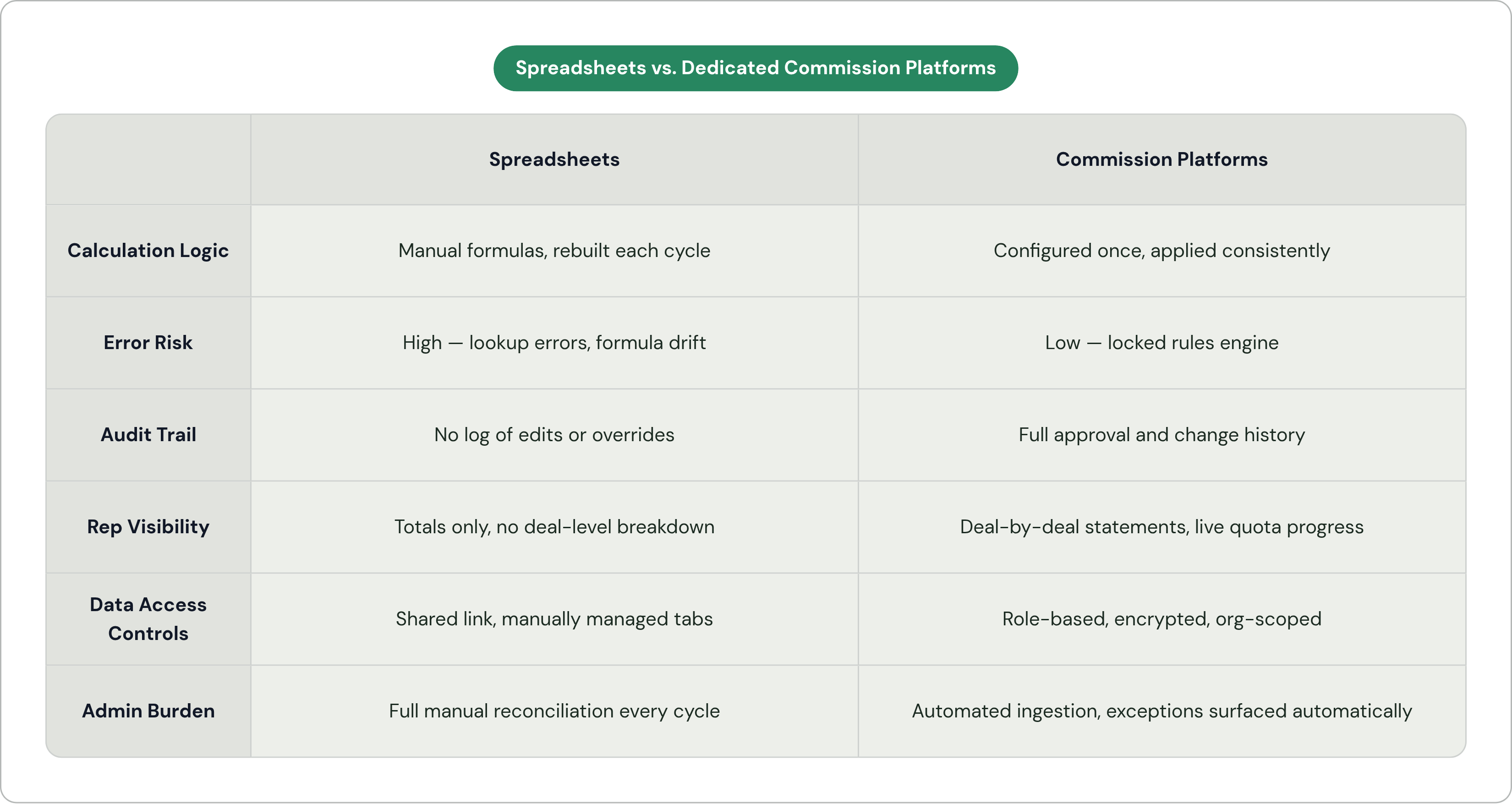
Purpose-built platforms replace the manual formula chain with a defined, repeatable workflow: data comes in from the CRM or a file upload, rules apply the same way to everyone, results get reviewed and locked, and the output exports straight to payroll. That's the whole cycle, and it holds its shape month over month in a way a spreadsheet process rarely does.
Calculation logic gets configured once and applied the same way to everyone, with no copy-paste errors and no formula drift. Tiered rates, accelerators, SPIFs, and clawbacks all run through the same rules engine every cycle instead of a bespoke formula somebody rebuilds by hand. Direct CRM integration means data ingestion stops being a manual export, and reconciliation exceptions surface on their own instead of demanding a line-by-line comparison.
Rep trust follows from the same shift. Deal-level statements give every rep a traceable breakdown of each line, with quota progress visible in real time instead of dropped on them all at once at month-end. Every plan change, override, and approval gets logged, and pay periods lock so history can't drift after the fact. Role-based access gets enforced at the platform level instead of approximated with a shared tab, and data stays encrypted and scoped to the organization.
Some platforms now use AI to help build plans, pulling structure out of existing plan documents and flagging logic conflicts before they go live. That speeds up setup, though a human still has to review the plan before anyone signs off, and that part hasn't changed. The stronger platforms in this space meet teams where their data already lives, plugging into whatever CRM is already in use instead of forcing a new workflow on top of the old one. Pricing matters too: platforms priced by compensation plan rather than by seat, like Quota Queue, a spreadsheet-free commission calculation platform built on that model, don't penalize a company for hiring, and that difference shows up in total cost as a team grows.
How to evaluate commission software options for your team's situation
Team size and plan complexity are the first filter, and there's no getting around it. A team under two dozen reps on a flat commission rate gets a genuinely lower return on automation than a team running tiered plans, accelerators, and deal data pulled from three different source systems.
A handful of questions do most of the real evaluation work. Does the platform integrate directly with the CRM and billing systems already in use, or is it a manual export dressed up as an integration? Can it handle the plan mechanics already in place, tiers, accelerators, SPIFs, clawbacks, draw arrangements, or only the simple case? What does a rep-facing statement actually look like, and is the detail enough for a rep to check their own number without calling ops? Does it produce a locked, auditable pay period record with approval logs attached? And how is it priced, by seat, by plan, or by payout volume, and how does that pricing behave as headcount grows?
For mid-to-large teams with more complicated crediting rules and territory structures, Everstage is built specifically for that range. At enterprise scale, purpose-built platforms exist for large, complex organizations with the integration depth and compliance rigor that scale tends to demand.
The decision comes down to a cost comparison, and it's worth actually running the numbers instead of guessing at them. Tally the real hours spent on commission admin each cycle, estimate the leakage from calculation errors, account for the cost of disputes and the turnover that unresolved distrust eventually produces, then weigh that total against what a platform costs. For most growing teams, that math resolves in one direction. Pick the platform that handles the plan mechanics you already run, connects to the data sources you already use, and gives reps enough visibility that shadow accounting stops being worth their time.