CRM Integration Depth Across Commission Platforms
Shallow CRM links hide data gaps that silently break commission calculations.
"Does it connect to Salesforce?" That question tells you almost nothing. Every commission platform on the market answers yes to it. What matters is which objects it reads, how often it reads them, and at what level of detail, because a commission plan almost never runs off a single field.
I've watched this play out enough times to know where the bodies are buried. Commission calculation touches at least four categories of CRM data: the Opportunity object (close date, stage, ARR or ACV, product line, split percentages), the Account object (territory, segment, whether a deal counts as a renewal or new business), the Contact or User object (rep assignment, ramp date, role changes), and, for any B2B company with real complexity in its motion, custom objects where product-level detail or usage-based terms actually live.
Shallow integrations grab the first of these and call it done. They sync closed-won Opportunity records on a schedule and treat that as sufficient. But a plan with tiered rates, SPIFs, clawbacks, or split credit needs fields a closed-won-only sync never touches, and that gap doesn't announce itself. It just sits there until someone's paycheck is wrong.
Here's what "stopping short" actually looks like. A plan needs a product-line breakdown to apply different rates to different SKUs, but the integration only surfaces deal total, so every deal gets rated as one undifferentiated blob. A plan applies ramp-adjusted quotas keyed to a rep's start date, but that field lives on the User object, not the Opportunity, and the integration was never built to read it. Ramp logic breaks quietly. Nobody notices until a new hire's first check comes out wrong. Split percentages get buried in a custom field the integration wasn't configured to pull, so split credit ends up calculated by hand in a spreadsheet, which defeats the entire point of automating this in the first place.
Every one of these gaps forces a manual workaround, and a manual workaround drags back exactly the fragility that moving off spreadsheets was supposed to kill. Quota Queue, a commission calculation platform that takes companies from raw deal data to payroll-ready statements without spreadsheets, is built to pull structured field data rather than a single closed-won record. Usage-based pricing makes it worse: when commission depends on consumption data, that data usually lives outside the standard Opportunity record entirely, in a billing system or a custom object the integration has to be deliberately engineered to reach. If nobody built that pipe, the platform is blind to the very thing it's supposed to pay on.
The CRM data quality problem that sits upstream of every integration
Before an integration ever touches the data, the data is often already bad. Validity's 2025 State of CRM Data Management report puts a number on it: 37% of teams report losing revenue directly because of poor data quality, and 68% say they struggle with incomplete CRM data outright. So the feed going into a commission platform is frequently compromised before a single calculation runs.
This hits commission harder than almost any other CRM-dependent process, because commission math is precise, dollar-denominated, and felt personally by the person waiting on the check. A typo in an ARR field doesn't just look wrong on a dashboard. It produces a payout wrong by a proportional amount, and someone's paycheck carries the error. A renewal reclassified after close, from new business to renewal or the reverse, changes the applicable rate, but if the calculation snapshot already fired, that change never reaches the payout. Deal ownership transferred mid-quarter creates an ambiguous split with no logged history to resolve it. A missing ramp date means quota-adjusted logic runs silently against the wrong denominator, and the rep has no way to know.
These are upstream data quality failures, not integration failures in the narrow sense. But integration depth decides whether they get caught or whether they compound silently into a payout nobody questions until a rep does the math themselves at 11pm on a Sunday. A shallow integration takes whatever the CRM hands it, runs the number, and ships it with no signal that anything might be off. A deep integration, with field-level validation built in, can catch the anomaly, the blank required field, the internally inconsistent date range, before the payout ever gets approved.
The Uber case is worth bringing up, not because Uber runs a commission platform, but because it shows what's at stake when calculation logic and data quality drift apart at scale. An accounting error in how Uber calculated its own commission structure led to systematic driver underpayment, averaging roughly $900 per driver, and it took years to fully unwind. Sophistication doesn't inoculate an organization against this. Structural safeguards do. So the real question for buyers isn't just which CRM fields the platform reads. It's what happens when a required field is blank or internally inconsistent. That second question is where shallow and deep integrations actually part ways.
What a deep integration actually looks like: real-time sync, field-level change detection, and audit trails
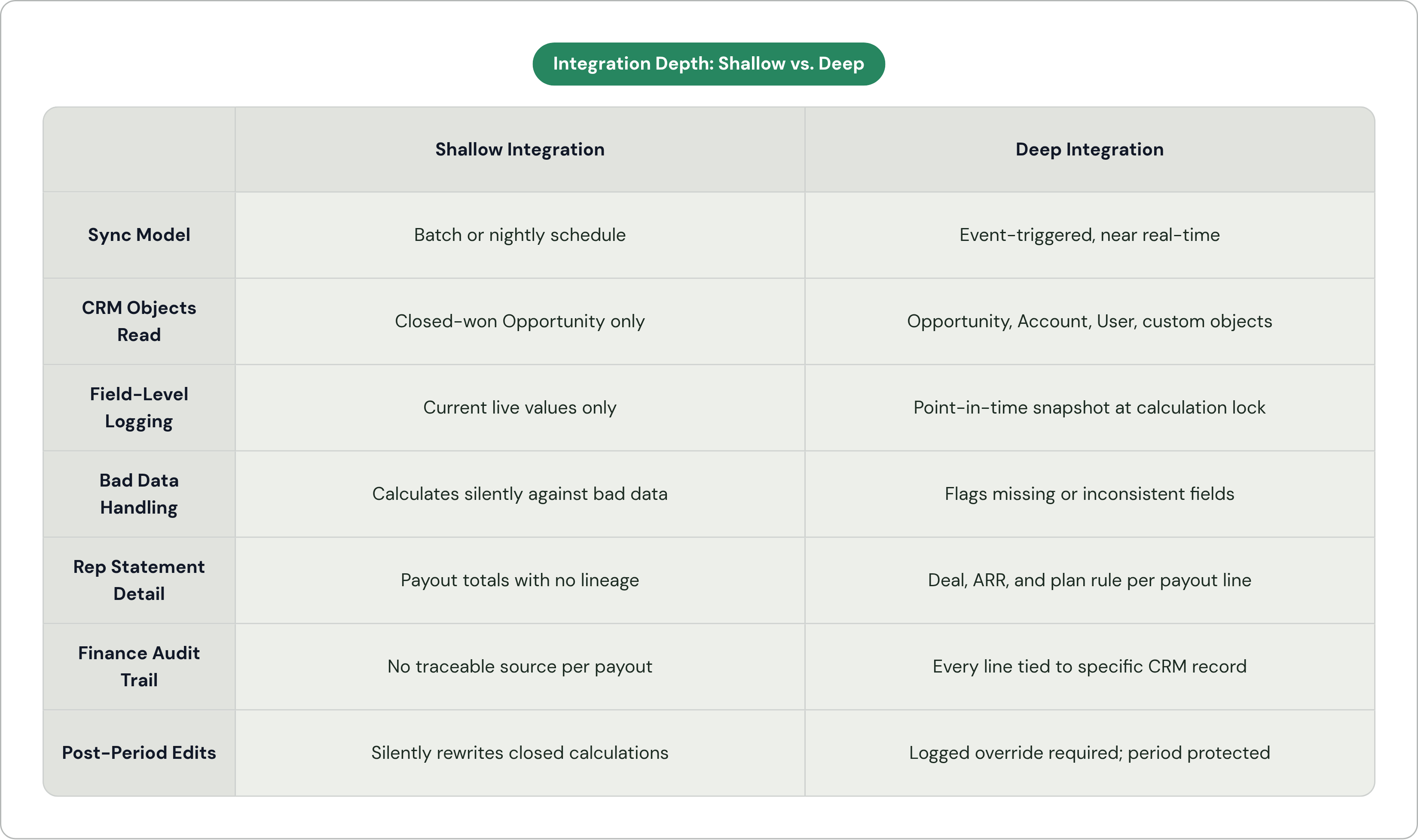
Depth breaks into three pieces, and a buyer can check each one directly instead of taking a vendor's word for it.
Start with sync frequency. A batch or nightly sync is cheap to build and cheap to maintain, but it opens a window, sometimes a full 24 hours, during which a CRM change is invisible to the commission engine. A rep closes a deal at 4pm; the sync runs at midnight; the commission calculation for that period may run on stale data and nobody will know it happened. Event-triggered sync pushes a signal the moment a relevant field changes, not just when a record flips to closed-won, and that closes the window. This matters most when pay periods are short or deals cluster near period-end, which, in most sales organizations, is exactly when they cluster.
Field-level change detection and historical logging come next. Knowing a deal's ARR right now isn't enough; a trustworthy system has to know what it was when the deal originally closed, and whether it's moved since. Without that, a retroactive CRM edit, someone fixing a typo, someone reclassifying a renewal, silently rewrites a calculation that's already been approved and paid. Spreadsheets were notoriously bad at catching this, because a cell has no memory of what it used to say. A deep integration logs CRM field values at the moment commission locks, and that point-in-time record survives whatever happens to the CRM afterward.
Bidirectionality, or writeback, is the third piece. Some platforms push commission status or payout figures back into CRM records, giving reps visibility inside the tool they already live in, usually Salesforce. Useful, but it opens governance questions: what gets written, under what conditions, who controls it. Writeback is nice to have; its absence won't sink a deal. The absence of deep read capability will.
Put these together and a platform that connects directly to CRM objects and applies plan rules close to real time kills the export-calculate-validate cycle that caused most spreadsheet-era errors to begin with. The audit trail closes the loop: a locked pay period should record not just the payout amounts but the CRM field values that produced them, so any dispute later gets resolved against a point-in-time record instead of someone's memory of what a deal looked like three months back.
How integration depth determines whether reps trust their commission statements
Sales Cookie's 2026 research found that a majority of reps keep their own shadow-accounting spreadsheets to check their commissions. Sit with that number for a second: a majority of reps don't trust what the official system tells them, so they build a second system by hand just to verify it. Aberdeen Group has separately documented that shadow accounting can eat a significant share of a rep's monthly time, time that isn't spent selling anything.
Integration depth is the root cause here, more than any other design choice a vendor makes. When a rep can't trace which CRM deal produced which line on their statement, they can't verify the number, so they rebuild it from memory and their own CRM view. When a deal they closed in Salesforce doesn't show up on the statement, they can't tell whether it's sync lag, a missing field, or a straight-up error. From where the rep sits, all three feel exactly the same: they feel like being underpaid.
Deal-level statement detail, "this payout came from this Opportunity, at this ARR, under this plan rule", only exists when the underlying integration carries enough field data to reconstruct the math from scratch. Shallow integrations simply don't have the information to produce a statement like that, so reps get handed a number with no lineage and are told to trust it anyway.
There's a real paradox buried in here. WorldatWork data shows 22% of reps file at least one commission dispute per year, and 9% of voluntary sales resignations trace back to compensation transparency issues. Yet piling more transparency on top of a broken calculation engine tends to erode trust faster, not slower, because errors that used to be invisible are now visible to everyone. The sequence runs the same way almost every time: confusion breeds distrust, distrust breeds shadow accounting, shadow accounting surfaces discrepancies, discrepancies turn into disputes, and unresolved disputes turn into attrition. Replacing a rep runs somewhere between $115,000 and $150,000 all-in. A platform deep enough to surface the CRM deal, the exact field values, and the applicable plan rule in one auditable statement cuts that chain off at the first link, before confusion even gets a foothold.
What integration depth means for Finance's ability to close the books and forecast commission expense
Commission expense sits among the largest variable line items on most P&Ls. Calculate it off a stale or incomplete CRM snapshot and Finance is working with a guess dressed up as a figure, which is worse than knowing you're guessing.
Deep integration changes three concrete things for Finance. Accruals stay current, because as deals update in the CRM, the liability figure moves with them, and that kills the end-of-quarter scramble to reconcile what was accrued against what's actually owed. Period locking becomes real, because a timestamped record of CRM state at the moment of lock means a later edit can't quietly rewrite a closed period without an explicit, logged override. And every payout line traces back to a specific CRM record and field value, which is exactly the documentation an audit wants and exactly what a spreadsheet-based process can't produce on demand.
The alternative shows up in headcount hours, not just dispute counts. One finance team spent 14 days a month on commission reconciliation before automating this, with no single source of truth tying together CRM, commission rules, and payroll. After switching to an integrated platform, that dropped to a single day, and zero disputes came up over the following six months. That's the gap between a process that eats two working weeks and one that doesn't touch your calendar at all.
Commissionly's 2025 benchmark data points to data fragmentation, deals in the CRM, rules in a spreadsheet, payout history scattered across email threads, as a central challenge facing RevOps teams. Deep integration folds all of that into a single traceable workflow, which is less a convenience than a precondition for Finance closing the books with any confidence. The question Finance should be asking in any evaluation is narrow and specific: if a CRM field gets edited after a pay period closes, what happens to the calculation for that period, and who gets told? A vendor without a clean answer is asking Finance to take the number on faith.
The questions buyers should ask about CRM integration before signing a contract
Buyers rarely get a second shot at asking these questions with real leverage. Once the contract's signed, the integration's depth is fixed, and any gaps become the buyer's problem to route around by hand. This conversation belongs in the evaluation, not the kickoff call.
On data breadth: which CRM objects does the platform read natively, Opportunity, Account, Contact, User, custom objects, specifically, not in the abstract? How does it handle commission logic tied to fields outside the standard Opportunity record: product line, ramp date, split percentage, the exact fields shallow integrations tend to skip?
On sync model: is the sync batch or event-triggered, and what's the lag between a CRM field change and an updated commission figure? Does the platform flag or queue deals with missing or inconsistent required fields, or does it just calculate against bad data and move on?
On change detection: does the platform capture CRM field values at the moment of calculation, or only whatever the current live values happen to be? What happens if a record gets edited after a pay period locks: ignored, flagged, or auto-recalculated? Can it produce, for any single payout line, an audit trail showing the exact CRM record and field values behind it?
On rep-facing transparency: can reps see deal-level detail in their own statements, which Opportunity, what ARR, which plan rule, and what's the path when a rep questions a payout and needs to trace it back to source?
On setup and maintenance: what happens when a new custom field needs to enter commission logic, does that require a support ticket to the vendor, or can someone configure it in-house? And what happens to the integration during a CRM migration or a change to field structure, because that's usually the moment shallow integrations break in ways nobody saw coming.
A vendor that answers all of this with some version of "we connect to your CRM" is selling a shallow integration, no matter how the marketing dresses it up. The platforms worth taking seriously are built to pull directly from CRM data at the field level, apply structured plan rules against it, and lock pay periods with a record solid enough to survive a dispute months down the line. Hold every candidate against this list before signing anything. The cost of finding the gap after the ink dries gets measured in disputes, attrition, and reconciliation hours that never had to happen.