Hidden Costs in Sales Commission Software Contracts
Per-seat pricing masks implementation fees, platform charges, and support tiers.
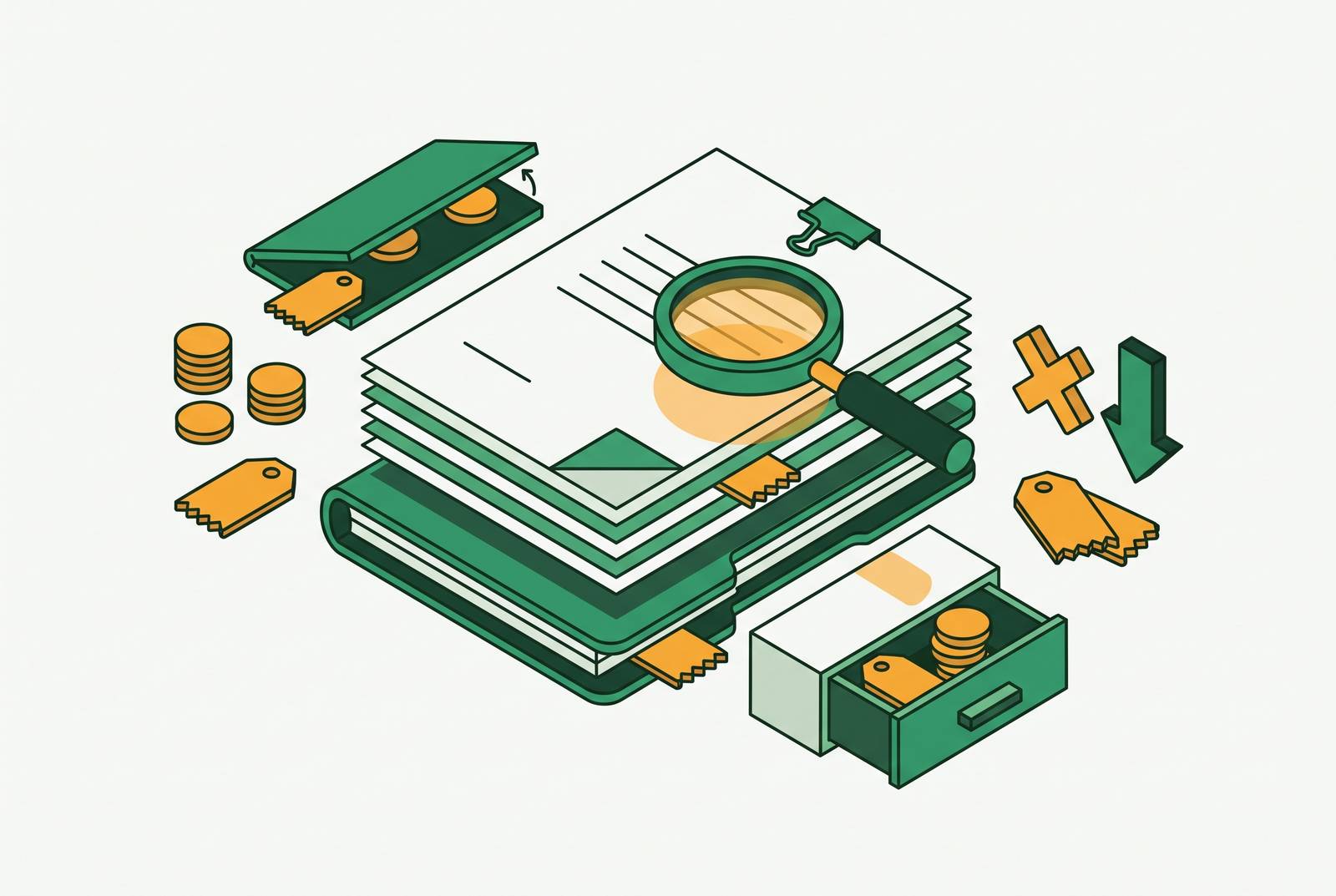
Sales commission software rarely costs what the pricing page says it costs. The published per-user rate is a floor, not a bill, and the gap between the two is where finance teams lose control of a budget they thought they'd already locked down. Most buyers treat the per-seat number as the number. That's the mistake this piece is about.
Implementation and onboarding fees: the first invoice that surprises buyers
The first real number a buyer sees usually shows up somewhere other than the monthly rate. It's the implementation invoice, and it lands after the contract is signed, which is exactly when a buyer has the least leverage to push back.
Vendors quote implementation as a percentage of contract value, or they scope it separately once the deal closes, so it never appears in the per-seat figure you compared across vendors in the first place. Public pricing data puts implementation anywhere from $5,000 to $150,000 or more, depending on the platform and how many compensation plans, data sources, and approval workflows need to get built. That range can add up to a significant share of the first year's license fees, stacked on top of whatever you already agreed to pay for seats. Some vendors itemize this openly, listing onboarding as its own line next to license and support cost, which at least lets a buyer see the number before signing. Others fold it into a quote that only materializes after a sales call, by which point the buyer has already spent weeks evaluating the platform on price alone, price that was never the real price.
CIO Dive data cited by JAGGAER found that 57% of IT leaders spend more than $1 million a year on platform migrations, with cost overruns averaging 18%. That overrun rarely traces back to one dramatic mistake. It comes from configuration scope nobody locked down at signing, change-management hours billed as extras, training costs that were never part of the base contract to begin with.
Get the implementation terms in writing before signing, not as a scope document that surfaces in week three of onboarding. Ask directly whether it's fixed-fee or time-and-materials. If a vendor won't commit to one or the other on paper, treat that as the answer.
Platform fees, per-connector charges, and support tiers piled on top of the per-user rate
Once implementation is behind you, the recurring fees start stacking. Platform fees are flat monthly charges layered on top of the per-user rate, independent of actual seat count. Some vendors disclose these in plain sight on their own pricing pages, and buyers still miss them, because the comparison stops at the per-user number and never gets to the line below it.
Connector fees scale differently: they track the number of systems wired together, not the number of people using the tool. Public benchmarks put non-Salesforce connector charges around $250 a month per connector for at least one major platform, and enterprise-scale ERP integrations can add $100,000 to $500,000 in middleware costs, according to JAGGAER's sourced data. A company running Salesforce, a separate ERP, and a payroll system isn't paying for three connectors so much as three recurring line items that never appear anywhere near the headline price.
Support tiers are the one buyers underestimate most. "Standard" support gets quoted as included, and the service-level commitment a production finance team actually needs during a payout dispute lives one tier up, priced separately, benchmarked in public data at roughly 15 to 30% of the subscription cost. Analytics modules, quota management, and ASC-606 reporting get the same treatment: features a buyer assumed were bundled turn out to require an upgrade the moment the team tries to use them for real.
None of this is fraud. It's how the category prices itself, and pretending otherwise doesn't help anyone negotiate better. The only real defense is asking for one number, fully loaded: per-user rate plus platform fee plus connectors plus support tier, before comparing a single vendor against another on price. A model priced around the compensation plan rather than the seat count sidesteps a good chunk of this problem outright, since headcount growth stops being the event that triggers a bigger bill every quarter. That structural choice matters more than any single line item above it.
How seat-count escalators and auto-renewal clauses quietly inflate multi-year cost
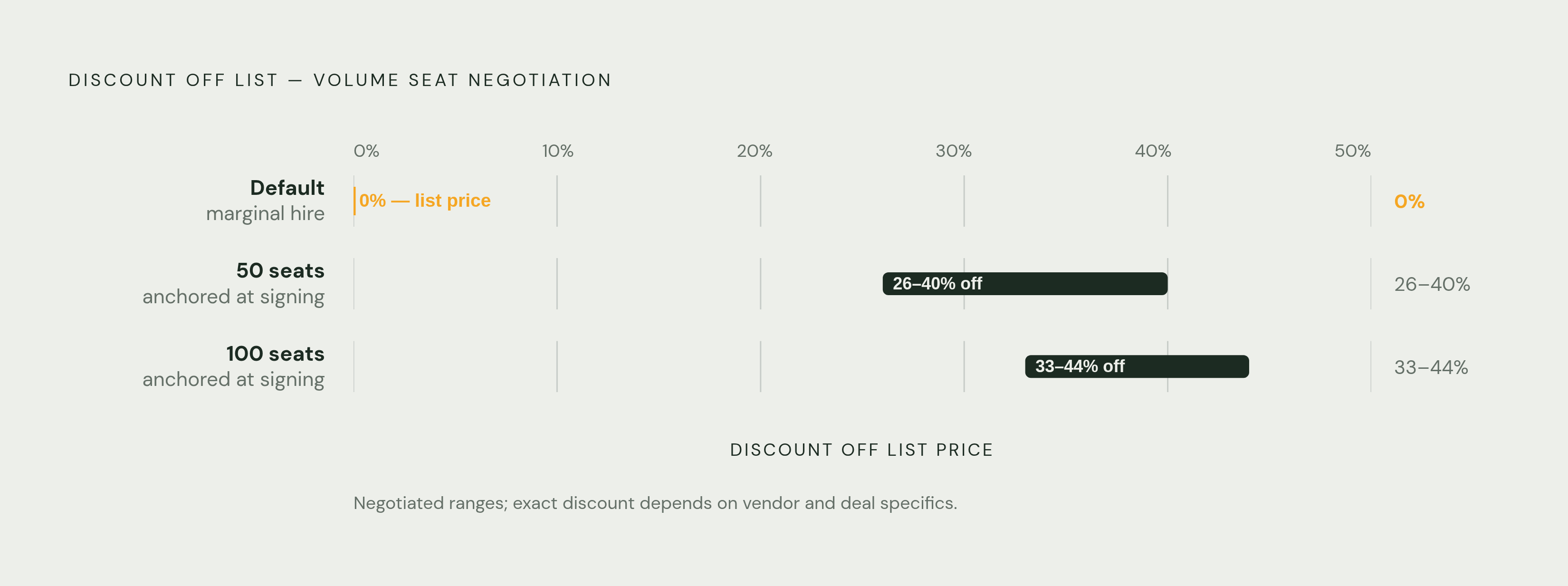
Per-user pricing looks simple until the sales team grows. Every new hire becomes a new line item, and a team that goes from 20 reps to 50 over a two-year term never actually negotiated pricing for 50 reps. It pays whatever the marginal seat costs on the day that rep started, which is list price almost by default, because nobody goes back and renegotiates the tier mid-contract.
Negotiation data compiled by Vendr shows real discount bands tied to volume: 26 to 40% off list at 50 seats, 33 to 44% off at 100 seats. The distance between those numbers and list price is the cost of failing to anchor on future headcount at signing. A buyer who locks in pricing for the team size expected in year two pays meaningfully less than one who renegotiates seat by seat as hiring happens, and that gap compounds at every renewal after.
Auto-renewal clauses compound the problem more quietly still. Escalation caps of 3 to 5% apply in roughly 55% of enterprise SaaS auto-renewal agreements, according to ContractKen data cited by JAGGAER, and those clauses sit buried in the renewal-terms section, triggering automatically the moment the cancellation-notice window gets missed. Major vendors raised SaaS pricing 10 to 20% in 2025, nearly four times faster than the 2.8% growth in IT budgets over the same period. A buyer with a capped 3 to 5% escalator is in a fundamentally different position than one exposed to list-price renewal terms. That gap is the entire argument for reading the renewal clause before signing rather than after.
Usage-based overage charges add one more wrinkle for platforms priced on storage or API call volume: rapid headcount growth or a mid-cycle plan change pushes usage past a tier limit and triggers premium rates nobody budgeted for. Early-termination fees can make staying with a platform that no longer fits cheaper than leaving it, and that math needs to happen before signing, not after the first renewal notice lands.
Data portability and exit costs: what it actually costs to leave a platform
Ask one specific question before signing anything: can every record be exported at any time, in a standards-based format, with no fee and no service request required? Not the vague version about "data ownership." The specific version. The answer separates vendors who treat portability as a feature from vendors who treat it as leverage, and most vendors, quietly, fall into the second group.
The lock-in problem isn't confined to any one buyer type. In public-sector ICT procurement, at least 40% of buyers report lock-in tied to poor data portability between systems, per Keystoneprocurement data cited by JAGGAER. Commission software running on the same category of platform architecture has no structural reason to behave better for private-sector finance teams.
When portability is restricted, the exit bill has specific, countable components. Historical payout and plan data has to be extracted, cleaned, and re-imported. Every connector built against the old platform's API has to be rebuilt from scratch against the new one. Most transitions require running both systems in parallel for months, which means double licensing costs for the duration of the switch. And the RevOps and finance staff who spent a year learning the old platform's compensation logic have to relearn a new one, from zero, while still closing payouts on time.
Oracle data cited by JAGGAER found that 83% of data migration projects fail or exceed budget and schedule, with average time overruns of 41%. That statistic explains a pattern across the category: buyers who realize the platform choice was wrong often don't leave. They stay, absorbing the ongoing cost of a bad fit, because the migration looks worse on paper than the status quo. Staying is itself a hidden cost of the original contract. It never shows up on an invoice, which is exactly why nobody accounts for it until the fit problem has compounded for another year or two.
The vendor pricing table: what nine major platforms actually disclose and what they don't
Pricing transparency across commission software vendors splits into two camps, and which camp a vendor sits in tells you something about how it expects to compete. The quote-only camp is the one to be wary of, not because hiding a number is dishonest, but because it's a negotiating posture built to work against the buyer.
One camp publishes real numbers. One vendor lists $15 a month for a dashboard-disabled tier, up to $60 per user monthly for its top published plan, no setup fee, no annual commitment required. Another lists $35 per user monthly on its entry tier and $50 on premium, billed annually, plus a separate flat platform fee layered on top depending on tier. A third publishes tiered per-user rates in the $25 to $40 range according to third-party listings, though its platform fee and contract term stay undisclosed. Historical third-party listings for at least one more vendor put per-user pricing between $15 and $33 a month, though the current version of that vendor's page routes prospects straight to a request-pricing form instead.
The other camp doesn't publish pricing at all, and that's a sales strategy, not an oversight. Third-party benchmarks put one enterprise platform's per-user cost around $55 with a median annual deal size in the mid-$30,000s. Another runs $40 to $60 per user monthly, with a related product benchmarked at $40 for teams up to 25 reps. A third shows a median annual deal near $50,000 with a documented range stretching from $50 to $120 per user monthly depending on deployment. A fourth benchmarks around $56 per user monthly, platform fees and contract terms undisclosed. A fifth prices per payee, with license, support, and implementation scoped as three separate line items, median annual deal near $41,000, observed range from roughly $30,000 to $107,000 annually, exact rates unpublished anywhere.
The quote-only camp is betting that a sales conversation beats a published number, and for the vendor, it usually does. Working through a short list of five hidden-pricing vendors typically eats 8 to 12 hours of meetings just to get comparable figures on the table, hours spent while the commission errors and payout disputes the software was supposed to fix keep happening in the background. Sales-led pricing tends to anchor high and discount downward through negotiation, and the number a buyer lands on after that process often still sits above what a transparently priced vendor charges from day one, no negotiation required. Transparency, in other words, is an obligation. It's a discount, built into the model before the first call ever happens.
Seven questions to ask a vendor before signing, and what the answers reveal
Each question below maps to one of the cost categories above. The value lies elsewhere, not exactly in asking them. It's in what a vendor's hesitation, or its precision, reveals before ink hits paper.
What is the fully loaded monthly cost, per-user rate plus platform fee plus connectors plus support tier, for the current team size and the integrations already planned? This surfaces the platform and connector fees that never show up in a headline rate.
Is implementation billed separately from the license, and is it fixed-fee or time-and-materials? The answer tells you whether that $15,000 to $75,000 cost is bounded or open-ended.
What happens to per-unit price as the team grows, and is volume pricing locked at signing? This is where the seat-count escalator either gets negotiated away now or gets paid for later, one hire at a time.
What is the cancellation-notice window, does the contract auto-renew, and is any renewal increase capped? This reveals whether the renewal terms buried in the back of the contract trigger a 3 to 5% bump or something closer to the 10 to 20% increases vendors pushed through in 2025.
What triggers a support-tier upgrade, and what does each tier cost? The answer shows whether standard support quietly degrades once the platform hits production, forcing an upgrade nobody budgeted for.
Can every record be exported at any time, in a standards-based format, at no charge and without a service request? This single question determines how expensive it is to leave, should the platform turn out wrong.
What are the early-termination fees, and what's owed exactly if the contract ends mid-term? This sets the real floor of the commitment, underneath whatever the quoted annual rate implies.
A vendor who answers all seven clearly and in writing, before a contract exists, is telling you something about how it'll behave after the ink dries. Some commission calculation platforms, Quota Queue among them, a spreadsheet-free commission management tool that prices by active compensation plans rather than by seats, publish that structural choice openly so buyers can evaluate it before a sales call ever happens. A vendor who routes every answer back to "let's get on a call" is telling you something too. Believe them the first time.