Commission Software Pricing Tiers and Feature Gating by Vendor
Critical compliance and trust features often hide behind premium pricing tiers.
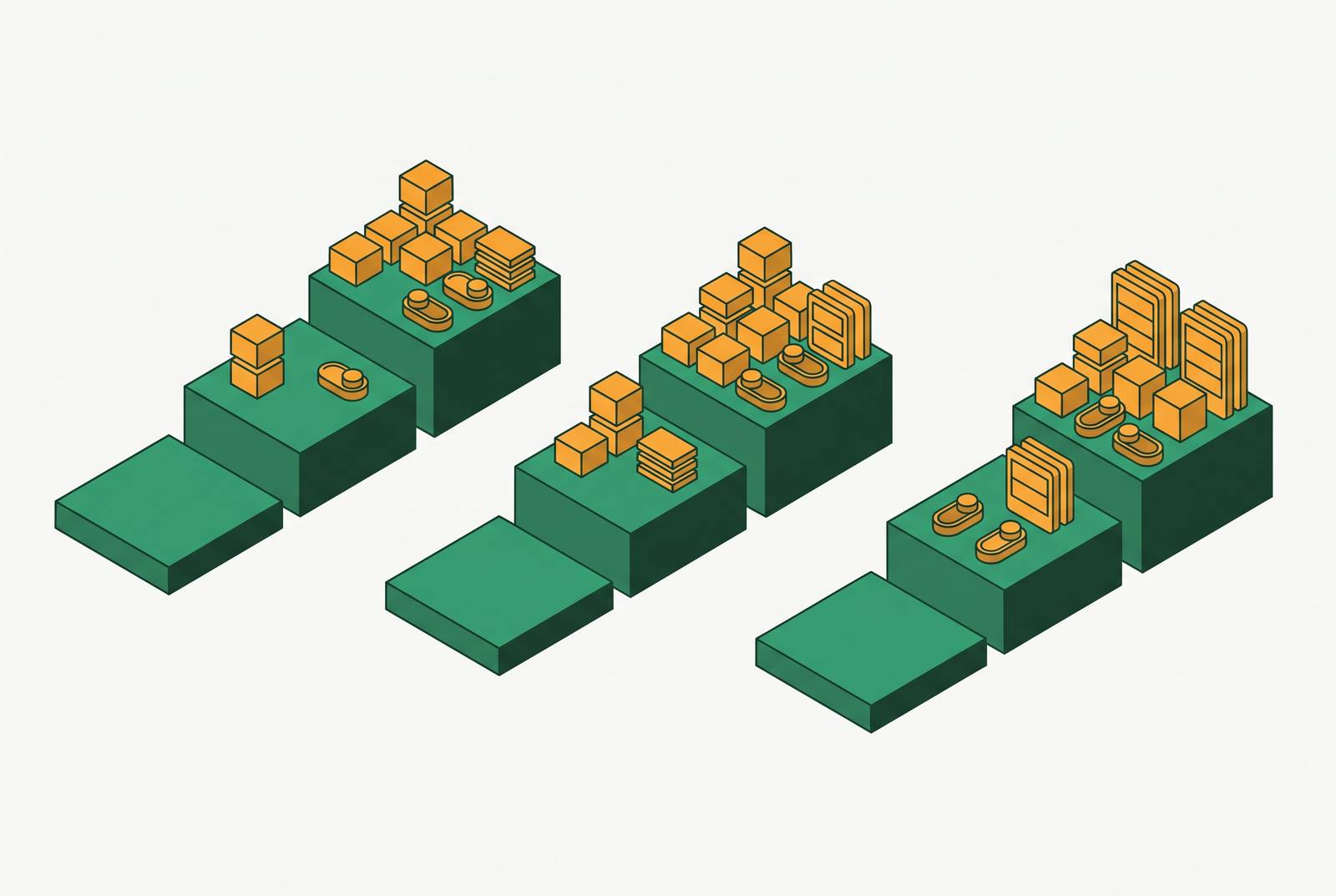
Commission software pricing looks simple until a finance team tries to lock a pay period and finds that feature sitting one tier above the contract it just signed. The real story is the fine print sitting one tier above the contract just signed. It's feature gating, the practice of tying capabilities like audit trails, accelerators, and rep-facing dashboards to subscription level rather than to actual product complexity. Buyers who don't map those gates before signing find out months later that the workflow their team depends on needs an upgrade nobody budgeted for. The pattern isn't random, either: the features that get gated hardest are the ones that protect the buyer, not the vendor.
The pricing models buyers encounter
Per-user, per-month billing dominates the category, running roughly $15 to $75 per seat per month. It's easy to budget for, but it scales linearly with headcount, so a hiring spree turns into a line-item spike nobody planned for.
Several vendors sell tier-based plans built around user bands instead of exact seat counts, so a company with 47 payees and one with 50 have the same "Growth" or "Professional" price. Others stack a mandatory monthly platform fee on top of per-seat costs, a detail that tends to get missed in the first pass of a sales quote and becomes visible only once the contract lands on someone's desk.
A meaningful share of vendors publish no pricing at all and route every inquiry straight to a sales call. That model deserves more suspicion than it gets: quote-only pricing exists to keep the buyer from comparing apples to apples before a rep gets on the phone. A smaller group prices by the number of active compensation plans rather than by seat, and that's the more buyer-friendly structure of the three. Platforms such as Quota Queue, a commission calculation platform that turns raw deal data into payroll-ready commission statements without spreadsheets, are priced this way. A team that grows headcount without adding new plan types isn't penalized for hiring.
Annual costs vary widely by segment. Entry-level plans for small teams often start around $2,000 to $5,000 a year; mid-market deals commonly run $10,000 to $50,000; enterprise contracts can clear $100,000 depending on plan complexity, seat count, and integration needs. A team of 50 payees on a basic plan might run about $15,000 a year, and the same structure at 250 users can climb past $60,000, according to Everstage's pricing guide. Layered on top of that is a newer trend: vendors building separate premium tiers just to monetize AI features, positioning them as must-haves whether or not teams actually use them, a pattern documented in software pricing research.
Which vendors publish prices and which require a sales call
According to a pricing guide from Sales Cookie, a handful of commission platforms publish per-user rates outright, though each tacks on extra fees that make sticker-price comparison harder than it looks. A longer list, including several well-known names in the category, publishes nothing at all. One vendor's pricing page now simply routes visitors to a request form, full stop.
That opacity costs buyers more than time. When price is quote-only, feature access is quote-only too, and buyers who don't know what to ask for tend to accept whatever tier structure the sales rep proposes as a starting point. Negotiating leverage sits with whoever holds the information, and in a quote-only sale, that's almost never the buyer.
One vendor's published structure shows the mechanics clearly. An entry tier includes standard CRM connections and reporting, with a per-user monthly rate plus a separate platform fee on top. A growth tier, priced above entry, adds further CRM connectors, more advanced plan logic, and team hierarchy management. That platform fee structure and what it covers varies by tier and vendor, and the details are rarely spelled out in the initial quote.
Another major player targets organizations running natively on Salesforce, with pricing available on request. That vendor charges a separate monthly fee, reported at around $250, for every non-Salesforce CRM connector, so a company running HubSpot or Dynamics pays a recurring surcharge just to connect its own sales data. Premium support on that platform carries an additional cost on top of the base license.
The features most commonly locked behind higher tiers
CRM integrations are near the top of the list. CRM connectivity varies by vendor: some include a primary integration at entry level while charging extra for additional connectors. Advanced reporting follows the same pattern: basic reports come standard, but custom dashboards and deeper performance analytics get pushed to mid or enterprise tiers.
Plan logic complexity works the same way. Flat-rate commission calculation is usually available from entry, but accelerators, SPIFs, multi-quota structures, and tiered rate logic typically require stepping up. Audit trails and locked pay periods, the most consequential item on this list, can sit behind higher-tier walls, despite being central to how finance teams handle ASC-606 compliance and resolve payout disputes. That placement is the wrong call, and the next section argues why.
Clawback configuration, which matters given how common clawback clauses are in SaaS compensation plans, can also require an advanced tier depending on the vendor. Multi-level approval workflows follow the same logic: a team might calculate commissions fine at entry level but can't build a structured, multi-step approval-and-lock process without upgrading.
Real-time rep visibility, meaning live quota progress and deal-level statement detail, is not always available below the top tiers. Multi-currency support can be either gated or underbuilt depending on the vendor. Dedicated support, customer success managers, and white-glove onboarding are, unsurprisingly, reserved for enterprise contracts, while lower tiers get documentation and chat. The three features most likely to trigger an actual upgrade decision are advanced reporting, CRM integration complexity, and the raw complexity of the comp plan itself.
Audit trails and rep visibility as core-tier features included standard for every tier.
Locking audit trails behind an enterprise contract treats commission integrity as a scale problem. It isn't one, since commission integrity is not a scale problem. Any team running more than one rep needs a defensible, logged record of how a payout got calculated and approved, and going without that record has measurable consequences well before a company reaches enterprise headcount.
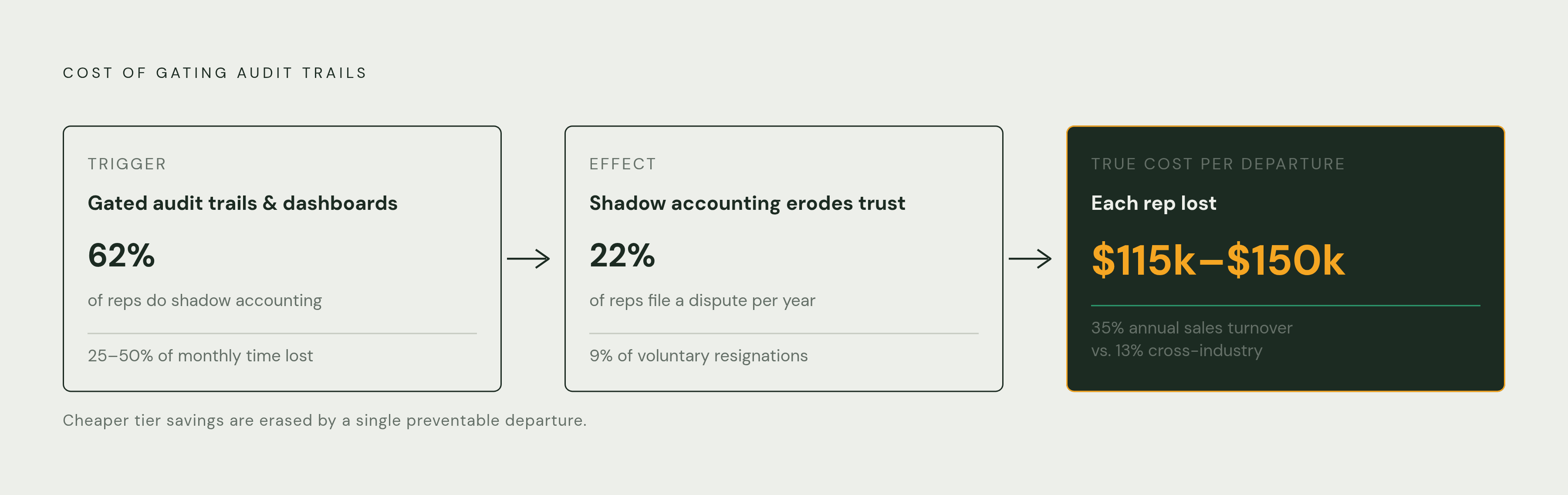
Sales Cookie's research found that 62% of reps independently verify their own commission payouts, a behavior researchers call shadow accounting. The Aberdeen Group estimates this eats up 25% to 50% of a rep's monthly time, time spent re-deriving numbers the software should have surfaced in the first place. Shadow accounting is a trust signal, not a productivity footnote. It occurs most on teams with a history of commission errors, and one bad payout cycle can do lasting damage to how sales views finance.
The dispute data backs this up. WorldatWork documents that 22% of reps file at least one commission dispute a year, and 9% of voluntary sales resignations trace back to compensation transparency problems. Replacing a sales rep costs somewhere between $115,000 and $150,000, and commission disputes are a leading trigger for that departure. Weigh that against the savings from buying a cheaper tier, and the math stops favoring the discount fast. Sales turnover already runs around 35% annually, nearly three times the cross-industry average of 13%, which makes any retention lever in this role worth far more than its sticker price suggests.
Gating audit trails and rep dashboards to higher tiers isn't a complexity decision, no matter how vendors frame it. These features don't demand more infrastructure to build. They demand a deliberate choice by the vendor: include them, or hold them back for revenue.
How AI feature gating is reshaping the mid-tier
A pattern has emerged across enterprise software broadly: vendors use AI capabilities to justify new premium tiers and price hikes, framing AI as a competitive necessity whether or not customers actually adopt it. Commission software fits the pattern exactly. AI-assisted plan building, scenario modeling, and payout forecasting get marketed as premium differentiators more and more often.
The underlying task, though, is often not that sophisticated. Parsing a compensation plan document and suggesting tiered rate structures is useful, but amounts to a workflow shortcut wearing an AI label. It's a workflow shortcut wearing an AI label. The real question for a buyer is whether the feature automates something genuinely hard, like extracting rules from a messy legacy plan PDF or flagging a formula error buried in a spreadsheet, or whether it's a repackaged manual step now marketed as intelligence.
AI-assisted plan extraction earns its keep when it meaningfully cuts the time needed to stand up a new compensation plan. Even then, human review of the output stays non-negotiable, since a misread commission rule that slips through unchecked becomes a payout error six months later. Vendors lean on native AI positioning to justify premium pricing, but without published detail on exactly which AI features live at which price point, buyers need to ask directly rather than assume the demo reflects what actually ships at their tier.
What to ask vendors before committing to a tier
On integrations: which CRM connectors come included at this tier, and which carry an add-on fee? Is there a per-connector surcharge for anything outside the vendor's primary ecosystem? Does the platform pull data from where deals already live, or does adopting it mean changing how the sales team works day to day?
On calculation logic: are accelerators, SPIFs, clawbacks, and tiered rates available now, or only at the next tier up? Can the actual comp plan get modeled in a trial or sandbox before signing anything?
On audit and compliance: are audit trails, locked pay periods, and approval logs part of this tier, or does full ASC-606 documentation require an enterprise contract? On rep visibility: can reps see real-time earnings and quota progress at this tier, and is that access counted in the per-user total or billed as an extra?
On total cost: what's the platform or base fee sitting on top of per-user pricing? What does implementation and onboarding cost, and is any of it included? If pricing runs per seat, what happens to the annual bill when headcount grows 30% in a year? If pricing runs per plan, what exactly counts as a "plan," and does adding regional or role-specific variants quietly multiply the cost?
On AI: which AI features are live at this tier versus gated above it, and does the platform train on customer data? Get a straight answer on the data-handling policy before assuming otherwise. On fit generally, the two pricing models pull in opposite directions: per-seat pricing punishes headcount growth by design, while plan-count pricing ties cost to plan complexity instead of team size. Ask which model a given vendor uses, and whether it actually matches how the organization plans to scale.
Reading a vendor's tier structure as a signal about their product priorities
A tier structure is a statement of values, whether the vendor intends it that way or not. A company that gates audit trails to its enterprise plan is saying, implicitly, that auditability is a luxury rather than a baseline expectation. Buyers should ask whether that lines up with their own standard for commission integrity, because most vendors won't volunteer the answer.
A vendor that pushes rep-facing dashboards into upper tiers is prioritizing administrative control over rep trust, which cuts directly against the goal of reducing shadow accounting in the first place. A vendor whose non-Salesforce integrations carry a surcharge at every tier is optimizing for one CRM ecosystem instead of meeting teams where their data already lives. Opaque, quote-only pricing concentrates negotiating leverage on the vendor's side of the table, and transparency in pricing tends to track with transparency in the product itself.
The right tier is the one that includes audit trails, real rep visibility, integration with the CRM the team actually uses, and enough plan logic to match the comp design already in place. Nothing less clears the bar, whatever the price. Research has found that 91% of organizations have less than 80% of their reps hitting quota, and a platform that keeps reps guessing about their own progress isn't going to move that number, no matter what tier it's sold under. Map the gates before signing. The alternative is finding out six months into the contract that the one feature finance can't live without was priced a tier above the one that got purchased.