Enterprise ICM Suite Costs vs Mid-Market Commission Platform Pricing
Enterprise ICM vendors hide real costs behind implementation fees and renewals.

One invoice tells the whole story: a single tier-threshold change to a commission plan, eleven weeks to process, $47,000 on the line item. That's the number Everstage's research surfaced when it went looking for what enterprise incentive compensation management (ICM) actually costs once the contract is signed. The annual contract value on an ICM proposal is not the cost of the software. It's the entry fee. The real number, the one that determines whether a platform was the right choice, only shows up after twelve or twenty-four months of implementation fees, professional services invoices, and renewal increases that weren't in the pitch deck.
That distinction matters more now because the market underneath it is growing fast. Commission software was valued at $2.61 billion in 2025 and is projected to reach $5.77 billion by 2034, a 9.2% compound annual growth rate. Growth at that pace funds a lot of things: better data models, faster calculation engines, AI features that genuinely reduce manual work. It also funds increasingly elaborate pricing architecture, and buyers rarely stop to ask whether the second thing is happening alongside the first.
How enterprise ICM vendors build their pricing so the real number only appears after you're committed
Almost none of the major enterprise ICM vendors publish pricing. A prospect has to sit through a discovery call, sometimes two, before anyone will put a number in writing, and that's not a courtesy extended so a sales rep can "understand your needs." It's a negotiation posture. Once a buyer is far enough into the process to have a champion internally and a board deadline looming, the leverage has already shifted.
Public aggregators put the platform-level range at roughly $15 to $75 per user per month, with full enterprise deployments running past $100,000 a year depending on plan complexity, headcount, and how many systems need to talk to each other. That per-seat figure applies, but it's only one input into a bill that has several other inputs hiding behind it.
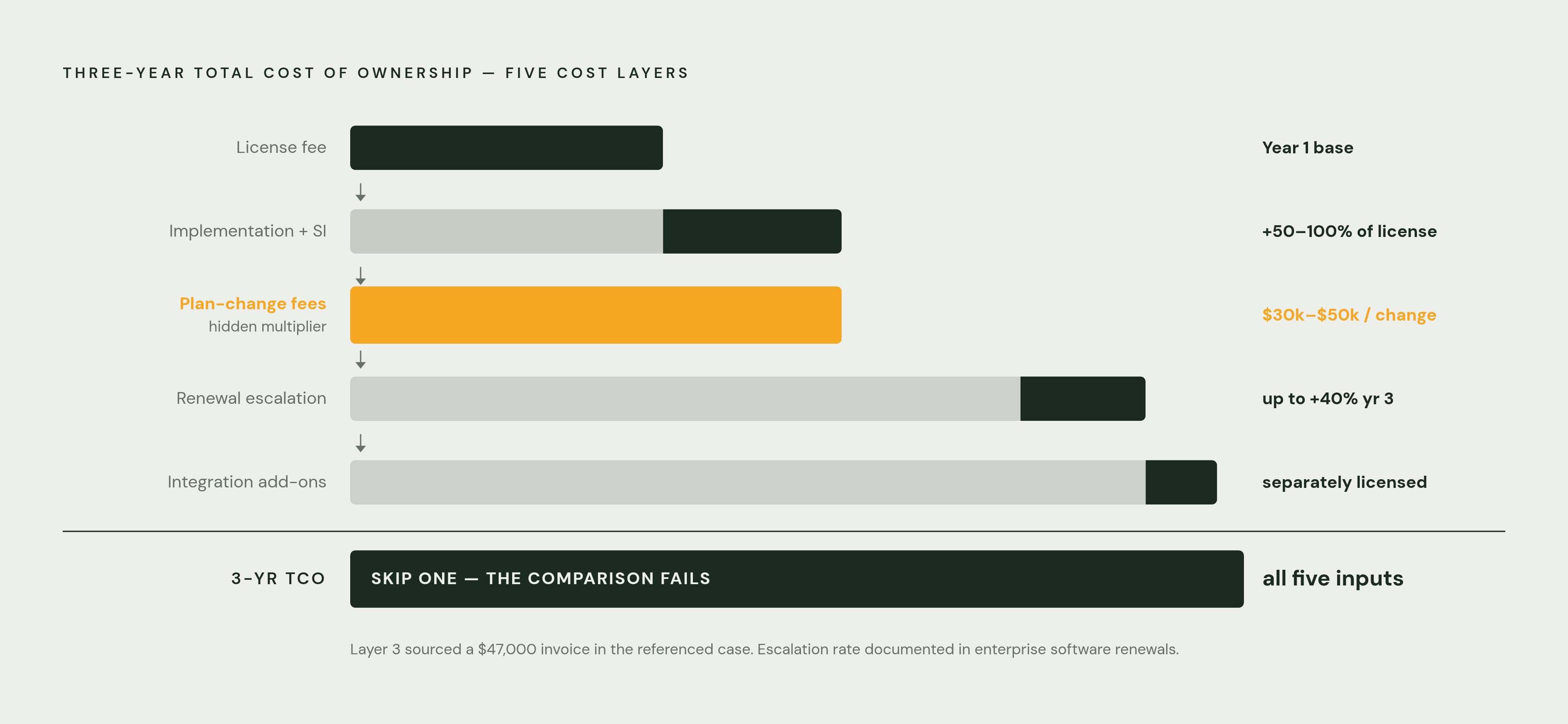
What the quote usually leaves out is where the damage happens. Implementation and onboarding get scoped as a separate statement of work, priced independently of the license. Many enterprise rollouts require a third-party systems integrator, firms like OpenSymmetry, Canidium, or SpectrumTek, and that's an entirely separate budget line with its own contract. Data migration gets scoped (and billed) once the vendor's team actually sees how messy the source systems are, which is usually after the deal has closed, not before. Then there's the mechanism behind that $47,000 invoice: professional services fees, commonly running $30,000 to $50,000 or more, charged every time a comp plan changes on a legacy platform that wasn't built for self-service editing. Premium integrations can sit behind a paid add-on rather than the base license, Varicent's direct database connections, for instance, require a separately licensed ELT module. Advanced analytics and reporting frequently sit behind a higher package tier entirely.
Then comes the renewal. Opaque, negotiated enterprise pricing tends to produce opaque, negotiated renewal increases, and the pattern shows up across enterprise software broadly, not just ICM: one buyer reported a 40% renewal jump on iCIMS. Nobody frames that as a scam, and it probably isn't one in any legal sense. But it is a structural incentive problem: the salesperson quoting implementation at time of signature has every reason to lowball scope, because the professional services team, not the salesperson, eats the fallout when a five-figure estimate turns into a six-figure invoice.
None of this is unmanageable if a buyer asks the right questions before signing. Get a written breakdown of which AI features are generally available today versus which ones live on a future roadmap. Get the implementation scoped as a fixed statement of work with not-to-exceed language, not open-ended time-and-materials. And get, in writing, a clear definition of exactly what triggers a professional services charge, versus what the platform lets a comp team handle on its own.
What enterprise ICM suites actually cost: Xactly, Varicent, SAP SuccessFactors, and Anaplan
Xactly deployments commonly land between $200,000 and $750,000-plus per year for the software license alone, before implementation, which adds another $50,000 to $150,000 or more on top. Enterprise rollouts typically need a systems integrator, and G2 data puts average time to go live at roughly five months, longer for complex plan structures. The genuine differentiator here is Xactly Insights: more than two decades of proprietary pay and performance data that supports real benchmarking work, not a marketing slide. That's a legitimate TCO justification for a large enterprise that actually uses the benchmarking. On the AI front, Xactly Intelligence and Extend AI Agents reached general availability in August 2025, while Incent AI Agents for core comp management entered early access only in December 2025. Buyers should ask for a GA date, not a roadmap slide. Xactly was not the Forrester Wave leader in the Q1 2025 evaluation, a fact worth weighing against any analyst-recognition talking point in a sales deck.
Varicent was named a Forrester Wave Leader in that same Q1 2025 evaluation, scoring the highest possible mark in 16 separate criteria, the strongest analyst standing among the platforms covered here. Forrester's report describes Varicent as the only evaluated solution with an in-depth set of AI capabilities, though a December 2025 announcement framed as "AI-native architecture" blends features that are shipped with features that are still coming, so the GA-versus-roadmap question applies here too. The hidden cost flag on Varicent is specific: direct database connections require its ELT module, a separately licensed product with its own optional paid add-ons inside it. Consulting cost is also a recurring complaint across roughly 600 G2 reviews. On performance, full model runs against large datasets are cited at 15 to 20 minutes, worth knowing for any team running frequent recalculations or mid-cycle what-if scenarios. Plan on three to six months or more of implementation with a named SI partner.
SAP SuccessFactors Incentive Management, the platform that grew out of the CallidusCloud acquisition (formerly SAP Commissions), carries a migration history that buyers inherit whether they want to or not. A recently mandated architecture migration has driven visible churn among existing customers. G2 review themes cluster around solid automation and accuracy on one side, and a steep learning curve and implementation complexity on the other, a pattern that echoes across most deep enterprise platforms. The best fit is narrow and specific: organizations already running SAP's HR and ERP stack, where the integration payoff outweighs the complexity tax.
Anaplan prices, per TrustRadius citing Vendr contract data, between $31,000 and $216,000 a year, with a median around $108,000. But that figure describes Anaplan as a planning platform broadly; ICM is an extension built on top of it, not a standalone module with its own price tag. The TCO logic inverts depending on what a company already owns. A business already running Anaplan for FP&A can extend into incentive comp without adding a net-new vendor to the stack. A business starting from zero is effectively buying an entire enterprise planning platform just to get the ICM piece. The fit case is large organizations already on Anaplan for finance and sales planning that want one data model spanning both planning and compensation.
How mid-market platforms price differently, and where their own hidden costs appear
The structural difference at the mid-market tier starts with visibility. Most of these platforms publish per-user pricing outright, or third-party aggregators have enough contract data to make the range knowable before a sales call ever happens. Implementation gets measured in weeks, not months. And on the better-built platforms, plan changes are something a comp admin does themselves, not a billable event routed through a vendor's professional services queue.
The general range sits at $15 to $75 per user per month across the tier, with SME implementations typically running two to eight weeks and total initial investment between $30,000 and $150,000 covering both software and basic setup.
Everstage doesn't publish pricing directly, but Vendr reports an average annual contract value of $38,000. Its no-code plan builder, real-time dashboards, and in-house implementation team (rather than an outsourced SI) are the real differentiators, and implementation runs faster than the enterprise tier. Pricing opacity still reintroduces some of the same evaluation friction a buyer would rather avoid, so the same written-scope questions apply.
Performio supports teams from roughly 20 reps up through several thousand, and stood out in the 2025 Forrester Wave as one of only three vendors to earn above-average customer feedback. Its distinguishing design choice is ingesting messy, multi-source data without forcing upstream changes to a company's CRM or ERP first, a real advantage for manufacturing, healthcare, or any enterprise SaaS company where the source data was never clean to begin with.
Mid-market pricing has its own blind spots, and they're worth naming directly. Per-seat pricing punishes growth: a sales team that doubles in headcount doubles its license cost, even if the compensation plan itself didn't get any more complicated. Premium integrations, connectors into an ERP, an HRIS, or a BI tool, are frequently sold as add-ons even at this tier. And the sharpest dashboards and finance-facing liability reporting sometimes sit behind a higher package, same as they do at the enterprise level.
The pricing model matters as much as the price itself. A platform charged by number of compensation plans, rather than by seat count, changes the growth math entirely: adding headcount stops being a cost event on its own.
The four cost categories that determine which tier a buyer actually belongs in
Plan complexity and change frequency comes first, because it's the single biggest driver of surprise cost. Tiers, accelerators, SPIFs, draws, clawbacks, splits: each one adds configuration surface area, and on a legacy enterprise platform, each plan change can run $30,000 to $50,000 or more in professional services. For a comp team revising its plan every quarter, that line item alone can dwarf the license fee. Self-service plan editing isn't a nice-to-have feature; it's the structural question that decides whether a comp team can make a change without opening a ticket and waiting on a vendor's calendar.
Number of payees and seat-based scaling is next, and it cuts in an unexpected direction at scale. Teams with significant payee counts need to model three-year headcount growth into the comparison, not the number sitting on today's roster. Enterprise suites often bundle seats into a flat platform fee past a certain threshold, while mid-market per-seat pricing, left unchecked, can quietly overtake an enterprise contract's total cost as the sales org grows.
Implementation and time-to-value is where the calendar becomes a cost. Cloud-deployed platforms for SMEs typically take two to eight weeks to go live. Enterprise ICM runs five months on average for Xactly, three to six months or more for Varicent, with SI fees sitting as a wholly separate budget line. That delay isn't free even when nobody's billing for it directly: reps keep selling under an old or half-configured plan, and finance keeps running a shadow spreadsheet in parallel until the new system is trusted enough to retire it.
Integration depth and data quality requirements round out the list. A native CRM connection, a paid ELT add-on like Varicent's, and a flexible flat-file import are three meaningfully different cost structures wearing the same label, "integration." Messy or multi-source data, the norm in manufacturing, healthcare, and any distributed sales org, drives implementation cost up on most platforms; Performio's data-ingestion design is the named exception built specifically to absorb that mess without forcing a CRM overhaul first. The right platform meets the data where it already lives, and that principle carries a direct TCO consequence, not just a technical one.
Put together, the practical output is a three-year model: license, plus implementation, plus SI cost where one applies, plus annual plan-change volume multiplied by per-change cost, plus a renewal-year escalation assumption. Skip any one of those five inputs and the comparison isn't really a comparison.
What accurate commission calculation is actually worth, and what errors on either platform type cost
Industry estimates put overpayment leakage at 3% to 5% of total variable compensation annually. On a $5 million commission budget, that's up to $250,000 a year in preventable loss, and it's the number every platform cost comparison should be measured against, because the software isn't just an expense; it's insurance against a specific, recurring bleed.
Finance teams close the books three to five days faster when commission math runs on an automated calculation engine instead of a manual one, and rep disputes drop 20% to 30% when reps can see their own real-time numbers instead of waiting for a monthly reconciliation email. Those two effects alone often justify the software spend independent of the sticker price.
More than 60% of small and mid-sized businesses still run commission calculations on spreadsheets, according to Commissionly's 2025 Benchmark Report, which reframes the whole comparison. That means the real-world choice, for a large share of the market, isn't enterprise ICM versus a mid-market platform. It's a platform of either kind versus a spreadsheet, and a spreadsheet's true cost never shows up on an invoice: the labor hours of whoever owns the formula, the disputes that formula errors generate downstream, and the audit exposure when a calculation can't be locked, traced, or defended to a regulator.
Audit trails and locked pay periods aren't abstract compliance checkboxes. They're what makes a number defensible when a rep, a manager, finance, or a regulator asks how it was produced. Their absence, common on spreadsheets and on some of the lighter platforms in the market, is a hidden cost that never appears as a line item until the day someone needs the answer and doesn't have one. Commission data is compensation data, plainly, and it deserves the same encryption, access control, and audit logging as payroll. That's a fair question to put to any vendor at any tier, not just the expensive ones.
How to read a commission software proposal before you're locked into the wrong tier
Six questions separate a clean proposal from an expensive surprise, and every one of them is answerable before a signature goes on the contract.
What exactly triggers a professional services charge? Get a written definition of what counts as self-service and what counts as billable, because the gap between those two categories is where most enterprise TCO overruns live.
Is the implementation scope fixed-fee or time-and-materials? Five-figure estimates routinely become six-figure invoices once a vague scope meets a messy source system, and a not-to-exceed clause is the only real protection against that drift.
Is the systems integrator a separate contract? If a deployment needs a partner like OpenSymmetry, Canidium, or a similarly positioned firm, that's two vendors, two contracts, and two renewal cycles to track, not one.
Which AI features are generally available today, and which are still on the roadmap? Ask for a dated GA list in writing. Xactly's Incent AI Agents were still in early access as of December 2025; Varicent's AI-native announcement from that same month blends shipped capability with future plans, and a buyer paying for a roadmap should know that's what they're paying for.
What are the renewal terms, specifically? A 40% jump with no new seats and no new features is a documented pattern in enterprise software generally, and asking for a renewal cap in writing costs nothing at the negotiating table.
And how does the price move as headcount grows? Per-seat pricing and per-plan pricing produce two very different three-year outcomes for a fast-growing sales org, and that's a math problem worth running before signing, not after the first renewal notice arrives.