Commission Software Total Cost of Ownership Beyond License Fees
Hidden implementation, integration, and admin costs often exceed the license fee itself.
Per-user pricing on commission platforms typically runs $15 to $75 a month, with small-team plans starting around $2,000 to $5,000 a year. Mid-market deployments commonly land between $10,000 and $50,000 annually, and enterprise contracts can clear $100,000 once user count, plan complexity, and integration scope get added up. None of that includes what happens after signature, which is the actual subject here.
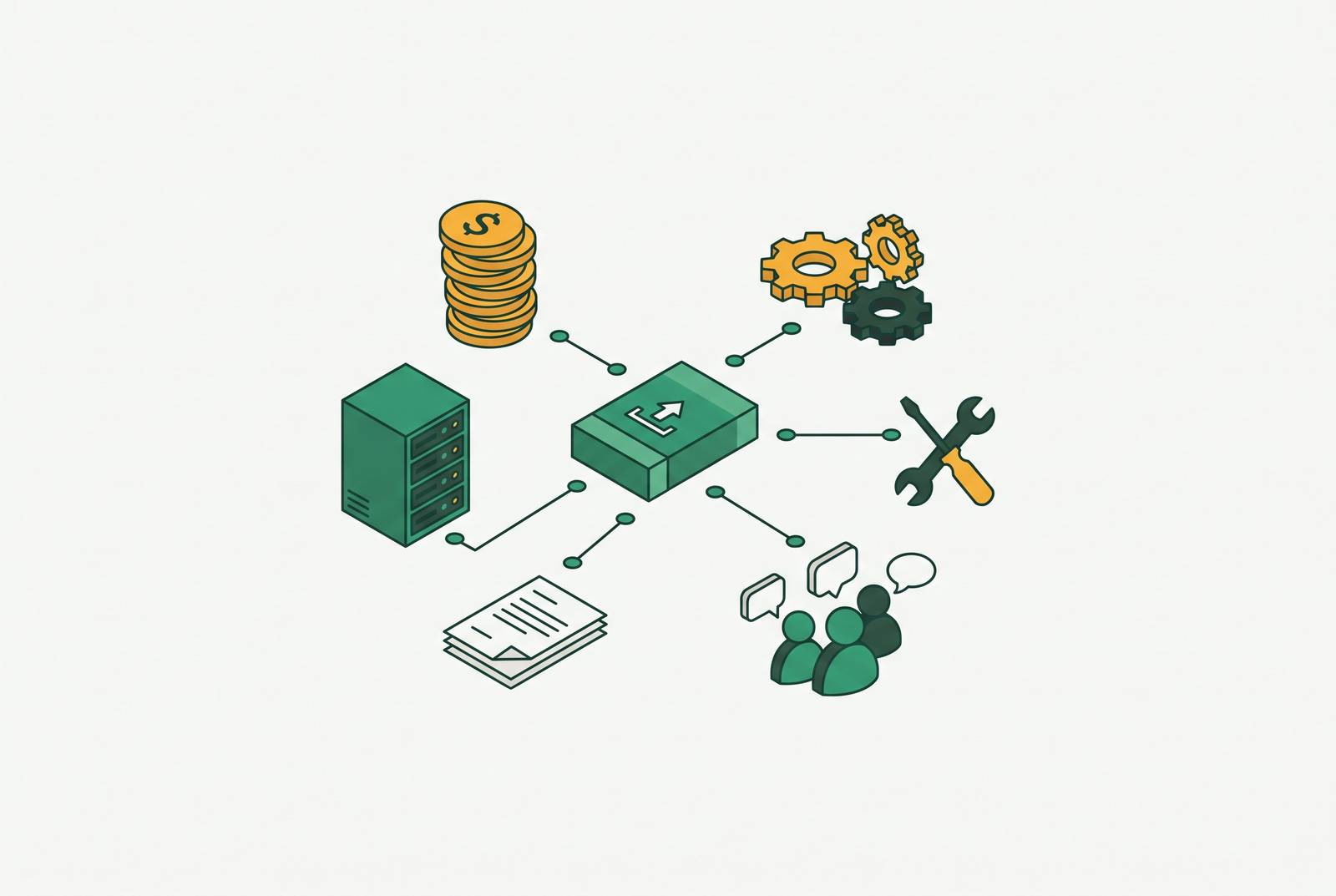
Four things push the number up. Seat count is the obvious one: most vendors charge per user or per payee, so cost climbs alongside headcount whether or not the new hires need anything past the base tier. Plan complexity is less obvious but often costs more. Tiered rates, accelerators, SPIFs, clawbacks, multi-currency payouts, and role-specific structures all add configuration work, and some vendors use that complexity as an excuse to bump customers into a pricier tier. Integration requirements matter too: native connectors to Salesforce, HubSpot, Workday, or an ERP come bundled on some plans and billed separately on others, with custom API work stacked on top of either. Support and success tiers, meaning white-glove onboarding or a dedicated customer success manager, get priced outside the base license more often than not.
Per-seat pricing is the wrong model for a company hiring fast, and buyers should say so at the negotiating table instead of treating it as the default. Ten more reps means the software bill grows right alongside payroll, whether or not those reps needed anything more complex than the base tier. Pricing tied to the number of active compensation plans, instead of headcount, decouples the software cost from hiring pace, a model that protects a scaling company's budget. Quota Queue, a spreadsheet-free commission calculation platform that moves deal data through configurable comp rules to payroll-ready statements, prices exactly this way. The sticker price rarely holds either way. Usage-based pricing shifts financial risk onto the buyer, and the real number tends to show up at the second renewal, not the first contract. Support contracts alone commonly add another 15 to 25% of license cost every year, a figure that almost never makes it into the initial vendor comparison spreadsheet.
Implementation costs that appear only after the contract is signed
Implementation doesn't end when onboarding week ends. It runs through data migration, system configuration, workflow testing, training, and go-live support, and each step carries its own labor cost and its own timeline, one that routinely runs longer than the sales rep promised.
The scope is what catches most buyers off guard. Historical commission data has to come out of spreadsheets or a legacy system and get checked against CRM and payroll records, line by line in many cases. Compensation logic, the multi-tier structures, accelerators, clawback rules, split-credit arrangements, has to get rebuilt inside the new platform. Calculated outputs need testing against prior pay periods before anyone trusts the system enough to go live. Then training happens twice: once for the finance and RevOps staff who configure and run the system, and again for sales reps who just need to read their statements. Reps who can't find their numbers go straight back to their own spreadsheets, which defeats the entire point of buying the software in the first place.
Buyers coming off spreadsheets run into a cost that's easy to miss going in: the plan logic isn't written down anywhere. It lives inside formulas, buried, and someone has to reverse-engineer it into documentation before it can be handed to a new system. Per impactbuying.com, maintenance and support contracts add 15 to 25% of license cost annually, and that percentage climbs further if implementation gets billed as a separate service instead of folded into the license.
A productivity tax during the transition makes the real cost worse. Finance and RevOps run both the old and new systems in parallel to check outputs across multiple pay cycles, and that overlap substantially increases their commission workload. That's the part timelines never account for. Before signing, buyers should ask a vendor directly whether implementation is included in the license fee, whether it's time-boxed, and what happens financially when configuration scope expands past that box. The answer to that last question decides whether implementation is a fixed cost or an open tab, and vendors who dodge it should be treated as a red flag, not a formality.
Integration overhead that compounds quietly over the contract term
Commission software has to pull deal data out of a CRM, push approved payouts into payroll, and often pull quota and headcount data from an HRIS. Every one of those handoffs is a place where things can break, and they break more often than vendor demos let on.
Per Kennect research, gaps between disconnected CRM, ERP, and commission systems create data mismatches, and the manual reconciliation needed to close those gaps can take up to six weeks. That's a recurring cost, not a one-time setup fee: it repeats every time the underlying systems change. Initial connector setup is cheaper and faster when a native integration already exists. Custom API work or middleware adds cost both upfront and every year after, with ongoing maintenance sitting as its own line item. When a CRM data model changes, a field gets renamed, or a pipeline gets restructured, the commission integration has to get updated or it breaks silently, often without anyone noticing until a payout looks wrong. Even integrations that work correctly still surface dirty data: duplicate records, missing close dates, wrong opportunity owners. Someone has to own that cleanup every cycle, and that's labor, not software. Vendors also version their own APIs, and a deprecated connector can force a buyer into re-implementation work on the vendor's schedule, not the buyer's.
Platforms built to work with a company's existing CRM data, instead of forcing a rip-and-replace of established workflows, cut both the upfront setup cost and the ongoing reconciliation labor. That distinction deserves real weight in a vendor comparison, not a footnote. Much of this expense stays invisible in vendor proposals because it gets filed under "IT" rather than "software," which puts it on a different budget line entirely and keeps it from ever getting compared against the license fee actually driving it up.
Ongoing admin overhead as a recurring line item most budgets miss
Commission management doesn't run itself once it's configured. Plan changes, quota adjustments, new hires, territory realignments, and clawback processing all need continuous attention from a real person, every cycle, indefinitely.
That person, usually a RevOps or finance analyst, carries a workload that almost never shows up as a software cost in anyone's budget. Deal data has to be imported and checked each period. Calculated statements need review and sign-off before payroll lockout. Rep disputes and questions have to get handled, and that task scales directly with team size. Plan rules need updating whenever comp plans change mid-year, and commission data has to survive intact, at the deal level, for ASC 606 / ASC 340-40 capitalization and amortization reporting instead of getting flattened into a single payout number.
Per walkme.com, maintenance can eat up 60 to 80% of total lifecycle cost for software generally, which is reason enough to stop comparing vendors on subscription fee alone. Spreadsheets carry an obvious key-person risk: one analyst's vacation can stall payroll. Software shifts that risk toward platform reliability, but a badly designed platform, or one only one person on staff actually understands, recreates the same single point of failure under a different name.
The scaling problem gets worse with headcount, not better. Per Sales Cookie, at 100-plus reps a single bad pay cycle, a plan change gone wrong, a batch clawback, a delayed trigger event, can generate roughly 15 simultaneous disputes, pulling finance and sales leadership into days of reconciliation that adds up to six figures in lost productivity annually. Any serious evaluation should model exact hours per cycle by role, then multiply by that organization's fully-loaded compensation, because the vendor's pitch deck will not do that math.
The cost of commission errors, what inaccurate payouts actually drain
Per a 2025 State of Incentive Compensation Management Report surveying more than 200 B2B leaders, 66% of companies had overpaid or underpaid commissions in the past year. The gap between them is too large to attribute to rounding. It's a structural one, and most of it traces back to three mechanical failure points.
Formula errors in multi-tier or accelerator structures cascade across an entire pay period once they're baked in. Data entry mistakes, a misplaced decimal, a reversed digit, a mismatched payment, slip through without an audit trail to catch them. Clawbacks and status changes go unprocessed because no workflow exists to flag them, and without version control, a mid-period plan change leaves old calculations running under the prior rules with nothing distinguishing them from the new ones.
Overpayments and underpayments fail in opposite directions, and the asymmetry is the part worth sitting with. Per salescookie.com research, overpayments generate silence: a rep who got an extra $8,000 on a deal that should have been split has no reason to flag it and often doesn't realize a mistake happened at all, so the error sits there until an audit or a system migration surfaces it. Underpayments do the opposite. They generate disputes immediately, and resolving those disputes costs finance time, management attention, and rep trust that doesn't fully come back even after the number gets fixed.
There's a legal dimension too. Commission calculation errors carry consequences beyond bookkeeping, touching areas of compliance that compound the cost of getting the number wrong. A spreadsheet that only sums rep payouts can obscure the deal-level detail that audits and reporting requirements ask for, a gap that turns expensive to reconstruct after the fact.
Rep distrust as a financial cost that rarely appears in any budget
Shadow accounting is the tell. When reps build their own commission trackers because they don't believe the official number, that's hours every month pulled away from selling and spent double-checking math instead. Any sales leader who spots it should treat it as a five-alarm signal, not a quirk.
The cost doesn't stop at distraction. Per Fullcast's 2025 Benchmarks Report, nearly 77% of sellers still missed quota, and commission-driven attrition makes an already hard attainment problem worse. Gartner survey data puts seller burnout at 90%, and Gartner data shows 64% of sales professionals say they'd leave for a similar role with better pay. Commission opacity feeds that willingness to walk, directly.
The math on replacement is the number that should end the debate over whether accurate commissions are worth paying for. A fully-ramped account executive costs roughly 1.5 to 2 times their fully-loaded compensation to replace once recruiting, onboarding, ramp time, and management attention are all counted. For a mid-to-senior AE, that replacement cost runs well into the six figures per departure. And the reps most likely to leave are the high performers, the ones with enough deals on the books to know exactly what they're owed, and enough leverage elsewhere to act on it the moment the number looks wrong. Real-time statement visibility, where reps can see deal-level commission detail at any point mid-cycle, addresses the root cause of shadow accounting and the distrust that feeds attrition.
The spreadsheet baseline: what "free" actually costs when you run the math
Commission spreadsheets are the most expensive software most organizations aren't paying for. No invoice ever arrives, but every cost line above still exists. It just gets absorbed into salaries, delays, and turnover instead of a subscription fee, and that absorption is exactly why the true cost stays invisible to whoever signs the vendor contract.
Per salescookie.com analysis, the payback period for commission software typically runs under eight months for any team with 20 or more reps, not because the software is cheap but because the hidden cost of the spreadsheet alternative runs high enough that the math closes fast. That hidden cost breaks into pieces that never show up on a budget line: admin labor spent updating formulas and fielding rep questions, error correction from overpayments quietly piling up while underpayments generate disputes, the opportunity cost of a RevOps lead spending hours on commission math instead of quota design, key-person dependency on whoever built the spreadsheet, plan rigidity that forces a formula rebuild every time a rule changes. Rep turnover driven by distrust sits at the bottom of that list on paper and the top of it in actual dollars, and it survives budget review unchallenged precisely because it's the hardest one to pin on the commission process specifically.
Per salescookie.com, organizations above 100 reps routinely find that staying on spreadsheets costs 5 to 20 times more than automating, and that ratio holds from 20-rep teams up through 2,500-rep organizations. Software is cheaper by year one and dramatically cheaper by year three. One illustrative comparison from salescookie.com puts the real choice at roughly $670,000 in hidden cost against roughly $36,000 in cost that actually shows up on an invoice. Buyers who run only the second number are the ones who end up surprised, and by then the surprise has already cost them a fiscal year.