Revenue Ops Managers on Automating Commission Calculations Without Owning a Dev Queue
No-code commission tools let RevOps run the full workflow without engineers.

A no-code commission platform is a spreadsheet replacement for sales commission calculation that lets RevOps manage the workflow from CRM import through locked, payroll-ready outputs. Configurable rules replace spreadsheet formulas and custom development, so plan changes need not enter an engineering queue. RevOps needs to run the whole process on its own, including the data transfers that can stay manual even when calculations are automated.
Why commission automation has become a RevOps ownership problem, not an IT one
A new accelerator, a mid-quarter SPIF, or a territory reassignment can leave RevOps waiting for an engineering ticket before an agreed plan becomes operational. The alternative is often a spreadsheet patch. Both paths fall short now that RevOps is responsible for commission calculation end-to-end. The ticket holds up the work, while the patch puts calculation logic in files where formula drift and version conflicts can occur.
The underlying infrastructure reflects an older division of work, in which finance handed requirements to engineering and waited. OnCentive's automation guide describes the resulting monthly cycle as finance pulling CRM data, RevOps scrambling to resolve errors and push payouts on time, and sales managers fielding disputes from reps with different numbers. Modern rules engines and no-code plan builders change that arrangement by letting the person who understands the compensation plan configure it directly.
What the spreadsheet-based commission workflow actually costs RevOps
Formula drift begins with an ordinary edit. A user can overwrite a formula cell without a warning, while a typo in a nested IF statement can miscalculate an entire column of reps. The error may remain unnoticed until a rep challenges a payout, sometimes pay periods later. Separate copies can also cause trouble when two operations managers work from different versions without a single source of truth. Reconciliation then requires establishing which file and which rules should govern the payment.
The same guide illustrates this with a Q4 workflow drawing opportunity data from Salesforce, revenue figures from NetSuite, and employee records from the HRIS. By Wednesday, a copy from last month has different accelerator rates. By Friday, three AEs are disputing their numbers. Without a record of the rules, inputs, and manual adjustments behind each payout, answering those disputes becomes a multi-hour reconstruction.
Errors also create unequal costs. Overpayments are effectively unrecoverable and may go unmeasured when the business simply absorbs them. Underpayments can prompt a rep to maintain a private tracker and challenge subsequent paychecks, extending the workload beyond the original correction. Meanwhile, commission files can be copied or shared without the access controls they need. As pay transparency requirements demand documented, defensible records, these weaknesses become governance liabilities.
The six stages of a fully automated commission workflow and what RevOps controls at each one
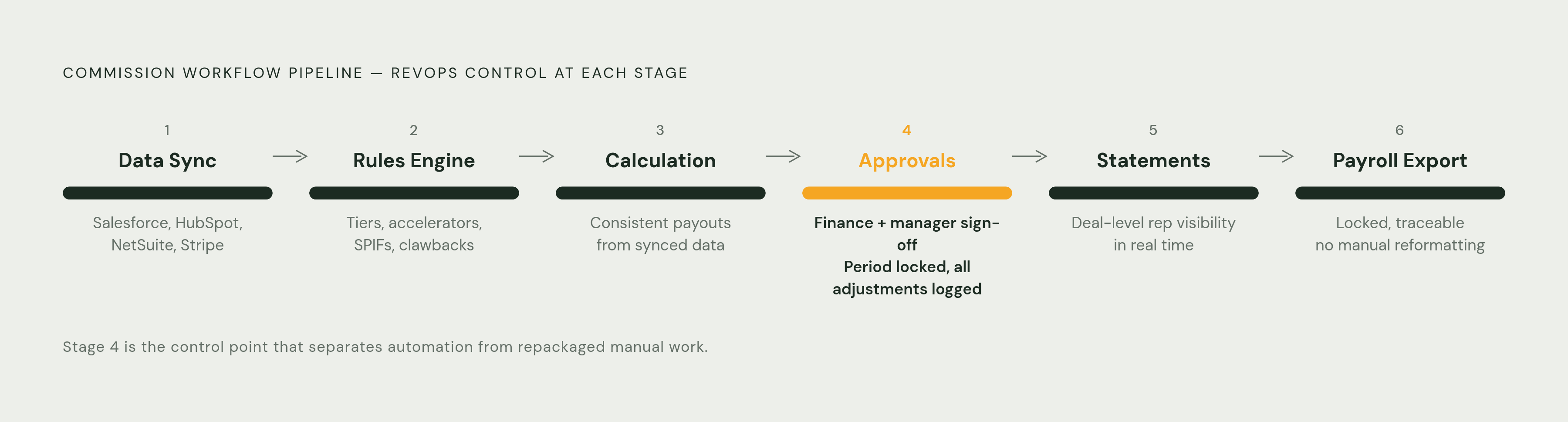
Full automation preserves human approval while removing manual transfers and the need to repeat calculations between control points and making clear who is responsible for rules, exceptions, and final sign-off.
Stage 1. Data sync. The platform imports opportunities, bookings, invoices, and employee data directly from source systems, including Salesforce, HubSpot, NetSuite, and Stripe. RevOps configures the connections and audits source records for completeness and consistency before go-live. Clean inputs are the first control point. The output is synced data ready for calculation, rather than an uploaded file that becomes stale as source records change.
Stage 2. Rules engine and plan configuration. The platform represents compensation plans, tiers, accelerators, and eligibility criteria as configurable rules that require no developer-written code. RevOps builds those rules, validates tier thresholds and eligibility logic, and confirms that SPIFs and clawback windows are captured correctly. Human approval remains essential before calculations begin. AI-assisted extraction can draft rules from an existing plan document, but the output of this stage must be a reviewed configuration.
Stage 3. Calculation. The platform applies the configured rules to synced data and computes payouts consistently each period. The guide describes a SaaS example involving multi-year subscriptions, renewals, and split deals across SDRs, AEs, and CSMs, with calculations running from the same CRM close event, eliminating month-end reconciliation. The output is a set of calculated payouts ready for review.
Stage 4. Approvals. The platform routes calculations through a structured process in which finance and managers approve or adjust them, with every adjustment logged. RevOps manages routing, resolves flagged exceptions in context, and locks the period once sign-off is complete. Locking prevents retroactive edits after the period closes.
Stage 5. Statement generation. The platform gives reps statements showing how pay was computed deal by deal, with real-time visibility as the period progresses. RevOps checks the statement format and the settings for who can see it. Reps need more than a final total. The output is an explanation they can inspect without asking RevOps to build and distribute a separate report.
Stage 6. Payroll export. The platform provides final numbers for payroll that are locked, approved, and traceable to the original deal data. RevOps runs the export without manually reformatting figures or copying them into payroll. Approval must survive the handoff to payment.
How CRM integration determines whether automation is real or just repackaged manual work
Integration can be tested by checking whether a deal closing in the CRM today shows up in the commission calculation today, without anyone exporting a CSV. RevOps buyers should ask that question directly. A platform may calculate commissions automatically but still need someone to supply fresh files. In that case, the calculation engine has changed, but the delay between the source event and the payout calculation remains.
Native connections close that gap by reading data from the CRM, data warehouse, and billing system as deals move. The guide identifies connectors across CRM systems such as Salesforce and HubSpot, ERP systems such as NetSuite, QuickBooks, and SAP, and billing systems such as Stripe and Zuora as requirements for sync without manual intervention. Connector depth therefore belongs in the operating assessment. The required data must flow without a developer maintaining the handoff.
Direct integration leaves poor source records as they are. Before go-live, RevOps must review CRM records, billing systems, and order management tools for completeness and consistency. Otherwise, the rules engine applies reliable arithmetic to unreliable inputs. The result can look authoritative while remaining wrong, making the pre-integration audit a prerequisite for automation.
What no-code plan design means in practice when comp plans change mid-quarter
When the CRO changes an accelerator threshold after the quarter starts, the operational question is how quickly RevOps can implement and test it. A sprint queue separates the decision from execution. A no-code plan builder instead lets RevOps change the configuration directly, whether the request concerns a SPIF, territory realignment, or accelerator adjustment. That independence is useful only if the proposed change can also be assessed before it affects payouts.
The guide describes self-serve modeling as a core capability of full automation platforms. RevOps can use simulation and sandboxing to apply a proposed change to historical deal data and show the CRO its projected payout impact. Testing belongs before rollout. This gives the plan owner a way to evaluate the consequences without conducting a separate spreadsheet modeling exercise.
AI assistance can shorten configuration time by reading an existing compensation document and drafting rules for review. It does not own the plan decision. RevOps still checks that the proposed configuration matches the agreed terms, while changes are logged and versioned so earlier and revised plans stay distinct. Reps should be able to see which version applied to each pay period so that a mid-quarter change does not obscure how earlier deals were calculated.
Rep visibility and dispute reduction as a RevOps efficiency outcome, not just a rep benefit
A commission dispute consumes more than a rep's attention. It creates investigation, data reconciliation, and manager work for RevOps and finance. Some disputes start with wrong calculations, but others start because the rep cannot see how a correct number was worked out. When the explanation is missing, private trackers become a substitute, diverting selling time into reconciliation every pay period.
Deal-level statements address that information gap directly. A rep who can compare commission calculations with current deal data can answer the question of why a particular deal produced a particular payment. The calculation itself need not change for transparency to reduce disputes. RevOps then has fewer requests to investigate and spends less time explaining routine payouts by hand.
The remaining disputes still need defensible records. Statements show the explanation, while the calculation history helps the team look into a rep's challenge to the result. Pay transparency regulations in more and more states require records of wage ranges, job titles, and pay histories. Rep-visible statements therefore serve as compliance artifacts as well as a way to build trust, rather than merely a reporting benefit for the sales team.
Commission data security requirements RevOps must enforce when owning the workflow
Owning commission automation includes responsibility for its security posture. Commission data is compensation data and requires the same rigor as payroll. Moving configuration out of an engineering queue does not reduce that obligation. For RevOps buyers, the security assessment must establish who can access the data, what they can change, and what record remains of their actions.
Encryption in transit and at rest protects data as it moves and while it is stored. Org-scoped tenancy prevents one team's data from being accessed by another, while role-based permissions restrict what each user can see and change. These are minimum requirements. Locked pay periods must also prevent retroactive edits, and comprehensive audit trails must log every calculation, adjustment, and approval.
Those records support daily operations as well as governance. When a rep disputes a payout from two periods ago, the audit trail should make the investigation a lookup. AI-assisted plan building adds a separate requirement because plan terms and deal-level data are sensitive. A no-training-on-customer-data policy keeps that information from being used to train models outside the organization's control.
What software should sales ops use instead of Excel for tracking commissions?
The buying criterion is whether a RevOps or finance admin can build, modify, and maintain the commission workflow without filing a ticket or calling a developer. Feature count is a weaker test. A platform can handle complex calculations but still leave the team needing file uploads, help from engineering, or reports shared by hand. Evaluation should therefore follow the workflow from source data through payroll.
For data and plan configuration, RevOps should assess native connections to the CRM and billing systems already in use, then establish whether admins can configure tiered rates, accelerators, SPIFs, and clawbacks directly. Can the requested change be implemented and tested in the platform the same day the CRO asks for it? Simulation against historical deal data should also let RevOps show projected payout impact before rollout.
For the payment workflow, the assessment should cover sign-off by finance, managers, and RevOps, with logged approvals and locked pay periods. Payroll export must preserve the approved record without manual reformatting. Rep visibility needs equal scrutiny. Real-time, deal-level statements should be available without requiring RevOps to create and distribute reports, or the reporting workload remains outside the automated process.
Finally, the security review should establish whether the platform meets the access, encryption, tenancy, audit, and model-training requirements above. The right replacement for a spreadsheet is a system RevOps can change, review, and govern through to payroll without acquiring another development dependency.