Locked Pay Periods and Commission Audit Trails
Commission disputes vanish when pay periods lock and audit trails document every change.

Commission data becomes trustworthy only when two structural controls are in place:
- a locked pay period that preserves the state of calculations at cycle-end, and
- an immutable audit trail that explains how every figure arrived at that state.
Without both, commission numbers aren't records; they are estimates, open to reinterpretation, and therefore open to dispute.
How Commission Errors Actually Accumulate Without These Controls
Spreadsheet-based commission workflows have no enforced lock and no system-generated trail. The file can be opened, changed, and saved at any point by anyone with access, and nothing in the environment records that it happened. Version control is informal: "commissionfinalv3_REAL.xlsx" is a filename, not a control. Every late-cycle adjustment, whether a retroactive deal split, a clawback deduction, or a mid-period quota revision, is applied directly to the file with no logged reason and no logged actor.
The error taxonomy this produces is predictable. Formula errors in multi-tier or accelerator structures cascade silently across an entire payout run before anyone notices. Retroactive CRM data changes, a deal amount corrected days after the period nominally closed, alter figures that have already been communicated to reps. Clawback conditions go unenforced because no system flags them; enforcement depends entirely on whoever is running the file remembering. Rounding conventions shift period to period with no documented standard.
What makes this worse is the asymmetry between over- and underpayment. Underpayments surface immediately: reps complain. Overpayments accumulate in silence. The rep has no incentive to report the error, the discrepancy compounds month over month, and Finance discovers it, if at all, during an annual audit, by which point recovery is a legal and political problem rather than an accounting one. Industry research has put overpayment leakage at roughly 4 to 5 percent of total variable compensation for startups I've spoken with that lack strong controls; interview-based SMB data has corroborated a figure within that range.
Without a locked period, there's no agreed-upon version of what was paid. When a dispute arises, it becomes a dispute about which copy of the file was authoritative, and that question often has no answer.
Why the Dispute Problem Is Really a Trust Problem
Research from the commission management space has found that a substantial majority of sales reps, in some surveys approaching two-thirds, maintain shadow-accounting spreadsheets to verify what they are owed. This isn't an administrative curiosity. It's a signal that reps don't trust the number they receive. Shadow accounting is itself error-prone, producing a second set of figures that don't always match the first. When they diverge, a dispute follows; and without a locked record and an audit trail, neither side can demonstrate which version is correct.
Separate research in the same domain has found that a significant majority of sales leaders believe their reps can't fully understand their own compensation plans. Opacity compounds distrust in a particular way. A rep who can't see the calculation logic has no mechanism for verifying accuracy, so any surprise deduction, a clawback, a deal split, a retroactive quota change, registers as a grievance rather than as an explanation. The absence of visible process invites the assumption of error.
The behavioral consequences are material. Reps sandbag, holding deals to a future period to protect accelerator thresholds they don't trust the current calculation to honor. Managers spend time mediating commission disputes instead of coaching. High performers, who carry the sharpest awareness of what they are owed, update their resumes first.
Trust in a commission system requires three qualities simultaneously: accuracy, transparency, and consistency. All three must be present. A transparent statement built on a broken calculation destroys trust faster than an opaque one, because the errors become visible. Locked periods and audit trails directly supply two of the three: transparency, because the rep can inspect the period-end record before it closes; and consistency, because the same rules produce the same results every cycle, and the log proves it. Accuracy is a function of plan design and data quality, but the controls make accuracy verifiable.
What a Well-Designed Lock Mechanism Covers
A lock isn't a single button press. It's a workflow with discrete stages, each of which creates its own record.
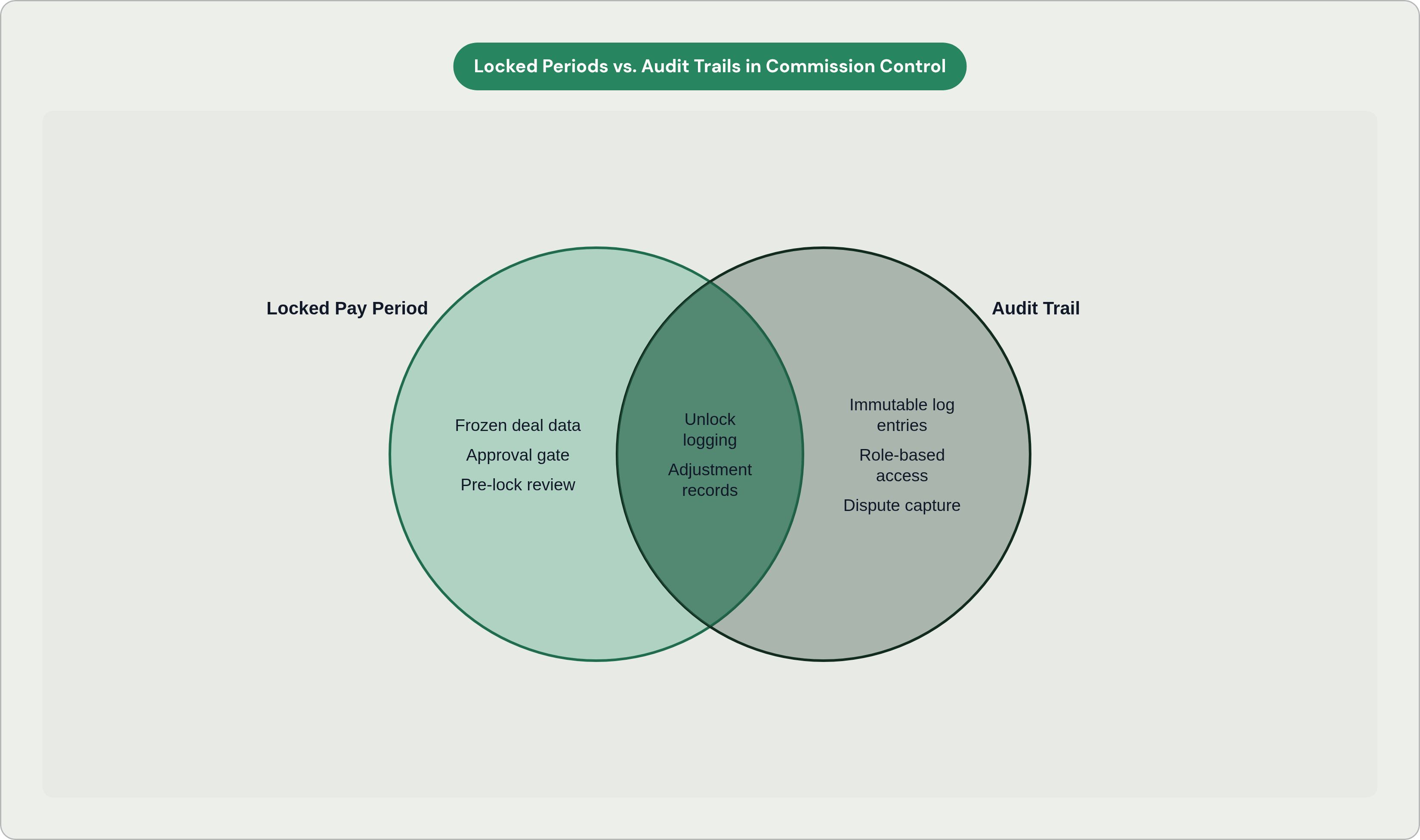
The pre-lock review stage allows managers and Finance to inspect calculated payouts, flag anomalies, and resolve open disputes before the period closes. This is the governance window where manual adjustments are entered with documented reasons, not applied informally after the fact. An approval gate follows: a named, authorized approver signs off on the period, and that approval is itself logged with role and timestamp. Lock execution then freezes the payout data, preventing any edit to deal inputs, rule parameters, or calculated results for that period. Post-lock, reps receive their statements, and what they see matches exactly what goes to payroll, because both derive from the same frozen record.
What the lock must actually cover to be meaningful is specific. The deal data as it existed at period-end must be preserved, insulated from subsequent CRM updates. The version of the compensation plan active during the period must be recorded, so that plan changes enacted afterward can't retroactively alter already-locked calculations. Every manual adjustment entered before lock must carry actor, timestamp, before-and-after values, and a documented reason. The payroll export must be logged: what was sent, in what format, to what destination, at what time.
Unlocking, which will sometimes be legitimate, requires its own governance layer. The ability to unlock must be restricted to a defined role, typically a Finance administrator, not available to whoever manages the day-to-day calculation workflow. Every unlock event is logged with reason and actor, so the unlock itself becomes part of the trail rather than an exception to it. Re-locking after a correction follows the same approval sequence as the original lock.
This structure produces a specific and valuable outcome: a dispute raised weeks after a period closes can be answered directly. Here is the locked record. Here is the plan version that ran. Here is the approval. Here is the export. No reconstruction is required.
What a Commission Audit Trail Must Log to Be Useful Under Scrutiny
The minimum viable audit trail logs every event that can change a commission outcome. Deal data import covers source system, timestamp, record identifiers, and field values as received. Rule application covers which plan version ran, which tiers or accelerators fired, and in what sequence. Manual adjustments must include actor, timestamp, before and after values, and a reason field that's required rather than optional. Dispute resolution must capture what was disputed, what was investigated, what was changed or upheld, and by whom. Approvals must include name, role, and timestamp, not simply a status of "approved" but the identity and authorization level of whoever approved it. Payroll export must capture the file generated, the timestamp, and the receiving system or recipient.
Immutability is what separates an audit trail from a collection of records. Log entries can't be edited or deleted; they can only be appended to. If a correction is required, the correction creates a new entry. The original entry remains. This is the same principle that governs financial ledgers, and it's the standard the Association of Certified Fraud Examiners recommends for startups seeking to reduce exposure to internal manipulation. A log that can be retroactively altered isn't an audit trail; it's a document.
Role-based access governs what each actor can see relative to what they can do. Reps see their own deal-level statements and the rules that applied to them, not other reps' data. Managers can inspect their team's calculations and log dispute context but can't alter underlying figures. Finance sees full period-level summaries and export records and holds the unlock authorization, with reason logging required. In any multi-tenant platform, org-scoped tenancy ensures no commission data crosses between customers.
A trail that covers these elements can answer four questions under any audit or dispute: what was calculated, why that number, who approved it, and whether anything changed afterward. Those four questions cover the full surface area of commission exposure.
How Finance and RevOps Use Locked Periods and Trails Across Their Workflows
Finance's core use case is accrual accuracy. Commission expense must be accrued in the period it's earned, not when it's paid, and locked period data gives Finance the confirmed period-end figure required to book that accrual with confidence. ASC 340-40, issued alongside ASC 606, requires that commissions tied to specific contracts be capitalized and amortized over the expected benefit period in certain circumstances rather than expensed immediately. The locked record provides the contract-level detail necessary to make that determination correctly. Without a locked record, accruals are estimates; with one, they're confirmed figures. That distinction matters at audit time, and it matters for financial statement integrity.
RevOps uses the same controls for plan change governance. When a compensation plan is revised mid-year, the audit trail shows precisely when the new version became active and which periods ran under which plan version. This protects the organization if a rep later asserts that the wrong plan was applied to their payout. Version-controlled plan documents tied to locked periods allow RevOps to iterate on plan design without sacrificing the historical record of what each period was calculated under.
Both functions share a broader benefit: commission data as a shared system of record. When Sales, Finance, and HR pull commission figures, they should see the same locked, approved number, not three different figures from three different files. The CRM-Finance reconciliation gap, where pipeline data and paid commission figures fail to align, closes when a single locked record is the source of truth for all downstream reporting.
For internal and external audit purposes, the practical value compounds. An auditor asking to see how a specific commission was calculated receives a logged, period-locked answer traceable through every step. No reconstruction from memory, no assembly of old spreadsheet versions. The record is the answer.
What Good Looks Like in Practice: The Full Workflow from Deal to Locked Statement
Step one: deal data enters from the CRM or via file upload, not from manual transcription. The import event is logged immediately, capturing source system, timestamp, record identifiers, and field values as received. Removing manual entry from this step eliminates an entire category of transcription error before calculation begins.
Step two: the compensation plan runs against the imported data. The active plan version is recorded at calculation time; the result is tied to a specific, named version, not to whatever the plan currently says. Tiers, accelerators, SPIFs, and clawback conditions are applied by rule logic rather than by formula interpretation. Where AI-assisted tools help extract plan rules from existing documents, every rule is reviewed and approved by a human before it executes.
Step three: pre-lock review. Managers and Finance inspect calculated payouts, flag anomalies, and resolve open disputes. Adjustments are entered with reasons. Reps can see their own in-progress statements in real time, which is the mechanism that makes shadow accounting unnecessary. The rep sees the same figure the system will lock; the discrepancy between internal and external accounting disappears at this stage.
Step four: lock and approval. An authorized approver signs off, with name, role, and timestamp recorded. The period is locked: deal data, plan version, calculated results, adjustments, and approval are frozen together as a unit. Reps receive their final statements, and those statements match exactly what goes to payroll.
Step five: export to payroll. The export event is logged, capturing file contents, timestamp, and destination. What Finance imports into the payroll system is traceable, without any gap, back to the locked commission record.
Any future dispute can be resolved by traversing the trail in reverse: payroll figure to export record, export record to locked period, locked period to approval, approval to adjustment log, adjustment log to rule application, rule application to source deal data. The chain is complete at every link.
Platforms like Quota Queue are built with this workflow as the default rather than as a configuration option. Lock, approval workflow, and audit trail are structural features, not add-ons. Commission data is encrypted in transit and at rest, and org-scoped tenancy prevents cross-tenant data exposure. The workflow described above is the path the system runs on, not a best-practice overlay applied after the fact.
What to Look for When Evaluating Whether a Commission Platform Actually Delivers This
The right evaluation questions cut through feature marketing quickly.
Is the lock enforced by the system or by convention? A folder labeled "FINAL," a protected Excel sheet, or a shared drive with restricted permissions isn't a lock. A lock means the system won't permit edits to a closed period without a deliberate, logged, role-restricted unlock action.
Can a locked period be edited without logging who unlocked it, when, and why? If the answer is yes, the lock is cosmetic. The unlock event must itself be part of the audit trail, or the trail has a gap precisely at the moment it matters most.
Does the audit trail cover manual adjustments, or only automated events? Many platforms log system actions comprehensively while leaving manual adjustments, the highest-risk category, either partially logged or dependent on voluntary documentation. The trail must cover both.
Are log entries immutable? Ask directly: can an administrator edit or delete a log entry? If yes, the log can't be called an audit trail in any defensible sense.
Is role-based access enforced at the data level, or only at the interface level? Interface-level restrictions can be circumvented; data-level restrictions can't. The distinction is meaningful in any environment where data is shared across a team.
Does the platform produce a statement that reps can see before the period closes, and does that statement match exactly what goes to payroll? If there's any transformation between the rep-facing statement and the payroll export, that transformation must itself be logged and traceable.
Finally, does the vendor treat these controls as core infrastructure or as premium features? Lock and audit trail functionality that sits behind a higher pricing tier, or that requires custom configuration to enable, signals that the vendor's product architecture doesn't treat data integrity as foundational. It should be the floor, not an upgrade.
The standard here isn't hypothetical. Every feature described in this piece exists in current software. Every startup I know that has implemented these controls operates with commission processes that are auditable on demand, disputable without reconstruction, and defensible to any external examiner. Every startup I know that hasn't is carrying a risk that compounds quietly, period over period, until it doesn't.