RevOps Commission Operations Role and Responsibilities Defined
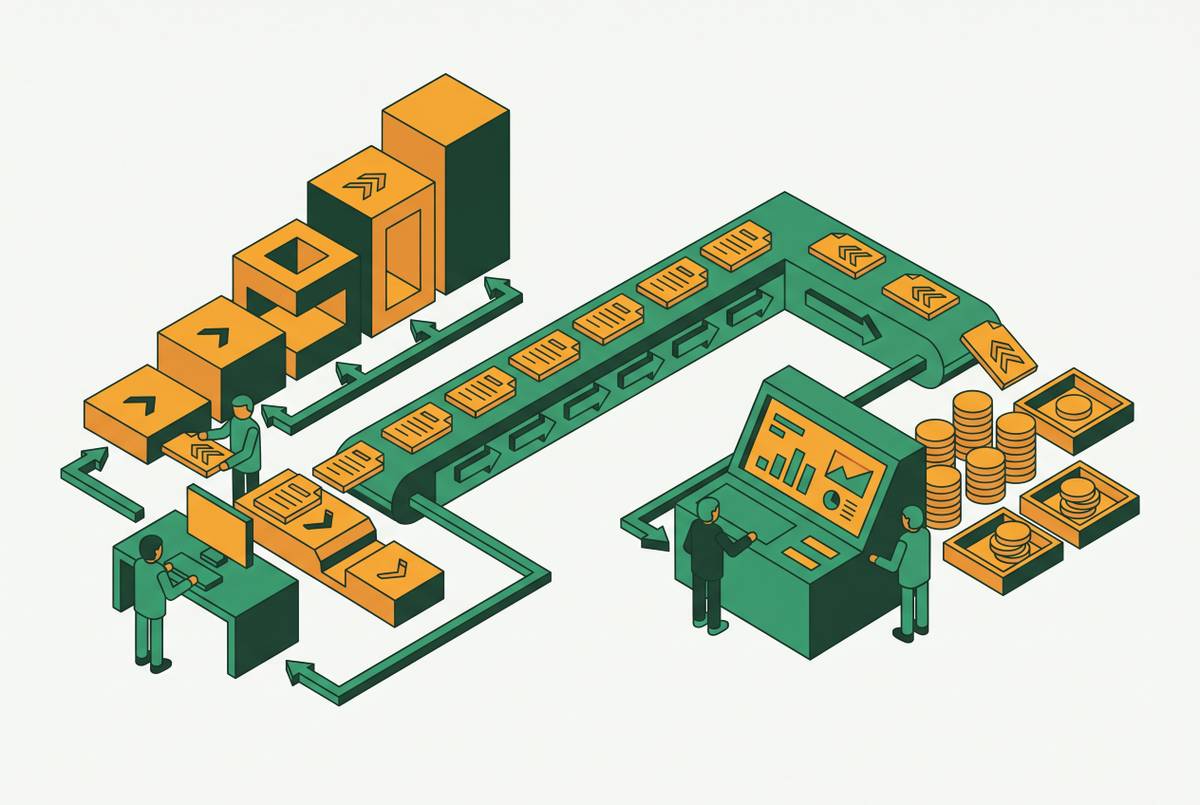
The five responsibilities that separate commission operations from administrative execution.

Commission operations is the RevOps discipline that makes compensation rules executable, payouts traceable, and payroll approvals repeatable. For mid-market RevOps and Finance teams, commission software should help run that whole process as well as calculate earnings. The defining requirement is governed ownership across plan design, data integrity, calculation governance, dispute resolution, and approval workflows.
What commission operations actually is inside a RevOps function
They receive a plan, maintain the calculation, and answer payout questions, but the boundaries of that work remain unclear. Commission operations gives those boundaries a name and assigns ownership to the process between compensation strategy and payroll. It belongs within RevOps because the function already connects territory design, quota methodology, forecasting, commission structures, and performance analytics.
The distinction between commission operations and commission administration is consequential. Administration describes periodic execution, while operations includes the rules, controls, and handoffs that make execution repeatable. Without that distinction, responsibility falls to whoever is closest to the spreadsheet, leaving it disconnected from authority over the decision. Formula drift and missing approval evidence then become symptoms of an undefined function.
Commission responsibilities change from execution to governance as RevOps seniority increases. At analyst level, the work is to check CRM data, keep deal records, and uphold the hygiene standards that make payouts accurate. Managers and senior analysts own more of the work of territory and quota planning, forecasting workflows, and commission plan administration. Directors own commission structures, quota methodology, and the process architecture that makes payouts defensible to Finance and the board. Seniority therefore changes both the nature of the decisions and the volume of work.
That distinction matters when responsibilities are assigned. An analyst should not inherit a plan configuration decision that requires director-level judgment, while a director should not become the default person for reconciling routine discrepancies. Smaller organizations may place all of these responsibilities with one or two people, but each accountability still needs an explicit owner. The tooling must support the same separation, with reproducible calculations for analysts, workflow visibility for managers, and audit evidence for directors. Moving the work into a structured tool such as Quota Queue can support those different responsibilities without requiring every level to be separately staffed.
The five domains that commission operations owns end to end
The first domain is plan design and documentation, which translates compensation strategy into rules that two people can calculate the same way. Those rules include tiered rates, accelerators, SPIFs, clawbacks, and role-specific structures. The second domain is data integrity and CRM alignment, which governs whether the inputs are accurate, current, and drawn from the system of record. The third is calculation governance, which produces a repeatable, locked, versioned result rather than an editable number with an uncertain history.
The fourth domain is dispute resolution, which gives reps and managers a defined way to challenge a payout and receive an evidence-based answer. The fifth is cross-functional approval and payroll handoff, which coordinates sales leadership, Finance, and HR to convert the calculation into an approved output. These domains provide a framework for distinguishing work that happens from work that is actually governed. A calculation may be accurate while its approval chain remains undocumented, just as a clear plan may rely on stale data. No domain can compensate for a missing control in another, so platform requirements must cover tasks across the whole sequence.
Plan design as an operational discipline, not a one-time strategy exercise
A plan handed over in a PDF is not necessarily ready to run. Commission ops must turn it into an executable specification, with enough precision that calculating a payout does not require interpreting strategy. The starting principle is to connect the compensation metric to what the role controls, such as closed revenue for AEs or qualified pipeline for BDRs. An SDR plan tied to qualified meetings or SQLs passed needs different rules from an AE plan with tiered accelerators above quota.
Other design choices also create operational obligations. An uncapped plan has no need for ceiling logic but still needs budget modeling, while a soft cap with leadership approval thresholds needs an approval workflow. Simplicity matters because a plan that cannot be explained in under a minute leaves too much room for ambiguity in execution. Documentation must also support applicable compensation disclosures without confusing disclosure requirements with a requirement to publish the full calculation methodology. Commission ops owns the usable design artifact, including its initial configuration, because undocumented overrides or inconsistent rules across periods can undermine even a sound plan.
Why spreadsheet-based calculation makes the calculation governance domain unworkable
Calculation governance must show how the current total came to be. It must establish which rules ran, which data entered the calculation, and which adjustments changed the result. When commissions run in spreadsheets, formula drift, file versions passed around, and missing audit evidence make those questions hard to answer. An error in a nested formula can affect a whole column and go unseen until a rep challenges the payout. By then, the file under review may no longer represent the file that produced the payment.
Formula checks, file-naming conventions, and sign-off emails depend on continued effort and do not themselves create a complete calculation record. As the team grows, so does the work required to maintain those controls. The alternative is an engine that locks periods, versions plan changes, preserves timestamped calculation history, and handles retroactive recalculations. Quota Queue provides a workflow for importing deal data, configuring rules, locking results, routing approvals, resolving disputes, and exporting payroll-ready statements.
Data integrity and CRM alignment as the upstream dependency for accurate payouts
Even a reproducible calculation produces the wrong payout when its inputs are wrong. Commission accuracy therefore begins before the calculation runs, at the point where CRM records become commission inputs. Manual exports separate those inputs from the CRM events they represent and introduce a delay into every cycle. A commission system that reads straight from the CRM can stay up to date as deals move through stages, but file-based ingestion still needs checks that the data is fresh.
Commission ops owns the data contract between the two systems. The CRM is still the system of record for deal data, forecasting context, and crediting triggers, and commission software records the incentive calculations. The contract defines which fields trigger credit, which validation runs before calculation, and how retroactive deal changes are handled after a period closes. Quota Queue can bring existing deal data into that process through native CRM connections or file imports. The choice of ingestion method does not transfer responsibility for input quality away from commission ops, which must also provide structured outputs that Finance and HR can use without rebuilding the analysis.
The cross-functional approval workflow that converts a calculation into a payroll output
A correct calculation is not yet an approved payroll commitment. Finance must be able to establish budget alignment and payout timing, while sales leadership must verify plan correctness and quota attainment. When those teams receive totals assembled from multiple spreadsheets, they face a choice between accepting the work on faith and reconstructing it. A defined approval chain gives each reviewer a specific decision and a common record on which to make it.
In that chain, sales leadership and Finance review the results, and sign-off is locked before the payroll-ready output is handed over. Commission ops owns the design and execution of that chain, including the explicit choice to pay at booking, invoicing, or cash collection. Each timing choice affects motivation and financial control, so ambiguity can turn a policy question into a payout dispute. Reliable forecasts and payout estimates also help Finance anticipate commission costs before quarter-end. The final locked commitment must be versioned, timestamped, and tied to a named approver so there is a firm record to turn to when questions come up later.
Dispute resolution as a defined workflow, not an ad hoc investigation
A commission dispute is an audit question about how a number was produced. Its answer must come from the calculation record. Without that record, the investigation becomes an attempt to recover the original file, identify its version, trace formulas, and account for undocumented adjustments. That doubt leads reps to keep their own totals of what they expect to earn, a practice known as shadow accounting. The resulting distrust reflects a process that cannot explain its output, rather than a problem that better reassurance can solve.
A defined dispute workflow needs a submission channel, a response SLA, access to the calculation evidence, and a documented resolution. Commission ops owns all four, including the ability to decompose a payout into its inputs, applied rules, and final outcome. A rep should be able to identify the deals included, the rate tier applied, and the resulting earnings without requesting a reconstruction. Deal-level statement detail provides that explanation before a disagreement hardens into a formal dispute. Real-time visibility into earnings and quota progress is therefore preventive work, exposing discrepancies early rather than merely making later investigations faster.
AI governance as the emerging sixth accountability in commission ops
When AI helps with plan extraction or commission-adjacent calculations, someone must also answer for its work. That gap matters because an AI-assisted output can enter the same payout process as a manually prepared one. Its origin does not reduce the need for an accountable owner.
For commission ops, the requirement is to know the inputs, require human review before an output is locked into a pay period, and preserve an audit trail that distinguishes AI-assisted results. This is a governance layer across the existing domains.
What good commission ops practice looks like as an operating model
Well-run commission ops follows a cadence in which each phase prepares evidence for the next. Plans are documented before the period opens, and CRM inputs are validated before calculation. At period close, results are calculated and locked, then reviewed through the approval chain before payroll handoff. Dispute investigations follow a standing workflow and response SLA. Where AI contributes to the process, its outputs pass through the same ownership and review requirements.
The quality of that cycle should not depend on who happens to run it. Versioned rules and a durable audit trail allow Finance to receive an approved output rather than a workbook it must independently reconstruct. Reps also need explanations, because the work is only complete when the payout can be explained. End-to-end commission platforms can connect these requirements in one workflow instead of leaving them scattered across files, email threads, and separate logs. For mid-market RevOps and Finance teams evaluating commission software, those connections are more meaningful criteria than calculation capability alone.
Quota Queue prices by compensation plans rather than seats, so adding reps to an existing plan does not increase the bill. That is a relevant distinction when comparing costs tied to headcount with costs tied to plan complexity, but it does not replace the governance test. Passing the governance test requires that, if the person running commissions left tomorrow, the next person could reconstruct every payout from the last three periods without asking anyone.