Commission Data Security Requirements and Compliance Controls
Commission data requires the same security controls as payroll data.
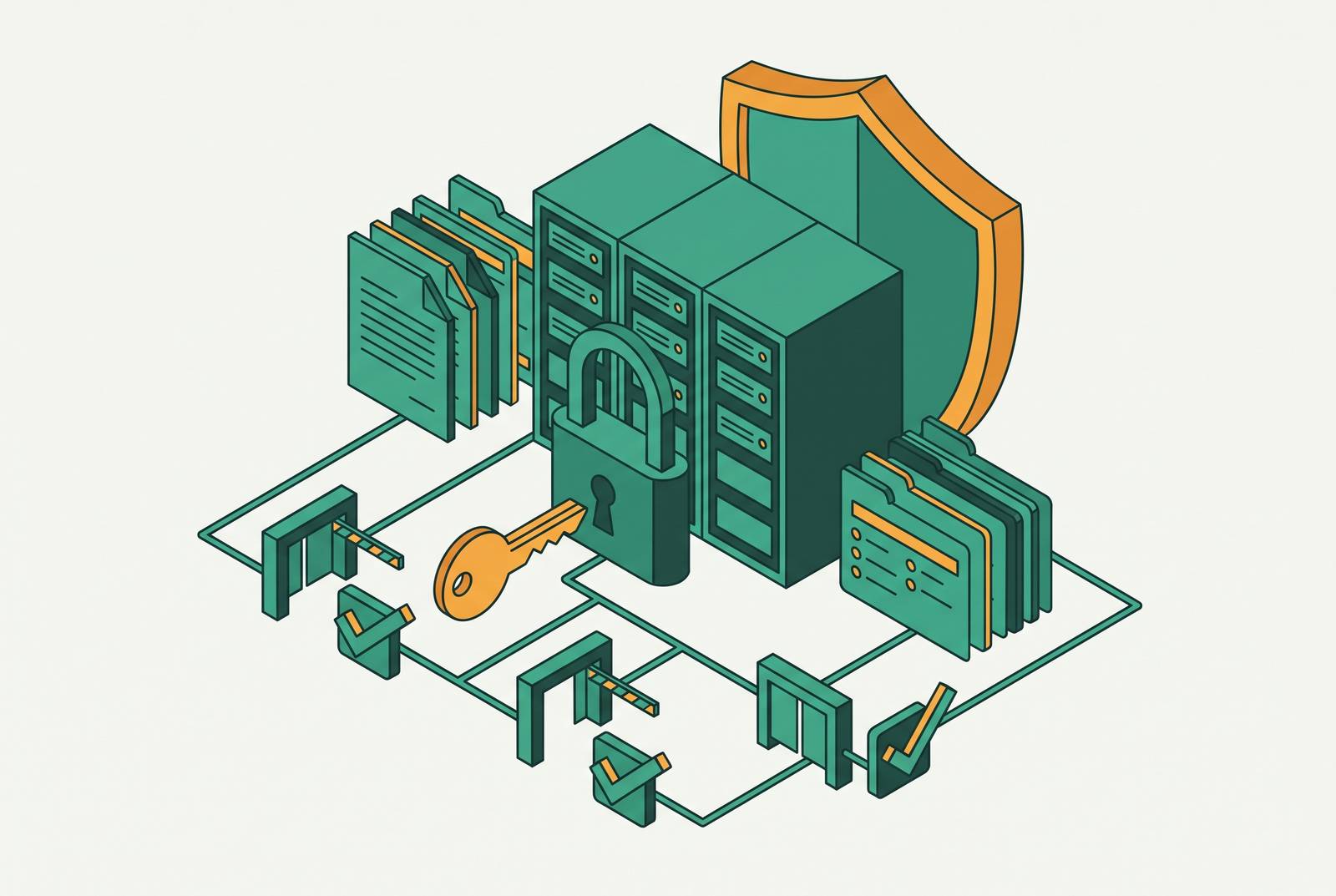
Commission data receives a fraction of the security attention that payroll data gets, despite containing the same information: individual earnings, deal attribution, quota attainment, and employment terms, all tied to named employees. The gap persists because organizations have classified commission records as reporting metrics rather than compensation data. That classification is wrong, and it now carries legal and operational consequences that most sales and finance teams have not yet absorbed.
Why commission data belongs in the same security category as payroll data
A payroll file is treated as what it is: a confidential record of what an organization pays its people, stored in systems with restricted access and moved only through controlled channels. A commission spreadsheet is treated as a working document. Commission records contain individual earnings amounts, deal-level attribution tied to named employees, quota attainment figures, and employment terms such as OTE and accelerator thresholds. Taken together, that is a detailed compensation profile of an identifiable person.
That profile qualifies as sensitive personal data in the regulatory sense. The term refers to information from which harm to an individual can flow: financial harm, discrimination, retaliation. Earnings records qualify on all three counts. A commission statement reveals what a rep earned, which deals they closed, and how their performance measured against quota. It reveals the terms under which they were hired and the thresholds at which their compensation accelerates. That information could be used to poach a high performer, to discriminate against an employee, or to retaliate against someone whose attainment fell short. It is compensation data, and the consequences of treating it as anything less are no longer theoretical.
The operational consequence of misclassification is visible in everyday practice. When teams see commission data as reporting data, they store it in shared spreadsheets, email it unencrypted, and grant access without role controls. These behaviors are routine in commission management. They would be considered unacceptable if applied to payroll files. Commission calculation platforms like Quota Queue enforce controls at the point of calculation itself: encryption in transit and at rest, role-based access, locked pay periods, and audit trails. The security posture matches the sensitivity of what is being managed, which is the standard compensation data demands.
The regulatory landscape that now covers commission data directly
Regulators have reached the same conclusion. If you sell in several states, each one may have its own comprehensive privacy law, and employee compensation data falls within scope of those laws. The pace of change matters because it converts what was once a theoretical compliance question into an operational one.
As of March 2026, 20 US states have comprehensive privacy laws. Indiana, Kentucky, and Rhode Island took effect on January 1, 2026, adding new assessment, notice, and transparency obligations. In 2025 alone, eight comprehensive state laws became effective: Delaware, Iowa, Maryland, Minnesota, Nebraska, New Hampshire, New Jersey, and Tennessee. Minnesota's Consumer Data Privacy Act took effect July 31, 2025, and it reaches further than comparable laws. Maryland's law, effective October 1, 2025, prohibits the selling of sensitive personal data regardless of consumer consent, a stronger baseline than most peer statutes.
The new obligations are specific. Kentucky's DPIA obligation applies only to processing activities created or generated on or after June 1, 2026. Rhode Island requires Data Protection Assessments for processing activities that present heightened risk of harm, with no grace period, and imposes a broadly applicable privacy notice requirement on all commercial websites collecting, storing, and selling personally identifiable information. State privacy laws now treat employee compensation data as sensitive personal information. When they do, it triggers Data Protection Assessments and heightened vendor controls. If you are evaluating commission software, check whether the platform vendor meets those standards.
The federal layer adds weight. The SEC's Regulation S-P now requires written cyber-related policies and procedures, notice to individuals within 30 days absent a no-harm finding, increased recordkeeping, and stringent new third-party risk management requirements. The DOJ's Bulk Data Rule, effective April 8, 2025 with additional requirements taking effect on October 6, 2025, introduced a framework governing how US persons engage in transactions with countries of concern or covered persons that access bulk personal data or government-related data, including requirements for stringent cybersecurity controls and record-keeping. A national sales organization may be simultaneously subject to a dozen different regimes, each with its own reporting obligations.
Why spreadsheets cannot meet these obligations
The problem is structural. Spreadsheets were never designed to carry the obligations that now attach to commission data, and no amount of process discipline can change what the format fundamentally cannot do. Teams managing commissions in spreadsheets are not being careless. They are using a tool that lacks the properties compliance requires, and those properties cannot be added through better habits.
The audit trail is the clearest example. There is no record of which rules ran, what data fed the calculation, or who made a manual adjustment. That information cannot be recovered after the fact. The spreadsheet contains only the result. It does not contain the chain of decisions that produced it.
Access control is another structural absence. Role-based restriction of who can view, edit, or approve is not a native spreadsheet capability. The same is true of encryption. It has no org-scoped access boundary. It cannot be shown to meet the data protection controls that state privacy laws and SEC Regulation S-P now require.
Formula drift compounds the problem. A typo buried in a nested IF statement will silently miscalculate an entire column of reps, and there is no mechanism to catch it before payout. That gap builds latency and error into the process before anyone has made a single mistake. It also means the data in the spreadsheet is never provably synchronized with the system of record.
Some teams argue that strong file-access policies and password protection are enough. They are not. Those are perimeter controls. They do not address the internal access, auditability, or encryption requirements that current regulations specify, and they fail entirely when a file is forwarded or downloaded.
The specific security controls that commission data now requires
You need a specific set of technical and procedural controls, each mappable to the requirement it satisfies. Encryption in transit and at rest is the baseline. Commission data moves between systems, from CRM to commission platform to payroll, and state privacy laws and SEC Regulation S-P require that sensitive personal data be protected during transmission and storage. This means the commission platform itself must encrypt data, not rely on the organization's network perimeter.
Role-based access controls let only people with a legitimate processing purpose see sensitive personal data. A sales rep should see their own statement, a manager their team's, Finance the full export. No more, no less. Audit trails and locked pay periods answer the question a regulator or auditor will always ask: show exactly how this number was calculated, who approved it, and when. SOX-adjacent organizations face particular pressure here. Auditors now expect ongoing proof that financial data is accurate, complete, and traceable, not point-in-time documentation.
Org-scoped tenancy is another control. Incident response readiness requires an organization to know, within hours, which individuals' commission data was affected by a breach. Morrison Foerster's December 2025 predictions flag that regulators will push for greater transparency and require organizations to prove they are staying current on emerging threats. Documentation of security controls is as important as the controls themselves.
Vendor due diligence is in scope. Any vendor processing commission data on an organization's behalf is a third party under SEC Regulation S-P's strengthened requirements, and the organization is responsible for verifying that vendor's controls. Where required by state law, organizations must also conduct formal Data Protection Impact Assessments. Organizations in those states processing employee commission data must assess and document the risk of that processing.
One additional control applies where commission platforms use AI to assist with plan building or extraction. The vendor must commit that customer commission data is not used to train shared models. Commission data is compensation data, and it must not leave the organization's logical boundary through model training.
The threat environment that makes these controls urgent rather than aspirational
The regulatory requirements coincide with a measurably worse threat environment. 2025 was a record-breaking year for threat actors across geographies and sophistication levels, with AI-driven social engineering and supply-chain compromises driving incidents to record numbers at significant cost. Threat actors used AI to increase the scale and speed of attacks and to find unpatched or zero-day vulnerabilities. These tools allow attacks to scale in ways that outpace perimeter defenses.
Morrison Foerster's December 2025 predictions flag more sophisticated ransomware attacks in 2026. They are increasingly powered by AI and aimed at critical infrastructure and supply chains. Commission records contain the same financial detail as payroll, individual earnings, employment terms, performance thresholds, and they often live in less protected environments. A threat actor who gains access to a commission spreadsheet shared via email has gained access to compensation data for an entire sales team.
The cross-border dimension adds complexity. The DOJ's Data Security Program limits transfers of certain quantities of sensitive American data to specified countries. The same predictions that describe the worsening threat environment also point to broader use of AI in defensive security and incident response. That is the direction mature security programs are heading. Organizations relying on spreadsheet-based commission management cannot access those capabilities.
How to evaluate whether a commission platform actually meets these requirements
Most commission platforms describe themselves in security terms. Compliance risk lives in the gap between what marketing says and what the controls verifiably do. Buyers need specific criteria to close that gap during evaluation.
SOC 2 Type II is the minimum verifiable attestation. Ask for the report itself, not a self-attestation, and check the audit period and any noted exceptions. The data processing agreement should specify retention periods and deletion obligations, breach notification timelines that allow the customer to meet its own 30-day SEC Regulation S-P obligation, sub-processor disclosure, and an explicit no-training-on-customer-data commitment for any AI features.
Audit trail verification should be hands-on. Ask to see it, not hear about it. Can the platform show a complete log of who changed a commission rule, when, and what the value was before and after? Can the organization export the full audit log for its own records? Can the platform enforce that a sales rep sees only their own statement, a manager sees only their direct reports, and Finance sees the full export, without custom engineering? Are access permissions logged and auditable?
CRM integration depth is a security and accuracy question, not just a convenience one. A platform that pulls deal data directly from the CRM in real time eliminates the manual export step where data is most vulnerable: emailed spreadsheets, local downloads, unsecured file shares. A platform that requires periodic manual exports has not closed the security gap. It has moved it to a different step in the process. Org-scoped tenancy should be confirmed explicitly. Quota Queue is built around these controls: encryption in transit and at rest, org-scoped tenancy, full audit trails, locked pay periods, logged approvals, role-based access, and a strict no-training-on-customer-data policy. Its plan-based pricing means organizations are not penalized for team growth while maintaining these controls.
The internal governance steps that technology controls alone cannot replace
A secure commission platform is the necessary condition for meeting current compliance obligations. But it only holds up under regulatory or legal scrutiny if the governance practices around it are sound. Data mapping is the starting point. For organizations with international sales teams, that mapping must include jurisdictions so that DOJ Bulk Data Rule and state law obligations can be assessed accurately.
Vendor governance policy should be formalized. Keep a register of vendors processing commission data, review their SOC 2 reports annually, and re-execute data processing agreements when vendor sub-processors change. A quarterly access review that confirms each user's access matches their current role is the governance practice that keeps the technical control valid.
Incident response readiness specific to commission data means answering within hours which employees' commission data was in the affected system, what period it covers, and who had access. Companies that invest in disciplined response frameworks and document security decisions defensibly fare better in both litigation and regulatory reviews. Documentation of the decision process is as important as the decision itself.
Data Protection Impact Assessments should precede new processing activities, not follow them. For organizations in Indiana, Kentucky, Rhode Island, and other states with DPIA requirements, any new way of processing commission data, a new integration, a new AI feature, a new reporting output, should trigger an assessment before deployment. Pay period locking works the same way. Locking a pay period after approval is a technical capability in a purpose-built commission platform, but it only works as a control if the organization has a defined approval workflow that specifies who reviews, who approves, and what evidence of approval is retained before the lock is applied. That governance layer is what transforms an audit trail from a log into evidence. Compliance is not a one-time implementation. It is an ongoing operational discipline, and the organizations best positioned for the current regulatory environment are those that have made security and auditability structural properties of their commission process rather than periodic reviews.
Sources
- 2025 Year in Review: Cybersecurity and Data Protection
- 2026 Data Security and Privacy Compliance Checklist: Key US State Law Updates, AI Rules, COPPA Changes, and Global Data Protection Risks - O'Melveny
- Privacy and Cybersecurity 2025–2026: Insights, challenges, and trends ahead
- Data, Cyber + Privacy Predictions for 2026