Build vs Buy Decision for Custom Commission Calculation Systems
Hidden costs and audit risks often make buying cheaper than building over a system's full life.

Building a custom commission calculation system looks like the cheaper, smarter path for most RevOps and engineering teams. It usually isn't, once maintenance, audit exposure, and compensation data risk get counted honestly across the life of the system rather than just at launch.
RevOps teams gravitate toward building commission tools because they know the business rules cold, and a first prototype comes together fast. That instinct isn't wrong. RevOps people spend their days stitching together CRM data, spreadsheets, and payroll exports, so building one more connector feels like Tuesday. A working commission calculator can get built in an afternoon. What gets built in an afternoon is a prototype, though, not a system that survives contact with a live sales org, and that distinction is where most of this decision actually lives.
The trouble starts once scope expands past the happy path: multiple roles, accelerators that kick in at different thresholds, payout eligibility rules, retroactive adjustments when a deal gets reclassified three months later, integrations that need to stay in sync, and an audit trail someone eventually asks for. Hidden cost and technical debt climb fast once those requirements appear in the plan, and they always appear.
There are two ways teams get this decision wrong, and neither involves stupidity. One is building when the underlying comp plan is fairly standard, which means paying engineering salaries for months to reproduce something a vendor already sells, with no competitive edge to show for it. The other is buying when the comp structure is genuinely unusual, then spending years bending that structure into a tool that was never built to hold it, patching around the mismatch instead of fixing it. The real question was never "can this be built?" Almost anything can be built. The question is whether building costs less and performs better than buying, once you look at the system over its full life rather than its first release.
What a custom commission build costs across its full lifetime
Custom software pricing in 2026 runs from around $75,000 for a lean MVP up past $600,000 for something enterprise-grade. AI-assisted development has pushed those numbers down, in some cases cutting cost by two to three times under favorable conditions, since a lot of scaffolding code that used to take a junior developer a week now takes an afternoon. That's usually the point where teams stop doing the math, satisfied with the smaller number on the launch invoice.
The number that gets missed sits on the other side of launch. Maintenance runs roughly 70% of a piece of software's total cost over its life, a widely cited industry benchmark. The build itself costs less than maintenance over the software's life, and that ratio alone should reorder how most teams frame this decision.
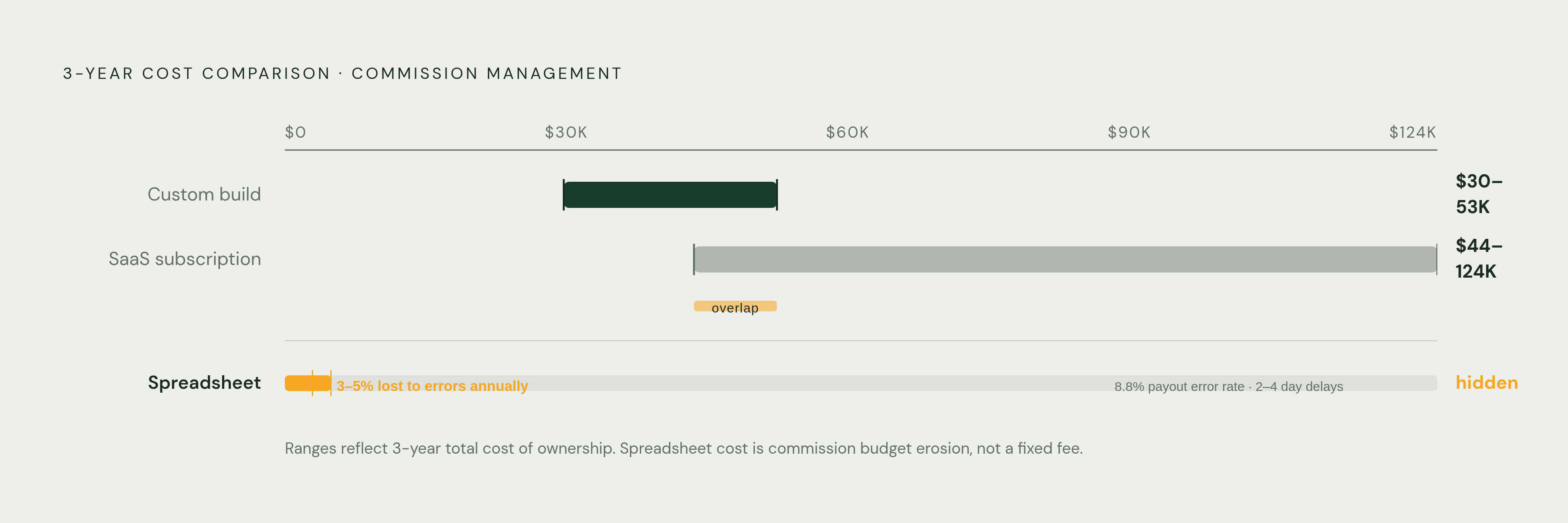
Look at a three-year window using general software cost data (not commission-specific, but directionally useful): a custom path runs somewhere between $30,000 and $53,000 total, while a comparable SaaS subscription runs $44,000 to $124,000 once seat fees, tier upgrades, and opportunity cost get factored in. Those ranges overlap substantially. Anyone who tells you building is automatically cheaper is skipping the middle of that range on purpose.
Buying carries its own drain. The 2026 SaaS Management Index found organizations use only 54.4% of the licenses they pay for, meaning close to 46% sits idle, and the average company loses $19.8 million a year to unused licenses. A bloated platform purchase is its own form of waste, just a quieter one than a failed build.
Legacy incentive compensation management platforms add a wrinkle that looks like flexibility but functions like a toll booth: professional services fees of $30,000 to $50,000 per comp plan change. That's lock-in with an invoice attached. That's lock-in with an invoice attached, to be priced into any "buy" decision before signing anything.
The upfront comparison, in short, is close enough that it shouldn't decide anything by itself. What happens after year one is where the real gap opens up.
Where custom-built commission tools structurally break down in production
A prototype and a production system solve different problems, even when they share the same spreadsheet math underneath. A prototype is fine for modeling a new plan structure or sanity-checking a payout scenario. It is not fine as the unaudited system of record that determines what a rep actually gets paid, and treating it that way is where most homegrown tools quietly go wrong.
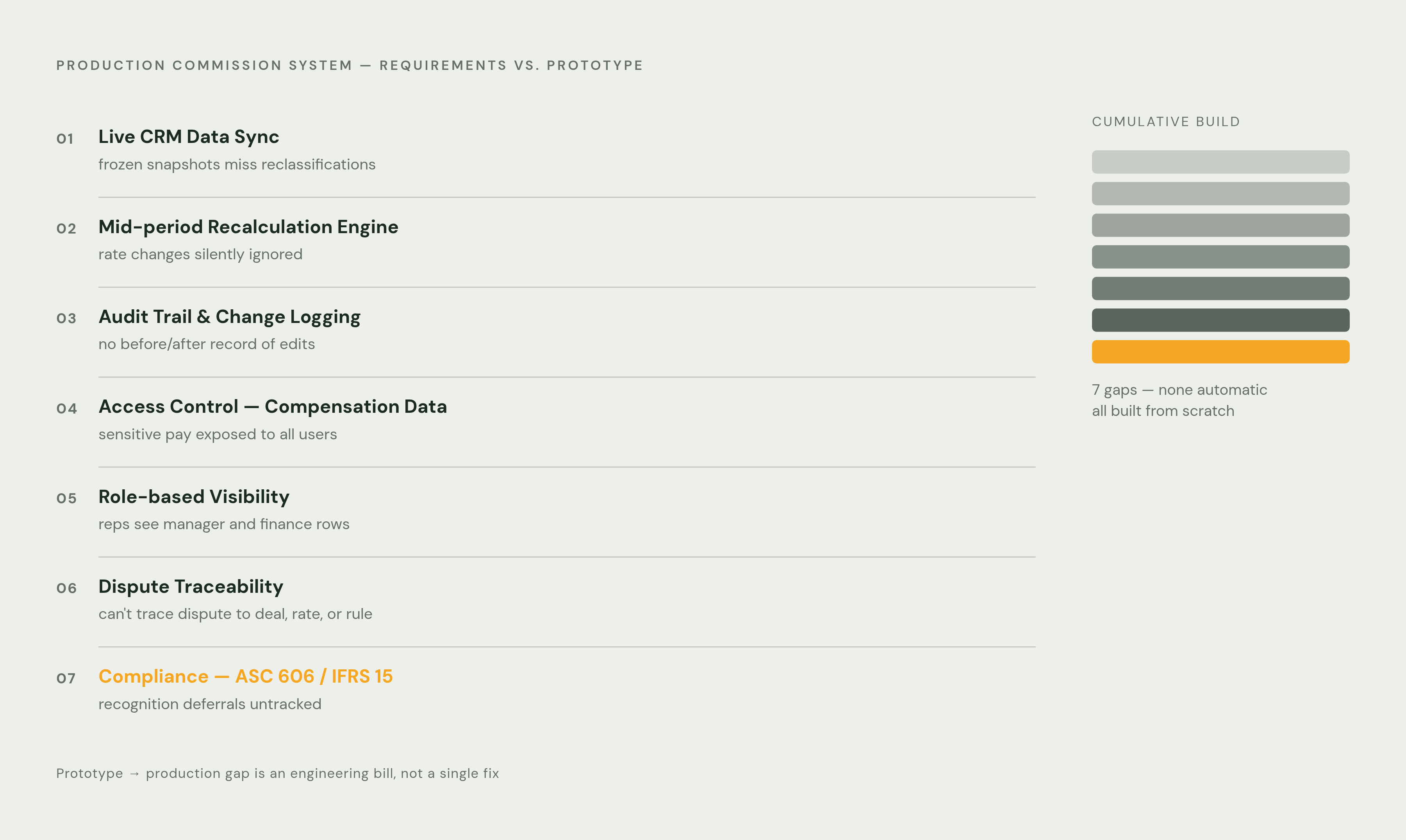
Seven things a production commission system needs that a prototype almost never has, and each one exposes a different failure mode. Live data sync from the CRM is the first: a prompt-built calculator usually works off an export, a snapshot frozen at the moment someone pulled it, so nothing recalculates when a deal moves stages or gets reclassified afterward. Recalculation when a plan changes mid-period is the second, and it needs an actual rule engine, not a script somebody patches by hand every time finance changes a threshold.
An audit trail is the third, and no custom build gets one automatically. Who changed a rate, when, and under whose authorization, none of that gets logged unless someone deliberately builds the logging layer, and that's usually the first corner cut under deadline pressure. Access control is the fourth: rep earnings are sensitive compensation data, and a spreadsheet or a quickly assembled internal tool inherits whatever security habits its builder happened to have that quarter, which is rarely a comforting standard.
Role-based visibility is the fifth requirement: reps, managers, and finance all need different views of the same underlying numbers, and building three permission layers on top of one calculation engine is not the "quick script" part of the project. Dispute traceability is the sixth. When a rep challenges a payout, can someone trace that dollar back to the specific deal, the specific rate, and the specific rule that produced it? If the answer takes a day of manual digging, the system has already failed the test that matters most. Compliance exposure is the seventh: for companies under ASC 606 or IFRS 15, commission numbers feed straight into revenue recognition, so an error buried in a custom build isn't a bug ticket, it's a restatement risk.
AI-written code adds a newer wrinkle worth taking seriously. Recent analysis of AI-authored commits found that 15% of commits introduced at least one issue, and 41.1% of the resulting security issues were still sitting live in production code, unfixed. Speed of generation and soundness of output are not the same thing, and teams leaning on AI to accelerate a commission build should not assume the two travel together.
Staffing adds a quieter risk. Available data on open-source projects finds that around 16% get abandoned after losing their core developers, and a homegrown commission tool carries that exact key-person exposure. The engineer who understands why the accelerator logic branches the way it does eventually leaves, and whoever inherits the codebase inherits the guesswork too.
None of this means building is always the wrong call. It means these seven items are the honest checklist a team has to answer before committing, not after the first payout dispute lands in someone's inbox.
The narrow conditions where building genuinely makes sense
Building makes sense when the software itself is part of how a company wins in its market, not when it's a back-office function that could be rented for a fraction of the engineering cost. That's the filter, and it's a narrower one than most teams assume going in.
A few situations pass that filter honestly. Commission logic that is the product itself, like a marketplace or creator platform where the payout engine faces customers directly and differentiates the offering, belongs in this category. A regulatory environment so specific that no off-the-shelf platform can meet it without customization heavy enough to defeat the point of buying also belongs here. So does a company that already owns the engineering capacity and the long-term maintenance appetite, and has modeled total cost of ownership honestly across three-plus years rather than stopping at the launch invoice. Add to that a team willing to build audit trails and access controls in from day one, as core requirements rather than features bolted on after the first compliance question.
Mistaking "our comp plan is complicated" for "our comp plan is uniquely complicated" is the trap." Multi-tier accelerators, splits, clawbacks, draws, and SPIFs feel bespoke from inside a company, but they are table stakes for purpose-built platforms, handled as standard configuration rather than custom engineering. Most teams that think they need a custom build are describing a plan that a configurable platform already handles out of the box.
A legitimate middle path exists: using AI to help configure plan logic inside an existing governed platform, rather than using AI to replace the platform entirely. AI assisting with rule-building is a reasonable accelerant. Human review before anything triggers a real payout is not optional, and any workflow that skips that review step has quietly turned a compensation system into an experiment.
What the spreadsheet baseline costs, and why it's the real comparison point for most teams
Most of this decision doesn't get made against a hypothetical build. It gets made against whatever a company is already doing, and for most companies that's a spreadsheet. Seventy-seven percent of companies still rely on spreadsheets to manage pay cycles, the 2025 Compensation Planning Trends Report found, and more than 60% of small and mid-sized businesses still use spreadsheets for commission tracking specifically, Commissionly's 2025 Benchmark Report found. Spreadsheets are the default, not the exception, which is why they deserve to be treated as the real baseline in this comparison rather than an afterthought.
Spreadsheet error rates aren't a minor annoyance to be managed around. Ray Panko's research, cited repeatedly across the industry, consistently finds that more than 80% of non-trivial spreadsheets contain at least one material error. That's not a tooling gap; it's a statement about the medium itself: spreadsheets were never built for repeatable financial calculation at scale, and every added tab, formula, and manual override compounds the odds of something breaking. That's a statement about the medium itself: spreadsheets were never built for repeatable financial calculation at scale, and every added tab, formula, and manual override compounds the odds of something breaking quietly.
That fragility costs real money. Companies lose 3 to 5% of total commission budget annually to overpayments and underpayments. Commission errors touch an average of 8.8% of payouts every year. Month-end close gets delayed two to four days at companies running commission math by hand. Perhaps the sharpest number of all: rep trust in the compensation program drops 31% after the very first calculation error reaches them, regardless of whether it gets corrected afterward. Trust, once dented, doesn't reset just because the number got fixed a week later.
A spreadsheet is itself a form of "build," even though nobody frames it that way. It needs ongoing maintenance, it breaks under plan changes, it has no audit trail worth the name, and it degrades sharply once headcount passes roughly 20 reps. VLOOKUP chains snap when someone reorders a column. Manual adjustments leave no log. CRM and billing data gets pasted in flat, original field names stripped out, context gone. None of these are edge cases. They're the normal operating condition of a spreadsheet-run comp process, and "doing nothing" is not a neutral, cost-free choice sitting outside this whole decision. It's the baseline every other option gets measured against.
What a purpose-built commission platform absorbs that a custom build must construct from scratch
Purpose-built platforms come with audit trails, access controls, CRM sync, recalculation logic, rep-facing statements, and dispute traceability already built in. A custom build has to construct every one of those independently, from the ground up, and each one is its own multi-week project rather than a checkbox.
Plan complexity that feels intimidating from inside a company, multi-tier accelerators, split attribution across reps, recoverable draws, retroactive adjustments, MBO overlays, clawbacks, SPIFs, is handled by these platforms as baseline functionality. It's the starting line for evaluation, not a premium feature worth paying extra for.
Visibility changes behavior, and there's data behind that claim. Commissionly's 2025 benchmark data shows teams with real-time commission visibility hit 15% higher quota attainment than teams without it. A rep who can see exactly how a deal translates into a paycheck behaves differently than one waiting for a number to land at the end of the month, and that gap compounds across a sales floor.
The administrative math is stark too. Modern platforms cut administrative time by 60 to 80% compared with spreadsheet-based processes, and companies switching over see substantial reductions in compensation planning errors. Security and compliance ride along as included infrastructure rather than add-ons: encryption in transit and at rest, org-scoped tenancy, no training on customer data, audit trails, locked pay periods for companies under ASC 606 or IFRS 15. A custom build treats each of those as a future sprint that keeps getting deprioritized. A platform treats them as the reason the product exists.
The same AI-assisted middle path from earlier applies here in its cleanest form: AI helping configure plan logic inside a governed system, with a human reviewing and approving before any payout actually runs. That's a legitimate accelerant. AI standing in as the unaudited payout engine itself is not, and the difference between those two setups is the difference between a tool and a liability.
Evaluating commission platforms when you've decided to buy
Six criteria determine whether commission software actually works in practice, drawn from a buyer's guide built on more than 300 verified user reviews plus independent market analysis. Calculation accuracy and reliability carries the heaviest weight at 25%: does the engine produce the right output for every plan structure, including the ugly edge cases, and does it stay consistent across periods, plan versions, and different groups of payees?
Plan logic flexibility is 20%: can it handle multi-tier accelerators, split attribution, recoverable draws, retroactive adjustments, and MBO overlays as the plan actually exists on paper, not a simplified stand-in version that breaks the moment finance adds an exception? Calculation transparency and traceability is also 20%: can every dollar in a payout be traced back to the specific deal, rate, and rule that generated it, on demand, without an engineer getting pulled in to explain it?
The remaining three matter just as much even without a fixed weight attached. Data integration asks whether the platform meets a team's data where it already lives, in the CRM, the billing system, the HRIS, without forcing a rip-and-replace of workflows that already work. Rep-facing visibility asks whether a rep can check their own statement without picking up the phone to finance. Administrative burden asks how long time-to-value realistically takes, and who owns plan changes once the initial setup is done.
Build the single most complicated commission scenario the comp plan actually contains, and run it through the platform before signing anything. If the output is wrong, or if nobody can walk through the calculation step by step and explain it, the software fails, regardless of any other feature it demonstrates. Everything else is a demo.
Pricing structure deserves scrutiny too. Platforms priced by the number of active compensation plans, rather than by seat count, avoid turning headcount growth into a cost penalty. Seat-based pricing quietly punishes a company for hiring, which is a strange incentive to build into a compensation tool of all things.
Migration tends to be less disruptive than most teams brace for. A structured move typically takes two to four weeks end to end, with data import and configuration often finished in two to five business days when a vendor handles support directly. Running the new platform in parallel with the old system for one full pay cycle before retiring the prior setup is the same discipline whether the prior setup was a spreadsheet or a homegrown tool, and skipping that parallel run is how a clean migration turns into a payroll dispute in month one.