Per-Seat vs Per-Plan Commission Software Pricing
Choosing between per-seat and per-plan pricing shapes your cost curve for years.

Two pricing models dominate commission software today, and they don't just charge differently, they scale differently. Per-seat pricing bills by headcount, so the invoice grows every time the org chart does. Per-plan pricing bills by tier or package rather than by individual headcount, so a company can add reps within a tier without the software bill moving at all. Buyers picking between the two are choosing which variable, growth in people or growth in plan complexity, drives their cost curve for the next several years.
The distinction matters more now than it did a couple years ago. Per-seat pricing still dominates SaaS broadly, but its grip is loosening, and commission software buyers are evaluating this decision in the middle of that shift, not after it settled. What makes commission platforms different from most SaaS categories is that the pricing model and the workflow model aren't separable. What you pay for determines who gets to log in, who sees what, and how a comp dispute gets resolved. Quota Queue, for instance, prices by active compensation plans rather than seats, a structural choice that shapes every access and approval decision downstream. The dollar figure on the pricing page is only half the evaluation.
How per-seat pricing scales in practice for sales teams
Per-seat, sometimes called per-payee, pricing charges a fixed fee for every individual user on the platform, billed monthly or annually. Across the commission software market, published rates run from roughly $15 to $75 per user per month, with enterprise-tier platforms like Xactly quoting closer to $900 to $1,800 per user per year.
A few reference points make the range concrete. One well-known platform bills $75 per user per month on an annual contract, a price that includes the platform's standard feature set. Another vendor uses custom per-seat pricing plus a one-time setup fee, with published rates near $660 per user per year, and total contracts for a 50 to 100-rep team commonly land between $20,000 and $65,000. Xactly, at the higher end, quotes per user per year rather than per month, reflecting its enterprise positioning. A payee-based platform in this space reports a median annual contract value in the low $40,000s.
Translate that into typical budgets: a small team on an entry-level per-seat plan might spend $2,000 to $5,000 a year. Mid-market teams commonly land between $10,000 and $50,000. Enterprise deployments regularly clear $100,000, and that's before implementation.
Per-seat pricing works cleanly when headcount is stable, when the team composition doesn't fluctuate season to season, and when there's no churn of contractors or channel reseller accounts moving in and out. It breaks down in the opposite conditions. Headcount growth becomes linear cost growth, dollar for dollar, hire for hire. Seasonal salespeople and channel partners generate what amounts to dead seat cost, since they're billed the same as a full-time rep even if they're active three months a year. Access itself becomes a budget decision rather than a workflow one: does finance get a seat, does a manager get one, or do they get locked out to save money? And teams sitting just under a tier ceiling face a step-change bill for adding one more payee, the software equivalent of a marginal tax bracket.
The sticker price is rarely the full number, either. Implementation fees on enterprise tools run from $5,000 to over $150,000, and integration and support costs frequently outweigh the subscription line in year one.
How per-plan pricing scales and where it changes the math
Per-plan pricing (sometimes structured as tiered or flat-package pricing) charges based on user-range bands or on the number of distinct compensation plans a company runs, not on individual seats. A vendor might sell packages labeled something like "Growth," "Professional," and "Enterprise," each with a pre-set user limit and feature set baked in. One platform in the space publishes tiers running from roughly $25 per user per month at the entry level to $50 per user per month at the top. A niche insurance-industry platform sells in flat agency blocks, $160 per month for one to five seats, $320 per month for six to ten, which shows how some vendors bundle seats into a plan-level price rather than counting heads individually.
The math changes in a specific, useful way. Add a rep within the same tier, and there's no incremental cost, because the comp plan count and the user band haven't moved. Finance, RevOps, and sales managers can get logins without each one triggering a new line item. For an organization with volatile headcount but a stable set of compensation structures, the yearly software cost is far more predictable under this model than under per-seat.
It has its own failure mode, though. Plan proliferation, lots of custom comp plans built for different roles, regions, or products, can push a company into a higher tier faster than headcount ever would. And a team growing between tiers sometimes ends up paying for capacity it hasn't grown into yet.
The structural difference, stated plainly: per-seat pricing penalizes growing the sales force. Per-plan pricing penalizes growing the complexity of how that sales force gets paid. Which one costs more for a given company depends entirely on which of those two variables is moving faster.
What happens to each model's cost as a team moves from 20 to 200 reps
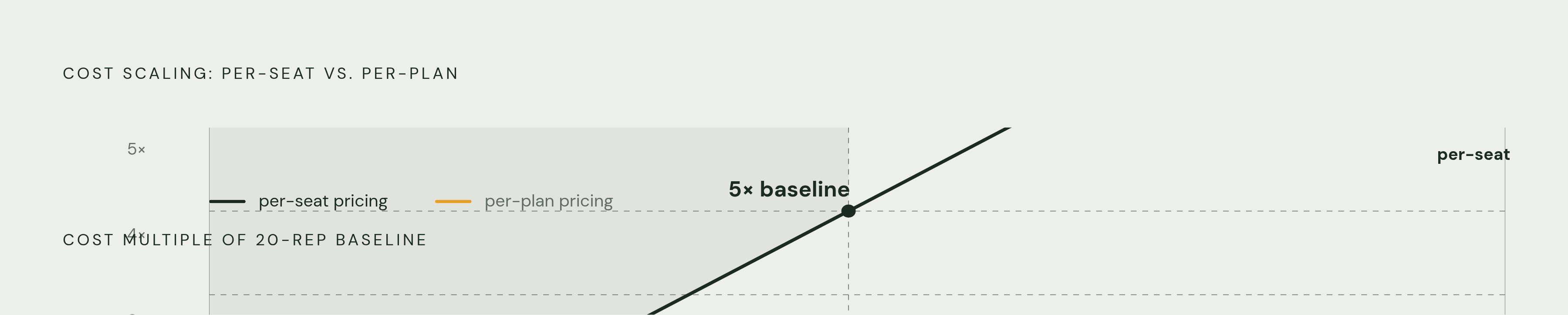
Picture a team of 20 reps that adds a manager layer, splits into regions, and grows to 200 reps over two or three years. That's a common trajectory, and it's the trajectory that turns a fine pricing decision into a painful one, or vice versa.
Under per-seat pricing, at 20 reps and a representative mid-range rate, the annual bill is modest and easy to plan around. At 100 reps, with zero change in plan complexity, the bill is five times higher. The software costs more even though the underlying commission logic hasn't changed one bit. By 200 reps, annual spend at mid-market rates can run well past whatever number was in the original budget, and at that point every quarter's hiring plan doubles as a software cost decision, whether anyone frames it that way or not.
Under per-plan pricing, the same growth story looks different. If the organization runs three comp plans, one for AEs, one for SDRs, one for managers, doubling headcount doesn't touch the plan count, and the bill barely moves. Cost inflects when plan complexity grows: adding a regional accelerator, a SPIF, or a channel partner plan adds a plan, not a seat. For a team with a lean plan architecture, the cost curve stays flat through most of the growth journey, in sharp contrast to per-seat.
There's no single crossover point where one model universally beats the other. It depends on the ratio of distinct plans to total payees. A team running 10 plans across 200 reps sits in a very different cost position than a team running 50 bespoke plans across just 50 reps, even though the second team is a fraction of the size. The practical move for a buyer is to count how many active comp plans exist right now and track how that number has moved year over year. That's the growth variable that actually determines which pricing structure works in the buyer's favor.
Operational friction that per-seat pricing creates beyond the invoice
When every login is a billable seat, access stops being a workflow decision and becomes a budget one. Finance often ends up with read-only access, or none at all. Managers can't see their own team's commission statements without the company paying for another seat. Reps, in the worst case, get a PDF at the end of the month and are expected to take it on faith.
That's not a small thing. Sales Cookie's research found a majority of reps keep their own shadow-accounting spreadsheets to check their commission numbers against what the company reports. Access rationing is a direct structural cause of that behavior: a rep who can't see the calculation in real time has no option but to rebuild it independently. Estimates put the time cost of that shadow work at 2 to 4 hours per rep per week, which at 100 reps adds up to thousands of selling hours a year spent double-checking pay instead of closing deals.
Approval workflows suffer the same squeeze. When only one finance analyst holds platform access, commission close depends entirely on that one person's calendar, the same key-person fragility that spreadsheets are supposed to fix, reappearing inside the software meant to replace them. And disputes compound the problem: WorldatWork data shows a significant share of reps file at least one commission dispute a year. Without a rep-facing portal showing deal-level detail, resolving that dispute means manual back-and-forth instead of the rep clicking through to the source transaction. None of this is accidental. It follows directly from a pricing structure that makes access itself the expensive part.
How per-plan pricing affects who gets access and how approvals flow
Once headcount stops driving the bill, access decisions can be made on the basis of who actually needs to see what, not on what the company can afford to expose. Finance can review calculations without generating a new charge. Managers can see team-level statements as a normal part of the approval process. Reps get a self-service earnings view without every portal login adding to the invoice.
That changes what the approval chain looks like structurally. Locked pay periods, logged approvals, full audit trails, none of that requires rationing who gets to participate in the review, because participation isn't metered. A functional version of this workflow runs in a fairly consistent order: raw deal data comes in, the comp plan rules apply, a rep-facing statement generates, a manager reviews it, finance locks the period, and the numbers export to payroll, with each step logged along the way.
Worth remembering here: commission data is compensation data, and it carries the same sensitivity as payroll. Encryption in transit and at rest, tenancy scoped to the organization, and audit logging aren't premium extras reserved for the top pricing tier, they're baseline, regardless of which pricing model a vendor sells. Separately, pay transparency rules are pushing companies toward more explainable, more rep-accessible commission statements, and per-plan pricing, which allows broad access without a per-login cost, lines up with that direction more naturally than a model that makes every rep-facing portal an added expense. The strongest case for plan-based pricing shows up in Finance and RevOps organizations that need several stakeholders in the workflow without renegotiating seat counts every hiring cycle.
Where each pricing model fits, and where it genuinely doesn't
Per-seat pricing is the right fit when headcount is stable and predictable from year to year, when the number of distinct comp plans is high relative to the size of the team (a handful of reps, each on a bespoke plan), and when the organization actually wants individual-level access control tied to named users.
Per-plan pricing fits better when the team is adding headcount faster than it's adding plan complexity, when finance, RevOps, and managers all need to be in the workflow without triggering a new bill each time, when rep-facing transparency, real-time earnings visibility, deal-level statements, is a priority, and when predictable software costs matter more than granular per-user control.
Looking at how named platforms sit on this spectrum: one platform charges $75 per user per month billed annually, a straightforward per-seat model. Another uses custom per-seat pricing plus a setup fee, with mid-market contracts landing between $20,000 and $65,000 for 50 to 100 reps. Xactly quotes per user per year, in the $900 to $1,800 range, aimed at enterprise buyers. A tiered platform runs from roughly $25 to $50 per user per month with features gated by tier rather than charged purely per head. And a payee-based platform quotes per-payee pricing with a median annual contract value in the low $40,000s.
The question worth asking before signing anything: over the next two years, which grows faster, the headcount paying commissions, or the number of distinct plans running underneath them? Whichever answer is true points squarely at the pricing model that will work in the buyer's favor. And implementation cost remains the wild card across every model on this list, free or included on some platforms, $5,000 to well over $150,000 on enterprise-grade ones, so factor that into total cost of ownership before comparing subscription lines side by side.
The checklist for evaluating a commission platform beyond its pricing page
Accuracy comes first. Can the platform handle tiered rates, accelerators, SPIFs, clawbacks, and split commissions without someone patching the gaps in a spreadsheet on the side? Industry estimates put the share of companies paying inaccurate commission rates at roughly 80%, and that's a rule-engine problem, not a pricing-model problem, no billing structure fixes bad calculation logic. Locked pay periods matter too: once a period closes, can the numbers still be changed quietly, or does any edit generate a logged, auditable event?
Data integration is the next test. Does the platform pull deal data directly from the CRM already in use, Salesforce, HubSpot, or even a CSV export, without forcing a rebuild of existing workflows? And on the way out, does it produce payroll-ready output, or does someone still have to reconcile a spreadsheet by hand before payroll can run?
Transparency is where the earlier friction argument becomes a concrete requirement. Every rep should have a self-service portal showing the deal ID, close date, deal amount, credit basis, split percentage, applied rate, and commission earned, each one linking back to the original transaction. If a rep has to leave that screen to verify any single number, the shadow-accounting habit doesn't go away, it just moves.
Security is non-negotiable regardless of which pricing tier a company lands in: encryption in transit and at rest, tenancy scoped to the organization, and a clear policy against training any model on customer compensation data. Commission data is payroll data in every way that matters, and it should be evaluated with that same level of scrutiny.
Last, pricing model transparency itself belongs on the checklist. A vendor should be able to say plainly whether a quote is per-seat, per-plan, or a custom enterprise number, and what triggers a price change, a new hire, a new plan, or a renegotiated contract. If that answer is vague on a sales call, treat it as a preview of how the rest of the relationship will go.