Multi-Currency Commission Calculation for Global Sales Teams
Real-time commission payouts in reps' own currencies end disputes before they start.

The fix is a statement, delivered on time, in the rep's own currency, that traces back line by line to a rate and a date someone actually wrote down. Give a rep the ability to watch their own commission calculate itself the moment a deal closes, paid out in the currency they actually spend, and the spreadsheet sitting open in the other tab stops getting updated. Nobody had to mandate that; it just stopped being useful.
Multi-currency commission calculation looks, at first glance, like a math problem: take a number, apply a rate, arrive at a payout. That framing misses almost everything that actually happens. Treating it like arithmetic instead of the workflow problem it actually is is how global sales teams end up with disputed statements, delayed payroll runs, and reps who quietly stop believing the number on their paycheck. The breakdown almost never happens at the conversion step itself. It happens earlier, in the buried decision about which rate to use and when, and later, when someone has to pull that decision back out six months on and defend it to a rep who's convinced they got shorted.
Four problems stack on top of each other in nearly every cross-border deal: FX timing, close-date ambiguity across time zones, credit splitting across reps and regions, and payout rules that shift country to country. None of it is exotic; it shows up in ordinary quarters at ordinary companies. Most commission tools on the market were built for a single-currency, single-jurisdiction team, though, and stretch one to cover a global sales org and you get workarounds bolted onto workarounds.
Salesforce admins already know a version of this by name: the roll-up summary field. Add multiple currencies to an org, and a roll-up field will sum USD, GBP, and CAD as if they were the same unit. The total renders clean, with no error and no warning, yet the number is also wrong, and the interface never tells you so. That one quiet failure is a decent stand-in for what happens to commission calculation generally, once multi-currency support gets bolted on after the fact instead of built in from day one.
How FX timing decisions ripple through every commission calculation
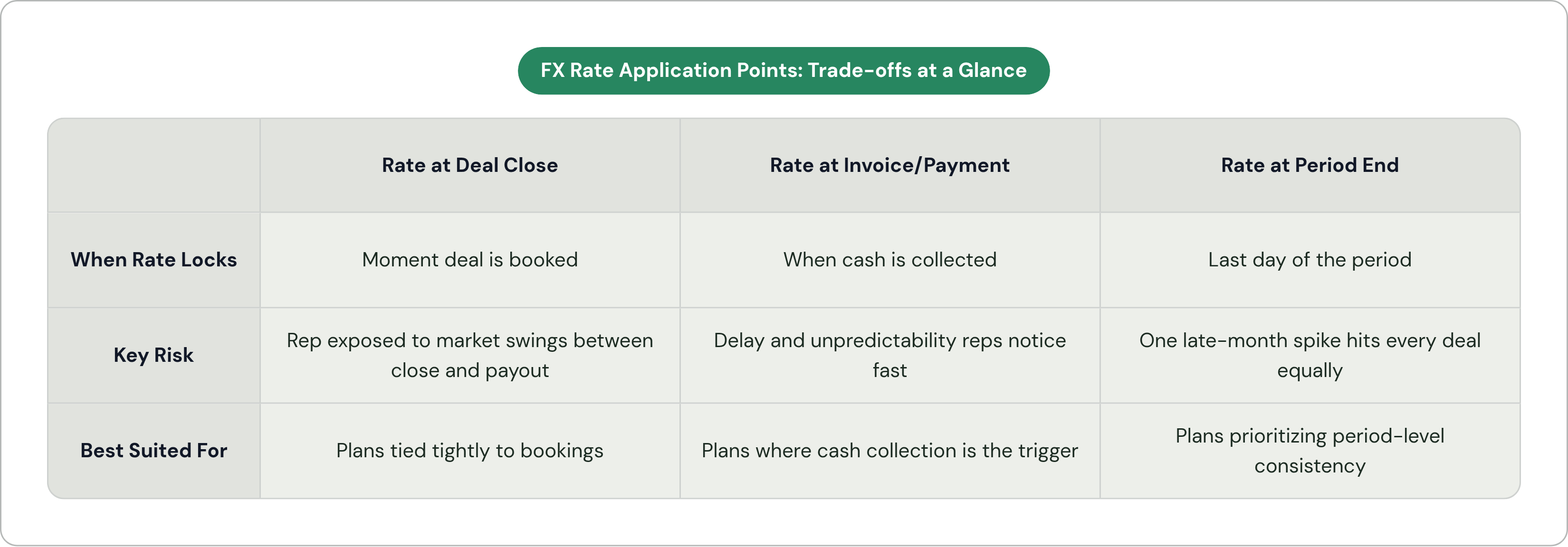
The moment a rate gets applied is a policy decision, whether anyone treats it that way or not. Most companies never say it out loud, so the system, or the analyst holding the spreadsheet, makes the call by default. Nobody looks at that default until a dispute forces the question, and by then it's a fight, not a discussion.
Three points of application dominate in practice, and each carries its own flavor of unfairness. Rate at deal close ties the rep's payout to whatever the currency did between close and payment, rewarding or punishing them for market movement they had zero hand in. Rate at invoice or payment date ties commission to cash actually collected, which some plans want structurally, but it drags in delay and unpredictability reps notice fast. Rate at period end, the lock date, is probably the most common choice in the field, and it has a quirk of its own: one spike in the currency market on the last day of the month hits every deal in that period equally, for better or worse, regardless of when any individual deal actually closed.
None of the three is correct on its face. What matters more is that the choice gets written down, applied the same way every time, and kept on file somewhere Finance can actually find it. If a deal got booked using a forecasted rate months back, the system has to lock that rate and pull it up exactly when a dispute or recalculation comes along later. A live FX lookup at payout time hands you today's rate for yesterday's deal, which misses the point entirely.
Rounding gets less attention than it deserves, probably because it looks trivial on its face. A fraction of a cent on one line item is invisible on its own; multiply that across hundreds of deals in a quarter, though, and the gap turns into real money, real enough to trigger an audit question from someone in Finance who noticed the total doesn't tie out. Whether the policy runs on truncation, round-half-up, or banker's rounding matters less than whether it's fixed once and applied identically every cycle, rather than left to whichever analyst happens to be closing the books that month.
The actual fix here is governance, plain and unglamorous. FX rate policy needs to live as a versioned document that Finance, RevOps, and reps can all point to when a question comes up, and the commission platform has to store the rate used on each transaction, not just the converted total. Otherwise a number on a statement can't trace back to what produced it, and you're just asking people to trust you.
Credit splitting across borders and why it generates more disputes than any other commission scenario
Multi-currency deals rarely belong to one rep. A London account executive closes in GBP, a New York solutions engineer carried the technical evaluation, a regional manager in Singapore holds overlay credit on the account. Three currencies and three payout jurisdictions can sit on one opportunity, and it happens more often than most people outside RevOps would guess.
Credit-split disputes drive more commission complaints on cross-border deals than anything else does. The reason is simple once you see it: two separate, contested questions get argued at the same time, who actually did the work, and at what rate and date the conversion ran. CRM systems barely help here. Opportunity records typically carry one currency and one primary owner, while the real split arrangement, the overlay credit, the co-sell handshake, lives in a side email or a verbal understanding between two managers that never made it into any system of record. None of that reaches an automated commission calculation unless someone types it in by hand, and someone eventually forgets to.
Stack the FX timing problem on top of that, and the math turns genuinely ambiguous. If three reps in three currencies each hold a slice of one deal, applying their percentages before conversion gives a different number than applying them after conversion. Neither approach is universally right; the system just has to pick one, write it down, and never quietly switch depending on the deal or who's asking.
Clawbacks make it worse still. A refunded or churned deal that needs commission clawed back runs through a completely different legal process depending on where the rep sits. Pulling variable pay back from a rep in France runs headfirst into French labor protections that simply don't exist for a rep sitting in Texas. Hand Finance only the dollar figure to recover, without the jurisdiction-specific rule governing how, or whether, it can legally be recovered at all, and you've handed them a number they can't act on.
What good looks like isn't complicated. Split rules stored at the plan level, applied consistently either before or after conversion according to a written policy, producing a deal-level statement each rep can read in their own currency without pinging Finance to translate it for them.
Designing commission plans that hold up across multiple currencies and regions
A plan that runs fine in one currency often falls apart the second you take it global. Usually the incentive logic itself isn't what breaks. The thresholds, accelerators, and quotas just weren't built with conversion in mind from the start, because nobody was thinking that far ahead when the plan got drafted in the first place.
Quota in one currency, payout in another, is common enough, and defensible. Setting quota in a functional currency like USD or EUR gives leadership something comparable across regions, while paying reps locally keeps the number meaningful to them day to day. That structure only holds up if the conversion point gets spelled out clearly in the plan document itself, not left as something everyone just assumes someone else settled.
Accelerators are where this gets sharp fast. If a rep needs a set percentage of quota to unlock an accelerator, and quota lives in USD while their deals close in JPY, the accelerator threshold has to run on the exact same rate methodology as the underlying commission math. Mismatch that even slightly, and accelerators fire at the wrong moment, paying out early or failing to trigger for a rep who genuinely earned it and now has to argue about it.
Quota-to-OTE ratios, usually four to six times base salary as an industry rule of thumb, hit the same normalization wall the moment companies try to benchmark equity across regions with different base salary structures. A ratio built on unconverted local figures isn't a fair benchmark, no matter how clean it looks on a slide in front of the board.
Short-term incentives carry their own version of this problem. A SPIF set in the home-office currency can feel like a smaller prize to a rep in a weaker-currency market, even when the number on paper is identical, so local-currency equivalents are worth the extra design step. A SPIF with a fixed cash amount also needs a periodic look-back, since currency drift over a year or two can quietly turn a motivating incentive into an afterthought nobody notices until it's gone stale.
Simplicity is close to a hard requirement here. A new rep, in any region, ought to sit down with a hypothetical deal and work out their own commission without calling anyone for help. Complexity that's merely annoying in one language and one currency turns genuinely unworkable once translated across five. And the compliance backdrop keeps getting less forgiving: several U.S. states, including California, New York, and Illinois, now require published commission plan documentation under guidance SHRM tracked in 2025, and the EU's Pay Transparency Directive imposes comparable obligations across member states. A plan that's mathematically sound but impossible to explain in plain language stopped being just an internal problem a while back.
Where spreadsheet-based multi-currency workflows fail in practice
Spreadsheets carry errors at a rate research puts at 88% of all spreadsheets containing at least one mistake, a number that always sounds too clean until you've watched it happen in a real Q4 close. In a single-currency shop that's already bad, and in a multi-currency shop it's worse, because a currency-conversion error doesn't sit still; it compounds as it flows downstream into every later calculation that touches it.
The typical global spreadsheet workflow runs through several handoffs, and each one is a fresh chance for something to go sideways. Finance exports data from the CRM, manually looks up a conversion rate, converts the figures, re-imports the result. Different regional teams often keep separate tabs, or entirely separate files, each built on its own rate assumptions, with no single version everyone agrees is the real one. Come time to roll it all up for the CFO, those files get merged, another round of conversion happens, quite possibly at a rate that doesn't match whatever actually calculated individual payouts weeks earlier.
Formatting errors deserve their own mention, because they're so easy to miss until they're not. Enter a deal value using Indian numbering conventions, where a lakh reads differently than a Western million, drop it into a formula built for Western formatting, and you can end up off by a factor of ten. The spreadsheet won't flag it, because it can't. The formula has no way to know the input was wrong, so it calculates faithfully on bad data, the way spreadsheets always do.
Research on commission accuracy puts the failure rate at 83% of companies failing to pay commissions correctly, and manual multi-currency handling sits right alongside outdated formulas and plain old data entry mistakes as one of the leading causes. Beyond the errors themselves, spreadsheets can't answer the audit question that always eventually comes up, who changed this conversion rate, when, and why. A global team fighting a commission dispute across two jurisdictions has nothing to point to when that question lands.
There's a security angle too, and it isn't a small one. SpreadsheetWeb reported in 2025 that 84% of compensation data breaches involve emailed spreadsheets, a real hazard for global teams that routinely fire files across regional offices and separate legal entities. Add it up and the cost stops being abstract: payout delays measured in days, reps who quit trusting their statements, Finance teams burning hours reconciling numbers instead of doing something more useful with their week.
What a purpose-built multi-currency commission platform must actually do
Native multi-currency support means something specific, worth spelling out plainly. It means the system stores the original transaction currency, applies a defined rate at a defined moment, keeps both the original and converted figures on record, and can reproduce the whole calculation on demand, line by line, whenever anyone asks it to.
Exchange rates need to update on their own, from a defined source, on a defined schedule. Manual rate entry is a single point of failure dressed up as routine work, and it becomes an audit liability the moment someone asks who typed the rate in and where it came from. Historical rates, once used, need to stick to the transaction permanently, so a recalculation six months out references the same number Finance actually used at the time, not whatever the market happens to show today.
Change-data capture matters more than it sounds like it should. When a closed deal gets edited, the platform has to catch it, log it, and recalculate every commission the change touches, automatically. That's the only reliable way to stop both double-payouts and missed clawbacks from slipping through. Credit-split modeling belongs at the plan level too, with splits applied consistently relative to the conversion step, rather than handled as a manual patch someone remembers to make after the fact, or doesn't.
Reporting has to serve different people differently, because they're asking different questions. A rep needs a statement in their own local currency with deal-level detail and quota progress shown the same way their quota was originally set. A regional manager needs team performance normalized into one common currency so comparisons across regions actually mean something side by side. Finance and the CFO need a consolidated liability view across every region in the functional currency, with the ability to drill into any single transaction sitting behind that number.
Local rules, France's social contribution treatment of variable pay, the UAE's contract requirements, California's commission documentation standards, need to live inside the platform itself as configuration. Manage them through parallel instances or manual overrides sitting outside the system, and they're outside anyone's memory in six months. Closed pay periods need to lock, with a record of who approved the close and when, so Finance can answer an audit question without digging through old email threads looking for the one that settled it. Integration needs to meet the CRM where it already lives, Salesforce, HubSpot, a CSV export, rather than demanding a full data migration before the platform does anything useful at all. And because commission data becomes compensation data the moment it crosses a border, encryption in transit and at rest, org-scoped tenancy, and a clear policy against training outside models on customer data belong on the baseline checklist, not the marketing slide nobody reads twice.
How leading multi-currency commission platforms compare on the capabilities that matter for global teams
Judging these platforms fairly means holding every one of them to the same yardstick: native multi-currency handling, automated rate updates, historical rate preservation, credit-split modeling, reporting built for more than one audience, breadth of CRM integration, configurability for local regulation, depth of the audit trail, and how the pricing actually works once you're the one paying it every month.
Everstage stands out for strong multi-currency handling and real-time visibility for reps, and it sits toward the enterprise end of the market with custom pricing and wide CRM integration coverage. Commissionly bakes in multi-currency support with automated rate updates at a price point mid-market teams can actually reach, which matters for companies nowhere near ready for an enterprise contract or an enterprise sales cycle. QCommission has been around for years and handles international commission scenarios explicitly, landing in the mid-market-to-enterprise range depending on how it's configured for a given team.
Quota Queue runs end-to-end: CRM data import, plan configuration, payroll-ready export, all in one workspace, with tiered rates, accelerators, SPIFs, and clawbacks handled together rather than bolted on as separate modules that don't talk to each other. It uses AI-assisted plan extraction to read existing commission plan documents during setup, which cuts down the migration timeline for teams coming off spreadsheets and dreading the switch. Pricing runs by compensation plan rather than by seat, a distinction that matters more than it sounds: a global team adding headcount doesn't have to renegotiate its contract every time it hires someone. Locked pay periods, a full audit trail, and org-scoped data tenancy round out how it handles the security and auditability that multi-jurisdiction commission data genuinely demands.
Pricing across this category runs from accessible monthly rates aimed at mid-market teams up to fully custom enterprise quotes, and the per-seat model common across the industry quietly punishes exactly the teams growing fastest. No platform here is the right answer for every company, and anyone telling you otherwise is selling something. The right pick depends on which structural problem hurts most for a given team: FX complexity, regulatory depth, the shape of the reporting hierarchy, fit with the CRM already in place, and whether the pricing model still makes sense once the team has doubled in size.
Preventing shadow accounting on global teams, where the trust gap is widest
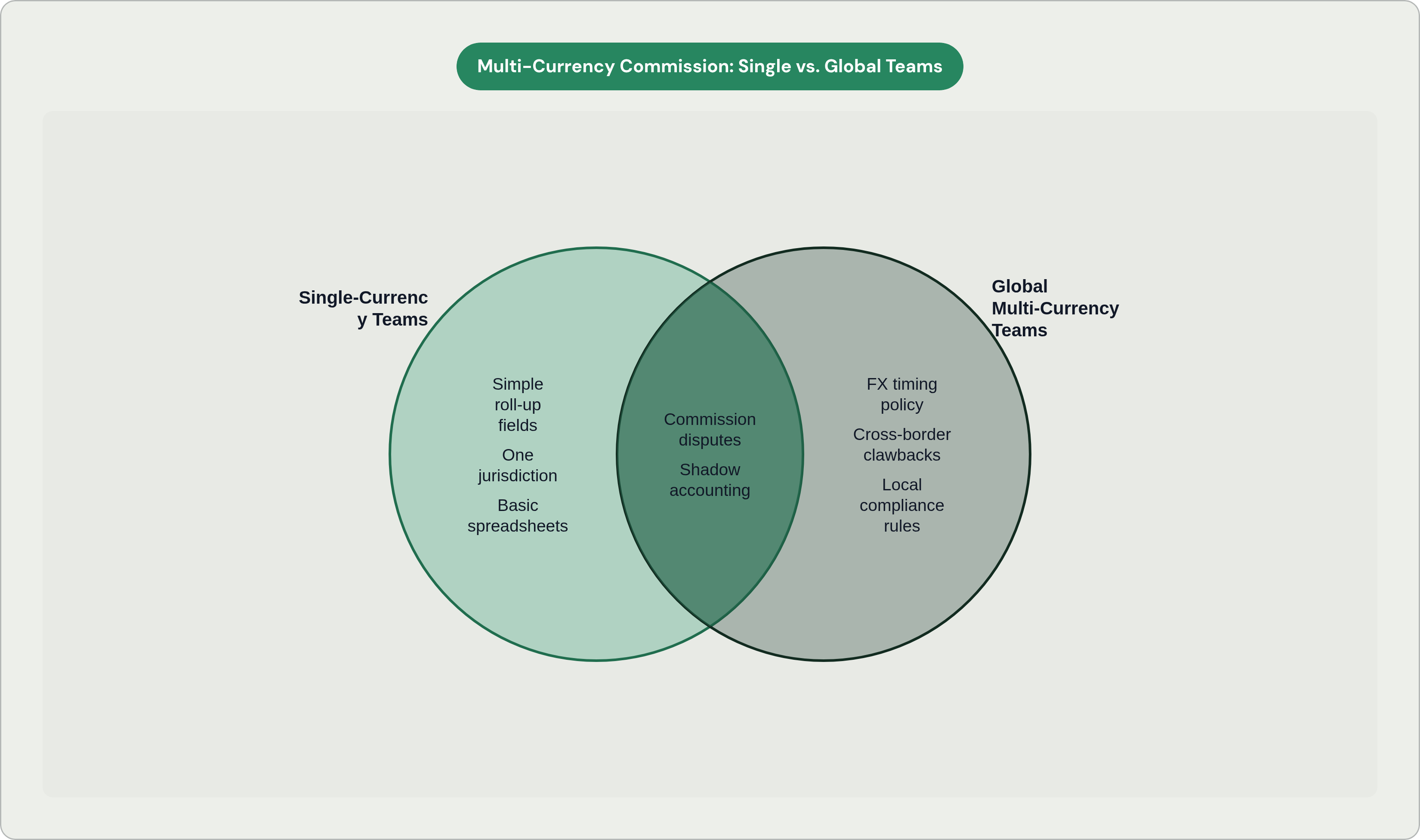
Sales Cookie research puts the share of reps who keep their own shadow-accounting spreadsheet to double-check their commissions at 62%, and on a global team that's probably a floor, not a ceiling. Multi-currency conversion hands reps one more, entirely reasonable reason to distrust whatever figure shows up on their statement at the end of the month.
That distrust costs something measurable, well beyond a vague hit to morale that shows up in an engagement survey nobody reads. Reps spend an estimated two to four hours a week maintaining their own shadow ledger, and multiplied across a global sales force, that's real selling time gone every single pay cycle, quietly, in the background, forever.
Multi-currency environments make shadow accounting worse for reasons specific to how they're built. A rep has no real way to check a conversion rate they never saw and didn't choose. Split credit stays invisible unless the statement breaks it out deal by deal, line by line. And payout delays, already a trust problem at a single-currency company, get worse when reps assume, often correctly, that the holdup traces back to currency complexity happening somewhere they can't see and nobody bothers to explain.
WorldatWork data puts the annual commission dispute rate at a substantial share of sales reps filing at least one dispute a year, and ties a meaningful portion of voluntary resignations in sales roles specifically back to compensation transparency issues. On a global team, where replacing someone costs real money and local hiring cycles crawl almost everywhere outside a handful of major hubs, those two numbers together describe a recurring cost of doing business, one that never shows up as a rounding error buried in an HR report somewhere nobody opens.