Sales Commission Formula Calculation Methods
How to structure formulas that align rep incentives with business outcomes.

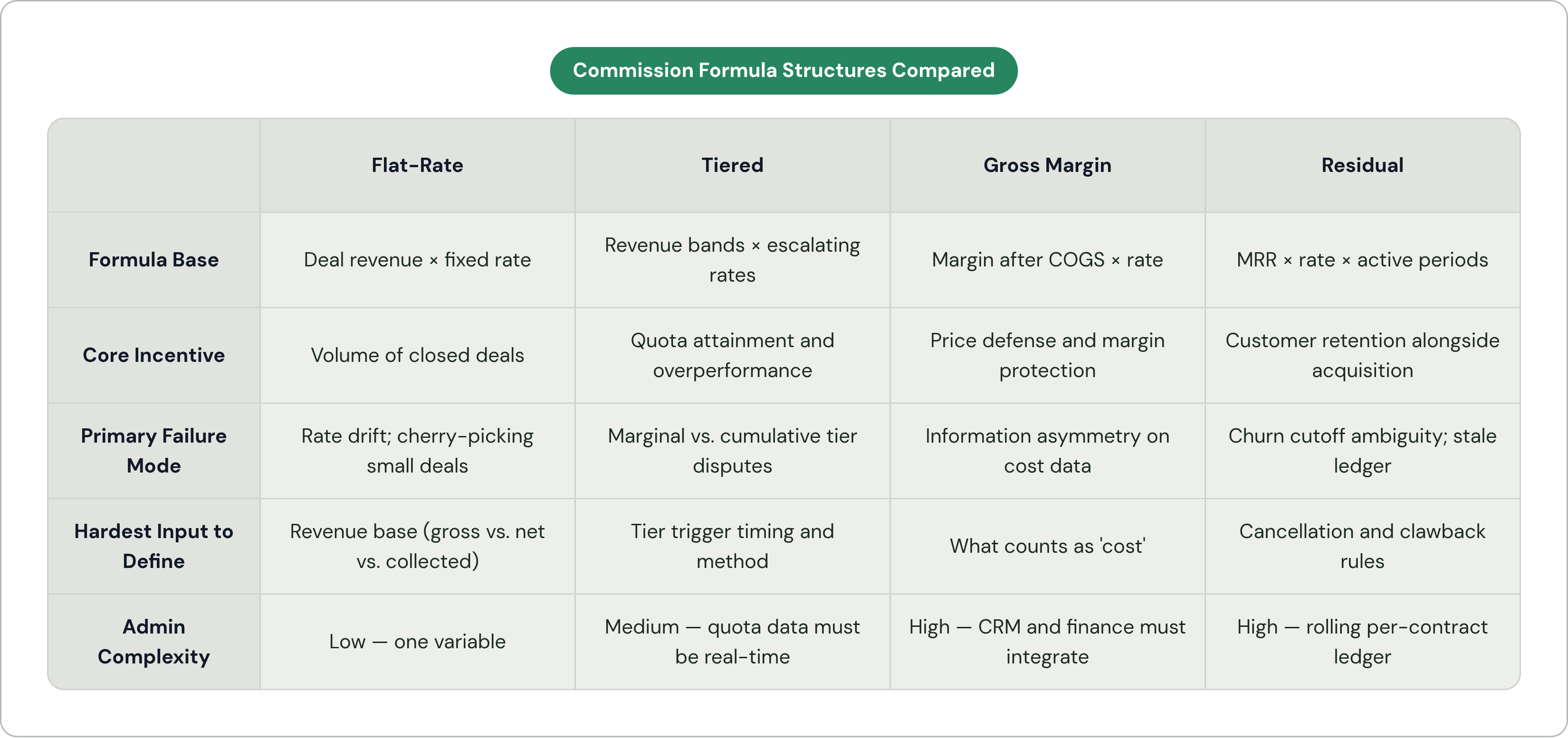
The flat-rate formula is Deal Value × Fixed Rate = Commission. Same percentage, every sale, regardless of size, complexity, or customer segment. One variable to communicate, one to verify, zero ambiguity about which rate applies.
That simplicity is a legitimate engineering choice, not a limitation to apologize for. Every early-stage team I know where plan administration overhead would outweigh incentive precision benefits enormously from a flat rate. Every high-volume transactional environment where deal sizes cluster tightly around a mean gains nothing from tiering, because there's no meaningful size variance to reward differently. Companies abandon flat-rate structures prematurely all the time because tiering feels more sophisticated, then spend months untangling what they've built.
The core trade-off is simplicity against incentive differentiation. A rep closing a small deal and a large deal earn proportionally identical commissions, with no nudge toward larger accounts and no structural reward for strategic selling. High performers earn more in absolute dollars but not a higher rate, and that distinction matters most at the top of the distribution. Every top rep I've seen is acutely sensitive to whether their compensation structure recognizes the marginal value of their effort. A flat rate, structurally, can't do that.
Two failure modes are specific to flat-rate plans. Rate drift is a percentage calibrated correctly at company founding that was never recalibrated as average deal sizes grew, margins compressed, or product mix shifted. The formula still runs. It just no longer connects commission expense to business outcomes. Cherry-picking follows from a different logic. When every deal pays the same percentage, reps rationally maximize volume of easy, small deals rather than investing time in larger, harder ones. The formula creates the incentive; the rep responds to it. The behavior is rational, not negligent.
One calculation pitfall cuts across even plans this simple. Defining the base — whether gross revenue, net revenue after returns, collected cash, or recognized revenue — produces materially different payouts from the same nominal percentage. A plan that states "a fixed commission rate" without specifying the base isn't one formula. It's four different formulas waiting to be interpreted in four different ways, and the dispute that follows isn't over the rate. It's over the base.
Tiered commission: how the rate-change trigger actually works in practice
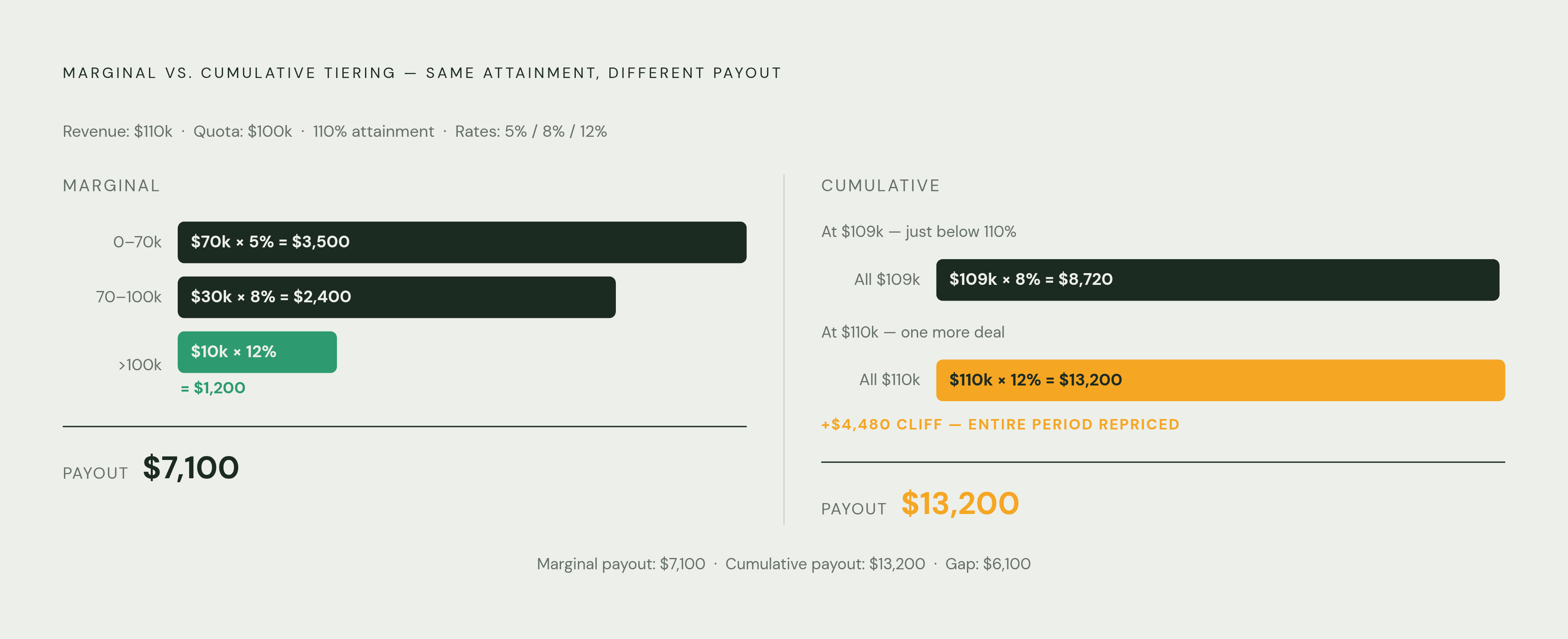
Tiered structures apply different rates to different bands of performance, most commonly quota attainment. The conceptual logic is to reward average performance adequately, goal attainment generously, and overperformance significantly. A representative structure applies one rate up to 70% of quota, a higher rate from 71% to 100%, and an accelerated rate above 100%.
The distinction that generates most tiered-commission disputes is whether the structure uses marginal or cumulative tiering. Most plan documents don't specify this clearly, and that omission causes genuine, months-long standoffs between sales and finance.
Marginal tiering, sometimes called stacked tiering, applies each tier's rate only to revenue earned within that band. The logic mirrors income tax brackets, where revenue below the first threshold is multiplied by rate one, revenue within the middle band by rate two, and revenue above the top threshold by rate three, with totals summed. Cumulative, or retroactive, tiering works differently. Once a rep crosses a threshold, the new rate applies to all revenue from dollar one, producing a cliff effect where a single additional deal can dramatically change total payout for the entire period. Reps who understand the mechanics will manage deal timing accordingly, delaying a close from one period to the next to ensure the retroactive trigger fires in the period where it maximizes their payout. The plan creates the incentive; the rep responds to it.
Plans that don't specify which method applies will be interpreted differently by reps and by finance. That is a guaranteed dispute at period close, every time.
Accelerators deserve their own treatment because they're frequently conflated with a higher tier rate, and the conflation produces calculation errors. An accelerator applies a multiplier to commissions earned above quota, not to the underlying rate. A 1.5x accelerator above 100% of quota means commission dollars earned in that band are multiplied by 1.5, not that the rate increases by 50 percentage points. Capping accelerators eliminates the marginal incentive for the highest performers, and the consequence isn't a math error. It's voluntary attrition. The rep who would have closed one more deal in the final week of the quarter, and didn't because the cap removed the financial reason to, is invisible in the commission report but visible in the revenue line.
Tiered plans require three inputs that flat-rate plans don't. First, accurate, real-time quota attainment figures, which are the input most likely to be stale or disputed. Second, explicit rules governing when deals count toward a tier, whether by booking date, close date, payment receipt, or revenue recognition. Third, a defined period reset, because tiers typically clear monthly or quarterly, and mid-period plan changes require a recalculation from period open that most spreadsheet-based systems can't perform without manual reconstruction.
This is also the structure where spreadsheet formula drift does the most damage. A copied formula referencing the wrong cell produces a silently incorrect tier assignment. The payout processes. The rep never knows.
Gross margin commission: what changes when profitability, not revenue, is the base
The gross margin commission formula is (Sale Price minus Cost of Goods Sold) × Commission Rate = Commission. The rate is applied to the profit the company retains, not the revenue it collects. A rep who closes a large deal with substantial COGS earns commission on the resulting margin. That same rep discounting the deal earns commission on a significantly reduced margin. The financial consequence of the discount lands directly on the rep's paycheck.
That's the incentive the structure is designed to create. In manufacturing, distribution, and other industries where deal-level profitability varies because of custom pricing, freight, implementation, or bundled services, a flat-rate or tiered plan applied to revenue treats a discounting rep and a margin-defending rep identically. Gross margin commission removes that equivalence. Price defense becomes a personal financial interest rather than a corporate talking point.
What this formula requires, beyond what flat-rate and tiered plans demand, is substantial. Deal-level cost data must be accessible at the time of commission calculation, which means finance and CRM systems must be integrated in ways they often aren't. A clear definition of "cost" must exist in the plan document, specifying whether it covers COGS only or is loaded with shipping, implementation labor, and post-sale support costs. The broader the cost definition, the lower and more volatile the commission base becomes across deals. A process must also exist for cost revisions after close. If COGS is restated thirty days after a deal closes because a supplier invoice arrived late, does the commission get recalculated? Plans that don't answer this question will be forced to answer it mid-dispute, which is the worst possible time to set policy.
The dominant failure mode in gross margin plans is information asymmetry. Finance holds the cost data; the rep doesn't. A rep who can't independently verify the margin figure on their own deal can't verify the commission base, which means they can't verify the payout. This opacity generates more shadow accounting than any other formula type, because a rep who is paid correctly but has no means to confirm it occupies functionally the same position as a rep who suspects underpayment. The distrust is identical either way.
Gross margin plans also require a floor provision. If COGS exceeds the sale price because of a heavily discounted deal or an unusual cost event, the formula produces a negative commission. The plan must define what happens, whether zero commission, a draw, or a clawback. Plans that omit this will encounter the scenario eventually, and absent a defined outcome, precedent gets set under duress.
Revenue-share, residual, and split commission structures and where their formulas get complicated
These three structures share a common characteristic: the formula itself is rarely the primary source of complexity. The hard work is defining what inputs feed the formula and in what proportion.
Revenue-share commission
The revenue-share formula is structurally identical to flat-rate. Total Revenue Generated × Agreed Percentage = Commission. What distinguishes it is that the base is a pool, not an individual deal. Revenue-share appears in partnership arrangements, affiliate channels, and team-based quota structures where attributing a single rep to a single deal is either impossible or counterproductive.
The complication is attribution. Defining what counts as "revenue generated by this rep or this channel" when multiple contributors touch an account is a judgment call the formula itself can't resolve. The formula calculates accurately once revenue attribution is determined. Determining attribution is the hard problem, and it must be settled in the policy layer before the formula is applied. Plans that reverse this sequence spend months relitigating the same allocation arguments.
Residual commission
The residual commission formula is Monthly Recurring Revenue × Rate × Number of Active Periods = Cumulative Commission. This structure appears in SaaS, insurance, and subscription models where the business wants to reward retention alongside acquisition. The rep earns a commission stream over the life of the customer relationship rather than a single payment at close.
The calculation challenge that defines residual plans is the churn event. If a customer cancels in month three of a twelve-month contract, the residual stops. The plan must define the cutoff precisely, whether by cancellation notice date, contractual end date, or last day of the paid billing period. It must also specify whether previously paid residual commission is subject to clawback if the customer churns within a defined window.
Residual plans require a rolling ledger, not a period-end snapshot. Every active customer contract is a live calculation with its own timeline. Spreadsheets manage this especially poorly because any cell referencing a customer's active status must be updated every period, and the likelihood of stale data producing incorrect payouts rises directly with the number of active accounts.
Split commissions
The split commission formula is Deal Commission Amount × Split Percentage Assigned to Rep = Individual Commission. Split structures are required when multiple reps contribute to a single deal, such as inside and outside sales, SDR and AE, overlay technical specialists, and multi-territory coverage.
Three things must be defined explicitly: who assigns split percentages and at what point in the sales cycle; what happens if assigned splits don't sum to 100%; and what happens if the SDR who sourced the deal departs before it closes. SPIFs, Sales Performance Incentive Funds, are a related but structurally distinct mechanism, a fixed-dollar bonus per qualifying deal rather than a percentage of deal value, layered on top of the base commission formula. They should be calculated separately.
The failure mode that cuts across all three arrangements occurs when a deal qualifies under multiple formula types simultaneously. A recurring deal with a gross margin component and a split between two reps requires three sequential calculations: determine the margin base, apply the commission rate, then apply the split percentages. Each layer depends on the output of the prior one. Plans that don't specify the order of operations leave the sequence to whoever is building the spreadsheet that month, which produces inconsistent results, period after period, silently.
Base salary plus commission and OTE structures: what the formula implies about plan risk
On-target earnings structures define the expected total compensation at 100% quota attainment, then divide that target between a fixed base salary and a variable commission component. The formula governs only the variable portion; the ratio between the two components determines how much formula accuracy matters in dollar terms.
A 70/30 split on a $100,000 OTE package means $70,000 in base salary and $30,000 in variable commission. Field sales roles commonly carry this structure because predictable income provides stability while the variable component preserves performance incentive. An 80/20 split is typical in customer success and account management roles where retention behavior is harder to tie cleanly to a single transaction.
The ratio carries a direct implication for how much formula accuracy matters. A 70/30 rep whose commission formula misfires loses a significant share of expected income: material, but survivable in the short term. A role structured at 50/50 or higher variable weight faces a formula error that can cut total compensation nearly in half. The accuracy demand rises proportionally with the variable percentage. A 1% miscalculation on a $30,000 variable component costs a rep $300; the same error on a larger variable component costs proportionally more. At scale across a team, that difference becomes a material line item on the commission expense report.
OTE is only a meaningful communication tool if the quota and the commission formula are calibrated to each other. A quota set at an arbitrary revenue figure that was never modeled against the commission rate and the base salary produces an OTE that is a fiction, a number on an offer letter that no one actually expects to pay or collect. The correct approach sets the quota at a defined multiple of base salary and derives the commission rate from that relationship. When that calibration is absent, OTE fails as both a recruitment tool and a performance anchor.
The attrition implication follows directly. Gartner research indicates that a substantial majority of sales professionals would leave for a comparable role offering better pay. In practice, "better pay" frequently means a more legible, more reliably calculated variable structure, not a higher nominal figure. A formula that can't be trusted is a compensation problem regardless of the OTE attached to it.
How formula errors actually happen: the calculation layer where things break
Xactly has reported that 83% of companies miss the mark on paying commissions accurately, and that 85% continue managing sales compensation in spreadsheets. The relationship between those two figures is not coincidental. Spreadsheets were built for different data management demands than commission calculation at scale, and the failures they produce are specific, recurring, and often undetectable until a rep starts asking questions.
Data mapping failures are the most common root cause. A deal closes in the CRM but maps to the wrong compensation plan, the wrong quota period, or the wrong rep. The formula executes correctly on wrong input and produces wrong output. The calculation appears clean; the error surfaces only when the rep compares their payout to their own records.
Threshold trigger failures follow in tiered plans. Quota attainment crosses a tier boundary mid-period and the rate doesn't update automatically. The rep continues earning the lower rate on deals that should have accelerated. Because the formula ran without error, no system flags the problem.
Stale formula logic is quieter still. A plan change was communicated to the sales team but the spreadsheet wasn't rebuilt. The old rate or old tier structure continues running because no one updated the cell references. This category compounds, as every deal processed between the plan change and the correction is wrong by the same amount, in the same direction. Manual entry errors, a misplaced decimal or an extra zero in a currency field, produce a payout that's an order of magnitude off. Across a multi-currency global team, the opportunity for this category of error is significant. Version conflicts complete the picture, where two administrators working on different copies of the same spreadsheet produce two different commission totals, and when a rep disputes a number, neither finance nor the rep can reconstruct the calculation chain.
The audit-trail gap is what converts individual errors into systemic disputes. Spreadsheets produce no record of who changed a cell, when, or why. A manual adjustment shifting a rep's commission by thousands of dollars is invisible to everyone who wasn't in the room. Without a log, a rep who disputes a number can't be shown the calculation chain; finance can't prove the number is correct. The argument resolves on authority rather than evidence, which erodes exactly the trust that commission plans are designed to build.
The spreadsheet error rate has been placed at 88% or higher across multiple studies. The Oracle class action filed in 2017, which sought $150 million over unpaid commissions, illustrates what happens when a formula error runs systematically across a large sales team over multiple periods. Individual disputes scale into class-level liability, and the legal exposure grows in direct proportion to how long the error went undetected.
Dedicated sales compensation management platforms, including Xactly, SAP SuccessFactors, Varicent, and Anaplan, as well as newer spreadsheet-free options such as Quota Queue, a commission calculation platform that turns raw deal data into payroll-ready statements through configurable compensation rules and auditable approval workflows, exist specifically to address the calculation and audit-trail failures that spreadsheet administration can't prevent. Each maintains a log of every calculation input and output, automates tier trigger updates, and provides reps with visibility into their own commission base. That transparency is the mechanism by which formula trust is established and maintained.
What formula errors cost: in rep hours, in dollars, and in attrition
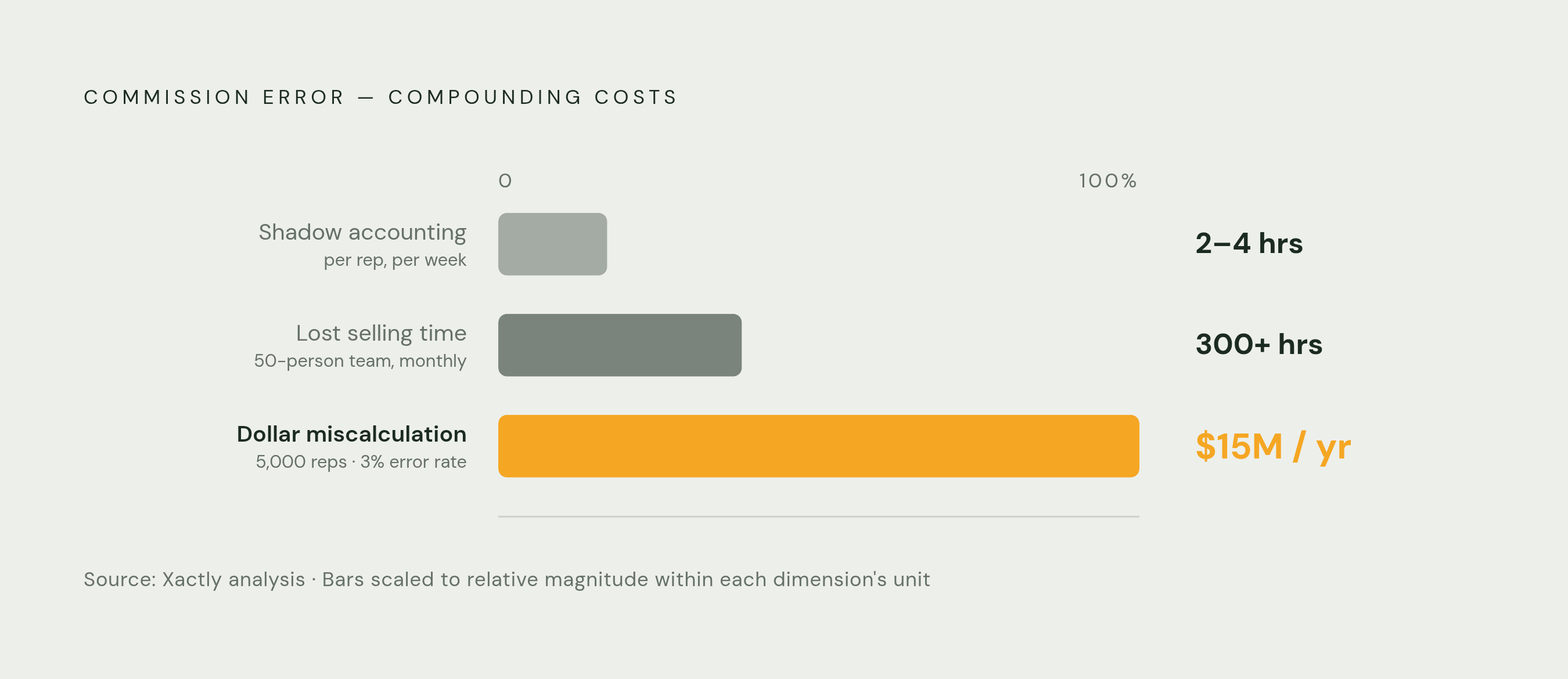
Commission disputes reduce seller productivity by an average of five to seven hours per month per rep. Across a 50-person sales team, that's more than 300 hours of lost selling time every month, recurring, unrecovered, and invisible to leadership because it doesn't appear on any pipeline report.
Shadow accounting compounds the figure. Sales Cookie has reported that a large majority of representatives independently track their own deals to verify payouts, at a cost of two to four hours per rep per week. Aberdeen Group documented that shadow accounting can consume a significant portion of a rep's monthly time in extreme cases. Those hours aren't a sign of conscientiousness. They're a sign that the system isn't trusted.
WorldatWork research indicates that a notable share of sales reps file at least one commission dispute per year. That's a structural feature of the current approach to commission administration, not a tail risk, and its frequency is a direct function of formula opacity and calculation error rates.
The dollar cost is calculable. At a 3% average compensation error rate across a team where each of 5,000 reps receives $100,000 in incentive compensation annually, the miscalculation cost reaches $15 million per year, per Xactly's analysis. A 1% error rate applied to a large enough population still means 11% of reps are paid incorrectly in a given year.
Attrition is the cost most teams I've seen misattribute. A rep who leaves citing "compensation concerns" is frequently not leaving because the OTE was too low. They're leaving because the commission arrived late, was wrong, couldn't be explained, and took three weeks and two escalations to correct. Watch enough exit interviews and a pattern becomes undeniable: the complaint is rarely the number itself. It's the experience of not being able to trust the number. The formula error isn't the cause listed on the exit survey, but it is the proximate cause in fact. Replacing a trained, ramped sales representative costs between 1.5 and 2 times annual salary by most human capital estimates, and that expense lands on a budget line that reads "recruiting" rather than "commission calculation errors." The misattribution keeps the problem invisible to the people with the resources to fix it.
The arithmetic behind a tiered gross margin split structure with a residual component is not, in isolation, difficult. What's difficult is administering these formulas accurately, at speed, across thousands of deals, with clean data, correct plan mapping, a complete audit trail, and timely delivery to the people who earned the money. Every team I've worked with is either managing that complexity deliberately or discovering it later, at a much higher price.