Gross Commission vs Net Commission Calculation
Net commission requires multiple data sources to sync correctly, which spreadsheets handle poorly.

Gross commission pays on the full deal amount before anything comes out of it. Net commission pays on what's left after deductions: cost of goods, draw balances, clawback reversals, whatever the plan subtracts. A rep once told me he'd been shorted $200 on a $1,000 deal, and he was right to check, but the plan wasn't actually broken. It just defined "commissionable amount" differently than the number sitting on his closed-won record. Whether that gap is legitimate or a mistake comes down to one thing: how well the plan documents what's being subtracted, and why.
How the definition of "commissionable amount" determines which method is even possible
Before a rate multiplies anything, somebody has to answer a more basic question: what dollar figure does the rate even apply to? Teams skip this constantly.
Total Contract Value works off the full multi-year deal. Sounds generous, until a customer churns in year two and finance wants some of that money back. Annual Contract Value, the default in most SaaS shops, pays on first-year value and treats renewals as a separate event. Monthly Recurring Revenue forces the plan to track a moving number every cycle instead of closing the books once at signing. Gross margin commission needs cost data that often doesn't exist yet in finalized form: a rep closes on Tuesday, and finance might not have a real margin number until the month closes out three weeks later. Net-new versus expansion revenue adds one more fork, since the same signed contract can produce different commissionable amounts depending on whether the account already existed on the books.
Try this test: hand the same closed deal to two people on the same team and have them calculate the commissionable amount separately, without talking to each other first. If they land on different numbers, the plan document has a hole in it, and that gap is where disputes come from, almost every time. Plans that pay on list price instead of net revenue or margin also breed a specific bad habit, because reps discount harder when the discount costs them nothing personally. Tying payout to net revenue or margin fixes that. It ties the rep's number to the number the business actually lives or dies by.
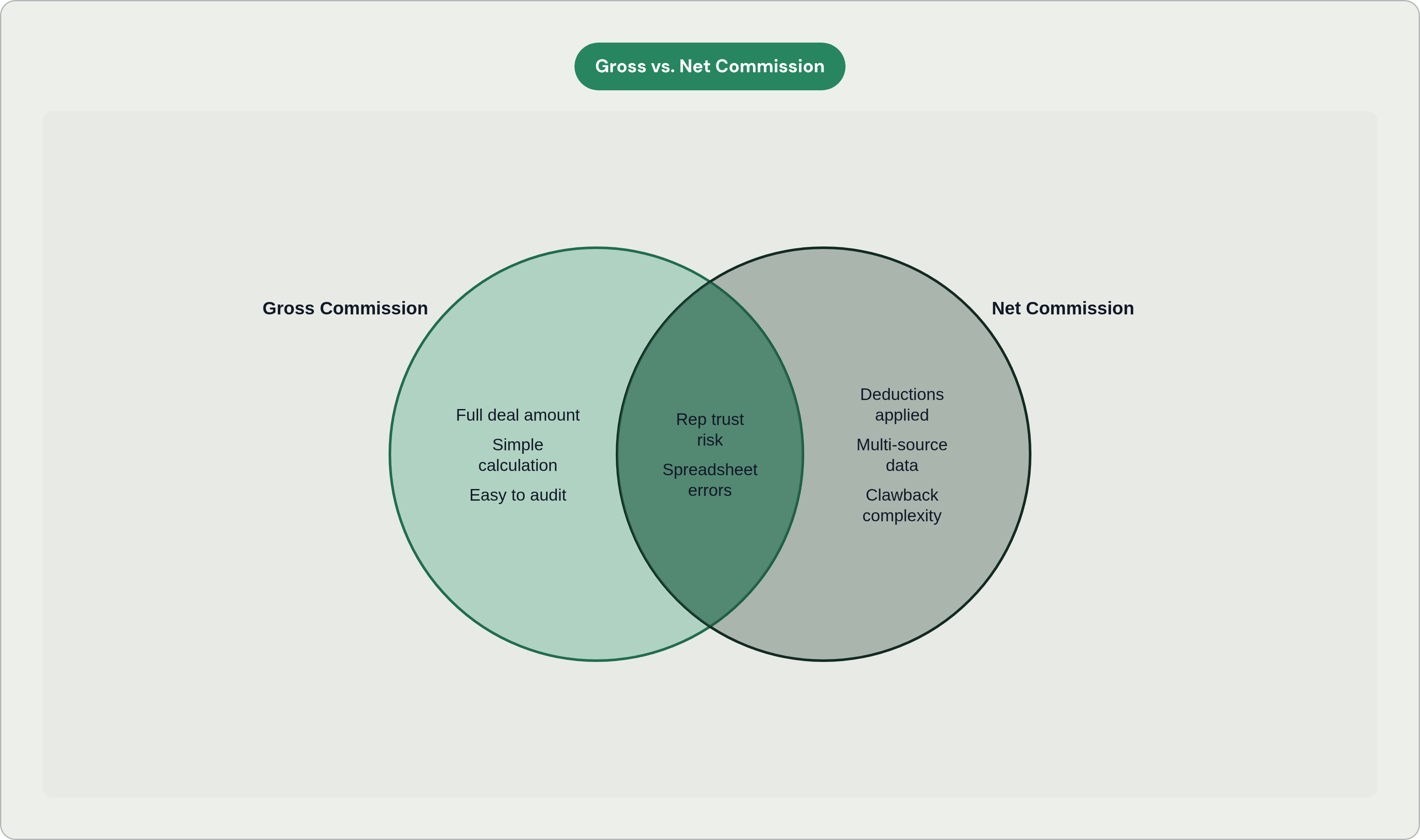
Where errors compound differently under gross vs. net calculation
Gross commission is forgiving, arithmetically. Rate times commissionable amount, done. Whatever error remains sits upstream, in the deal record itself: a wrong close date, a contract value that got fat-fingered, a discount that never made it into the CRM correctly.
Net commission stacks risk in layers, and each layer can poison everything downstream of it. Cost data might be an estimate rather than a final number, or it might sit in an ERP that doesn't sync cleanly with whatever CRM the rep actually closed the deal in. Draw balances have to carry forward across pay periods without drifting off. Clawback triggers depend on churn or non-payment data that usually lives in a completely separate system from the original sale. Mid-cycle plan changes, applied retroactively without care, can quietly rewrite what counts as a deduction for deals that already closed months ago.
Commission over- and underpayment is common enough that most finance teams treat it as a when, not an if, and every one of those errors chips away at how much a rep trusts the number on the statement. Clawbacks make the net side worse. A large share of SaaS companies enforce clawback clauses now, so every churn inside the lookback window forces a retroactive recalculation of a commission that already went out the door. Multi-year deals compound it further: a plan that pays ACV at close and again at renewal has to remember the original calculation and reapply that same logic months or years later. That's exactly the kind of task that fails quietly in a spreadsheet, the moment a tab gets overwritten or someone edits a deal record without telling anyone.
Most of this isn't a rate problem, at bottom. It's an inputs problem: a wrong deal amount, a missed deduction, a cost figure copied over stale from last quarter's export that nobody caught before it went out.
Why spreadsheets fail specifically at net commission calculation
Spreadsheets carry a well-known baseline error rate; studies going back to the 1990s keep finding errors in a large majority of working spreadsheets pulled from real companies. That alone should disqualify spreadsheets from anything touching payroll, and net commission just asks more of a spreadsheet than gross does, which is exactly why it breaks harder.
Net calculations need several data sources stitched together: CRM for the deal, an ERP or finance system for cost, HR for draw balances. Every handoff between those systems is a chance to grab the wrong column or the wrong month, and deduction rules shift over time on top of that, leaving a tab with no memory of which rule applied to which pay period. Clawbacks are worse still. Spreadsheets have no native way to flag a churn event that happens months later and reverse the associated payout automatically, so somebody has to remember to go back and do it by hand, and somebody always forgets, eventually.
A single misplaced decimal in a cost figure runs through every net calculation in that tab before anyone catches it, and by the time somebody does, it's already been paid out. Commission administrators lose real chunks of every month to manual payout review and dispute chasing, and most of that time goes toward tracking down where one deduction went sideways. Gross commission in a spreadsheet is fragile, sure, but a reviewer can still eyeball rate times amount and sanity-check it in ten seconds. Net commission in a spreadsheet is fragile and basically unauditable, because the deduction logic lives inside a formula that never shows up on the statement the rep actually sees.
The risk isn't only mathematical, either. The UK's ICO handed down a provisional £750,000 fine against the Police Service of Northern Ireland in 2024 over a spreadsheet-related data disclosure. Commission data carries that same personally identifying, payroll-adjacent risk, and sometimes the failure isn't a wrong number at all, but the right file landing in the wrong inbox.
What a structured commission platform must handle to calculate net commission correctly
The math behind net commission was never the hard part. Assembling the inputs, in the right state, at the right moment, that's the actual work, and it's what a platform needs to be built around from the start.
Start with one trusted source for deal revenue, pulled straight from CRM rather than exported and retyped somewhere by hand. Cost data needs to be finalized and timestamped before a calculation runs, not estimated at the moment of payout because finance hasn't closed the books yet. Every deduction type, draw recovery, expense offsets, clawback triggers, needs to be written down and version-controlled, so a plan change made in March doesn't quietly reach back and rewrite what happened in January. Once a pay period closes and gets approved, lock it. Any edit after that point needs a logged change event, never a silent overwrite. The whole system also needs an audit trail running from the raw deal record through every deduction to the final number, so a rep can trace their own payout instead of taking it on faith.
Clawback handling deserves its own workflow entirely: detect the churn event, match it to the original commission record, calculate the reversal, apply it to the correct future pay period. Spreadsheets don't have a real version of this. Gross margin plans add one more dependency on top, since the platform has to receive and validate cost data from finance before marking a calculation complete, rather than assuming the number's ready just because the pay cycle rolled over.
Gartner has tracked a steady rise in large firms running dedicated sales compensation software with embedded analytics and real-time reporting, and that shift says something about how far plan complexity has outrun the tools a lot of mid-market teams are still stuck with. Quota Queue was built around exactly this gap: it pulls deal data from CRM or file upload, applies configured rules (tiered rates, clawbacks, SPIFs, accelerators) in a workflow someone can actually review, and locks pay periods with approval and export for payroll. The deduction logic sits out in the open instead of buried inside a cell formula nobody remembers to check.
How plan design choices around gross vs. net affect rep trust and transparency
A large share of reps say they can't fully explain their own comp plan, when asked directly. That's not a complexity problem so much as an opacity one, since a plan can look simple on paper and still feel like a black box if nobody can see how the deductions got applied.
Net commission plans are especially hard to self-verify, since the deduction math almost never shows up on the statement itself. A rep looking at a net number lower than expected, with zero visibility into which deductions caused the drop, has two options: assume there's an error and start a fight, or quietly eat the loss. Both outcomes are bad. Disputes wear down the relationship between sales and finance over time, and silent acceptance means reps are getting underpaid with no way to ever catch it.
There's a retention cost buried in here too, and it's not small. A meaningful share of sales professionals say they'd leave for a comparable role if the pay felt better somewhere else, and commission disputes are a frequent trigger for that reassessment, even when base comp is genuinely competitive. The fix isn't complicated in concept: reps should see the gross figure, each deduction and its basis, and the resulting net, at the deal level, not as one lump total sitting at the bottom of a page.
Here's a decent test. Hand a rep a hypothetical deal and ask them to walk through their own net commission calculation by hand. If they can't land on the right answer, the deduction logic is too buried to be enforced fairly, whether or not the underlying math actually checks out. Pay transparency laws in states including California, New York, and Illinois are turning this from a nice-to-have into a documentation requirement. A plan with deductions that aren't written down clearly, or that get applied inconsistently, now carries compliance exposure stacked on top of the trust problem. The standard worth aiming for is the one payroll already uses for taxes: a statement that shows gross to net, every subtraction labeled, so the math is visible instead of assumed.
Designing a gross or net commission plan that finance and RevOps can actually administer
The choice between gross and net isn't something a company decides once and forgets about. Product mix shifts, discounting behavior changes, and cost data either gets more reliable as the business matures or degrades as it scales, and any of those shifts should trigger a fresh look at the plan.
As a rough guide: net revenue commission makes sense when simplicity and auditability matter more than margin precision, or when cost data just isn't reliably available at the moment a deal closes. Gross margin commission earns its complexity when margin protection is a real strategic priority, when reps have genuine influence over deal structure and discount depth, and when finance can supply verified cost numbers on a predictable schedule. Hybrid structures, a net revenue base with a gross margin kicker above quota, work fine too, but they need to be stress-tested against the platform before rollout, not discovered as a problem after the first payout cycle goes sideways.
Deduction policy has to be written down in specific, calculable terms, not gestured at in vague language. Draw recovery, expense chargebacks, clawback windows: each one needs its exact method spelled out in the plan document itself. Clawback windows commonly run 90 to 180 days, and the plan needs to state plainly what actually triggers one (cancellation, churn, non-payment) rather than leaving that to be argued about after the fact.
Before a net commission plan goes live, a few questions deserve an honest answer. Is the commissionable amount defined tightly enough that two people would land on the same number independently? Is cost data finalized before the pay cycle closes, or is the team working off estimates and hoping they're close enough? Is there an actual system tracking draw balances and clawback obligations across periods, or is that still living in a tab on someone's desktop? Can a rep see the calculation broken out at the deal level, or only a total at the bottom of the page?
Most Finance, RevOps, and Sales leaders will tell you their comp plan creates real operational friction, and most of that traces back to rules defined loosely and calculated inconsistently, not to whether the plan was gross or net to begin with. The method matters less than whether every stakeholder, rep, manager, finance, can take the same inputs and land on the same number, every time, without a debate. I've seen plans work fine on both sides of the gross-net line. The ones that don't tend to share one thing: nobody in the room can agree on what the number should have been in the first place.