ROI of Commission Software Replacing Manual Spreadsheet Processes
Automating commissions recovers 3-5% in payroll accuracy while cutting admin time by 60-80%.
Commission automation software grew fast between 2024 and 2026, and the market keeps compounding near 10% a year through 2034. Yet Business Research Insights found 47% of companies still ran incentive compensation on spreadsheets, and only 27% had automated the process end to end. The tools exist. The gap holds because switching costs land on a budget line and staying costs never do, and that asymmetry is the real subject here. What follows traces where the hidden cost lives, category by category, and closes with a model any finance or revenue operations leader can run against their own numbers.
Sales organizations still running commissions on spreadsheets in 2026
Spreadsheets are free, familiar, and bendable to whatever a comp plan demands this quarter. They get picked in year one and survive, unreplaced, into year five, because nobody has to defend keeping them. A CRM failure is loud. A spreadsheet failure stays quiet until a rep disputes a payout or an auditor asks a question nobody in the room can answer.
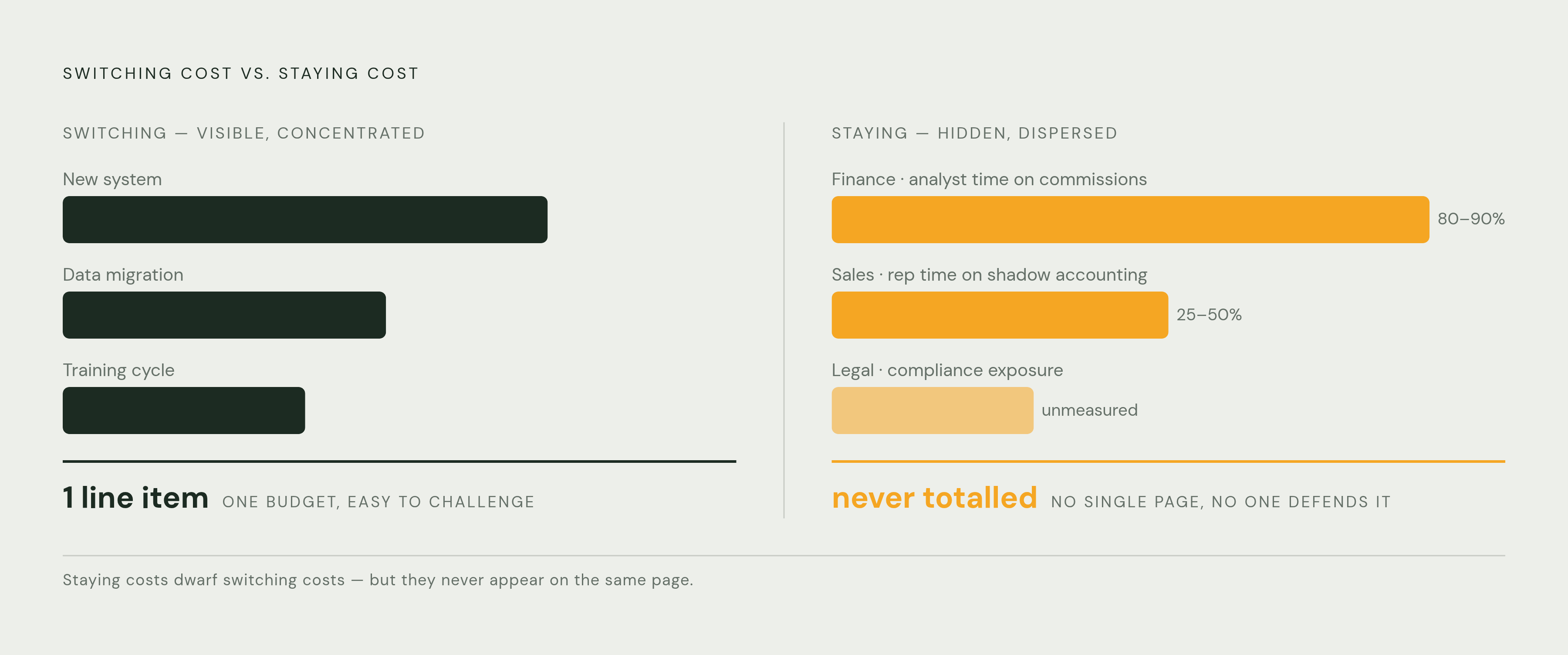
That's the wrong tradeoff, and the adoption numbers make the point. A market compounding at nearly 10% a year should be crowding manual process out faster than this. Instead, fewer than a third of companies run fully automated systems, and the rest split between partial automation and spreadsheets held together by macros, named ranges, and formulas written by an analyst who left three years ago. Switching costs are concrete, covering a new system, a data migration, and a training cycle, all sitting on one line of a budget request. The cost of staying put spreads thin across finance, sales, and legal, and is never visible as a single number anyone has to defend, so it survives budget review year after year without a real challenge.
The structural reasons spreadsheets produce errors at scale, not just occasionally
Ray Panko's research at the University of Hawaii, backed by a separate error catalog maintained by a spreadsheet risk research group, found that more than 80% of non-trivial spreadsheets carry at least one material error. The word that matters there is structural. These are competent people working inside a tool that was never built to model commission logic at scale. They're competent people working inside a tool that was never built to model commission logic at scale, and Qobra's analysis put manual commission calculation error rates at 5% to 15%, a spread wide enough to swing a single payroll run by tens of thousands of dollars depending on team size.
The failure mode is mechanical and repeats the same way everywhere. Formulas live inside individual cells instead of in auditable code, so a copy-paste error somewhere in the middle of the sheet sits invisible until a rep notices a short check. Spreadsheets have no native way to handle a variable that changes mid-year, and when a quota, a commission rate, or an OTE shifts, the usual fix is a new tab with a naming convention that makes sense only to whoever built it, and stops making sense the day that person leaves. There's no version snapshot either, so the exact sheet that calculated last March's payroll can't be reconstructed once thousands of edits have overwritten it.
Add to that the absence of any real multi-source data model. CRM records, billing data, and HRIS exports all get flattened into one sheet, and the cross-lookups tying them together turn into long chains of VLOOKUP formulas that break the moment someone reorders a column. There's no audit log, so a manual adjustment can change what a rep is owed and nothing records who made the change, when, or why. These structural gaps create compounding failure modes that often go undetected until a rep disputes a payout or reconciliation runs weeks after the fact.
Quantifying payout error costs: the 3–5% leakage calculation
Gartner, via Xactly, puts total sales-compensation overpayment from calculation errors at 3% to 5% of total spend. Industry surveys from 2026 are in the same range: manual processes run roughly 1% to 3% overpayment leakage, a figure that drops below 0.5% once a company automates. The gap between those two numbers is the recoverable savings, and it's the cleanest argument for switching in this entire piece.
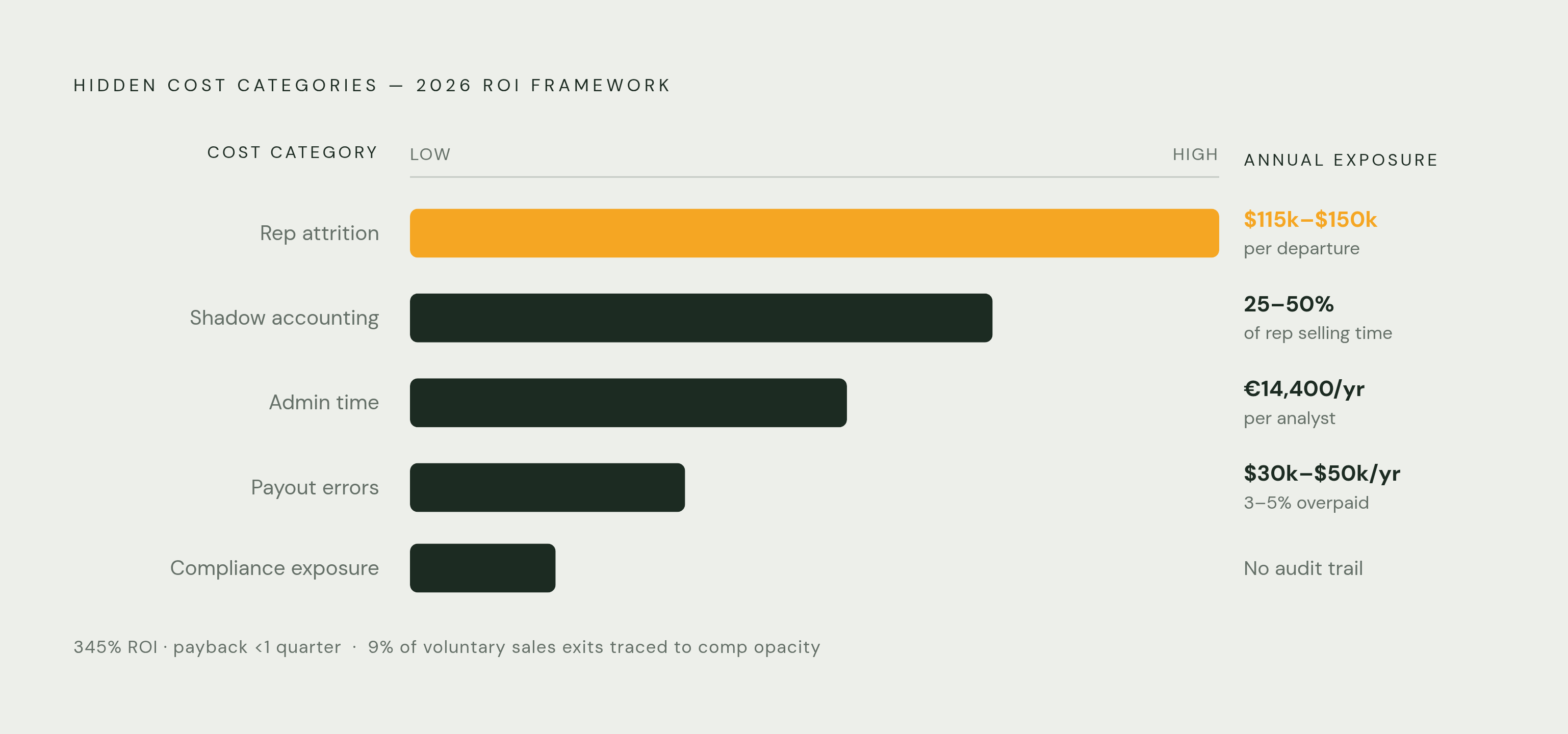
One benchmark set spreadsheet-based overpayment at 4.2% of total payouts against 0.5% to 1% for automated systems. Independent analysis put typical annual losses at $30,000 to $50,000 for mid-sized sales organizations. A 2026 worked example modeled a company recovering 4% of its commission budget purely by tightening calculation accuracy, which is roughly the point where the software pays for itself on error correction alone, before any other benefit gets counted.
The admin time cost that finance teams absorb without ever invoicing it
A 2026 case study documented a finance team spending 80% to 90% of its working hours on commission calculation, reconciliation, and dispute resolution before automating, with that figure dropping to 10% to 20% afterward. Commissions go from a full-time job to a task someone handles alongside their actual role. That's not a modest efficiency gain.
A separate benchmark put manual commission admin time at roughly 23 hours per pay period, against 5 to 7 hours once a company automates. Multiplying that gap by a fully-loaded analyst's hourly rate makes the number turn uncomfortable fast, especially at companies running monthly cycles across a sales team of any real size. One mid-2026 worked example modeled saving 20 of 25 monthly admin hours at a €60 hourly rate: €14,400 a year, and that's one analyst's time, not the total across an entire finance function. Broader 2026 comparisons reported 60% to 80% reductions in admin time after companies left spreadsheets behind, wide enough a range to call it the norm rather than a lucky outlier.
Shadow accounting's drain on selling time and trust
Shadow accounting happens when reps stop trusting the number on their official commission statement and start keeping a private spreadsheet to check the company's math against their own. It looks like a minor workaround. It actually signals that the compensation system has failed at its one essential job: convincing the people it pays that the number is right.
Sales Cookie research found 62% of sales reps keep a shadow-accounting spreadsheet specifically to verify commissions. The Aberdeen Group, in research cited by commission software analysts, found shadow accounting can eat 25% to 50% of a rep's monthly working time. That's time pulled directly out of selling and redirected into verification work, done by the exact people whose job is closing deals, not auditing payroll on the side.
The dissatisfaction traces to a systemic pattern. The same survey found 68% of employees dissatisfied with how their company manages manual commissions: 31% cited calculation errors, 28.8% cited unnecessary complexity, and 24% cited a lack of transparency into how the number gets built. Three complaints, one root cause: a system nobody outside finance can actually audit.
Rep attrition as the largest and most underweighted ROI category
Industry benchmarks put sales turnover close to 35% annually, nearly triple the roughly 13% average across all industries. That gap alone should worry any revenue leader; the sharper finding is that roughly 9% of voluntary resignations in sales roles trace directly to compensation transparency issues, not pay level, but opacity and distrust in how the pay gets calculated.
Replacing a fully-ramped account executive costs a multiple of that rep's fully-loaded compensation once recruiting, onboarding, ramp-time opportunity cost, and management attention all get factored in. One 2026 roundup put the figure at $115,000 to $150,000 per departure. And the reps most likely to walk over a broken comp system aren't the marginal performers. They're the top ones, the reps with the largest commission checks and the most to lose from a single calculation error, and, not coincidentally, the ones already holding an outside offer.
Compliance and audit exposure: the cost category that arrives without warning
Revenue recognition standards require deal-level commission data to be tracked individually over time, not rolled up into one monthly total, and that demands a level of granularity spreadsheets rarely preserve.
Spreadsheets and CRM exports rarely preserve that level of detail. At most growing companies, commission data gets aggregated into a single per-rep payout figure, which is precisely the wrong shape for revenue recognition compliance. The final number on the statement might be correct. The deal-level trail that would justify it to an auditor is already gone, and there's no way to reconstruct it after the fact.
Audit defensibility fails here for structural reasons, not because of one bad quarter. No immutable log, no version snapshots, no separation between who enters an adjustment and who approves it. An auditor can't sign off on a compensation expense line they can't trace to its source. The commission calculation methodology itself becomes something auditors want documented in full, and a spreadsheet model cannot produce the artifact they are asking for.
A practical ROI model: how to run the math for your own organization
A 2026 framework for evaluating commission automation names five return drivers: fewer payout errors, admin time recovered, faster time-to-value, higher rep productivity and retention, and lower compliance risk. Each one maps to a section above, and each one is measurable with numbers most finance teams already have sitting in a report somewhere.
One worked example ties the pieces together. Recovering 4% of a sizable commission budget through tighter calculation accuracy recovers a meaningful sum on its own. Saving 20 of 25 monthly admin hours at €60 an hour recovers another €14,400 a year. Combined, one 2026 model put the resulting return on investment at roughly 345%, with payback landing inside the first quarter after implementation, before attrition or compliance savings even enter the calculation.
Companies that want their own number before committing to anything can run a plain exercise. For one full pay period, log every minute spent on commissions (prep, reconciliation, disputes, corrections, approvals) and multiply the total by the fully-loaded hourly cost of everyone involved. Run honestly, that figure is usually the first moment a finance leader sees the real size of what the spreadsheet has been costing, quietly, month after month, without ever once appearing as a line item anywhere.