Hidden Fees and Contract Terms in Commission Software Agreements
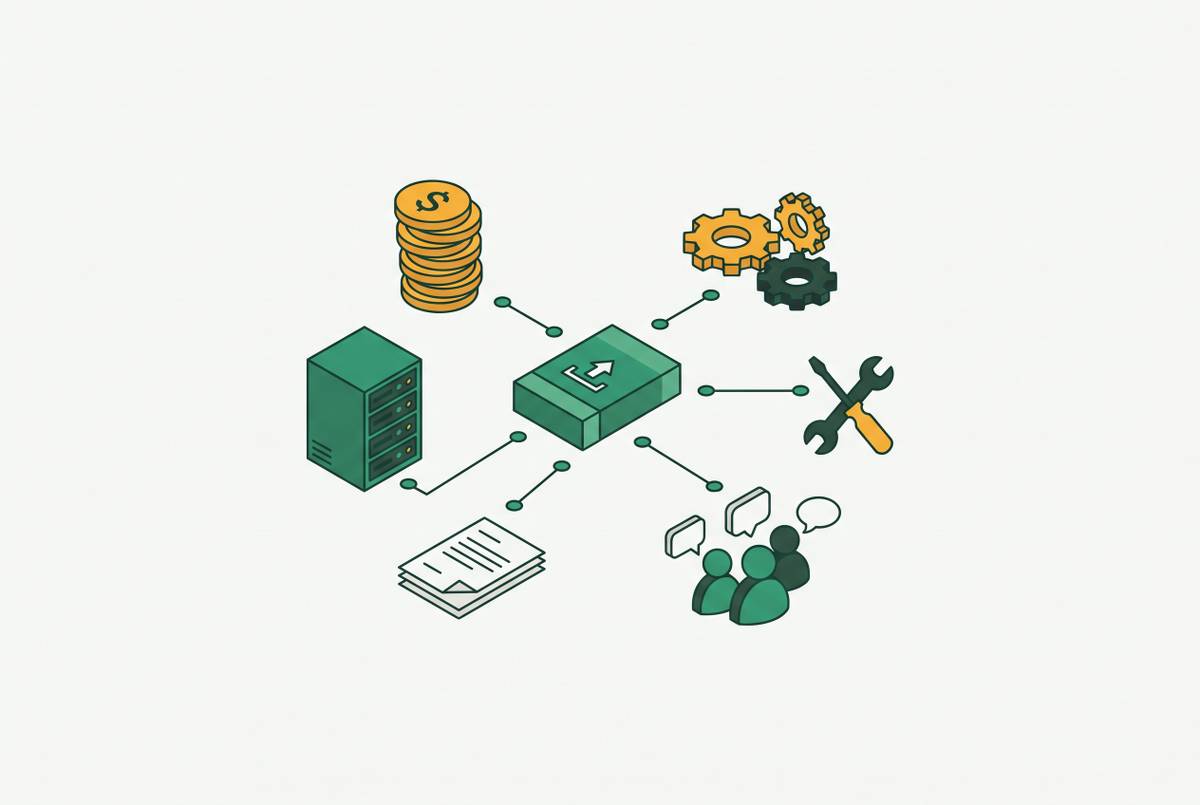
Your actual cost arrives months later when implementation and integration fees hit the invoice.

Commission software contracts hide their real cost in the fine print, not the headline rate. Vendors compete on the number they show you in the demo, not the number that shows up on the invoice eighteen months later, and the gap between those two numbers is where most of the damage happens. That gap is deliberate. It's a structural feature of how these contracts get built, and the vendors who benefit from it rarely do.
Commission software sits deep in this opacity, and it's one of the least transparent corners of the sales-ops stack. As of June 2026, some vendors publish per-user rates on their websites. Others keep pricing behind a request form or a sales call. That split is the whole story in miniature: the vendors with nothing to hide tend to show their math, and the ones who make you call for a quote are pricing to what you'll tolerate, not to a fixed rate card.
What follows is a walk through the clause types that turn a reasonable-looking quote into a multi-year cost problem, and what to ask before any of them end up in a signature block.
The implementation fee that arrives after you've already said yes
The single most common surprise in a commission software deal is the implementation fee, and it tends to arrive as a separate invoice after the license agreement is already signed.
Implementation fees at some vendors run $15,000 to $75,000, according to data compiled by Vendr. Some platforms list a one-time setup fee as its own billable line, separate from the subscription, breaking out onboarding and implementation as its own component rather than folding it into the license cost. None of this is hidden, exactly. It's usually right there in the documentation. The failure is that most buyers never ask to see that documentation before they sign the master agreement, so the number lands as news instead of as something they already knew.
At the enterprise tier the exposure gets structurally worse, not just bigger. Implementation on enterprise platforms generally runs 50 to 150 percent of the Year 1 license fee, and ERP integrations layered on top can add another $100,000 to $500,000 in middleware costs, according to procurement research on enterprise platform implementation costs. Data migration is where a lot of that overrun actually lives: an Oracle white paper cited in the same research found that 83 percent of data migration projects either fail outright or exceed budget and schedule, with average cost and time overruns of 30 percent and 41 percent respectively. That's a substantial discrepancy, and one that compounds quickly when migration scope wasn't established before signing.
Get a written scope of implementation before signing anything. What's included, what gets billed hourly, and what specifically triggers a change order. Then ask the question that gets skipped almost every time: is data migration actually in scope, or is it a separate line item waiting on a later invoice? It's almost never included by default, and assuming otherwise is how a six-figure implementation quote turns into a seven-figure one.
Platform fees, per-seat escalators, and the rates that compound at renewal
The per-user rate quoted in a sales deck is rarely the full pricing picture, and platform fees are where that picture gets complicated fast.
Some vendors charge a fixed platform fee per month that covers only a baseline number of users, with higher tiers billed at a higher flat rate. Salesforce Spiff, now part of Salesforce following its 2024 acquisition, charges $75 per user per month as an add-on to Sales Cloud. Those numbers are public, which is more than can be said for a lot of the category. But public doesn't mean simple: multiply either figure by a headcount that doubles in eighteen months, and the "per-user" framing starts to look less like pricing and more like a tax on hiring.
Renewal terms make the math worse. Annual price increases of 3 to 7 percent are standard unless a buyer locks in a rate at signing, and those escalator clauses tend to live deep in the renewal section where nobody reads past the notice period. Data from ContractKen found that escalation caps of 3 to 5 percent apply in roughly 55 percent of enterprise SaaS auto-renewal agreements. Flip that number around: close to half of these contracts carry no cap at all, which means the renewal price is whatever the vendor decides it is.
Per-seat pricing punishes exactly the behavior a growing sales org needs to reward, which is hiring. Every new rep becomes a pricing event, and a buyer who doesn't model headcount growth into the contract term before signing will end up paying more per rep at scale than at signing. That runs backward from how software pricing is supposed to work. Some platforms price by compensation plan instead of by seat, which kills the escalation dynamic outright, since adding a rep to an existing plan doesn't trigger a new billing tier. That structure is the better one, and any vendor still pricing strictly per seat should have to explain why. Quota Queue, a commission calculation platform that processes deal data into payroll-ready statements and bills by active compensation plans rather than by headcount, is built on exactly that model. Ask directly how adding ten reps next quarter changes the invoice. If nobody on the call can answer precisely, that's the answer.
Connector surcharges and integration fees that weren't in the demo
Commission software is only as useful as its connections to the CRM, the ERP, and the HRIS sitting next to it, and those connections get priced as if they were optional add-ons rather than the reason the software works at all.
The demo shows the Salesforce sync working. Commission data flows in from the CRM without friction, updates in real time, matches what the sales team already sees on their own dashboard. What the demo doesn't show is the pricing tier where that integration actually lives. Premium integrations, ERP and HRIS connectors, advanced analytics add-ons: these sit in a standard hidden-cost category across the entire space, and ERP integration alone can represent a significant share of middleware spend layered on top of the base license.
List every system the platform needs to talk to before evaluating anything. Then require, in writing, a statement of exactly which connectors come bundled at the quoted price and which ones cost extra. A platform built to meet a sales team where its data already lives, rather than forcing a CRM migration or a workflow rebuild, removes an entire category of this risk before it starts, which is worth more than any feature comparison in the demo.
One more question that rarely gets asked: what happens when the CRM vendor pushes a breaking API change? Someone has to pay to fix the connector on the other side. Find out now whether that someone is the vendor or the buyer, because by the time the API breaks, it's too late to negotiate.
Plan reconfiguration charges: paying again every time the business changes
Commission plans move. Quotas get revised, territories get redrawn, accelerator thresholds shift mid-year because the business shifted mid-year. A platform that can't absorb that motion without a support ticket is selling a liability. It's selling a service relationship with software attached, and the pricing should reflect that honestly, which it usually doesn't.
If an internal admin can't change plan logic, or post a manual adjustment, without filing a ticket and waiting on vendor staff, the buyer has effectively signed up for ongoing professional services billed at the vendor's pace, not theirs. Plan reconfiguration fees are a distinct cost category that deserves its own line of questioning during evaluation, not an assumption based on whatever the sales deck implied.
The deeper cost here is behavioral as well as financial. When a plan change is expensive and slow, sales leadership stops proposing changes even when the business clearly needs them, and a comp plan that made sense in Q1 keeps running unchanged in Q3 because nobody wants to reopen the change-order process. Test this in the proof of concept, not the slide deck. Who has permission to edit plan logic, is there a charge per modification, and what's the actual turnaround time on a reconfiguration request?
Auto-renewal clauses and the cancellation window most buyers miss
Auto-renewal is the default across this category, not the exception. Annual contracts are standard across the category, according to published pricing pages and data compiled by Vendr, and multi-year agreements are common at the enterprise tier on top of that. Multi-year terms can lower the effective rate on the right platform, but they also lock in risk if the business's needs change before the contract ends, and that risk almost never gets priced into the decision at signing.
The costliest miss in this section of any contract is the cancellation window itself. Auto-renewal triggers automatically unless the buyer acts inside a notice period that varies by contract, and that window sits buried several pages into the terms rather than flagged anywhere near the signature line. Miss it by a week, and the contract renews on its own terms, not the terms anyone actually negotiated. And those renewed terms, remember, often aren't even the terms originally signed: with escalation caps present in only about 55 percent of enterprise auto-renewal agreements, the price that comes back is frequently higher, with no cap stopping it.
A short list earns its keep here: the exact number of days' notice required to cancel or renegotiate, whether the renewal price carries a cap and at what percentage, whether multi-year pricing needs a separate signed addendum, and who on the buyer's side actually receives the renewal notice when it arrives. Log the cancellation deadline into a calendar the day the contract is signed. It's unglamorous, and it works.
Data portability terms and what it actually costs to leave
Exit cost is the final mechanism of vendor lock-in, and it's the term buyers are least likely to interrogate at signing, mostly because nobody is thinking about leaving on the day they arrive.
The pattern isn't new. A 2013 survey tied to the European Commission's Digital Agenda (Action 23) found that 40 percent of public-sector buyers reported vendor lock-in linked directly to poor data portability between systems. Commission data raises the stakes further, since it's personally identifying, financially material, and tied directly to payroll. Confirm before signing whether all of that data is exportable on demand, in what format, and through what mechanism, whether that's an API, a bulk export tool, or something more manual. If the answer is vague during evaluation, treat the vagueness itself as the answer: data that can't be cleanly exported is data being held, whether or not the vendor frames it that way.
Early termination fees compound the exit problem further. They're standard across a lot of SaaS contracts and routinely overlooked until the moment someone tries to leave. Confirm whether one applies, how it's calculated, and whether it shrinks the longer the contract runs or stays flat regardless of tenure.
For buyers in the EU, the landscape actually shifted. The EU Data Act, effective September 12, 2025, requires that customers be able to switch providers with two months' notice, prohibits switching charges outright starting January 12, 2027, mandates data portability in machine-readable formats, and requires technical interoperability through open APIs. US buyers have no statutory equivalent to any of that. Exit terms in the US remain entirely a function of what's written into the contract, which makes the questions above a matter of negotiation, not a legal backstop someone else provides for free.
The due-diligence checklist: what to ask before signing any commission software contract
Everything above collapses into a set of questions worth carrying into any vendor call, RFP, or renewal conversation.
On implementation: is it billed separately from the license, what's explicitly included (configuration, training, migration), and what specifically triggers an out-of-scope charge?
On pricing and escalators: is the per-user or per-plan rate fixed for the full contract term, is the renewal price cap in writing, and does adding users or plans mid-term trigger a re-quote?
On integrations: which connectors are included at the quoted price, who pays when a connected CRM pushes a breaking API update, and are analytics or BI integrations billed separately?
On plan configuration: can internal admins change plan logic without a service ticket, and is there a charge attached to each modification?
On auto-renewal: what's the exact cancellation notice window, does the renewal use the negotiated price or a fresh quote, and how is the early termination fee calculated?
On data portability: can all data be exported on demand, in what format, and is there a fee for bulk export? What happens to the data once the contract ends, and for how long does the vendor retain it?
On support: what's covered under standard support, and what specifically triggers an upgrade to a paid tier?
On security: is commission data encrypted both in transit and at rest, is tenancy scoped by organization or does data commingle across customers, and is there an audit trail that locks pay periods and logs every approval?
What transparent commission software pricing actually looks like
A contract that survives every question above looks structurally different from what most enterprise vendors put in front of a buyer on day one, and the difference is visible before a single clause gets negotiated.
It starts with published rates, numbers available without a discovery call first. It prices by compensation plan rather than by seat, so a hiring wave doesn't automatically re-trigger the quote. Implementation scope gets written down before signature, not negotiated after the fact. Standard CRM and payroll connectors come included in the license, not sold back as an add-on. Internal admins can edit plan logic without opening a ticket, and data exports on demand, in a standard format, with no fee attached to leaving.
Security belongs in that same baseline, not in a premium tier priced separately. Commission data is compensation data, and encryption in transit and at rest, org-scoped tenancy, a full audit trail, and a clear policy against training vendor models on customer data should all be table stakes, not upsells a buyer has to negotiate for.
There's a rep-side signal worth watching too. A platform that gives reps real-time visibility into their own earnings, quota progress, and deal-level detail cuts down on the shadow spreadsheets reps build to track what they think they're owed. Reps who can see their own numbers hit quota at higher rates than reps waiting on a month-end reconciliation, and fewer disputes mean a lighter support load on the vendor's side, which means less exposure to a forced upgrade into a paid support tier.
None of this means chasing the lowest number on the page. Cheapest-at-signing is often costliest-at-scale, once the platform fees compound and the connectors turn out to cost extra. It means checking whether the contract structure actually matches what the sales call promised. That alignment, or the lack of it, is the clearest signal available for how the relationship runs once the contract is signed and the invoices start arriving on their own schedule.