Commission Software Switching Costs and Migration Risks
Switching costs are real and temporary, but staying broken costs far more.
Most revenue leaders already know their commission process is broken. A substantial share of CCaaS migrations underperform, but when they do, the causes are rarely platform quality: limited internal talent with new technology, complex internal IT landscapes, and lack of executive support. But the renewal gets signed anyway, or the decision to replace the spreadsheet gets tabled for another quarter. Only 27% of companies have fully automated their end-to-end commissions process, so most revenue teams are still running payouts on spreadsheets or some patchwork of manual steps. It is a stable equilibrium, because spreadsheets carry no licensing fee, no implementation timeline, and no named owner who has to defend the decision to change them. They look cheap because nobody has priced what they actually cost.
That asymmetry is the whole story behind why commission software decisions stall. The cost of switching appears as a line item: a vendor quote, a project timeline, a training budget. Nobody itemizes the cost of staying, so it never competes on equal footing in a budget conversation. Vendors know this, and the switching-cost objection has become one of the most reliable retention tools in enterprise software, because the conversation stops at the named costs and never turns to what staying is quietly costing in the background. The rest of this piece puts both sides of that ledger on the table, starting with the side that actually gets scrutinized.
What switching commission software costs, line by line
Switching commission software does carry real costs, and naming them honestly is the only way to evaluate them honestly. Four categories account for nearly all of it: data migration, re-integration with the CRM and ERP, training, and the parallel-running period after go-live. Each one is also bounded, with a defined end point, and each one gets inflated routinely in conversations designed to keep a customer from leaving.
You pull historical commission records, deal data, rep mappings, and pay period archives out of the current system when you migrate data, and load them into the new one in a usable format. This step is not optional to skip for the sake of speed: organizations subject to SOX have to retain financial records for a minimum of seven years, so historical commission data has to be accessible for audit lookback long after the switch is complete. The real risk here is whether the data comes across intact. Before any contract is signed, the organization needs written confirmation from the vendor on three questions: do the field mappings transfer cleanly, does calculation history migrate at the record level, and does the new platform's import format actually support every field the organization needs. These are the questions that decide whether migration succeeds, not how many hours it takes.
CRM and ERP re-integration is where the real stakes sit, because commission software is only as accurate as the deal data feeding it. If a platform cannot connect cleanly to Salesforce, HubSpot, or the ERP system handling revenue-recognition-dependent payouts, someone has to reconcile numbers by hand, which brings back the exact errors the new system was supposed to eliminate. Where a vendor has certified, pre-built connectors for the organization's specific CRM and ERP version, this step is mostly configuration and testing. Customized environments or multi-entity setups take longer and cost more. This line item is also the most negotiable part of the entire switching conversation: many vendors will discount or absorb integration services for organizations switching away from a named competitor, and it is worth asking directly rather than accepting the first quote.
Training gets overstated more than any other line item, largely because the vendor trying to keep a customer has an incentive to make the alternative sound harder than it is. Switching-cost research on modern cloud platforms finds that most employees need just 30 to 45 minutes of orientation, not days of formal training. If a system fits how the team works, it changes outcomes for years, so the imbalance favors switching even before you weigh any other cost.
The parallel-running period, where both systems run side by side for at least one full pay cycle after go-live, is standard practice, so you should budget for it explicitly. It is the window where you can still catch calculation errors and unexpected plan outcomes before they do damage. For commission software specifically, this period functions as a shadow-pay validation: payouts get computed under both the old and new systems and reconciled against each other before the old system is retired, the same discipline that any serious change to a commission plan requires. The cost falls on the RevOps and Finance team, and it is temporary, bounded to one or two pay cycles.
Taken together, implementation with vendor support takes two to eight weeks, not months. Every cost named in this section has a start date and an end date. None of them compounds. That distinction matters, because the costs examined next have no end date.
The ongoing cost of staying on a broken commission system
Staying on a manual or fragmented commission system is a compounding annual drain that runs across four categories: calculation errors, eroding rep trust, RevOps overhead, and compliance exposure, and most of it never appears on a budget line at all.
Calculation errors are the most direct and most structural failure. In a shared spreadsheet, any user can overwrite a formula cell without so much as a warning, and a single typo in a nested IF statement will silently miscalculate payouts across an entire column of reps, often going unnoticed until a rep flags it, sometimes pay periods after the fact. At larger organizations, this gets worse because the spreadsheet itself stops being singular: Finance holds one version, Sales Ops holds another, and leadership reviews a static export that stopped matching reality days earlier. Once there is no single source of truth, every stakeholder group loses confidence in the numbers at the same time, and rebuilding that confidence costs more than building it the first time would have.
Trust erosion follows close behind, and it matters because compensation is one of the strongest behavioral levers a sales organization has, but only when reps believe the number on the page is correct. Platforms like Quota Queue, a spreadsheet-free commission calculation tool that produces auditable, rep-level payout statements from raw deal data, exist precisely to close that credibility gap before it widens. Where that belief breaks down, reps build their own shadow calculations, managers start double-checking every payout by hand, and Sales Ops stops doing strategic work and becomes a full-time validation layer. Trust erosion lowers retention: research from Fullcast attributes roughly 56% of sales rep turnover to dissatisfaction with pay and commission structure, including payouts that arrive late or inconsistently. Replacing a rep carries its own recruiting, onboarding, and ramp-time cost, and that cost almost never gets traced back to the commission process that caused the departure.
RevOps and Finance absorb a disproportionate share of this burden directly: they spend hours on dispute resolution, reconciling competing spreadsheet versions, and manually checking calculations that should never have needed checking. That time is not logged against the commission process anywhere, so it never enters the staying-versus-switching analysis at all. A 2025 PwC survey cited in Onspring's research on switching costs found that organizations using the right compliance technology reported better visibility, faster issue identification, and higher productivity, which implies the reverse just as clearly: the wrong tool keeps adding overhead indefinitely.
Compliance exposure is the category organizations most often underweight, because it reads as abstract until an audit actually asks for it. Commission data sits at the intersection of payroll and financial reporting, and for public companies it counts as a SOX-relevant system: executives have to certify the accuracy of compensation data, and a spreadsheet with undocumented formula changes and no audit trail cannot support that certification with any confidence. SOX requirements call for audit logs of access and changes to financial systems, retained for a minimum of seven years, and a shared commission spreadsheet with no change log and no access controls fails that requirement by its structure, not by any one mistake. The standard has also moved. By 2026, SOX compliance expects continuous verification that financial data stays accurate, complete, and trustworthy over time rather than a single point-in-time control check, and a spreadsheet-based system has no way to demonstrate that kind of ongoing proof. This is a structural gap for any organization with audit obligations.
Staying has costs that spread out and stay invisible, so they get underweighted every time a budget conversation only shows the switching invoice. Research on switching costs finds that in most cases where switching is genuinely warranted, the ongoing annual cost of staying exceeds the one-time cost of switching within six months. The arithmetic favors switching, if you put both columns of the ledger on the same page.
Why migration projects fail
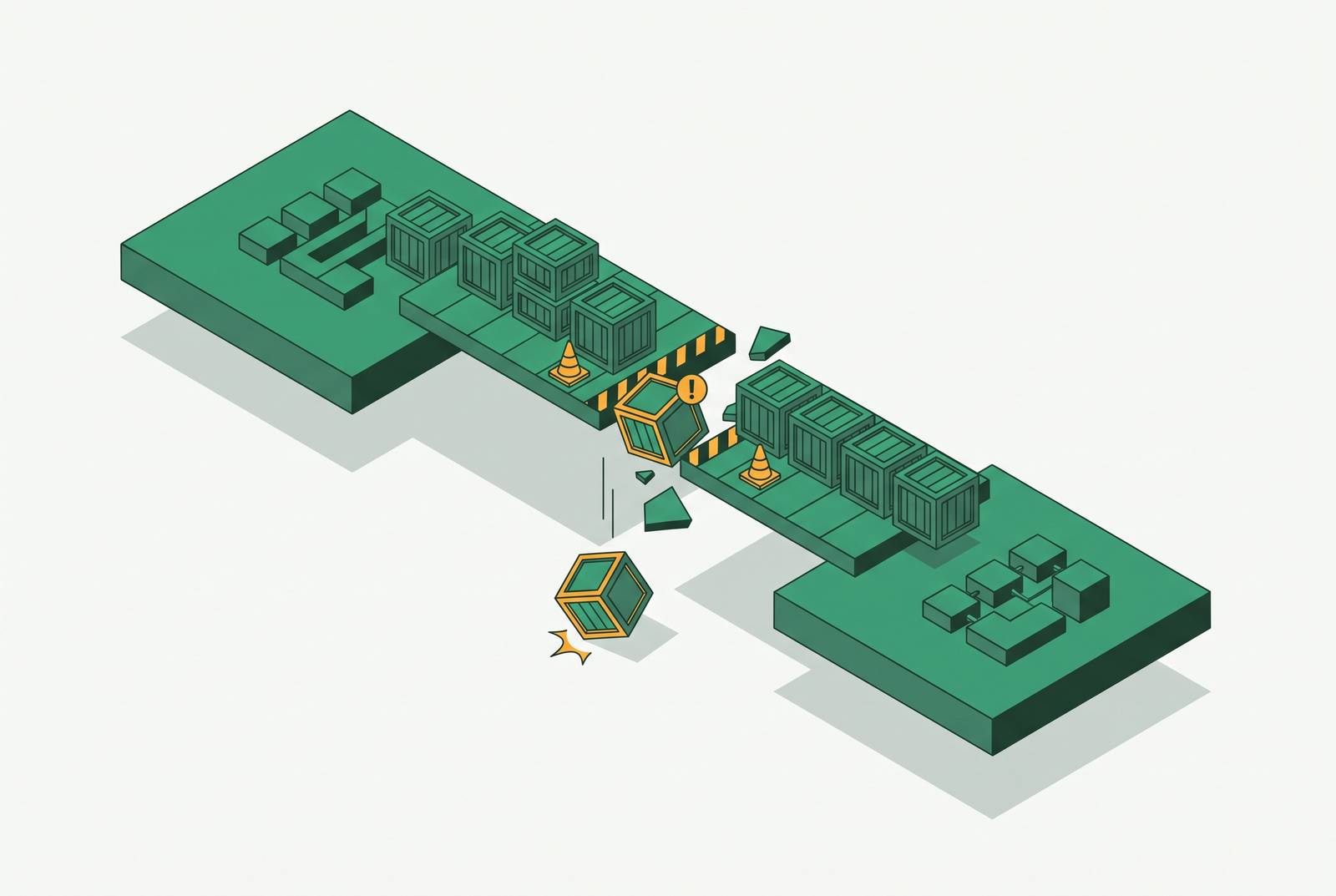
Migration is not risk-free, and the strongest objection to switching is about execution. That risk is driven far more by discipline than by which platform gets chosen, and the ways these projects fail are documented well enough to plan around.
Adjacent categories of software migration show the same pattern repeatedly. Forrester's research on contact-center migrations found that a substantial share underperform expectations, and the top three causes were limited internal talent with the new technology, complicated internal IT landscapes, and a lack of executive support, not weaknesses in the platform itself. Data migration research more broadly backs this up: a large majority of data migration projects either fail outright or run over budget and over schedule. The thread connecting both findings is that the technology is rarely the root cause of a failed migration. Operational readiness, change management, and whether leadership actually backs the project are what determine the outcome.
Commission migrations carry a few specific versions of this risk. Data integrity on export matters because the new platform can only be as accurate as what gets loaded into it, and historical records with undocumented formula logic, informal plan rules, or unresolved disputes will carry those same problems forward if they migrate without a cleanup step first. Vendor lock-in on the way out is a related concern: a 2026 Parallels survey found that the vast majority of IT leaders worry about vendor lock-in, and commission platforms with limited export options or proprietary data formats create exactly that risk. If you confirm full data portability before you sign anything, you protect against being trapped in the next system the way you may be trapped in the current one.
Migrating a commission plan that is already too complicated does not fix the plan; it just recreates the same confusion inside a more expensive system, which makes this last risk less technical and more organizational. The migration moment is the natural point to simplify a plan that has accumulated exceptions and side agreements over years, because that cleanup is far harder to justify once the new system is already live and the team has moved on to other priorities. A plan that cannot be explained to a new rep in a few sentences is a plan that will keep generating disputes regardless of which software calculates it.
None of these risks argue against switching. They argue for treating migration as an operational project with executive sponsorship and a cleanup step, handled by the organization rather than left entirely to whichever vendor wins the deal. Organizations that plan for these specific failure patterns, rather than assuming a new platform will fix a broken process on its own, are the ones that come out the other side with a system reps actually trust.
Sources
- True Cost of Switching Expense Management Platforms: The Hidden Numbers
- fullcast.com
- d2dhq.com
- The Hidden Costs of Staying: Why 'Perceived' Switching Costs Are Holding You Back - Onspring
- CCaaS Migration Guide: What the Market Data, Compliance Requirements, and Failure Rates Tell You [2026] - InflectionCX