Commission Software Total Cost for Small Sales Teams
Most teams price commission software against spreadsheet invoices, not spreadsheet costs.
Small sales teams evaluating commission software almost always price the wrong thing first. They compare monthly fees, pick the cheapest per-seat rate, and treat the decision as settled. The subscription is one line in a broader cost structure that also includes setup, integration, and the labor of running commissions the old way, and any one of those can dwarf what the invoice says. The comparison that actually matters is total software cost against the total cost of the spreadsheet system already sitting in place, and most teams have never priced that second side of the ledger. That's the wrong instinct, and it's worth correcting before anything else.
The market is getting harder to shop in as it grows. More vendors, more pricing structures, more bundled features nobody asked for. Meanwhile, well over half of small and midsize businesses still run commissions in spreadsheets, and that default feels free. It isn't.
Pricing spans a wide range, with costs varying significantly based on team size, plan complexity, and the features a vendor bundles into the base subscription. Where a team lands on that range depends less on brand name than on how the vendor structures the bill.
Most platforms price per user or per payee, so cost grows every time the team hires. A ten-person floor that grows to fifteen reps next year isn't just adding headcount, it's adding a proportional software cost on top of it. Some vendors structure pricing around factors other than headcount, which can matter more than most buyers realize going in: a model that doesn't scale directly with rep count doesn't punish growth the same way a per-seat model does, and a team with hiring plans should weight that accordingly.
What's bundled into the base number varies just as much. What's included in a base plan varies by vendor and tier. Implementation, custom integrations, premium support tiers, and audit or compliance features are frequently sold as add-ons. Two vendors can post the same sticker price and land at very different totals once user count, plan complexity, integration needs, and support level get applied to one team's actual setup. The sticker price is a starting bid, not a total, and treating it as one is the first mistake most buyers make.
Setup and implementation costs that rarely appear in the first conversation
Implementation is not a task finished in an afternoon by importing a CSV. It covers system configuration, workflow testing, rep and admin training, data migration out of whatever spreadsheets the team used before, and onboarding for the finance and ops staff who'll run the thing day to day.
Enterprise contracts often bundle in white-glove onboarding or a dedicated customer success manager. Smaller or lower-tier plans may not include that service, and teams should confirm before signing what onboarding support is actually covered. Migration cost tends to reflect the complexity of the existing spreadsheet setup. A file with a handful of clean formulas migrates cheaply. A workbook full of undocumented exceptions, nested conditionals, and one-off manual adjustments turns migration into a multi-week project, and most teams underestimate which category their own spreadsheet falls into. Premium support, meaning a guaranteed response time or a named account manager, is another cost that tends to surface after the contract is signed rather than during the sales call.
Before signing anything, a small team should ask whether implementation is included in the quoted price or scoped separately, what support tier comes standard versus what requires an upgrade, whether there's a genuine self-serve path to going live and how long that takes for a team this size, and whether changing a plan rule later means opening a ticket with the vendor or just editing a field. A platform that pulls data straight from the CRM a team already runs, instead of demanding a parallel manual entry process, cuts both the setup scope and the maintenance burden that follows it.
Integration costs: connecting commission software to the systems that already hold your data
Commission math depends on data scattered across systems. Deal data lives in the CRM, financial data sits in an ERP or accounting tool, and payout data eventually has to land in the HRIS or payroll system. Every one of those connections is a place cost can appear, and a place something can break.
Native integrations with the CRM, ERP, and payroll systems a team already uses are the standard a small team should benchmark against. Custom API work, or connecting to a system the vendor doesn't already support, usually carries its own scoping fee and its own timeline stacked on top of the base subscription.
Plenty of growing companies still handle this the hard way: export CRM data into a spreadsheet, run the math there, generate one lump payout number per rep for payroll. That process throws away the deal-level detail finance needs for reporting, and that auditors expect to see if a payout is ever challenged. The real integration test is whether a platform stays connected to the CRM long after signing. It's what happens to that connection when the CRM's deal stages or data model change six months from now, and whether keeping it current is the team's job or the vendor's.
Every manual export between systems is a recurring labor cost that never shows up on a software invoice. Someone has to pull the data, clean it, and reconcile it every single commission period, and that labor compounds across every cycle the team runs afterward. A platform built to push data automatically, rather than depend on someone remembering to pull it, removes an entire category of hidden cost that a business case built only around the subscription fee will miss completely.
The real cost of errors in a spreadsheet-based process
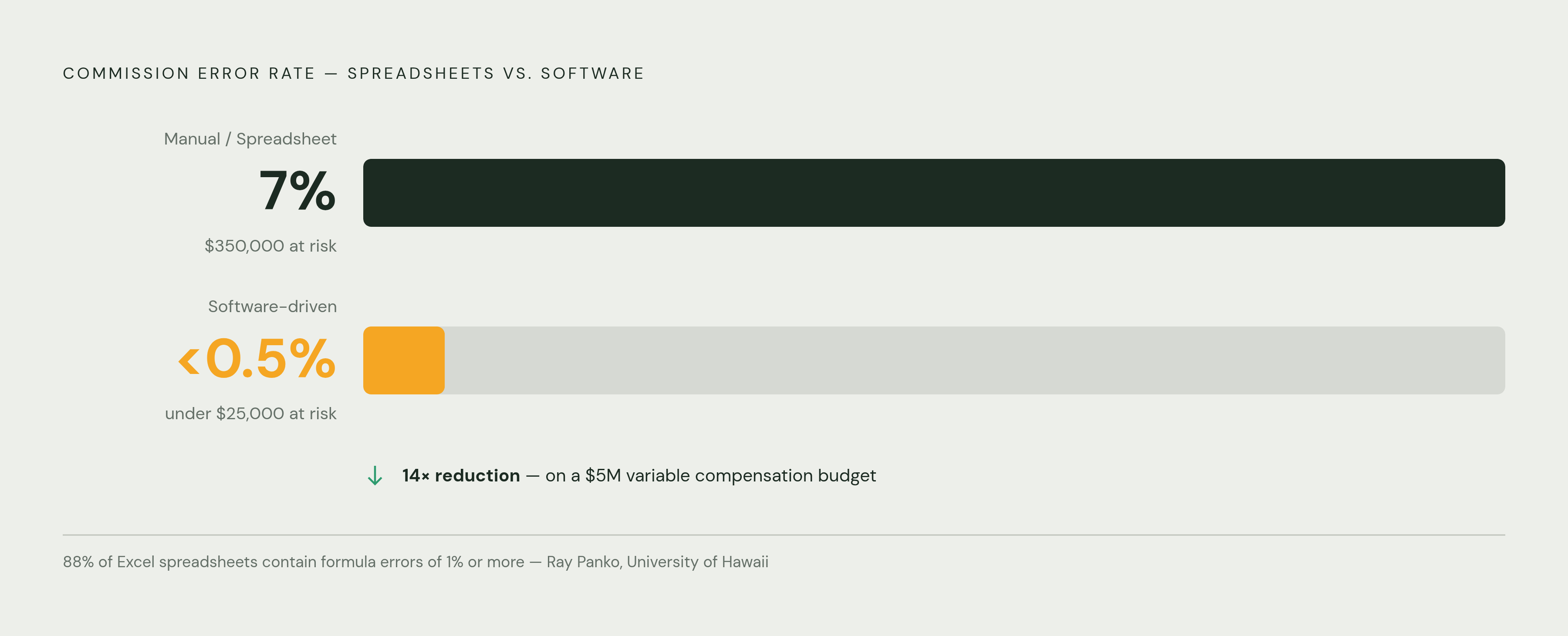
Manual commission processes carry an error rate industry estimates put at 3% to 5% of total variable compensation spend. For a team paying $5 million a year in commission, that's $150,000 to $250,000 lost annually to overpayments, underpayments, or disputes that eat someone's whole afternoon to untangle. Handed over to spreadsheet mistakes every year, that figure amounts to roughly a second full-time salary, making it the clearest number in this whole comparison.
The underlying data quality is worse than most people assume. Research by University of Hawaii professor emeritus Ray Panko found that 88% of Excel spreadsheets contain formula errors of 1% or more. It's a structural flaw, not a skills gap among the people building these files. It's a structural property of spreadsheets themselves: no version control, no audit log, no warning before someone overwrites a formula cell.
Errors compound quietly because shared spreadsheets have no guardrails at all. A single typo in a nested IF statement can silently miscalculate payouts across an entire column of reps, and it might not surface until someone questions their check weeks later. When multiple people maintain different versions of the same file, version conflicts creep in undetected, sometimes for a full pay period before anyone notices the gap.
The cost isn't only financial. Reps who don't trust their commission numbers behave differently. They hold deals back right at period end, they sit on high-value opportunities until "the process gets fixed," and they spend selling time auditing their own paycheck instead of working pipeline. Oracle and HP have both faced lawsuits over commission disputes, and litigation like that costs millions regardless of who wins. Research cited by commission software analysts shows that moving from manual calculation to commission software can drop error rates from an industry average of 7% down to under 0.5%. It's a substantial improvement, not a marginal one. It's the difference between a process that mostly works and one that mostly doesn't, and it stands as the single strongest argument against staying on spreadsheets past the size a small team currently is.
Admin labor: the commission management hours that never show up on a software invoice
At a team of 50 reps, finance and ops staff commonly spend 8 to 15 hours per commission period resolving disputes alone. Not calculating anything, just fielding pushback after the numbers go out. That's a recurring cost with no line item, paid entirely in staff hours nobody bothers to log.
The full manual cycle runs the same way every time: pull data from the CRM and other systems, import it, clean it, validate it, run the calculation, check the formulas for errors, reconcile whatever doesn't match, handle the rep disputes that inevitably follow, then pull together documentation in case anyone needs to audit the result later. Every step takes longer as the team grows and as comp plans get more complicated, and the whole cycle repeats every single period without fail.
That labor cost has a second, quieter face. Reps already spend a minority of their working week actually selling, and administrative work, commission tracking included, eats into what's left. Lost selling time is a revenue cost, not just a staffing problem buried in an HR spreadsheet.
Gartner data shows commission platforms cut administrative time by 60% to 80% against spreadsheet-based systems. Across team sizes from 20 reps up to organizations running more than 2,500, the research consistently finds software cheaper than spreadsheets by year one, and dramatically cheaper by year three. The crossover point comes fast, not at some distant break-even a finance team can safely ignore for now.
Add it up, and you get admin labor, overpayment corrections, dispute resolution, audit prep, informal shadow spreadsheets nobody signed off on, a slower month-end close, and a comp structure too rigid to adjust without a rebuild. None of it shows up on an invoice. Together, it routinely runs into six figures a year.
The turnover cost that commission errors quietly produce
Sales roles turn over at close to 35% annually, nearly three times the roughly 13% average across all industries. Replacing one rep costs somewhere around $115,000 once recruiting, training, and lost productivity get factored in, and some estimates put replacement cost at 150% to 200% of a departing rep's annual on-target earnings. For a small team, losing one rep is a serious operational blow. It's a budget event that shows up in next quarter's numbers.
Pay is the trigger more often than people assume, but not in the way most managers guess. A Gartner survey found 64% of sales professionals would leave for a comparable role elsewhere if it paid better, and "better pay" in practice often means pay a rep can see and trust in real time, not necessarily a bigger number printed on the offer letter. Companies that set clear on-target earnings and build pay transparency into the process see meaningfully better rep retention, according to PayScale's 2025 Compensation Best Practices Report. The lever there is trust in the process, not the size of the check, a point most retention conversations get backwards.
The cascade is predictable once commission errors become routine. Reps start holding deals back near period end. They disengage from a number they no longer trust. Managers and finance staff burn hours on disputes that shouldn't need to happen in the first place. Eventually someone leaves, and the turnover cost is just the largest single invoice at the end of a chain that started with one broken formula nobody caught in time. For a team of 10 to 15 reps, one turnover event caused by avoidable commission errors can cost more than several years of a commission platform's subscription fees combined.
How to build a total cost comparison that holds up to scrutiny
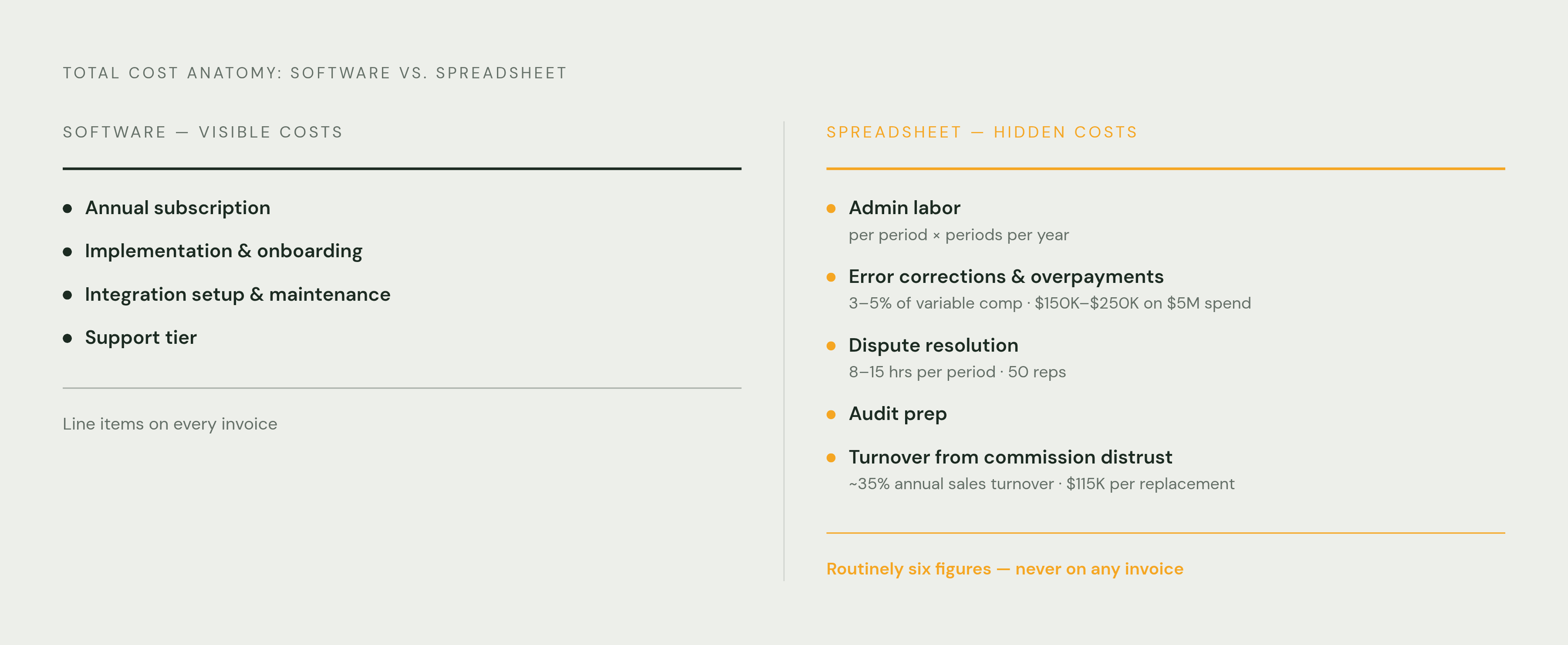
A comparison that holds up needs two full columns, not one. The software column includes the annual subscription, implementation and onboarding, integration setup and its ongoing maintenance, training, and whatever support tier the team actually needs. The spreadsheet column includes admin labor per period multiplied by the number of periods run each year, the cost of correcting errors and recovering overpayments, time spent on disputes, time spent preparing for audits, and turnover attributable to reps who stopped trusting their pay.
Once both columns are filled in honestly, the comparison rarely stays close. Software tends to win on total cost well within the first few years, and the gap typically widens from there. That's the finding, and it's not a close call.
Three questions sharpen this for a specific team. How many hours does the team spend each period right now on calculation, validation, and disputes? What has the actual commission error rate been over the last 12 months, and what has that cost in overpayments or rep friction? And how much has the team spent on recruiting and onboarding this past year, with how many of those departures tracing back to commission dissatisfaction?
Pricing model matters here too. A per-seat model means the software cost rises every time the team hires, while a per-plan model keeps cost tied to comp structure complexity rather than headcount, which suits a small team with growth plans far better. Audit readiness is easy to overlook until the exact moment it's needed: a spreadsheet cannot produce a timestamped record showing what calculation ran, on what data, on what date. If a payout is ever formally disputed, a team running on spreadsheets has nothing to point to. A team running on software does.
What to evaluate when comparing platforms for a small team's actual situation
Six criteria matter most once a small team narrows its options down. Start with the pricing model: does the cost compound with every hire, or stay tied to plan complexity instead? Then the implementation path: is there a genuine self-serve option, and how long does a team this size actually take to go live on it?
CRM integration comes third: does the platform push data automatically from systems already in use, or does it depend on someone manually exporting and re-uploading files every single period? Fourth is rep-facing visibility: can reps see their own real-time earnings and how those numbers get calculated, or do they wait for someone in finance to run the math and email them a total?
Fifth, support structure: is help included at a tier a small team can actually afford, or does real support only show up once the account moves up-market? And sixth, audit trail capability: can the platform show, on demand, exactly what calculation produced a given payout and when it ran?
Weigh those six against the four cost categories laid out above: subscription, setup, integration, and the labor and error cost of the status quo already running today. Once that math is done honestly, the total cost picture stops being a guess. It becomes a number a small team can defend in front of whoever signs the check.