Commission Software ROI Calculation for Finance Teams
Quantify the hidden cost of manual commission management across four measurable budget categories.
Manual commission management doesn't show up as a line item anywhere in the budget, and that's exactly the problem. The cost is real, it's usually six figures a year at a mid-market company, and it hides across four categories that nobody in Finance has been asked to add up. This piece adds them up.
What manual commission management actually costs (the four cost categories Finance needs to quantify)
Spreadsheets are free. That's the trap. No vendor sends an invoice for the hours lost to manual commission calculation, so the cost never gets a budget code and never gets scrutinized the way a software subscription would. It just sits there, distributed across payroll, headcount, and rework, invisible to anyone who isn't specifically looking for it.
Four categories carry that cost, and each one is measurable in terms Finance already uses. Admin labor consumed by the commission cycle itself: someone runs the calculation, someone reviews it, someone approves it, someone posts the journal entry. Overpayments and calculation errors, which bleed real dollars out of commission budget every cycle. Dispute resolution burden, which pulls Sales Ops and Finance managers into investigations that shouldn't need to happen. And audit risk paired with close cycle drag, which shows up as delayed reporting and, in the worst case, regulatory exposure.
A fifth category exists too: rep attrition driven by distrust in how they're paid. It's real, but it resists clean attribution, so treat it as a secondary consideration in the strategic narrative rather than a line in the payback model.
This is a widespread problem affecting the core operation, not a fringe one. Commissionly's 2025 Benchmark Report found more than 60% of SMBs still manage commissions in spreadsheets, which means the Finance team modeling this cost is modeling the norm, not an outlier. And the point of the exercise is to arrive at a number honestly, without inflating it to justify a purchase that's already been decided on. It's to build something conservative enough that it survives a CFO reading it line by line.
Calculating the admin labor cost: how many hours the commission cycle actually consumes
The hours are scattered, which is precisely why nobody notices them. A sales-ops lead runs the calculation. A finance manager reviews it. A controller signs off. An accounting clerk posts the entry. None of those people would describe commissions as their full-time job, yet together this work typically consumes 10 to 25% of one or two full-time positions across a single commission cycle, according to research from salescookie.com.
Forrester's benchmark puts a finer point on it: commissions teams spend an average of 40 hours per 50 payees just to run the calculation, plus another 4 hours per plan each quarter to configure and optimize. Those are inputs Finance can plug directly into its own headcount and payee count, no modeling assumptions required.
Translating that to dollars is mechanical. Count everyone who touches commissions each cycle, even the people who only spend two hours on it. Estimate hours per person per cycle and multiply by the number of cycles run annually. Apply a fully-loaded cost rate. In the worked example later in this piece, that rate is $130,000 a year for one FTE-equivalent. What comes out the other end is the gross labor cost, and automation typically cuts that figure by 50 to 70%.
Worth asking what those hours actually buy. Mostly, it's data entry, formula troubleshooting, manual exports pulled from the CRM, and reconciling two versions of the same spreadsheet that drifted apart. That amounts to compiling rather than analysis. It's plumbing, and it displaces the work Finance actually exists to do.
The broader pattern holds from the HR side as well: automating manual processes meaningfully reduces administrative hours compared to spreadsheet-based workflows. Commission calculations carry more branching logic than standard salary administration, tiers, accelerators, splits, clawbacks, so the savings run higher still.
Calculating the overpayment cost: the percentage of commission budget that leaks through manual processes
Industry surveys put overpayment leakage at 3 to 5% of total commission spend in manual environments, dropping to under 0.5% once the process is automated, per salescookie.com. That gap, multiplied by total commission spend, is the number Finance should be putting in front of a CFO first, because it's the cleanest math in the whole model: commission spend times leakage rate equals annual overpayment exposure.
The leakage is the product of a system operating exactly as designed, not careless people. It's structural. Nested formula logic produces arithmetic errors that nobody catches until months later. Clawbacks on canceled or revised deals get missed because nobody re-runs the calculation after the fact. Split-credit deals get double-counted when two reps' spreadsheets both claim the same deal. Mid-period quota changes never flow through to the actual calculation. And when a rep's plan language is ambiguous, and Finance can't trace exactly how a number was produced, the interpretation tends to drift toward whatever favors the rep, not because anyone's cheating, but because there's no audit trail to argue against.
The version-conflict failure mode deserves its own mention. When two ops managers each work from a separate copy of the commission spreadsheet, merging their changes by hand reintroduces errors that were already fixed in one version but not the other. That single mechanism accounts for a meaningful share of overpayments in manual environments, and it's avoidable, in principle, by never letting two live copies exist in the first place. In practice, almost every manual process ends up with two live copies eventually.
The legal tail end of this is worth naming, even if it's rare. Oracle and HP have both faced lawsuits tied to commission payment failures, Oracle over allegedly retroactive reductions and contract non-compliance, HP and HPE over breakdowns in their commission-tracking systems. Most mid-market companies will never see litigation over this. But the overpayment savings alone, without factoring in legal exposure at all, tend to justify the investment on their own.
Calculating the dispute resolution cost: what each commission dispute actually costs Finance and Sales Ops
Every commission dispute costs something specific and countable. Research from everstage.com puts the average dispute at 4.9 hours of combined Finance and Sales Ops time, and that's only when the underlying calculation can't be traced back to source data without a manual dig. When it can be traced instantly, the dispute often resolves in minutes instead.
Scale matters here. Everstage's ICM research found that roughly 30% of commission payouts end up in dispute in manual environments. Dedicated commission software brings that down to around 5%. That marks a structural shift in how often Finance and Sales Ops get pulled off their actual jobs to go argue about a spreadsheet, far beyond a marginal improvement.
Per-dispute cost breaks into three buckets: Sales Ops time tracing the number back to source data, a finance manager's time validating and approving whatever correction gets made, and, often, a rep's manager getting drawn into the conversation because the rep escalated. Salescookie.com research pegs a typical dispute at $300 to $800 in fully-loaded internal cost once all three are counted.
There's a cost here that resists a dollar figure but shouldn't be ignored. Research from everstage.com found that rep trust in the compensation program drops 31% after the first calculation error reaches them, regardless of whether Finance catches and corrects it afterward. The correction doesn't undo the damage. The rep remembers that the number was wrong before anyone told them it was wrong.
Many of these disputes aren't math errors at all. They're data mismatches, meaning the commission calculation pulls from one data cut, the rep's CRM view shows another, and the payout looks wrong even when the formula behind it is completely correct, according to research on this failure mode. That entire category of dispute disappears once commission software and CRM are pulling from the same source of truth, which is a meaningful argument on its own, separate from the labor savings.
None of this happens in a vacuum, either. A Gartner survey found 64% of sales professionals would leave for a similar role elsewhere if it paid better. Compensation distrust isn't the whole story behind that number, but it's a real input, even if Finance can't isolate its exact share.
Calculating the audit risk and close cycle cost: what spreadsheet-based commissions do to period close and regulatory exposure
Commission calculation sits on the critical path for period close at most companies running it manually, and research from everstage.com found that manual commission processes delay close by 2 to 4 days when the calculation runs in the final days of the period. Automating that step turns days into hours, and that's a number Finance can carry directly into its own close-cycle benchmarking without needing to estimate anything.
The deeper issue is the audit trail, or the absence of one. A spreadsheet can't produce a timestamped record showing exactly what calculation ran, on what data, on what date. The consequence is straightforward: without that record, Finance has no defense if a payout is formally disputed or a regulator comes asking questions. It's not that the calculation was necessarily wrong. It's that nobody can prove what it was.
Commission expense recognition carries traceability obligations under revenue recognition standards, and spreadsheet-based processes create exposure on that front that grows in direct proportion to headcount and deal volume. The bigger the company gets, the more this becomes a real compliance liability rather than a hypothetical one.
Ownership gets murky here too. Finance owns the outputs, recognition, reporting, compliance, but the data those outputs depend on lives scattered across CRM, payroll, ERP, and spreadsheets simultaneously. When deal dates shift or quotas reset mid-period, that fragmentation is exactly what slows close and opens audit gaps. Nobody owns the full picture, which means nobody can close the gap quickly when something moves.
For any company on an IPO track, this stops being an internal efficiency question. Faster, cleaner close is due-diligence table stakes, and the commission calculation step is frequently the one holding everything else up.
A worked example: building the full ROI model for a mid-market SaaS company
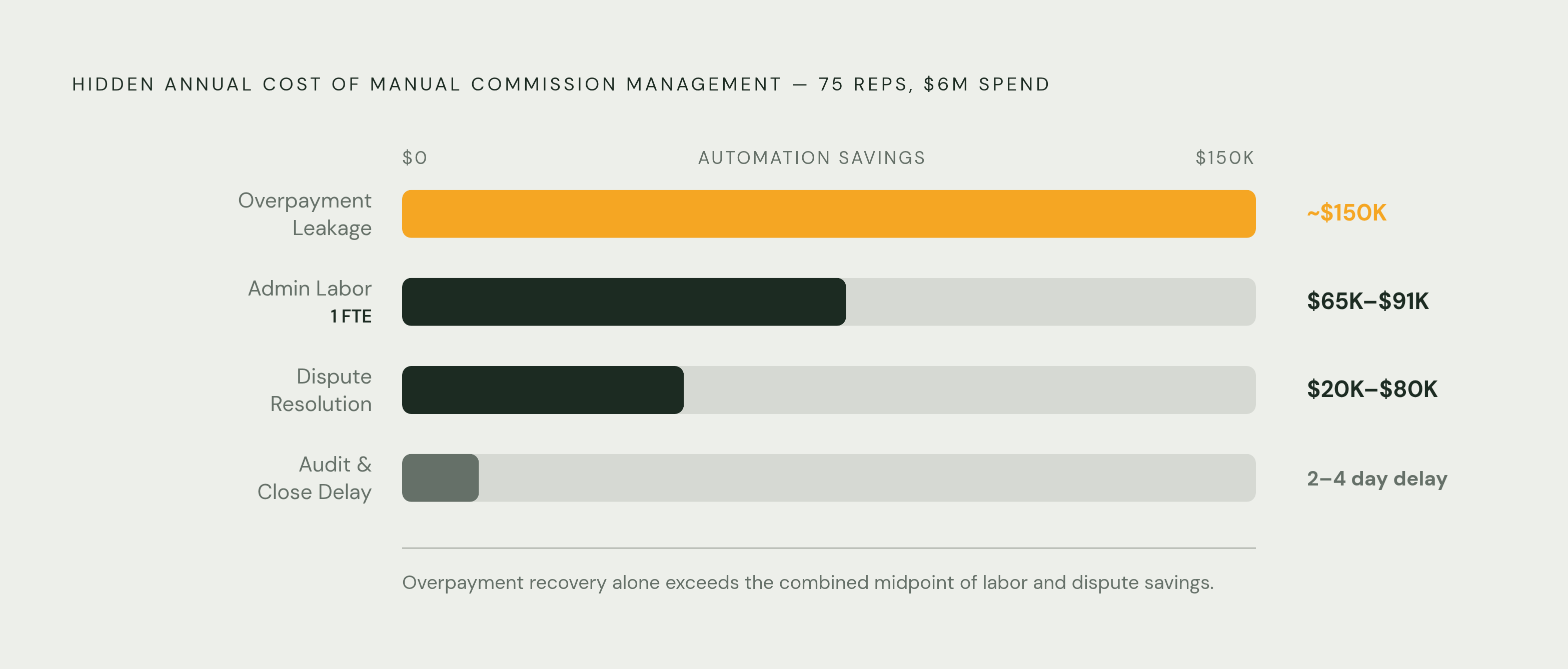
Take a representative mid-market SaaS company, drawn from salescookie.com's research, which has 75 reps total (25 SDRs, 40 AEs, 10 managers), $6M in annual commission spend, $80M in ARR, a 12-day close cycle, and a Finance team that collectively spends the equivalent of one FTE, fully loaded at $130,000 a year, touching commissions across multiple people.
Start with overpayment savings, because it's the largest and cleanest number. $6M in commission spend at 3% leakage is $180,000 in gross exposure. Automation brings leakage under 0.5%, which recovers roughly $150,000 a year.
Add Finance labor savings next. $130,000 fully-loaded FTE-equivalent, cut by 50 to 70%, yields $65,000 to $91,000 a year redirected toward work that isn't formula troubleshooting.
Then dispute resolution. Estimate dispute volume at roughly 30% of monthly payouts in the manual state, apply 4.9 hours per dispute at loaded rates, and the reduction to a 5% dispute rate post-software produces a saving that most mid-market teams land somewhere between $20,000 and $80,000 a year, per salescookie.com.
Close cycle improvement is the hardest line to put a dollar figure on. A 2 to 4 day reduction doesn't convert cleanly into cash, but Finance can still quantify it in terms of management reporting speed, and for any company approaching an IPO, in terms of due diligence readiness.
Net all four lines against the cost of the software itself, and the payback timeline for this profile isn't a close call. Overpayment recovery and labor savings alone dominate the model before disputes and audit exposure are even added in.
One caveat matters more than any other in this exercise. Implementations that keep parallel spreadsheets running too long, or never make an explicit decision to shut the old process down, only capture about half the benefit modeled here. The worked example above assumes full replacement, not a hybrid state that drags on for two quarters because nobody wanted to pull the plug.
What to look for in commission software to make the ROI case hold
There's one test that matters more than any feature list: build the company's most complex commission scenario, tiers, accelerators, splits, clawbacks, all of it, and run it through the platform. If the output is wrong, or if nobody can explain step by step how it got there, the platform has failed the only test that counts, according to evaluation guidance from everstage.com.
Beyond that test, the criteria map directly back to each of the four cost categories already covered. For admin labor, the platform needs automated data ingestion from the CRM the company already uses, meeting the data where it lives rather than demanding a rip-and-replace of existing workflows. For overpayments, the calculation engine has to apply tiered rates, accelerators, clawbacks, and split attribution consistently, without formula cells sitting exposed to being silently overwritten. For disputes, reps need a statement that shows deal-level detail: which deals contributed, which accelerator tier applied, what adjustments were made and why. For audit and close, the platform needs locked pay periods, logged approvals, and a timestamped audit trail Finance can pull up on demand, not reconstruct after the fact.
Security sits underneath all of it. Commission data is compensation data, which makes it some of the most sensitive information a company holds. Encryption in transit and at rest, org-scoped tenancy, no training models on customer data, and a full audit trail aren't premium features, they're the floor.
AI has a legitimate role in plan building and in extracting terms from existing plan documents, and that's a genuine time saver. But human review before anything exports to payroll isn't optional. The entire ROI case rests on accuracy, and accuracy doesn't get outsourced to a model without a person checking its work.
How to present the ROI case to a CFO without overstating it
Vendor ROI calculators exist to produce large numbers, because a large number closes a deal. A Finance-built case does the opposite: it uses conservative inputs, states what it can't precisely quantify, and for exactly that reason, it's more persuasive than anything a vendor hands over.
Use the published benchmarks as floors, not as targets to hit. The 3 to 5% overpayment leakage range is well established: model the low end of it, not the high end. The 30% dispute rate is a manual-environment benchmark, so apply it against actual payout volume rather than assuming the number will be worse.
Split the case into what's quantifiable and what's directional, and don't blur the two. Overpayment recovery, labor reallocation, and dispute cost reduction go into the payback model, because they can be defended with math. Close cycle improvement, audit readiness, and rep trust belong in a separate section as strategic benefits, supported by evidence, the 31% trust drop after a first calculation error, or Varicent's Market Spotlight finding that 82% of revenue leaders and sellers say incentives tied to long-term outcomes keep them engaged, without forcing an invented dollar figure onto them.
State the caveat rather than hoping nobody asks: teams under roughly 15 reps often don't clear the ROI hurdle in year one. Naming that boundary earns more credibility with a CFO than avoiding it does, because it signals the case was actually tested rather than assumed.
Keep the payback timeline conservative in the final presentation. For many mid-market teams, overpayment recovery alone represents a substantial offset against software cost as the dominant line, and that number holds up fine on its own. It doesn't need help from inflated secondary categories to make the case.
The framing that lands is a shift in what commission software actually is. It functions as a shared investment that benefits every team drawing on it, not a Finance cost center competing for budget against other priorities. It's the infrastructure that makes compensation data accurate, traceable, and defensible, which is exactly what the rest of the business is already counting on Finance to deliver, whether anyone's said so out loud or not.