SPIF Design and Administration in Sales Teams
Clarify your SPIF's objective and structure before launch or watch reps game the scoreboard.

Every effective SPIF traces back to a single, unambiguous business objective. Not "more revenue," which is a goal the way "be healthier" is a goal. A defensible objective sounds like increasing multi-year contract attach rate in Q3, moving stalled deals past the proposal stage before fiscal year-end, or driving product attach of a newly launched SKU into existing accounts. The objective names the behavior, the population, and the period. If you can't articulate what changes in rep behavior and why that change produces a measurable business outcome, the SPIF isn't ready to launch.
This distinction matters because reps optimize for the metric they're rewarded on, not the outcome the business actually wants. SPIFs tied to activity volume, demos booked or calls made, generate volume. They don't generate revenue. A well-designed SPIF uses qualifying criteria with a demonstrated link to closed revenue: ICP-qualified progression to a defined pipeline stage, buying committee engagement at a named level, a specific deal structure achieved. The proxy must be tight enough that optimizing for it produces the underlying business result rather than gaming the scoreboard.
The differentiator among top-performing organizations isn't the mere existence of an incentive program. It's deliberate goal-setting. Companies that can't answer "what rep behavior are we trying to change and why" before launch are mostly spending budget on deals already headed to close. That's not incentive compensation. That's a donation to the quarter's bookings number.
Channel SPIFs require their own objective-setting process. Certifications, solution attach, and co-sell motions carry different success signals than direct sales programs. Applying a direct-sales template to a channel motion produces neither the behavior nor the result you wanted.
Structural Choices That Determine Whether a SPIF Motivates or Confuses
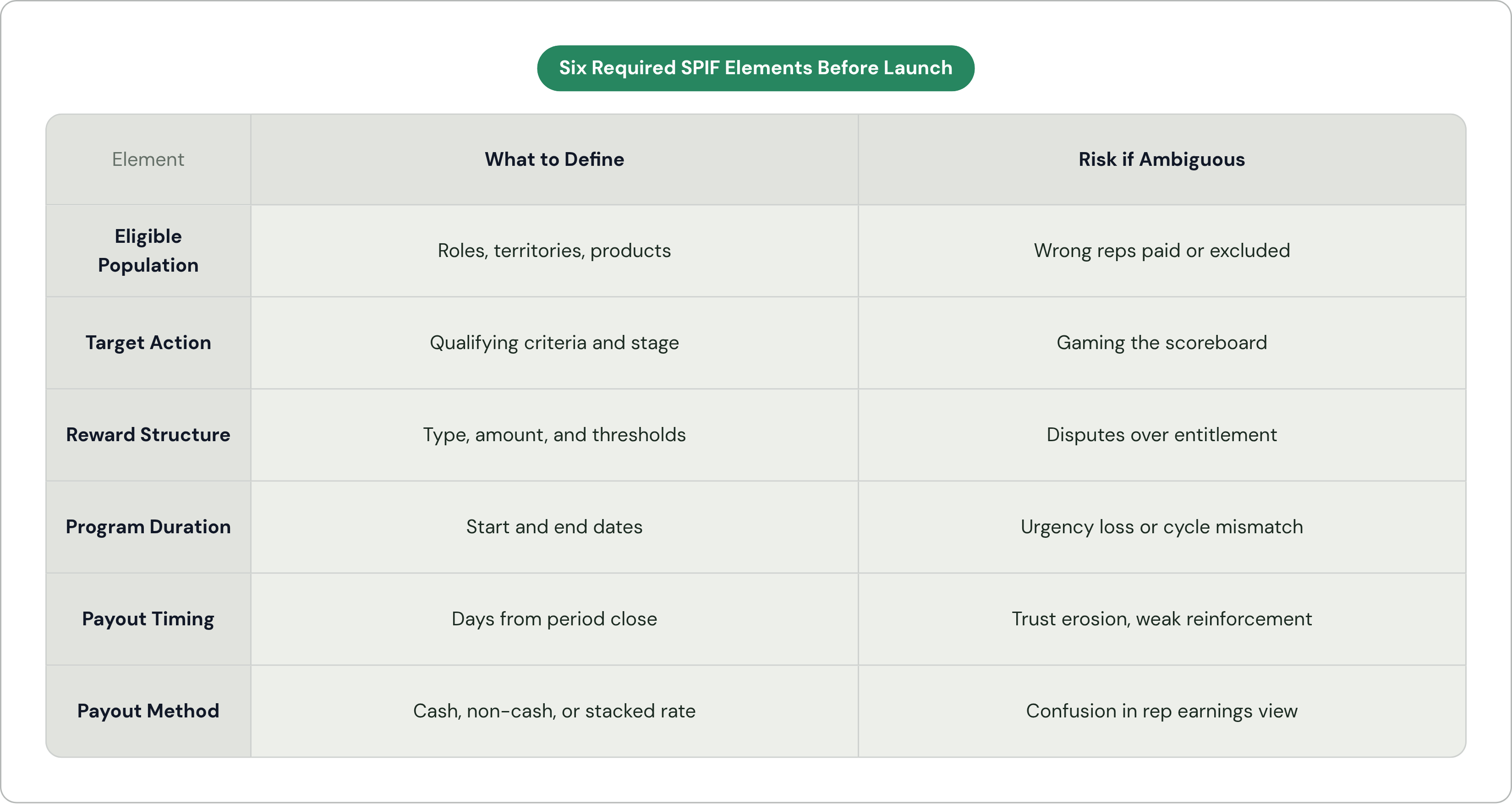
A rep who can't explain the program to a colleague in sixty seconds is already a disengaged rep. Simplicity isn't aesthetic preference in SPIF design; it's structural. Complexity in the rules is a tax on participation, and reps pay that tax by tuning out.
Before launch, six elements must be fully specified: the eligible population (roles, territories, products), the target action and its qualifying criteria, the reward structure and amount, the start and end dates, the payout timing, and the payout method. Ambiguity in any one of these at launch guarantees disputes at close. Anyone who's managed more than a handful of SPIF cycles has watched this happen reliably enough that it stops feeling like bad luck. It starts feeling like physics.
Duration should fall between two and six weeks. Long enough to move real deals through meaningful pipeline stages; short enough to sustain urgency. Programs that run longer lose motivational sharpness as urgency dissipates, and programs that run shorter don't accommodate the actual sales cycle of the deals they're designed to move. The window is narrower than most program designers initially assume.
Frequency is as consequential as duration. Running more than eight to twelve SPIFs per year causes reps to tune them out. The signal-to-noise ratio collapses, and marginal lift disappears. There's also a predictability trap that doesn't get discussed enough: SPIFs that land at the same point every quarter get anticipated rather than acted on. Reps learn the pattern and hold deals in anticipation, producing the opposite of the intended effect. The program stops being an incentive and becomes a sandtrap the team is navigating around.
Reward structure carries real tradeoffs. Flat cash bonuses are universally understood but generate the lowest behavioral stickiness per dollar spent. Commission rate stacking keeps the reward visible inside the rep's normal earnings view, which matters more than most program designers acknowledge. Research from Lift and Shift found that non-cash rewards cost roughly $0.04 for every incremental sales dollar generated, compared to $0.12 for cash, and carry more perceived value per dollar spent. That cost differential gets overlooked more often than it should. Logo milestone incentives, used to reward securing a reference customer or a case study, are increasingly common in enterprise sales where strategic wins carry value well beyond the initial contract.
Budget sizing follows a practical rule of thumb: target a reward equivalent to roughly five to seven percent of a participant's average income over the SPIF duration. Enough to register; calibrated to the difficulty of the qualifying behavior.
How Tracking Failures Undermine SPIFs That Were Well Designed on Paper
The most common SPIF failure mode isn't bad design. It's broken visibility. When reps can't see their progress in real time, they disengage mid-program, disputes spike at period close, and the program pays out having changed very little. Both outcomes are predictable. That's what makes them expensive.
Sellers don't trust a program they can't see. The motivational effect depends entirely on the rep believing the scoreboard is accurate and current. Without that feedback loop, there's no urgency amplification. The rep has no signal telling them they're three deals away from a threshold, so they don't push. The SPIF runs its course, pays out, and leaves no behavioral residue.
The spreadsheet problem is specific and structural. SPIFs are frequently tracked in a spreadsheet built quickly at program launch, by one person, without version control, without locked periods, and without an audit trail. That spreadsheet becomes the single point of failure for the entire program. Manual updates create lag between deal close and rep visibility. Formula errors accumulate across a four-to-six week program with no mechanism to catch them. When disputes arise at close, there is no evidence to resolve them, only competing recollections and a lot of wasted time.
A 2025 survey of more than 200 U.S.-based B2B incentive compensation leaders found that 66% of companies overpaid or underpaid commissions in the past year. SPIF payouts run through the same broken processes that produce those errors. ITA Group's 2025 research found that 96% of distributor and manufacturer sales reps report challenges with their sales incentive program experience. That number deserves a moment. It indicates the problem is less about program design than about execution infrastructure. A clean program document still delivers a broken experience when the operational foundation can't support it.
Payout Timing and Transparency as a Design Requirement, Not an Afterthought
Payout delay erodes trust in direct proportion to its length. Every day between performance and payment weakens the connection between the action the rep took and the reward they received. Operant conditioning research on reinforcement schedules has established this relationship for decades. Slow payout isn't merely inconvenient; it actively degrades the behavioral signal the SPIF was designed to send. By the time a check arrives sixty days later, the deal that earned it is ancient history in a rep's mind.
The practical target is a seven-to-fourteen day payout window from period close. Slow enough to allow validation; fast enough to feel connected to the behavior. Payout cycles stretching to sixty or ninety days after close aren't unusual in manually administered programs, and they corrode trust regardless of how well the SPIF was conceived.
Real-time visibility means something specific in practice. Reps see a running SPIF earnings total alongside their regular commission statement. Qualifying criteria are visible at the deal level, not just in a PDF distributed at launch that most reps won't open again after day one. Managers see team-level progress and can intervene when reps are close to a threshold. That intervention is one of the highest-leverage moves a frontline manager can make during a SPIF window, and it requires data to execute. Without it, managers are encouraging reps to push harder without being able to say toward what, exactly, or how far away it is.
Speed and visibility are both required, and neither substitutes for the other. A dashboard that updates in real time but pays sixty-plus days later still fails the trust test. Speed without visibility leaves reps guessing. Visibility without speed rewards them too late to reinforce anything.
Pay transparency laws add a compliance dimension that deserves explicit attention. States including California, New York, and Illinois now require clear documentation of pay calculations for variable compensation. SPIF rules and payout records must be auditable, not merely accurate. Accuracy without an audit trail isn't compliance; it's an assumption waiting to be tested in the wrong forum.
What the Administration Workflow Actually Needs to Cover
SPIF administration is a compressed commission cycle. It requires the same data sourcing, calculation rigor, review steps, and approval workflow as regular commissions, executed in a shorter window with less margin for error. Teams that treat it as something simpler discover the gap at the worst possible moment, which is usually after the period has closed and the disputes have started.
The workflow covers five stages. Data sourcing must be defined before the program opens: which CRM fields, which deal records, which stage transitions determine eligibility. Defining this after the program closes invites retroactive disputes and inconsistent application. Calculation applies the SPIF rules against qualified deal data; tiered thresholds, rate stacks, and flat bonuses require the same logic rigor as regular commission tiers. Review requires a named person to validate results before payout, catching data errors and edge cases including split credit, late-stage deal transfers, and cancellations that occurred mid-program. Approval and lock means a named approver signs off and the period is closed to retroactive alteration. Payout and documentation means reps receive a statement showing SPIF earnings at the deal level, and payroll receives a clean export.
Clawback rules require written definition before launch. If a deal that triggered a SPIF payment cancels within ninety days, what happens to the payout? That answer must exist in the program document before the first cancellation occurs. Every team that hasn't written it down before launch has had to answer the question anyway, under worse conditions, with less goodwill in the room.
Split credit and overlay rep scenarios are the single most common source of post-program disputes. Multi-rep deals need explicit SPIF credit rules stated in advance. Ambiguity here isn't a minor operational inconvenience; it creates trust and legal exposure that scales with deal count.
Gartner data indicates that 62% of large firms now use specialized sales compensation technology with embedded analytics and real-time reporting. The operational gap between those firms and spreadsheet-run teams is widest in short-cycle, high-touch programs like SPIFs, where compressed timelines and audit requirements exceed what manual processes can reliably support.
How Commission Software Handles SPIF Administration Compared to Spreadsheets
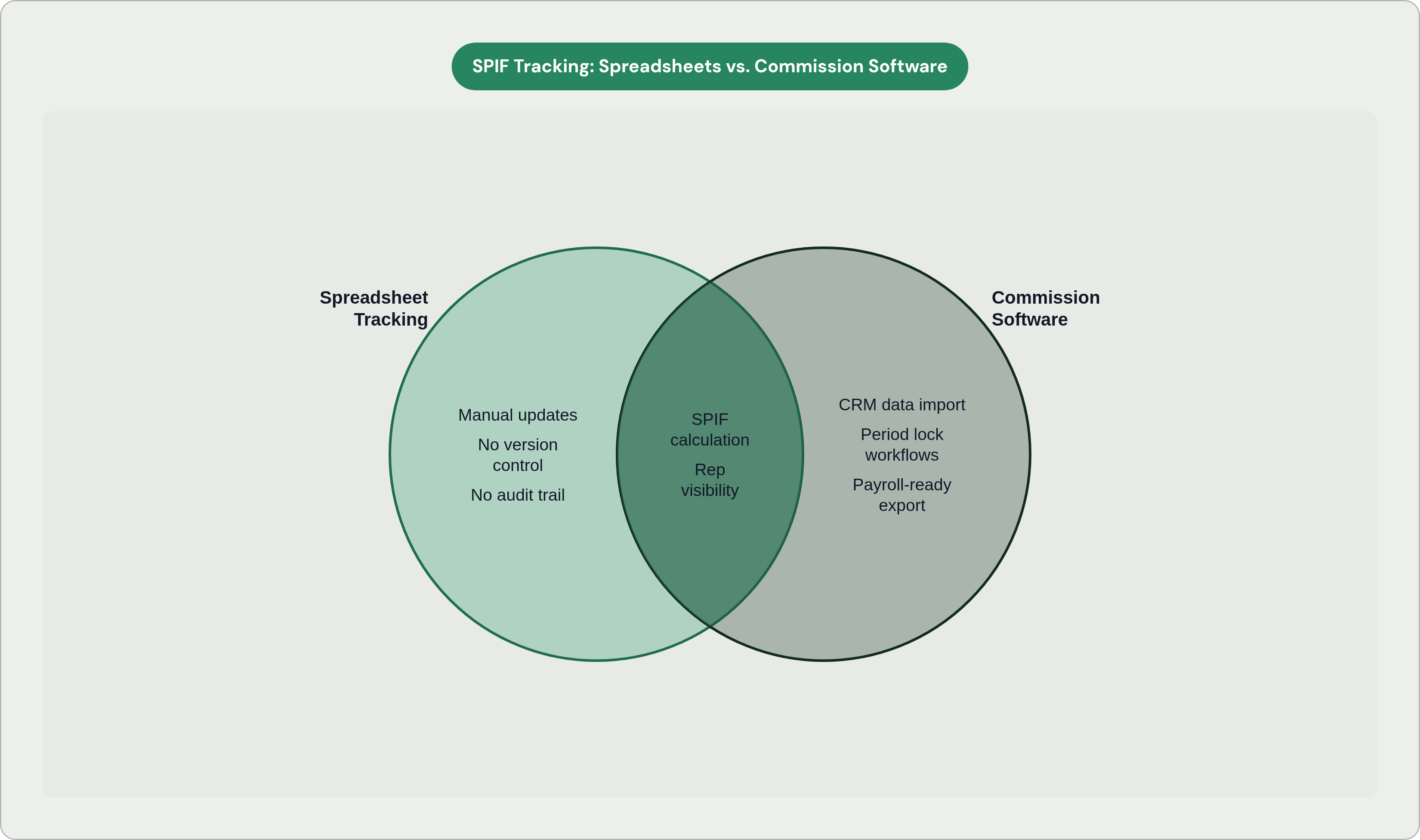
The spreadsheet SPIF problem is a concentration of every risk that exists in spreadsheet commission management generally, compressed into a shorter window with higher operational stakes. The spreadsheet is built under time pressure, maintained by one person, with no version control, no locked periods, no real-time rep visibility without constant manual refresh, and no audit trail. For a four-to-six week program where urgency and trust are the core mechanisms, those limitations aren't inconveniences. They're the reason well-designed programs fail in execution.
Commission software purpose-built for incentive compensation addresses each of those failure points directly. Qualifying deal data imports from the CRM. SPIF rules, including tiered thresholds, rate stacks, accelerators, and clawbacks, are configured in the same rule engine as regular comp plans rather than in a separate spreadsheet carrying its own independent logic. SPIF earnings appear in the rep-facing statement alongside base commission so reps see total earnings in one place. Period locks with approval workflows make results auditable. Payroll exports consolidate SPIF payouts with regular commission in a single file.
Quota Queue supports SPIFs as a configurable rule type within its comp plan builder. Reps see SPIF earnings in the same statement as regular commission, finance receives a single payroll-ready export, and the pay period lock produces an audit trail that manual processes can't replicate. Quota Queue's plan-based pricing model also avoids the per-seat cost spike that penalizes teams expanding SPIF coverage across a wider rep population for a short-term program, which is a meaningful cost driver for teams running SPIFs across extended channel or overlay populations.
The question for teams still on spreadsheets isn't whether the spreadsheet is working. It's what one formula error in a SPIF calculation costs in rep trust, dispute resolution hours, and finance rework. Multiply that by a year's worth of programs and the number gets uncomfortable quickly.
Measuring Whether a SPIF Actually Worked and Using That to Design the Next One
Declaring a SPIF successful because sales went up during the period is not measurement. Revenue often moves during a SPIF window for reasons unrelated to the program: seasonal dynamics, a large deal tracking to close regardless, an external market event. A meaningful post-SPIF review asks harder questions and has to be willing to live with uncomfortable answers.
Did the target behavior actually change, or did deals that would have closed anyway simply close a few days sooner? What was the conversion rate from SPIF-qualifying activity to closed revenue? How many reps participated, and how were earnings distributed across the performance distribution? Did the program motivate the middle of the population, the reps who needed a nudge, or did earnings concentrate among top performers who would've hit their numbers regardless? What was total SPIF cost relative to incremental revenue causally attributable to the program?
The pull-forward problem deserves particular attention because it's the one that hides longest. A SPIF that moves Q3 deals into Q2 creates a Q3 that looks weak relative to trend. If the team doesn't track this, they run the same SPIF in Q3, pull Q4 forward, and spend multiple quarters misreading their own pipeline health. Each individual quarter looks explainable in isolation. The cumulative distortion only becomes visible if someone is tracking it across periods, and most teams aren't. By the time the pattern is obvious, it has already shaped a budget cycle or two.
The eight-to-twelve annual SPIF frequency cap reflects the empirical reality that programs run too often lose marginal lift as reps habituate to them. Post-program data is the only mechanism for knowing whether a specific SPIF design earned its repeat or has reached diminishing returns in that population.
Good data infrastructure makes this analysis tractable. Locked, auditable SPIF records can be compared period-over-period. Deal-level attribution shows which reps, which deals, and which qualifying actions drove payout. A running log of design choices, covering qualifying criteria, reward structure, and duration, correlated with outcomes over time, is worth maintaining with the same discipline as a pipeline forecast. Teams that build it accumulate an advantage that isn't available to teams that start from scratch each cycle.