Sales Compensation Plan Design for SaaS Recurring Revenue Models
Tying SaaS rep pay to bookings instead of retention metrics rewards closing deals that churn.

Only a small minority of companies report satisfaction with their sales compensation plans. Sit with that number for a second: most organizations are running incentive structures that fight the business model they're supposed to grow. I've sat in enough comp design meetings to know why. The problem is structural, not motivational, and it shows up the moment you compare a transactional sale to a subscription one.
In a transactional sale, a closed deal is the finish line. The rep gets paid, the customer takes delivery, and the revenue relationship is basically settled. SaaS runs on a different clock entirely. A signed contract is a starting point, because the revenue has to be earned again at every renewal. A rep who closes five new logos in a quarter and loses two of them to churn eighteen months later hasn't generated the value their commission check implied, and once you factor in how customer acquisition cost compounds over a multi-year relationship, the ARR lost to that churn can wipe out several other wins combined.
ARR tells you scale. NRR tells you whether the existing base is expanding or eroding, probably the single best predictor of whether a SaaS business compounds or plateaus. Churn tells you how big the leak in the bucket is, no matter how fast the top of the funnel fills it. Bookings and total contract value tell you none of that. A comp plan built around one-time bookings pays reps to close and move on, whether or not the account is a fit or a flight risk waiting to happen. That's a design flaw baked into the plan itself.
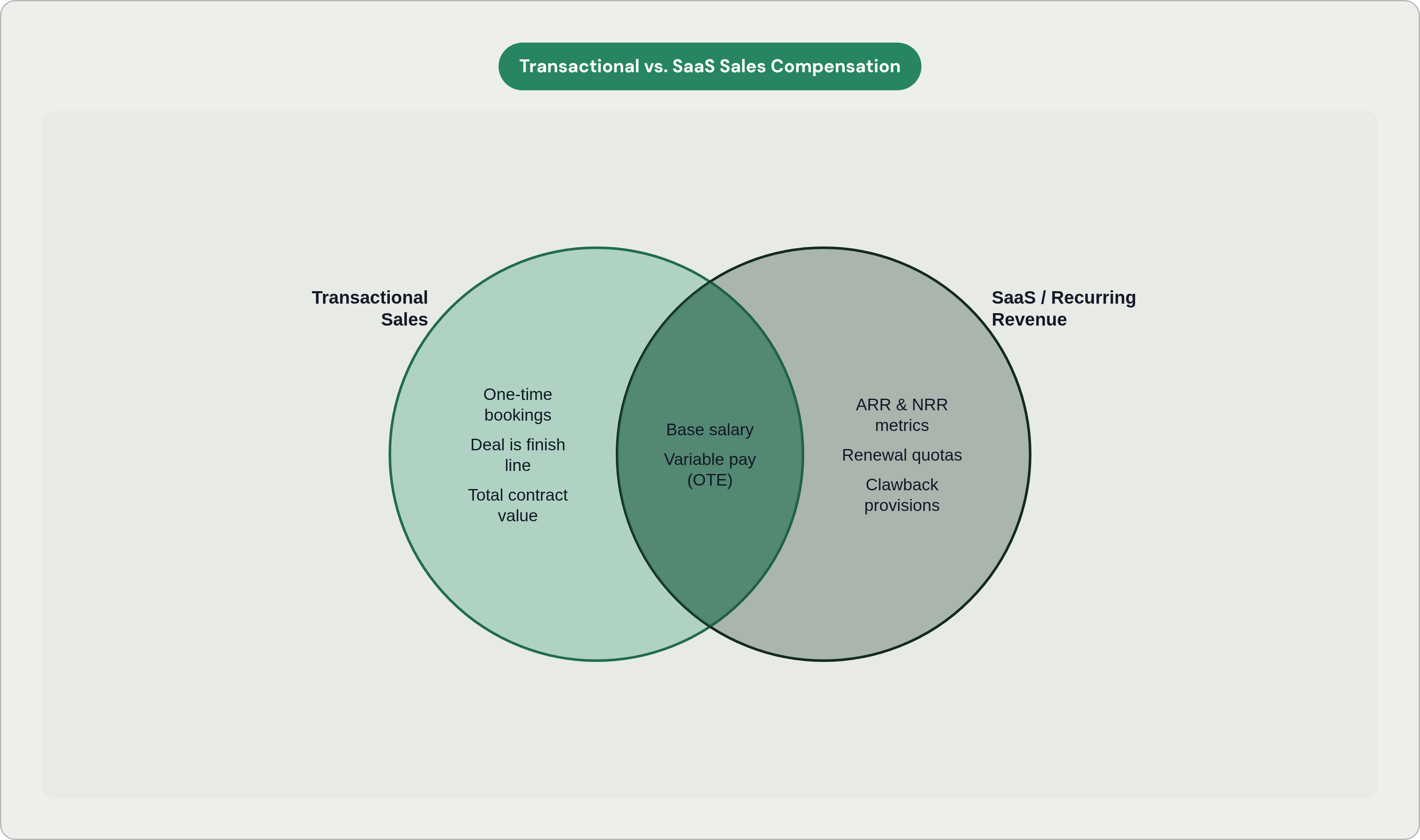
The structural building blocks every SaaS comp plan shares
Every SaaS comp plan is built from the same handful of parts. Each one just means something different once you put it in a recurring-revenue context.
Base salary gives a rep the stability to work sales cycles that can run six, nine, twelve months without resorting to desperation tactics, like discounting a deal into a bad fit just to hit a number. Variable pay, usually expressed as on-target earnings (OTE), moves with performance against quota. Pay mix, the ratio between the two, sets how much risk a rep carries and what kind of behavior that risk produces. Quota is the target variable pay gets measured against, and it only works if it's tied to ARR, not raw bookings.
Accelerators reward overachievement without forcing a rewrite of the base plan every time someone blows past target. Clawbacks recapture commission when a customer churns shortly after signing, tying new-business pay to whether the business actually survives. SPIFs are short-term incentives, useful for launching a new product or pushing into a segment, dangerous the moment a company stacks too many of them at once.
The best plans fit on one page. If understanding a comp plan takes a spreadsheet with a dozen tabs and nested conditional logic, the plan has already failed at its main job: living in a rep's head while they're out selling. Limit the measurable components of any single role's plan to two or three components. Beyond that, reps stop optimizing for the plan and start guessing. And once a plan goes live, it shouldn't change mid-year; changing the rules after reps have already built pipeline around them is one of the fastest ways to torch trust on a sales team, and trust, once broken, is expensive to rebuild.
Winning by Design's framework sets a useful financial guardrail here: when customer lifetime value is unproven, combined OTE cost across SDR, AE, and CSM roles shouldn't exceed 40% of Year 1 revenue. Once LTV is proven out at two years or more, that ceiling can rise to 60%. It's a discipline that keeps a company from over-investing in acquisition cost before it has evidence customers actually stick around long enough to justify it.
How pay mix and quota should differ across SDR, AE, and CSM roles
Pay mix should track how close a role sits to closed revenue and how much retention risk it carries. These ratios aren't arbitrary. They reflect real differences in what each role can actually control.
SDRs typically run around 65/35, base to variable. Pipeline generation is measurable, but it's a lagging indicator of closed revenue, so a heavier base stabilizes behavior through what's often a long, unglamorous prospecting grind. AEs sit closer to 50/50, the classic closer split, because they're directly accountable for ARR, and an even mix maximizes the incentive to close without leaving them financially exposed when a quarter runs cold. CSMs land around 80/20, and that heavier base isn't generosity. It's realism. Retention and expansion outcomes are real, but only partly within an individual CSM's control; product gaps and botched onboarding show up in churn numbers no matter how good the CSM is.
Quota-setting runs on its own logic. The most useful starting guardrail for AEs is the 4x to 6x OTE rule: an AE earning a $200,000 OTE should carry a quota somewhere between $800,000 and $1.2 million in ARR. That range needs validating two ways, top-down against the company's overall ARR target and bottom-up against what a rep can realistically carry given territory, segment, and ramp time. Quotas set purely top-down tend to fail attainability tests, because somebody modeled the number on a spreadsheet without checking whether it's achievable at the rep level.
Cadence matters just as much as the number. A monthly quota on a nine-month enterprise sales cycle punishes reps for the shape of their pipeline, not their performance. That's a design failure, not a rep failure.
SDR quotas should measure meetings held or qualified opportunities created, never raw dial counts, and never ARR influenced by their outreach months later since that signal is too lagged to act on. CSM quotas should measure renewal ARR, net revenue retention, or some blend of the two, never new-logo closes, which sit outside the CSM's actual motion entirely.
The handoff between AE and CSM deserves real scrutiny, because that's where a lot of churn quietly originates. AE quota ends the moment a contract is signed. CSM quota picks up at renewal. In between sits a gap, and deals that were under-scoped, oversold, or closed with the wrong buyer champion fall straight into it. Nobody's incentive structure is watching that seam.
Commission rates for new business, renewals, and expansion — and why they should be different
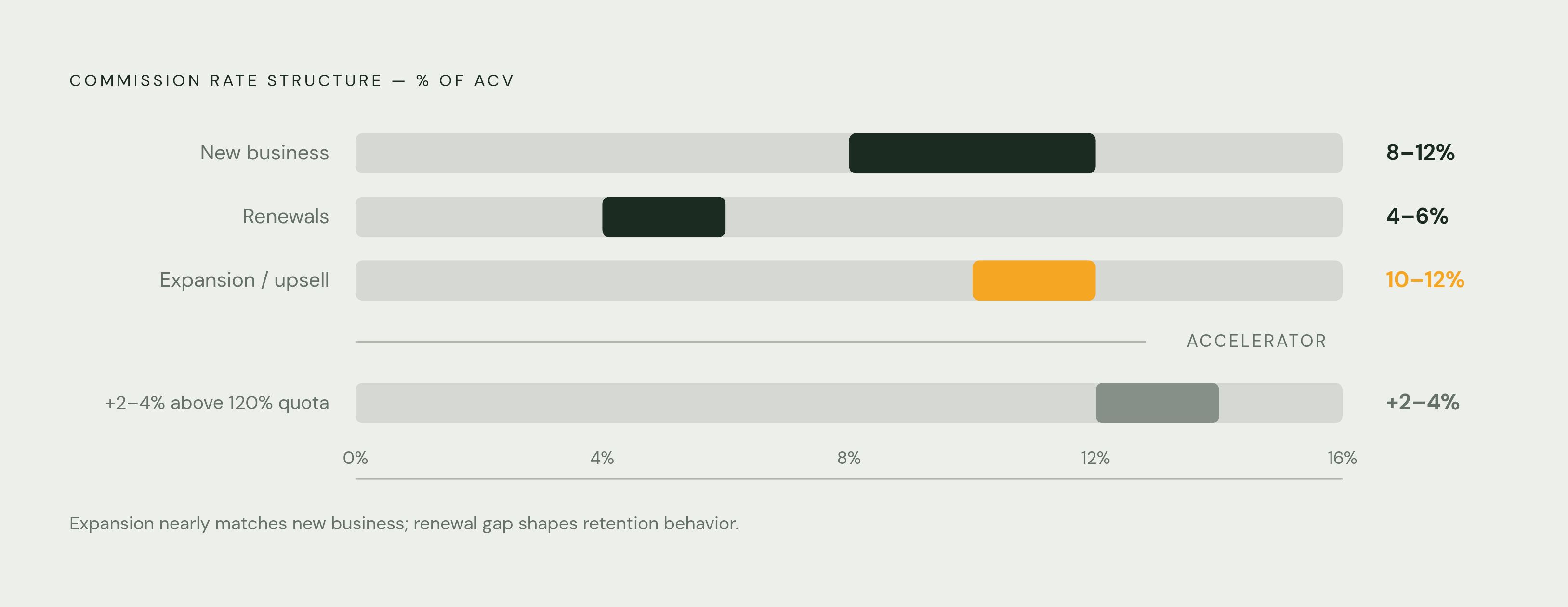
Pay the same rate on every dollar of ARR, regardless of source, and you get predictable, undesirable behavior. If renewal revenue pays the same as new-logo revenue, reps chase new logos and let renewals coast on autopilot, because new business feels more exciting and runs a shorter, more controllable cycle. If expansion pays the same as renewal, reps have no reason to invest effort growing an existing account, even though upsell is typically lower-risk and higher-margin than a cold new-logo close.
Current market benchmarks, as of 2025, reflect this pretty clearly. New business commissions typically run 8% to 12% of annual contract value, reflecting the real difficulty and cost of winning a brand-new logo. Renewal commissions sit lower, around 4% to 6% of ACV, since the relationship already exists, though the rate still has to be meaningful enough that reps treat retention as a genuine priority. Expansion and upsell commissions run higher than renewals, typically 10% to 12% of incremental ACV, rewarding the actual selling effort it takes to grow an account rather than just keep it alive. Accelerators above quota typically add another 2% to 4% once a rep clears 120% of target.
Some organizations use tiered structures instead of flat rates: base commission on the first portion of quota attainment, then a stepped-up rate at defined thresholds. It keeps the incentive progressive without forcing a full plan redesign every time a rep's performance shifts.
Residual commissions, where a rep earns a small ongoing percentage of recurring subscription revenue for as long as the account stays active, are less common but worth considering in low-churn, high-LTV segments. They tie a rep's long-term financial interest directly to the customer's long-term health, an alignment a one-time bookings model never had to solve for.
Usage-based pricing complicates all of this. When revenue scales with consumption rather than a fixed contract value, ACV at signing becomes a floor rather than a ceiling, and crediting rules have to account for revenue that changes shape after the deal closes. Multi-stakeholder deals, where more than one rep touched the account, need explicit attribution language written into the plan before launch, not negotiated after the first dispute breaks out.
Clawbacks and accelerators as the plan's alignment enforcement layer
Without a clawback provision, a rep gets paid in full the moment ink hits paper, regardless of what happens to that customer afterward. That's a real gap. It means the comp plan has no mechanism connecting new-business pay to whether the business is actually kept.
The standard fix is a clawback window, typically 90 to 180 days post-close. If the customer cancels inside that window, the company recaptures a portion of the commission already paid. The harder design question is whether that recapture should be full or pro-rated. Pro-rating by months survived, so a customer who churns at month two costs the rep less than one who churns at month one, tends to be more defensible and easier for reps to swallow. One rule matters more than the mechanics, though: clawback terms need to be spelled out at plan rollout, never applied retroactively. Retroactive enforcement doesn't just annoy reps. It breaks trust in the entire comp system.
Accelerators serve a different function. Their job is to make the cost of overachievement predictable for finance while keeping the upside open-ended enough to motivate genuine stretch performance. Where the threshold sits matters more than most plan designers realize. Accelerators that kick in right at quota attainment end up rewarding mediocrity, since hitting quota exactly shouldn't trigger bonus-tier pay. The more defensible trigger sits meaningfully above quota.
Some of the more sophisticated plans pair accelerators with a secondary retention condition. A rep who closes well above new-logo quota but whose book shows early churn signals shouldn't collect the full accelerator, full stop. This is where plan architecture enforces the retention imperative structurally, instead of hoping reps internalize it on their own.
Multi-year deals deserve a modest kicker of their own: a small additional rate on years two and three of contracted value rewards the durability those deals signal, since a three-year commitment carries a fundamentally different risk profile than a one-year contract up for renewal in twelve months.
SPIFs remain useful for short-term focus, a product launch, a segment push, but every SPIF needs a sunset date baked in at launch. Stack too many without an expiration and the plan stops fitting on one page. ICONIQ Growth data shows over 60% of SaaS companies now prioritize outcomes like renewals, upsells, and multithreaded deals as key compensation drivers, which tells you accelerator and clawback design is already moving away from bookings alone.
CSM compensation as a first-class retention architecture, not an afterthought
Most companies spend the bulk of their comp design effort on the AE plan and treat CSM compensation as a simplified afterthought, often just a smaller-scale copy of the AE structure. That undervalues a business where net revenue retention drives valuation as much as, or more than, new logo growth does.
CSM quotas should be built around renewal ARR at risk, net revenue retention rate, and expansion ARR generated within existing accounts. They should never include new-logo closes; that's a different motion entirely, drawing on a different skill set and creating direct coverage conflicts with the AE team over who owns which conversation.
The 80/20 pay mix isn't a lesser version of the AE split. It's a deliberate acknowledgment that churn is partly structural. Product gaps, botched onboarding, and pricing mismatches all show up in a CSM's retention numbers, and none of them are within an individual CSM's control to fix alone. If a CSM also owns expansion and upsell motion within their accounts, their commission rate on that incremental ACV should approach AE-level rates for that specific activity. Otherwise CSMs have every incentive to avoid the upsell conversation entirely, protecting the relationship rather than risking it for a commission that barely moves the needle.
Some organizations split the CSM function into onboarding-focused and renewal-focused roles, each with its own comp structure tailored to the motion. Others keep the role unified. Either approach works, provided the metrics actually match what the person does day to day.
One detail gets overlooked constantly: ramp periods. A new CSM who inherits a book of business already sitting at renewal risk deserves the same ramp consideration a new AE gets when handed a cold territory. Skip this and you set new CSMs up to fail in their very first cycle. The CSM who burns out and quits in month four is a cost the business rarely counts when it's building the comp model.
Why spreadsheet-based commission management breaks under SaaS plan complexity
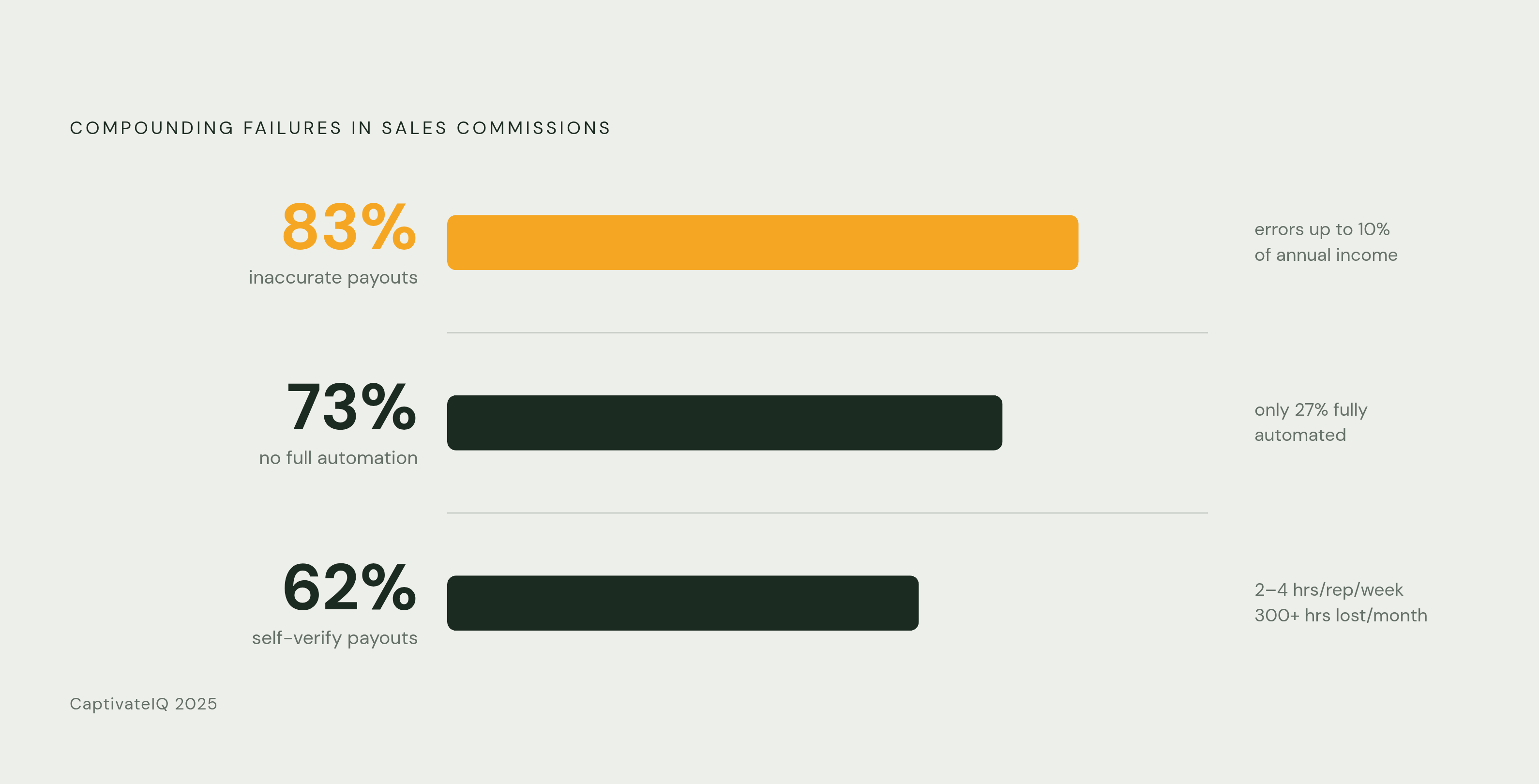
The infrastructure most companies use to run these plans hasn't kept pace with how complex the plans themselves have gotten. Commission calculation platforms like Quota Queue exist specifically to replace the spreadsheets most teams are still relying on for this. Only 27% of companies have a fully automated end-to-end commissions process, according to a 2025 State of Incentive Compensation Report. Most companies are running SaaS-level plan complexity on spreadsheets built for something a lot simpler.
The failure points are specific. Tiered rates and accelerators need conditional logic that compounds across every rep on the roster, and a single formula error in one row cascades silently across the rest. Clawback enforcement means tracking a deal's status for months after close, cross-referencing spreadsheets against a CRM that's rarely perfectly in sync. Multi-role quota splits, where an AE, an SDR, and a CSM all touch the same account at different points, need attribution logic a flat spreadsheet just can't represent cleanly. Usage-based pricing adds a moving target on top of all of it, since consumption revenue gets recognized after the period closes, forcing a retroactive recalculation of commissions already reported as final.
Somewhere around 20 reps, this stops being an occasional inconvenience and becomes structurally unreliable. Formula drift, version conflicts between the finance copy and the sales ops copy, manual entry mistakes: none of these are rare edge cases at that scale. They're the default state.
There's a hidden cost here too. Commission spreadsheets function as expensive, unbudgeted software. The labor spent maintaining them, the overpayments that go uncorrected, the hours spent resolving disputes: none of that shows up on a software invoice, but it's a real cost sitting on the books somewhere. Sales Cookie's 2026 survey of 86 organizations found administrators spend roughly 23 hours a month, about 13% of a full-time role, on repetitive commission tasks. For a Sales Ops Specialist at a fully loaded cost of $95,000 to $115,000 a year, that works out to $12,000 to $15,000 a year spent on arithmetic a calculator should be doing. The accuracy record doesn't inspire much confidence either: 83% of companies fail to pay commissions accurately, with errors reaching as high as 10% of a rep's annual income. That's well past the point where reps notice, start asking questions, and quietly check out.
How commission errors erode the rep trust that SaaS retention depends on
Trust in the comp plan isn't a soft metric. It's foundational, and the data on it is bleak: A large majority of sales reps don't trust their own commission calculations. In a SaaS business where CSMs and AEs are both supposed to be aligned around customer health, distrust in the very system meant to reward that alignment sits like a contradiction at the center of the business.
The behavioral symptom of that distrust is shadow accounting. Sales Cookie's 2026 research found 62% of reps independently verify their own payouts, essentially rebuilding the company's commission math on their own time because they don't trust the official version. That verification work costs two to four hours per rep, per week, time that should go toward selling, customer success work, or renewal prep instead. Scale that across a 50-person team and commission disputes alone eat an estimated 300-plus hours of lost selling time every month. Not a rounding error. A real drag on the top line.
Spreadsheets make the problem worse because they leave no audit trail. If a manual adjustment changes a rep's commission by a few thousand dollars, there's often no record of who made the change, when, or why. In a dispute, that absence of a paper trail is indefensible, and it's exactly the kind of gap that turns into a legal problem rather than just an HR headache. Commissions are frequently treated as earned wages under the law, not discretionary bonuses, which puts commission errors in the same legal category as payroll failures. Oracle's sales team learned this the hard way in 2017, when unpaid commission disputes led to a $150 million class action lawsuit, a number large enough that it should still be sitting in the back of every VP of Sales's mind when they sign off on a comp plan built on a spreadsheet nobody fully trusts.
A rep who doesn't trust their commission statement stops trusting the plan's incentives to guide behavior toward the right accounts, the right renewal conversations, the right level of care in a deal. In a business model where revenue has to be earned over and over, a disengaged rep is a rep who's already checked out of the retention work the whole architecture was built to protect.