Clawback Clauses in Sales Commission Plans
How clawback policies determine what commissions reps actually keep.

A clawback clause is a contractual right to reclaim commission a company already paid a rep, triggered by a defined event that happens after the money changed hands. A clawback is a demand for money back, distinct from a delayed payout or a hold on unearned commission. Whether that demand feels legitimate to the rep who receives it, or feels like a betrayal of the plan they signed, comes down almost entirely to how the clause was written, communicated, and enforced long before the triggering event ever occurred.
Clawbacks have been around for a while, but their reach has grown. They moved into mainstream corporate use after the 2008 financial crisis, largely as a response to executive misconduct and accounting fraud; Salesforce has reported that Fortune 500 adoption of clawback policies jumped from under 3% of companies in 2005 to 82% by 2010. What started as an executive-pay safeguard has since worked its way down into ordinary sales organizations of every size. Today, a rep at a mid-market SaaS company is about as likely to encounter a clawback provision as a public company CFO.
The circumstances that trigger a clawback and why each one exists
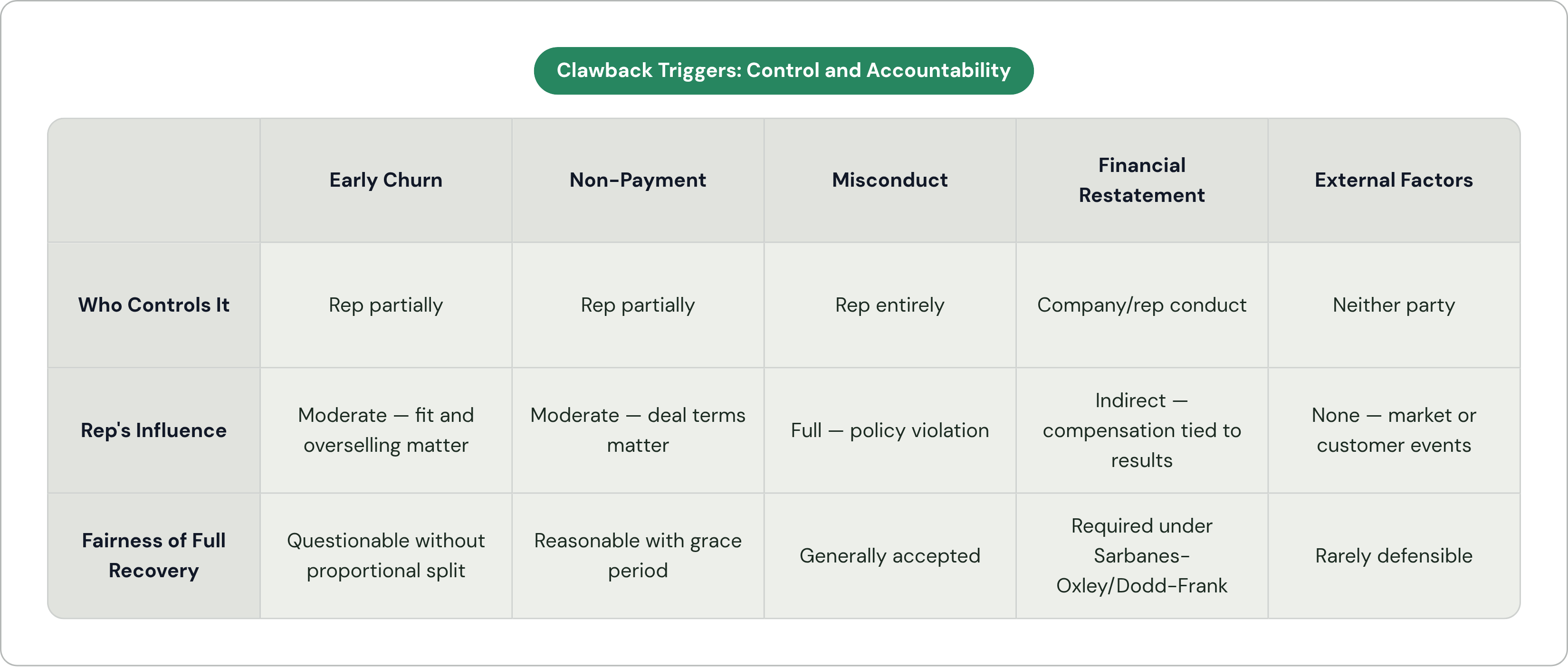
The most common trigger, by a wide margin, is early customer churn. A rep gets paid on a signed contract, the customer cancels before the company has delivered meaningful value, and the business is left having paid for revenue that never really existed. This is especially acute in subscription and SaaS models, where a deal can close on paper, get booked, get commissioned, and then quietly disappear before a single invoice clears. Industry practitioners sometimes call this "ghost revenue," and it is a structural risk baked into any business model where payment happens over time rather than at the point of sale.
Non-payment works the same way from a different angle. A rep earns commission on booked revenue, but the customer never actually pays, or pays so late that the company has effectively financed the deal out of its own commission budget. This shows up most in industries where invoicing cycles stretch for months. Product returns trigger clawbacks too, mainly in retail and e-commerce, where return windows are contractually defined and return rates eat directly into margin.
Then there is misconduct: a rep overselling capabilities the product doesn't have, falsifying a forecast, or closing a deal on terms nobody at the company approved. This category exists for obvious reasons and rarely generates sympathy.
Financial restatements sit in a different category entirely. Under Sarbanes-Oxley and Dodd-Frank, companies are required to claw back compensation tied to financial results that later get restated. FW Cook's 2024 analysis found that roughly 70% of large firms with market caps above $10 billion apply clawback policies to a broader group of executives than Section 16 of SEC regulations actually requires. That is a signal, not an accident: large organizations have decided the reputational and legal cost of under-scoping a clawback policy outweighs the administrative cost of over-scoping it.
What separates a fair trigger from an unfair one is control. Some triggers, like a restatement or a documented policy breach, sit entirely within the company's or the rep's own conduct. Others, like churn from a deal the rep pushed onto a customer who was never a good fit, sit in a gray zone the rep partially influenced. And some, like a customer going bankrupt eighteen months into a three-year contract, sit entirely outside anyone's control. A clawback policy that treats all three the same way is a policy that hasn't thought hard enough about what it's actually punishing.
How the math works: the two main recovery methods and when to use each
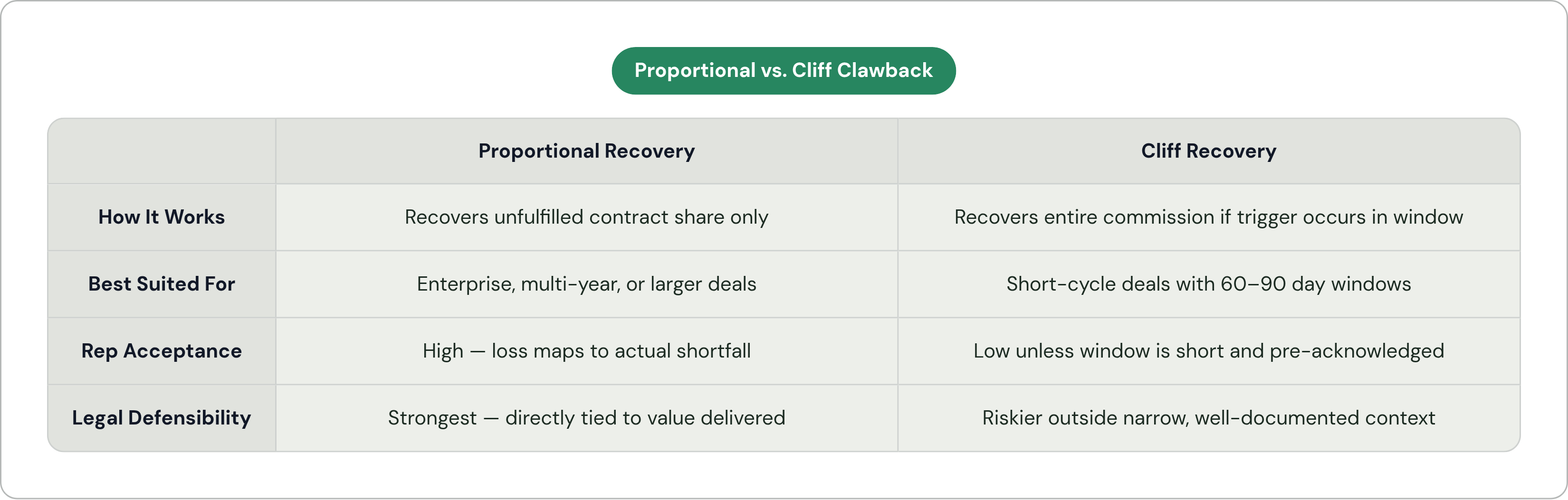
There are really only two ways to calculate what gets clawed back, and the difference between them determines whether a policy feels fair or feels punitive.
Proportional clawback recovers only the commission tied to the unfulfilled portion of the contract. Say a rep earns $12,000 on a 12-month contract and the customer churns after four months. The clawback recovers $12,000 times eight-twelfths, or the proportional unfulfilled share, leaving the rep with the portion they earned for the value actually delivered. This is the most legally defensible method, and it's also the one reps tend to accept without much friction, because the loss maps directly onto the shortfall rather than landing as a blanket penalty.
Full, or cliff, clawback recovers the entire commission the moment a trigger occurs inside a defined lookback window, regardless of how much of the contract term already played out. This method only makes sense with short windows, something in the 60 to 90 day range, paired with explicit written acknowledgment from the rep at the time the plan is signed. Used outside that narrow context, cliff clawbacks carry real morale risk and should never be a company's default choice.
How the recovery actually gets taken varies by team. Some plans reduce the rep's quota credit in the following period rather than demanding cash back; that tends to suit high-volume, high-velocity sales motions. Others recalculate the original commission and true it up in a subsequent pay cycle, which works better for longer or larger deal cycles where clawback events are rarer but larger in dollar terms. Lump-sum repayment, where the company asks the rep to write a check, is the riskiest option legally, particularly in wage-protection states, and it requires careful documentation to survive scrutiny.
Timing of the original payout compounds all of this. The majority of commission plans pay out at the moment a deal closes, which is precisely when clawback exposure is highest, since nothing about post-sale performance has happened yet. A smaller share of plans pay at delivery, and a smaller share still pay only after the customer has actually paid. Paying later reduces clawback exposure almost by definition, but it introduces its own problem: reps waiting longer for money they've already earned, which creates cash-flow friction of a different kind.
The legal ground rules that determine whether a clawback can actually be enforced
Here is the tension sitting underneath every clawback clause: in most states, earned commission is legally treated as a wage, and wage-protection statutes limit how, and whether, an employer can take back money it already paid. Once a commission is "earned" under a given state's definition, clawing it back without a pre-existing contractual basis can amount to an unlawful wage deduction, full stop.
Enforceability generally comes down to four questions. Was the clawback provision written down before the commission was ever earned? Did the rep specifically acknowledge that provision, in writing, as part of their compensation plan? Are the conditions that trigger the clawback unambiguous, with no room for a good-faith rep to misread them? And does the recovery method itself comply with the wage laws of the state the rep works in?
That last question matters more than most companies assume. California, New York, and Illinois all impose tighter restrictions than the rest of the country, and a multi-state sales team cannot run on a single, uniform clawback policy without real legal review of each jurisdiction it touches.
The consequences of getting this wrong are documented, not hypothetical. Oracle's sales organization filed a major class action in 2017 over unpaid commissions, and IBM lost a class action brought by its own sales staff in 2019 over commissions the company had denied. Both cases turned in part on how the compensation terms were written and how clearly they had been communicated to the people bound by them. Policy language that was airtight two years ago can become unenforceable as state and federal wage law evolves, which means a clawback clause is never a document you write once and file away.
Why clawback design is where most plans go wrong
The protective logic behind clawbacks is sound. Without some mechanism to recover money on deals that don't hold, reps face a lopsided incentive: close the deal, get paid, and let someone else worry about whether the customer sticks around. Overselling, targeting the wrong customer segment, agreeing to discount terms that doom retention from day one, all of these become rational behaviors when commission is paid regardless of outcome.
But the morale risk runs symmetrically in the other direction. A clawback that feels arbitrary, that reaches back further than a rep could have reasonably anticipated, or that claws back the full amount for a partial failure, does not align incentives. It teaches reps to distrust the compensation plan and to treat every deal as a potential future liability rather than a win.
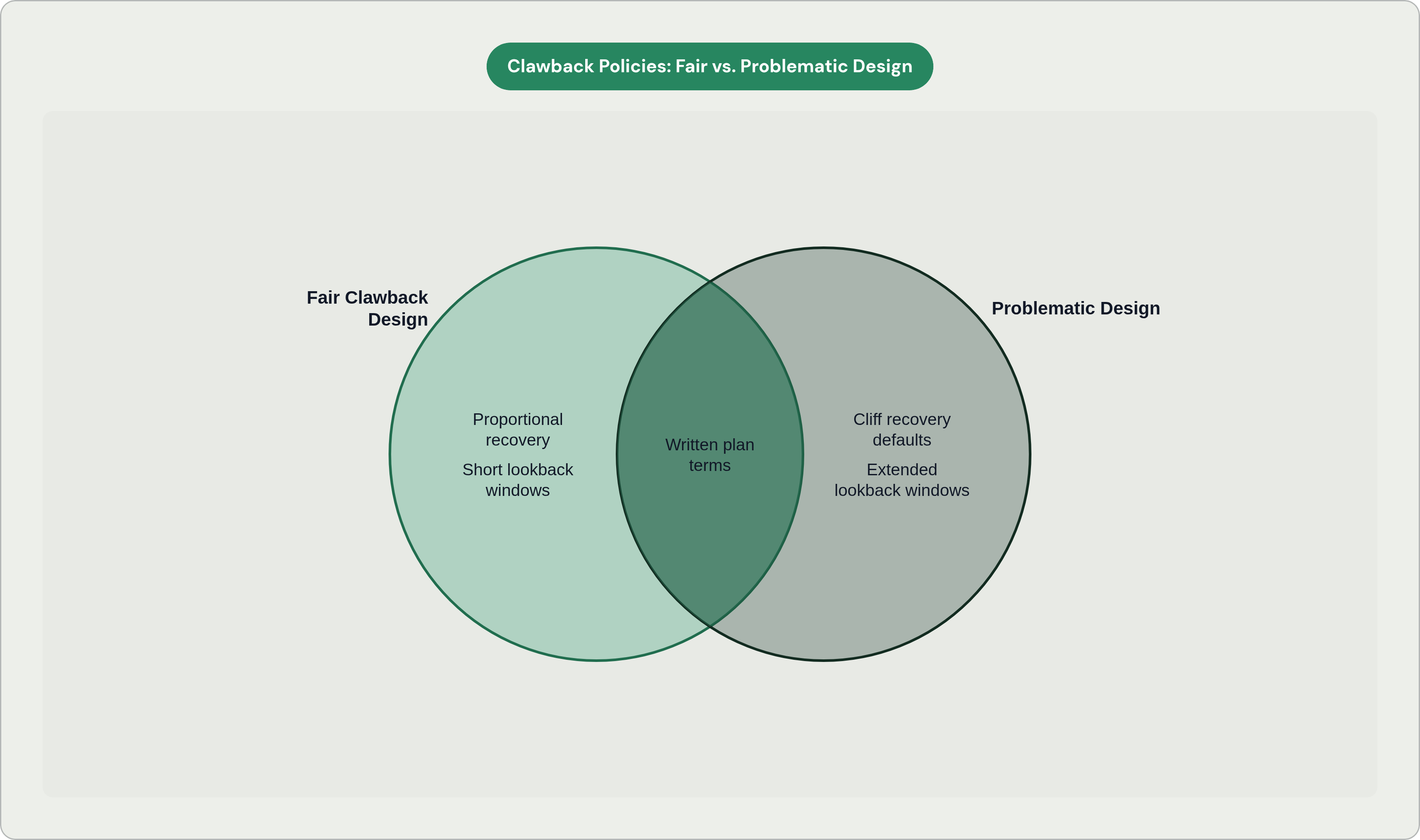
The failure modes repeat across companies with striking regularity. Lookback windows stretch far longer than any rep's realistic ability to influence what happens to a customer after the ink dries. Full cliff recovery gets applied to slow-developing churn, the kind that takes eight or nine months to surface, long after the rep had any signal something was wrong. Trigger language fails to distinguish between churn the rep actually caused and churn caused by a product gap, a pricing mismatch, or a botched handoff to customer success. And the definitions themselves are often vague enough that "cancellation" means something different to legal, to finance, and to the rep reading their offer letter.
Complexity itself is part of the problem. Research cited by Xactly has found that companies running simpler incentive plans see lower rates of both sales attrition and commission calculation errors. A clawback clause buried on page eleven of a fifteen-page plan document is a clause the rep won't fully understand until the day it shows up as a deduction on their pay stub, and by then the damage to trust is already done. This is the structural failure that commission calculation platforms like Quota Queue, a spreadsheet-free commission management tool that takes companies from raw deal data to payroll-ready statements with locked pay periods and auditable approval workflows, are designed to prevent. PayScale's 2025 Compensation Best Practices Report, cited by Everstage, found that companies introducing clear, achievable on-target-earnings figures and building genuine pay transparency saw rep retention improve by 12 to 15%. Clawback design sits squarely inside that trust equation, as a central factor rather than a peripheral one.
The design decisions that make a clawback clause fair and defensible
Start with the lookback window, and set it to match the rep's actual sphere of influence, not the company's maximum theoretical exposure. For short-cycle, transactional sales, a window of 30 to 90 days is usually proportionate and defensible. For enterprise or multi-year contracts, a proportional method applied across the full contract term serves everyone better than a cliff clawback with a long window bolted on top. The window should never stretch so far that the rep, by any reasonable measure, had no ability to affect the outcome.
Default to proportional recovery. Reserve cliff recovery for the narrow case of very short windows paired with explicit, signed rep acknowledgment, and treat it as the exception rather than the house style.
Define every trigger term with precision, in the plan document itself, not in a side conversation with a sales manager. What separates a cancellation from a downgrade, or a downgrade from a temporary pause? Does non-payment trigger recovery immediately, or only after a defined grace period has run out? What happens when a customer gets acquired and the contract transfers to a new entity entirely?
Limit clawback triggers to outcomes the rep could reasonably influence. Churn caused by a customer success failure, or by a product issue nobody on the sales side could have anticipated, belongs under a different accountability structure entirely; folding it into the rep's clawback exposure just punishes the wrong function. Put the clause in writing before any commission is earned, get a signed acknowledgment, and have legal counsel review the language whenever the team operates across more than one state.
Some companies reduce clawback frequency structurally rather than just refining how recovery works after the fact. A split commission structure, paying part at close and the remainder at first renewal or another payment milestone, shrinks the pool of money exposed to clawback without dulling the rep's motivation to close. Hold-and-release models defer a portion of commission until a specific milestone is hit; they work, but they introduce cash-flow friction that the plan needs to acknowledge openly rather than bury in fine print. Harvard Business Review analysis cited by DemandFarm found that organizations running effective clawback policies saw overall sales performance improve by up to 15%. The mechanism behind that number is alignment.
How clawbacks interact with the broader accuracy problem in commission management
None of this design work matters if the underlying numbers are wrong. A clawback calculation is only as trustworthy as the original commission figure it's subtracting from, and commission accuracy across the industry is not in good shape. Research consistently finds that somewhere between 60% and 90% of companies experience errors in their commission calculations, that the vast majority of commission spreadsheets contain at least one error, and that a large share of organizations don't even track payment accuracy as a formal metric. At a modest average error rate across a sizable sales force, the dollar exposure adds up fast, carrying real financial operations weight rather than amounting to a rounding issue.
Clawback disputes concentrate this exact problem into its sharpest form. A rep who already distrusts their commission statement is not going to accept a clawback notice at face value, they're going to scrutinize it, line by line. And if the underlying calculation has an error in it, what should have been a legitimate, defensible recovery turns into a legal dispute, or worse, a resignation.
Shadow accounting makes this sharper still. A meaningful share of reps, according to interview data reported by industry researchers, already keep their own independent record of what they're owed, separate from whatever the company's system says. A clawback notice that contradicts a rep's own spreadsheet, with no clear and auditable trail explaining the discrepancy, reads as a confrontation rather than a correction. Commission disputes generally cost reps several hours of lost selling time per month while they chase down explanations instead of working their pipeline, and clawback disputes sit at the higher end of that range precisely because they require reconstructing calculations from prior periods, sometimes months after the fact.
What reps need to see and when they need to see it
A clawback that surprises a rep has already failed, structurally, before a single dollar changes hands. The trigger condition, the lookback window, the calculation method, and any live exposure sitting on the rep's current book of business should all be visible to that rep well before the triggering event occurs, not delivered after the fact as a mystery deduction on a pay stub.
Real transparency looks specific. A rep should be able to see, at any point, which of their deals currently sit inside an active clawback window. They should be able to see the actual dollar amount at risk if a given deal churns, not just the commission they originally banked. And when a clawback does get applied, the rep should receive a deal-level statement laying out the original commission, the specific trigger event and its date, the calculation method used, and the exact amount recovered, all in one place.
This cuts both ways. A rep who can audit their own clawback exposure in real time is far less likely to escalate a dispute, and the company walks away with a clean, documented record if a dispute does surface anyway. Locked pay periods and audit trails matter just as much here as they do for original commission payouts; the ability to show precisely what was calculated, under which version of the plan, and who signed off on it, is what turns a contested clawback into a settled one instead of a lawsuit. Industry data from WorldatWork puts the share of reps who file at least one commission dispute in a given year at a substantial minority, and separate research cited by commission software vendors traces a meaningful share of voluntary resignations back to compensation transparency problems specifically. Those numbers represent the floor cost of running an opaque process; they move, and move meaningfully, once transparency gets built into the workflow from the start rather than bolted on after the first lawsuit.
Keeping clawback calculations accurate and auditable as plans change
Clawbacks are structurally harder to calculate correctly than a standard forward-looking commission, because they require a lookback: the original commission amount, the exact version of the plan in effect when that commission was earned, the triggering event and its date, and the correct recovery formula, all tied back to one specific deal. Miss any one of those pieces and the calculation is wrong, even if the intent behind it was right.
Spreadsheet-based commission tracking tends to fall apart under this weight. Plan versions rarely get locked in a spreadsheet, so a formula change made for next quarter can quietly overwrite the logic that governed a deal from eight months ago. There's usually no automated connection between a churn event recorded in the CRM and the commission ledger sitting in a separate file. And every recalculation happens by hand, which is exactly the kind of manual process that produces errors even before a clawback scenario adds another layer of complexity on top.
A structured commission system handles this differently. Pay periods get locked, so the commission record from the time of original payment stays exactly as it was calculated, with an audit log showing who approved it and when. Churn events flow directly from the CRM into the commission workflow without anyone re-entering data by hand. The clawback calculation itself, whether proportional or cliff, runs automatically against the preserved original commission figure, with no manual lookback required to reconstruct what happened months earlier. And reps see all of it, the original deal, the original commission, and the clawback, in a single statement rather than pieced together across separate systems.
In a well-structured system, plan rules, including clawback windows, trigger definitions, and recovery methods, get configured once and then applied consistently across every rep and every deal that falls under them. Pay periods lock and require approval before they are final. Reps get deal-level statement detail they can check themselves, rather than waiting for finance to explain a deduction after the fact. And the system connects to the CRM data or commission files a team is already using, rather than asking that team to rebuild its workflow from scratch just to get clawback math right.