Sales Incentive Plan Examples for B2B Sales Roles
How to structure base pay, commission rates, and quotas that actually motivate sales teams.

Every B2B incentive plan, regardless of role, is built on the same foundational decisions. Getting these wrong makes everything downstream irrelevant.
Pay mix is the ratio of base salary to variable compensation, expressed as a proportion of on-target earnings. A 50:50 plan puts half of total earnings at risk; a 70:30 plan offers considerably more stability. Pay mix is the decision that most immediately signals how much the company believes a rep's direct output controls the revenue outcome. Roles closer to the close carry higher variable ratios. Roles further from it carry lower ones. This is not arbitrary convention; it reflects real differences in individual leverage over deal results.
On-target earnings (OTE) anchors the plan's promise. It's the total compensation a rep should expect at full quota attainment, base plus variable combined. OTE must be set competitively against market data for the role and geography. A plan that can't attract or retain the people it's designed to motivate has already failed.
Quota calibration is as consequential as the commission rate itself. The Bridge Group benchmarks healthy plans as those where 60 to 70% of reps attain or exceed quota. Below that threshold, the plan stops functioning as a motivational instrument and becomes a source of attrition. Quotas derived from top-down revenue pressure, rather than territory-level capacity analysis, routinely fail this test. The quota is the plan's load-bearing assumption; when it's wrong, nothing else can compensate.
Measure count discipline separates coherent plans from complicated ones. Beyond three or four metrics, reps can't prioritize effectively. The cognitive load of optimizing across five or six measures produces diffuse behavior rather than focused behavior. Effective plans select the outcomes the role actually controls and leave the rest to management. This is harder to do than it sounds, particularly when multiple stakeholders each want their priority reflected in the comp plan.
Accelerators are rate increases that apply above a quota attainment threshold. They reward overperformance without raising fixed base cost. The most common structure applies an elevated commission rate on every dollar above a defined threshold, typically at or just above quota attainment. Flat-rate plans with hard caps are structurally indifferent to the difference between a rep at 100% and one at 130%. That indifference gets communicated.
SPIFs, short-term performance incentive funds, are overlays that redirect attention to specific products, verticals, or deal types without restructuring the base plan. They work best as time-bounded instruments. When SPIFs become permanent fixtures, they get absorbed into baseline expectations and lose their effect entirely.
Structurally, B2B commission plans fall into three practical patterns: base-plus-commission, which balances stability with variable incentive and suits longer cycles; tiered commission structures, which escalate rates as volume milestones are crossed; and revenue-based structures with deal-specific rate variations, which apply different rates to new logos versus renewals or to different product lines. For B2B SaaS specifically, total commission expense typically runs roughly 10 to 11% of annual contract value. That range is a useful sanity check before deployment.
Account Executive plans: closing-focused structures built around new logo and deal value
The AE's job is to own the full sales cycle, navigate multiple stakeholders, manage a process that can span months, and close. The plan must reward deal value and quota attainment, not activity. Activity is the instrument. Closed revenue is the outcome.
The standard pay mix for AEs is 50:50, a ratio that reflects cycle length and complexity while keeping variable compensation meaningful. A 60:40 or 70:30 split is common in enterprise environments where cycle length is extreme and reps need income stability through long periods of pipeline development without close events. The stability isn't generosity; it's structural necessity.
A concrete plan for a technology services AE might look like this: a base salary combined with a 10% uncapped commission on gross revenue, with an annual quota set at a level achievable by the majority of the team. An accelerator activates at 110% attainment, raising the commission rate to 15% on every dollar above quota. The 110% threshold is deliberate: high enough that the accelerator cost is earned before it triggers, low enough that top performers can realistically reach it within the performance period.
Where new logo and renewal rates diverge within a single AE plan, the differential communicates priorities more precisely than any quota memo. A software company example: 7% on new logos, 3% on renewals. When AEs carry both a net-new quota and a renewal book, the rate differential prevents over-investment in protected renewals at the expense of harder, more valuable new pipeline. The arithmetic of the plan tells the rep what the company actually wants.
Gartner's research covering 145 B2B sales organizations found that AEs primarily operate under quota and goal plans (33%) and commission rate plans (31%), with hybrid plans representing 27% of structures. The plurality use quota attainment as the organizing logic, and for good reason: it aligns the rep's variable payout directly with the company's revenue target.
Payout frequency matters more than many plan designers acknowledge. AEs on long cycles still need quarterly payment cadences to maintain the connection between effort and reward. Annual payouts create a temporal gap so wide that the incentive loses its behavioral effect mid-year. Gartner HR research found that more frequent payout cycles are associated with a 15 to 18% increase in year-over-year quota attainment compared to annual or semi-annual cycles. For AEs managing multi-month deals, quarterly is the practical minimum.
SDR and BDR plans: activity-anchored structures that reward pipeline quality, not just volume
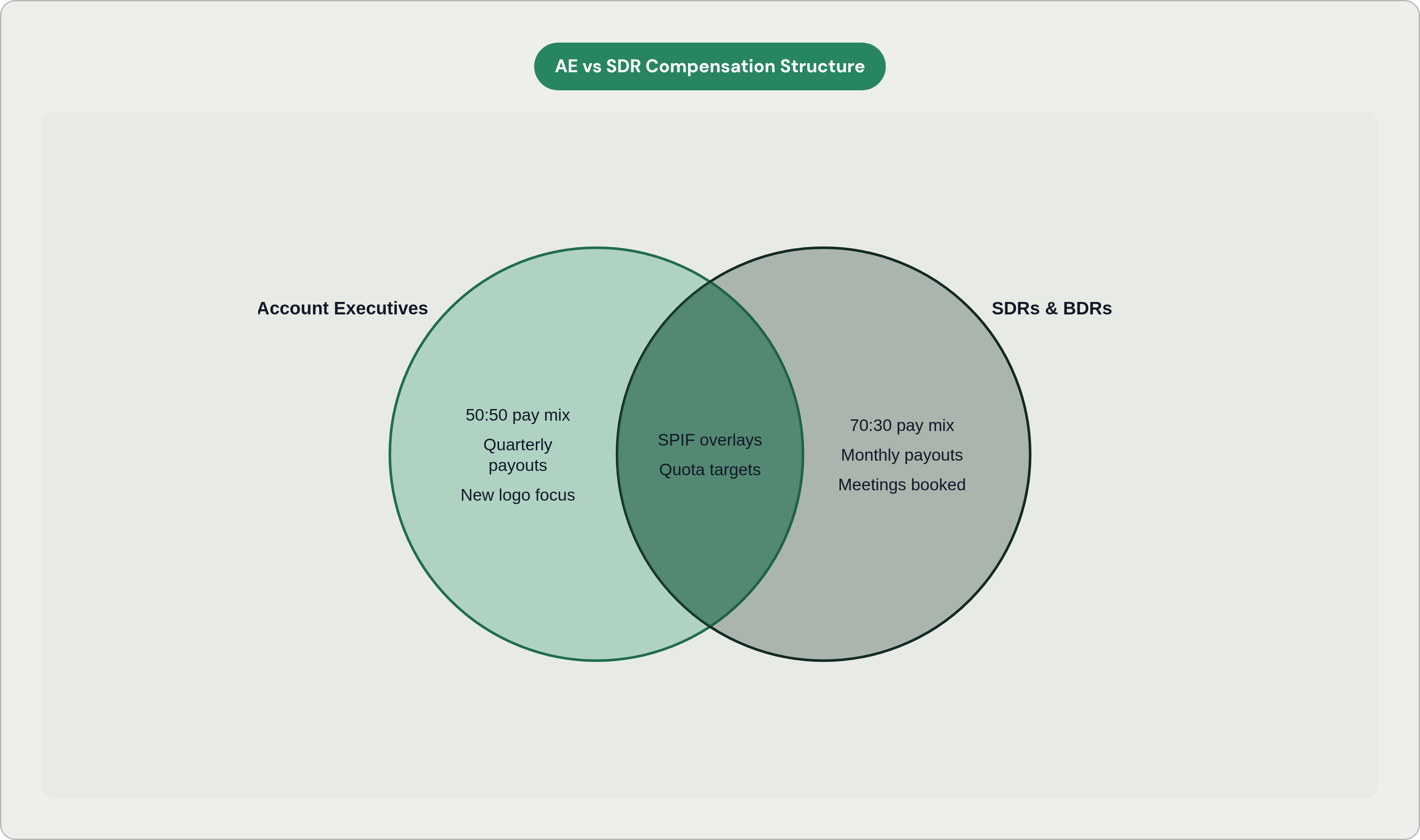
The SDR and BDR role is not a closing role. It's a pipeline creation role. This distinction is foundational: because SDRs and BDRs don't control deal outcomes, compensating them on closed revenue is a structural mismatch. The feedback loop between their work and a closed deal is too long, and too contaminated by variables outside their control, to function as a reliable behavioral signal.
The standard pay mix for SDRs and BDRs is 70:30 or 60:40 base-to-variable. The higher base reflects that the role does not control deal outcome and requires income stability to sustain the high daily activity volume outbound prospecting demands. Gartner data shows that sales development roles favor commission rate plans (36%) and quota/goal plans (29%), a preference well-suited to the activity-based nature of the work.
What SDR variable pay should be tied to is a short list. Meetings booked is the primary, most measurable metric. Qualified meetings held or accepted by an AE introduces a quality gate that filters low-value bookings. Opportunities created that advance past a defined CRM stage reward pipeline quality rather than volume. Each additional metric downstream of meetings booked requires more elapsed time and more organizational coordination to measure, which creates its own feedback-loop problem for a role operating on a weekly rhythm.
The quality gate is the most consequential design choice in an SDR plan. Without it, an incentive on meetings booked produces exactly what it says: meetings, regardless of fit or probability of becoming real pipeline. The cost lands on AEs whose calendars fill with poorly qualified conversations. The quality gate is the mechanism that makes the SDR plan serve the organization rather than just the SDR's metric. It is also, in practice, the hardest thing to get right, because defining what "qualified" means requires agreement across sales and marketing that many organizations never fully achieve.
SPIF design for SDRs maps naturally to the role's weekly cadence. A short-burst incentive, such as a bonus per qualified meeting booked within a target vertical during a defined campaign window, aligns with how outbound campaigns are actually run. It focuses energy without requiring a plan restructure.
SDR plans benefit from monthly payout cycles. The feedback loop between activity and reward must be tight. An annual or even quarterly payout for a role generating output daily severs the connection between the work and the reward. Retention compounds this concern: 64% of sales professionals report they'd leave for a similar role with better pay. SDR roles, which frequently attract early-career talent still calibrating professional expectations, are disproportionately vulnerable to attrition when the variable component feels arbitrary, unreachable, or opaque.
Customer Success Manager plans: retention-first structures that separate CSM accountability from AE incentives
The CSM's motion operates on a different timescale than an AE's. The value a CSM creates is measured in months and years: onboarding quality, product adoption, relationship depth, proactive issue resolution. All of that work ultimately manifests in renewal and expansion, but the manifestation is slow and diffuse. Putting a CSM on an AE-style commission plan rewards the close event while ignoring the relationship infrastructure that made the renewal possible.
CSM pay mix is weighted more heavily toward base than an AE's. Much of what determines retention outcomes is relationship quality and proactive engagement, neither of which can be cleanly attributed to a single transaction. The variable component should be meaningful, but base salary stability reflects that CSMs are managing multi-year relationships, not deal cycles with discrete close events.
The metrics that belong in a CSM variable plan are grounded in retention and growth. Net Revenue Retention captures both churn prevention and expansion within the existing customer base and is the most comprehensive single measure of CSM effectiveness. Gross Revenue Retention isolates churn without expansion, useful when CSMs don't own the expansion motion. Renewal rate against a quota of accounts due in the period creates a time-bounded performance target. Expansion ARR belongs in the plan when CSMs own the expansion motion, but that ownership must be defined explicitly to prevent overlap disputes with AEs carrying renewal or expansion quotas. Ambiguity here is expensive, and common.
ICONIQ Growth has reported that a majority of SaaS companies now prioritize renewals, upsells, and multithreaded deals as key compensation drivers. CSM compensation is moving from a secondary consideration in plan design to a central one, which reflects how much of SaaS revenue depends on what happens after the initial close.
A concrete CSM plan: base salary plus variable tied to renewal rate quota (weighted most heavily), expansion ARR above a defined target (secondary weight), and, optionally, a customer health or QBR completion metric used sparingly as a leading indicator, never in a way that allows it to crowd out outcome metrics. An accelerator on expansion ARR above target rewards CSMs who actively grow accounts, not merely protect them.
Clawback provisions are appropriate and worth including. If a CSM earns commission on a renewal and the account churns within 90 days, a partial clawback protects the company from renewals closed for commission rather than genuine customer retention. It also signals that renewal quality matters as much as renewal volume.
The separation of AE and CSM accountability in plan design is structural, not political. When AEs carry renewal quotas alongside net-new quotas, CSM accountability becomes ambiguous. The plan must define ownership before commission rates are set. Organizations that skip this step eventually discover the cost in disputed credits and misaligned behavior.
Channel and partner sales plans: tiered structures that reward volume progression through indirect motions
Channel and partner sales introduce structural complexity that doesn't exist in direct sales: the company's revenue outcomes depend on the behavior of people who aren't employees. Plan design must account for that mediated relationship.
Two distinct roles require distinct plan structures. The internal channel or partner manager, who enables and supports a network of resellers or referral partners, is incentivized on partner-sourced revenue, partner activation milestones, and influenced pipeline. The direct channel representative selling through a tiered distribution structure is incentivized on personal volume with escalating rates tied to volume milestones. Conflating these two roles in a single plan structure produces misaligned incentives in both directions, and it happens more often than it should.
For a direct channel rep operating through a tiered distribution structure, a concrete example: 5% commission on sales up to a defined first volume threshold; 7% between the first and second threshold; 10% above the upper threshold. The design logic is progressive incentive. At each tier, the next level is visible and reachable, which sustains momentum past the point where a flat-rate structure would produce plateau behavior.
For an internal partner manager, the plan logic differs. Commission is weighted across partner-sourced bookings, partner onboarding milestones, and influenced pipeline. One consulting-sector example allocates 70% of commission to booked revenue, 20% to margin contribution, and 10% to team goals. The margin component is particularly relevant in channel motions where deal-level discounting erodes profitability. Compensating on margin alongside revenue aligns the partner manager's incentive with deal quality, not just deal volume.
SPIFs for deal registration within partner accounts are a standard channel incentive tool. They focus partner energy on specific products or net-new accounts without requiring a base plan restructure, and they create a record of partner contribution that supports commission attribution.
Channel plans are the most complex to administer of any B2B role. Tiered rate logic, deal registration credits, co-sell splits across internal and partner reps, and clawback provisions for unqualified deals compound one another. This is where spreadsheet administration fails earliest and most completely.
Where plan design breaks down in practice: quota miscalibration and measure overload
The most common and most costly failure in B2B incentive plan design is not a rate error. It's a quota error. Salesforce's 2024 State of Sales reported that most reps missed quota in the prior year, and a substantial majority didn't expect to hit it in the current year. When the majority of a sales team is failing to reach their target, the plan design is the first suspect, not the personnel. Quotas set by top-down revenue pressure rather than territory-level capacity analysis are punitive instruments dressed as performance standards.
The Bridge Group's benchmark provides a useful operational check: healthy plans put 60 to 70% of reps at or above quota. Below that range, the plan has become a tool for recording failure rather than driving performance. Most organizations discover this late, if at all, because quota attainment is typically reported as an individual performance issue rather than a plan design signal. The diagnosis is sitting in the distribution data. Few companies think to look at it that way.
Measure overload is the second most common failure mode. The theoretical appeal of a multi-metric plan is that it captures the full complexity of a role. The practical result is that reps can't prioritize and stop optimizing meaningfully for any single outcome. Three to four measures is the functional ceiling. Beyond that, the commission statement becomes a source of confusion rather than a behavioral signal, and the plan's motivational function quietly collapses.
The transparency gap compounds both problems. When reps can't trace their commission statement to underlying deal-level calculations, the plan loses its behavioral function. A rep who doesn't understand why their check is what it is can't use the plan to decide what to do next. Survey data consistently shows that lack of commission visibility is a specific and frequently cited source of dissatisfaction, and dissatisfaction with variable pay is among the most reliable predictors of voluntary attrition.
Pay frequency mismatch by role persists in many organizations because standardizing payout timing across a team is administratively convenient. It is not motivationally neutral. Annual payouts for SDRs disconnect reward from the daily activity driving it by a gap so wide the incentive becomes theoretical. Monthly payout cycles for SDRs and CSMs, quarterly for AEs, are not administrative preferences; they reflect the temporal relationship between each role's work and the outcomes being measured. Treating them as equivalent is a design error.
Finally, a plan that can't be communicated can't drive behavior. If a rep can't explain their own incentive structure in two minutes, the plan is an administrative document, not a motivational instrument. Gallup research from February 2024 found that non-cash recognition paired with financial incentives improved rep retention by 27%, a finding that points toward the broader principle: plan structure alone is insufficient. Transparency, recognition cadence, and the human legibility of the plan all determine whether the incentive system actually reaches the people it's designed to move.
How commission software makes role-specific plans administrable at scale
Role-specific plans with tiered rates, accelerators, multiple measure weights, clawback provisions, and SPIF overlays are precisely the plans that can't be sustained in a spreadsheet environment. The mechanics are too interdependent, the calculations too frequent, and the audit requirements too stringent. Industry research finds that only 27% of companies have fully automated their end-to-end commissions process. The majority are administering plans of growing complexity with tools built for simpler work. The 2025 Compensation Planning Trends Report found, separately, that 77% of companies still rely on spreadsheets for pay cycle management. These two figures together describe an industry running sophisticated plans on inadequate infrastructure.
What breaks when complex plans meet spreadsheets is specific. Retroactive recalculations for plan amendments or deal modifications are manual, version-controlled poorly, and produce inconsistent outputs. Tiered rate logic and accelerator thresholds are error-prone in formula-based sheets, particularly when deal exceptions, mid-year adjustments, or co-sell splits are involved. The absence of an audit trail means reps can't trace their statement to underlying calculations, and Finance can't resolve disputes with documented evidence. These are not edge cases. They are routine.
Purpose-built commission software addresses each failure point by role. For AEs, tiered rate and accelerator logic is applied automatically at the deal level, with quota attainment tracked in real time against CRM data. For SDRs, activity-based metrics tied to CRM stages are tracked continuously, and SPIF overlays can be configured without modifying the base plan structure. For CSMs, NRR and renewal rate calculations run against a defined book of accounts, and clawback rules are enforced automatically when churn events are logged. For channel reps, tiered volume calculations incorporate deal registration credits and co-sell splits without manual intervention.
Platforms in this category worth evaluating include Everstage, Performio, Xactly, Varicent, and Quota Queue, a commission calculation platform that takes companies from raw deal data to payroll-ready statements without spreadsheets. Each offers configurable plan logic suited to the role-specific complexity described throughout this piece. Team size, CRM infrastructure, and the degree of plan customization required will shape the selection. But the consistent selection criterion across all of them is this: the system must represent the plan accurately enough that a rep can verify their own commission statement from the deal level up.
The case for purpose-built administration is a trust case. When reps can see exactly how their commission is calculated, in real time, at the deal level, the plan functions as the behavioral signal it was designed to be. When they can't, the plan becomes a source of friction, dispute, and eventually attrition. Administrative infrastructure is not separate from plan design. It's the mechanism by which the design actually reaches the rep.